Exclusive | CZ on Resilience, Adaptability, and Lifelong Drive: Accepting Destiny in Career Choices, Striving for Success in Life
Article Source: Meanders of the World Podcast
TL;DR:
Small talk in Bhutan. CZ said he no longer considers himself the busiest but replies to messages as soon as he sees them. Regardless of progress, he only keeps those who push him forward, with only three to five things in mind to do.
If rebuilding a global trading platform: Do not engage with U.S. users from day one; contracts and financial products will be earlier and more comprehensive, while blocking some regions. The Binance Life book ambiguously describes the mood at the time.
The two most stressful periods: ICO launch price drop and being stuck in the U.S. for over ten months—the real stress comes from uncertainty. To cope with stress: separate matters, have undefined wealth goals, believe in the simulation theory: do your best and leave the rest to fate. Founders often underestimate the difficulty, must be adaptable and love what they do; diligence for peace of mind can sometimes be abandoned.
He still believes Bitcoin has value, but payment and on-chain governance did not meet early expectations; RWAs and stablecoins were understood later. He continues to work because helping people makes him happy—the Binance Charity from a few tens of thousands of children at the beginning of the year to around 1.2 million now.
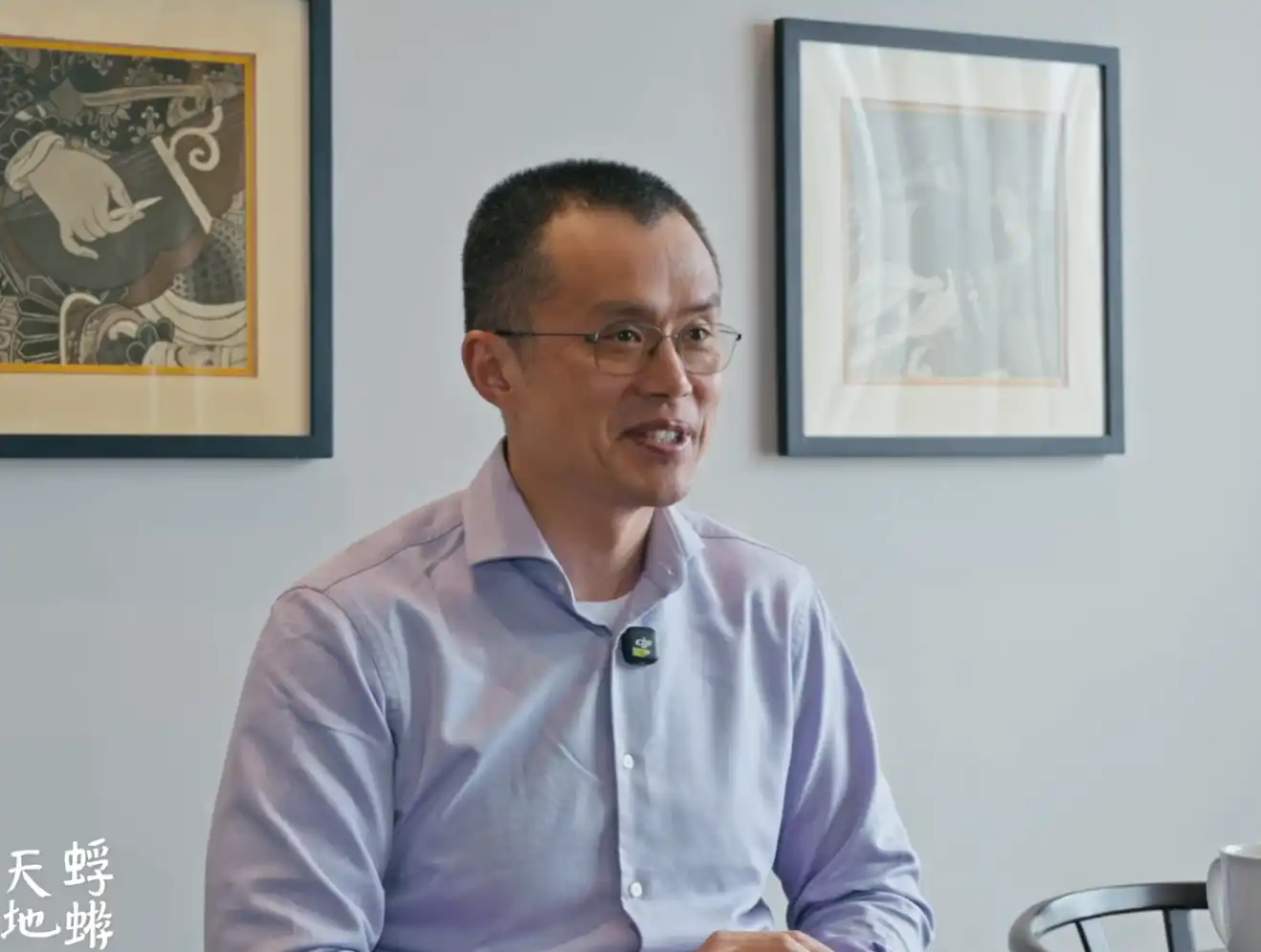
CZ appeared on the Meanders of the World Podcast, discussing stress resistance, adaptability, and lifelong motivation. The full conversation between host Hanyang and CZ is as follows:
Busyness, Message Response, and Task Management
Hanyang: I have a small question, are you tired now?
CZ: Not really, a little bit, but okay.
Hanyang: Do you think you are one of the busiest people in the world now?
CZ: No, definitely not. I think I might have been one of the busier ones in the past few years, but I shouldn't be that busy in these two years.
Hanyang: It's been three years since I met you. No matter what time I message you, you always reply, making me feel like you have no concept of time zones.
CZ: I reply when I see the message. If I see the message and don't reply, I will forget later. After a meeting, I might take a few minutes to check messages and reply. I will check in the morning and before going to bed. I will take a look when chatting with friends for a while. But if I am doing something serious, I won't look at it first. If your message requires a quick reply, I will respond first, or else I will forget.
Hanyang: Do you think you can reply to 500 messages in one day?
CZ: Yes, absolutely, definitely more than that. Sometimes right after I reply to a message, I need to find a message I replied to before, and I have to scroll down for a long time. I can reply to many messages within a few minutes.
Hanyang: I can imagine you must be handling a lot of things at the same time. How do you ensure that your mind can keep track of every single thing? Like where one thing is at, and then where the other thing is at.
CZ: I still have a lot of miscellaneous things to deal with, and as a CEO, there are also a lot of miscellaneous things to handle, so I'm not very good at tracking. When people come to me, I tell them what to do, and then I don't actively follow up with them the next day or the next week. I usually don't do that. So I need the people I work with to be very proactive; they need to push you forward. If we need to have another meeting tomorrow or the day after tomorrow, they need to schedule it, not me going to them tomorrow. If anyone is working with me, they need to update me on the progress of the project; I usually don't remind them. And usually, in this situation, there is a bit of a problem with the project. So I hope that the person needs to have updates tomorrow or a week later, they message me, and then I will remember. I need people who are very proactive and self-driven. The people around me are generally proactive. Also, it's crucial for me: you can remember three to five very important things in your mind, but these three to five things are what I need to do, and the rest is what they need to do, and they need to report to me proactively.
If You Were to Redo a Global Exchange Platform with Today's Experience
Hanyang: Speaking of three to five things, my second question is related to that. I have previously written about Binance and researched a lot of your public statements. One impression that is quite deep is that around 2017-2018, you would emphasize that the main idea for Binance was to make it a faster, more user-friendly, and more secure company. But looking at your statements in 2025, especially this year, you emphasize that you may have underestimated the legal, regulatory, and political aspects to some extent in those years. Assuming that today, with all your current experience, you could go back to 2017 and create a global cryptocurrency exchange platform from scratch, would you set yourself some constitution or absolutely unshakable rules?
CZ: Anyway, looking back from the future is hindsight, and things are clearer. I think the first rule would be: don't even touch U.S. users. From day one, don't touch U.S. users. Their definition of a centralized finance platform is: if you touch U.S. users, you need to be regulated by the U.S., you need a license in the U.S. They don't implement this 100%, but they have the right and the ability to do so. Also, looking back now, there are some things we didn't execute fast enough. Someone asked me online yesterday, are these two not conflicting? Are you supposed to be more careful or faster? If we could go back with today's experience, some things wouldn't hesitate, and some things wouldn't be done at all.
Han Yang: Can you give an example? What is something that, if you were to do it again, you would not hesitate?
CZ: Many very small product features. For example, I might have deployed smart contracts earlier. Even some other financial products, it's possible that we could have launched them earlier and had a more comprehensive coverage of financial products. But we should have blocked off some regions entirely. Additionally, communication with regulators could have been more ample. Firstly, this is not my strong suit, and secondly, we are not in one country; we have to communicate with over 100 countries, which is challenging. So, in this area, we could do more.
Han Yang: But from a third-party perspective, Binance is already one of the exchanges that communicates the most with regulators.
CZ: Binance is definitely the most, not just one of them.
Han Yang: But you still feel it's not enough?
CZ: The coverage is still somewhat insufficient. And if you want to do this for real, the cost is very high. It's not just a matter of money; you need to hire the right people, spend a lot of time, and dedicate a lot of time to managing this. When you hire a bunch of people all working on this, the CEO of the company may end up spending a lot of time looking at this. These are all costs. If you do this, the product may suffer. Because Binance is global, many countries need to be communicated with. Most companies usually only need to deal with one regulatory body. The regulator's expectation is: most traditional companies spend 30% of their time on me, and they also expect you to spend 30% of your time on them. But if you have to spend that kind of 30% of time in over 100 places, it's very difficult. So, this is not just about adding people. You can't expect everyone in every location to act on their own; they still need to report upwards, and many decisions need to be made, so senior management will spend a lot of time. There may be other ways to do this better.
The Untold Story of Binance
Han Yang: When I read your book "The Untold Story of Binance," I was deeply touched by something. Sometimes, when writing about past events, you can get stuck in a feeling of not knowing what to do. Some things are too complex, to the point where you don't know how to explain them to others. Is there anything that you now see as particularly important back then but is underestimated by people today, and as the author, it's challenging to explain to readers?
CZ: There is definitely this feeling. Sometimes, the emotions at the time cannot be expressed. For example, in 2019, there was a hack where withdrawals were suspended for a week, but trading continued, and the entire system was being upgraded. For those seven days, I basically didn't sleep, maybe catching a quick nap here and there, while the engineers were basically working non-stop for three to five days. The pressure at that time, I feel, was not expressed clearly in the book. Also, dealing with enforcement agencies in very few countries. Some enforcement agencies are very unreasonable, to the point of being illegal. They used public funds for trading, lost money, and then asked us to compensate. The communication pressure was immense. Some of these are described in the book, some are not yet in the book due to various reasons and cannot be included in the book at the moment. So when writing a book, there are always many things that cannot be included. Even what is included sometimes cannot be described in full detail. But that's just how it is.
Han Yang: Your answer makes me feel very intrigued. From what I understand, your response might be about how a specific event was underestimated by others. However, as I listened, I sensed that you were somewhat regretful, indicating that it was difficult to express your emotions in words at that moment.
CZ: Yes. I feel that my ability to express myself is not that strong, and my writing skills are not that strong either. So, at that time, there was a lot of internal pressure or thoughts. Overall, it was not expressed clearly enough in the book. I used simple language in the book because my proficiency in Chinese and English is limited, so I used very simple language to describe what happened. At the same time, I didn't particularly want to spend too much effort describing what I was thinking. I just think I'll let the reader read it and experience roughly what kind of feeling I had at the time.
Two Most Stressful Periods
Han Yang: Now that you have gone through all of this, looking back on everything, what do you think was the one thing that really stressed you out?
CZ: I think probably just two, which is quite simple. One is the ICO. Right after our ICO, when trading started, the price dropped. The pressure was very high for those two weeks. After that, it was dealing with the U.S. issue. I was basically stuck in the U.S. for over 10 months. They told me at that time, when you come, you have to wait for six months and then spend another four months in jail. If it was 100% certain, you know what to expect. When I went, I thought going to jail was a very slim chance because no one has ever gone to jail just for a one-time violation of the U.S. Bank Secrecy Act, no one has ever, I was the only one. We had no fraud, no user losses. So, I thought at that time I might be under house arrest in the U.S. for a few months. Being under house arrest was very simple for me because I don't usually like going out. As long as I can go online at home, it's fine for me. The biggest source of pressure at that time in the U.S. was the uncertainty. I wasn't sure if they would eventually let me go, if they would add something later, keep adding things, just keep bothering you. The pressure of uncertainty during that time was very high.
Han Yang: So, it sounds like, how is your sleep?
CZ: I usually sleep well. I haven't been sleeping well these past two days, but it's in phases. 80% of the time, my sleep is fine. I usually sleep 6 hours at night, and I take a nap during the day for about half an hour to an hour, so it adds up to about six to seven hours or seven to eight hours. I rarely sleep for 8 hours; I usually get 7 hours.
How CZ Handles Pressure
Han Yang: Before I met you for the first time, I had already written an article about Binance. Many friends said, if you meet CZ, what questions should you ask him? The vast majority hope I ask: As Binance, a company that has grown so rapidly, and you as the founder have undergone a significant transformation in a short period, experiencing immense pressure. They want to know how you actually deal with this pressure and transformation.
CZ: First of all, in the early years, I slept a bit less and my sleep was more fragmented. Sometimes I only slept three to four hours at night, which increased the pressure on me. But I have always had a habit of taking a nap. If you take a half-hour nap during the day, you will feel much more refreshed. In addition, regarding this pressure, I don't know how I developed this personality, but I am a very stress-resistant person. I have been like this since I was young.
For example, when I was young, if my parents argued at home and my sister and I saw them, both of them might not be in a good mood. When the two of us went to school together, if our parents had an argument, it would affect my sister's mood at school. After I arrived at school, my friends couldn't tell that I was in a bad mood; they wouldn't sense that my parents had argued. My sister's friends would ask her why she was in a bad mood that day. So, I would isolate these two things and keep them separate. When I handle company matters, many people have told me that in one meeting, I may be dealing with very high-pressure issues, such as negotiating with U.S. lawyers, discussing lawsuits, or handling a U.S. case; then in the next meeting, it might be about a product. There may be one or two people who attend both meetings, and they say, 'Wow, how come you suddenly seem so calm in the product meeting?' For me, these are just two different things. The pressure is still there, and I can definitely feel it, but I usually keep these things quite separate.
Secondly, in terms of stress resistance, my worldview has always been this way. I rarely set goals for myself. I don't say I must rank a certain position, must be extremely wealthy, must earn a specific amount of money, must grow by a certain multiple, or grow by a certain percentage every year. I generally don't set these goals. I just do my best. If the market is bad this year, the company's performance may decline, but I did my best, I didn’t slack off, and I didn’t make major mistakes. It's the same way when I deal with problems. No matter how difficult the problem is, I just do my best to solve it.
I mentioned in my book that I believe in simulation theory, I believe that the world is simulated, so it's like a game. It's simulated, but it doesn't mean that this game is not important. However, in this game, as long as I do my best, what else can I do? When faced with difficult problems, I try my best to solve them; when faced with simple problems, I still try my best to solve them. As long as I do my best, whatever the consequences of a difficult problem are, I leave it to fate. If I have this mindset, the pressure will be greatly reduced. The pressure is still there, but it's accepting fate. Whatever happens in the end, let it happen. You just do your best to handle it, and after handling it, you can only wait and embrace serendipity.
The Things Founders Often Underestimate, and Whether Effort Really Matters
Hanyang: How is your stomach?
CZ: My stomach is pretty good. Sometimes my intestines are not great, but my stomach is fine.
Hanyang: We are quite alike. Sometimes when I eat raw fish or something not very fresh, my intestines may feel a bit off, but my stomach is fine. I've come to realize more and more that the more outstanding founders you talk to, the more you realize that resilience is a particularly important prerequisite. While most people discuss product-market fit and growth in entrepreneurship, many overlook the founder's resilience. In my opinion, in entrepreneurship, whether it's the product, technology, IQ, or EQ, these are all easy to see. But what they often don't talk about is resilience. I think as a founder, anyone successful has to bear a lot of pressure. So, as a founder, I want to ask a question about founders. Now that you are investing, you must meet a large number of founders, and you are also an excellent founder yourself. What do you think are the things that a founder should know—including something you should have known when you were starting out—that maybe someone who has not been particularly successful, who has not gone through this journey, can't imagine?
CZ: Most people underestimate the difficulty of doing something. When most people start a business, they always think that an ordinary case is actually a very good case. Eighty to ninety percent of startups fail, but as a founder, they are always more optimistic. I think firstly, they are more optimistic, secondly, as I just mentioned, they need to be resilient, and thirdly, they need to be adaptable. Some people are very smart, but sometimes they can't adapt. Their IQ may be high, but their adaptability is very weak. They need a structure that is difficult to change. But in entrepreneurship, you not only need to be intelligent, but you also need to be able to change, accept change, and adjust at any time. Another point is that founders need to love what they are doing. Without this love, they cannot persevere. This is too exhausting, and all startups are exhausting.
Hanyang: You mentioned earlier that you need to try your best in your work. How did you determine that when you were working on Binance, some of your efforts—there is often a saying that you should not use tactical diligence to cover up strategic laziness—how did you determine if what you were doing was macroscopically useful, or if there were things that just made you feel comfortable, just made you feel like you were working hard?
CZ: If at any time you feel that something is only making yourself work hard, then you don't need to do it. What you do must be meaningful. If at any time you feel that this thing is just something I did to make myself happy, then you basically don't need to do that. You might as well do nothing and take a break. Resting is also a form of adjustment. Sometimes when you are very tired, you can take a break. This is not laziness. If you don't take a break, if you don't rest, you cannot go further. For entrepreneurs, there is no need to deceive yourself. Most investors won't be watching you work for hours on end. So, it's entirely self-regulated. Most entrepreneurs don't need external forces to push themselves. From my perspective, if I have nothing to do, I listen to audiobooks. I usually don't listen to music. Sometimes when I take a break, I can also do that.
Hanyang: Do you watch short videos nowadays?
CZ: I occasionally watch, but not too much. I have a habit that if I watch for a bit, I get bored. Because the current recommendation algorithm is too uniform, after watching three or four videos, they are all the same, and I lose interest.
The "Consensus" in the Crypto World Today
Hanyang: Let me ask you a blockchain question. In the early days, the pioneers of blockchain and crypto had a lot of imagination about the entire blockchain and crypto world, some of which were realized, and some were not. The word I am most often asked about here is consensus. My personal feeling is that everyone's consensus on consensus has changed a lot over the past 10 years. What do you think today, especially for you, when we talk about the consensus of the crypto world, what does this consensus refer to? What do you still believe in? What do you think we are not doing well enough?
CZ: The word "consensus" has a rather special definition in blockchain: for the first time in human history, a technology emerged where a group of people can distrust each other but can maintain a common ledger. So, this is a kind of consensus. Another aspect is some consensus within the industry. I think some have been achieved, while some have not. One of the key achievements is that Bitcoin has not disappeared. Bitcoin is valuable. Whether it is a currency or a commodity, these are labels given by others, and each country can assign different labels to it, but it is a valuable thing, it has utility, it has value.
And this industry has been growing. This is a new technology for money. So, at the very core, there are no issues. Some consensus has still not happened. For example, payments, which are still very small. It's not that it hasn't happened at all, but it hasn't reached the level we imagined where everyone is using it for payments after about a decade. This is also because the current payment system in most countries is still good, and most people do not make cross-border payments. Those who do cross-border payments are gradually growing. And some things have not been realized. For example, because this is a consensus mechanism, should government real estate certification be handled with blockchain? It would be much easier with blockchain. Anything that requires certification can be blockchain-ized. It seems that this has not been widely implemented at the moment. It doesn't mean it can't be achieved in the future, just that the current implementation progress is not very extensive.
Regarding blockchain itself, I think the improvement in performance is still too slow. Creating a new blockchain, upgrading new technology on Bitcoin, is a rather difficult task. Because once you want to upgrade Bitcoin, there is a possibility of community voting and forking, so the upgrade of Bitcoin is rather slow. But because it upgrades slowly, it is particularly stable, which is also an advantage. So, there are advantages and disadvantages. In the ideas of many of us early adopters, many things have been achieved, and many have not. But the entire industry is still evolving, and many things that we cannot even imagine have happened. Regarding Real-World Assets (RWA), even a year and a half ago, I would have had doubts about whether RWAs could succeed, but now it has grown rapidly.
To be honest, stablecoins, I might have had some doubts about them even 5 years ago. I wondered how far stablecoins could really go, as I didn't fully understand them at that time. Stablecoins have their own use cases. So, things like these are what we hadn't thought of before. Things I hadn't thought of before.
The Underestimated Figures Outside the Industry
Han Yang: Because whenever people mention blockchain, they always mention a few names, like you, like the "Crypto Queen," and then Vitalik, among others. In your view, including when you were writing your book, you must have thought of many people. Are there any individuals who are underestimated by those outside the industry? Someone who is crucial to this industry but unknown to people outside the industry. Or perhaps some events that reflect this?
CZ: Yes. I haven't thought about this question in detail, but certainly. There are many technical people who, later on, gradually became less prominent—or were very active in the early days but are less so now. Especially the Bitcoin core developers. Initially, there were probably around a dozen people who had direct email interactions with Satoshi Nakamoto. Among them, several individuals started their own projects and so on, some succeeded, some not so much, but quite a few of them gradually faded away. These people actually made significant contributions. There are also many entrepreneurs who may have been active in the early days, made significant contributions to the industry, but then sold their company or handed it over to others. For example, there was a young man at that time who created Blockchain.info at the age of 22. At that time, it was the largest Bitcoin traffic website in the industry, serving as the Bitcoin block explorer, where you could check transactions, and also a wallet, which was quite popular at the time. This young man was Ben Reeves. Later, he—being a very introverted person—slowly sold the company to others and withdrew. He is British and then became rather silent. I estimate that if we really want to dig deep, we might uncover hundreds of such people.
The Reason I'm Still Working
Han Yang: I have one last question. What do you think is still motivating you to work today? Because you could totally choose not to work, but clearly, although you are not one of the busiest individuals, you are still a very, very busy person. What makes you happy?
CZ: I think it's just about living life. We definitely seek happiness in life. We could play golf all day or spend time at the beach, but these things would become boring. Occasionally doing them might bring you joy, but you might not always do them or feel 100% happy doing them. In my understanding, any being that helps our kind is a source of happiness. Our genes are designed that way. If it doesn't help our kind, the overall strength of the species would be weaker and might be naturally selected out. So, it's naturally ingrained in our genes: when we can take care of ourselves and take care of our kind, taking care of others, at that moment, we feel a very happy emotion. Whether others say thank you or not, you don't have to worry about it. At least for me, that's how I see it. So, our genes are designed this way, it's a very foundational thing. And how do you leverage this? For me, if I do something that I feel is helpful to many people, I feel happier. This has little to do with making money or fame for me. If I do something and I think it's helpful, I feel happy.
Just like why I still spend a lot of time on this free educational platform, GuGu School, right now. Every time I have a meeting with them, it makes me happy. When I heard that we are now teaching 1.2 million kids, and at the beginning of the year there were only tens of thousands of kids, when I heard this number, I look at this app, I feel very happy. So why did I do it? Just because it makes me happy. What else makes me happy? Eating good food also makes me happy, but I can't eat too much, I am already too fat now. There are many things that you can do that are limited, but when you do something that contributes positively to society and humanity, it is basically unlimited. The only limitation is my energy and time. So I might as well do my best, do as much as I can in the time I have.
Hanyang: Is your back feeling better now?
CZ: My back is much better now. I have had two surgeries, two minor surgeries, for a herniated disc. It took about two and a half years to slowly recover and do rehabilitation. I still feel uncomfortable if I sit for a long time, and I still feel my back is weaker when I move, weaker than a normal person. But I have recovered to a point where I can go skiing, I can go kite surfing, and now I can sit here for an interview for one or two hours without a problem. But most of the time when I work at home, in the morning when I make phone calls, I lie in bed, there is a small stand on the bed, and I put the computer on myself like this.
Closing Segment: Iconic Building to Preserve
Hanyang: We end all our interviews with the same question: if you could choose one building in the world to be modeled and preserved forever, which building would you choose? It doesn't have to be a building of your own, you can choose freely. Many people choose their own room, their own school, anything.
CZ: I am not an expert on this. I think many buildings have significant modeling value, but from my perspective now, the older the building, the more modeling value it has, because the older it is, the easier it is to deteriorate. Like the Acropolis of Athens in Greece, and like Machu Picchu in Peru, which I haven't been to. I have visited the one in Greece. And in India, the Seven Wonders of the World, the Taj Mahal. I think these things are— but these things in turn have been modeled by many people. But I think the quality of the modeling you do is still quite high, so it's okay to model them multiple times. Like where we are now in Bhutan, the buildings here have a deep cultural heritage, and there are many old buildings, which I think are pretty good. So in this regard, I'm not an expert, I'm just saying casually.
Han: Alright, thank you.
CZ: Thank you.
Welcome to join the official BlockBeats community:
Telegram Subscription Group: https://t.me/theblockbeats
Telegram Discussion Group: https://t.me/BlockBeats_App
Official Twitter Account: https://twitter.com/BlockBeatsAsia