Opinion: Binance Ends Exchange Wealth Effect, Trump Initiates New Wave of Prosperity
Original Title: "Binance Ends Exchange Wealth Effect, Trump Initiates New Wealth Creation Wave"
Original Source: Lord Web3
Asset Product Diversity ≠ Strong Wealth Effect
In 2021, CZ vowed that "centralized exchanges are just a stepping stone to on-chain DeFi."
In 2026, CZ, in his fateful year, went all-in on his reputation in an attempt to forcefully reignite the Meme trading craze.
Moral criticism, in the face of a $73.7 billion net worth, has become utterly powerless. However, Satoshi Nakamoto's envisioned P2P transfer system has inevitably transformed into the grand backdrop for PVP.
If the history of exchanges were to be traced as a timeline, 2026 would be the era of poorest liquidity and reputation. The inventor of Perp, BitMEX, failed and closed down, AB Finance perished before achieving glory, OKX immersed itself in compliance and gradually faded away, not to mention a founder more concerned about friendly competition than self.
The universal exchange Binance, viewing US stocks as a lifeline, has a primary mission of surpassing the second derivative of Hyperliquid, TradeXYZ.
Becoming a full-service brokerage or going all-in on DeFi is no longer an ideological debate; it directly determines whether an enterprise can survive.
No one knows for sure whether a crypto world without CEXs will rely on on-chain disruption of traditional finance or will take away all confidence like MenTougou and FTX.
At the very least, now is the time to seriously consider writing a phase summary for exchanges. The decision at this turning point will generate specific wealth opportunities from the grand scheme of things.
At a Loss, Will Robinhood Save Liquidity?
"Coinbase's Alibabaization, Major Acquisitions Fail to Open a Second Growth Curve"
The story of the all-encompassing brokerage, which began in 2025, essentially encountered Perp DEX/PM/Stock/Pre-IPO in 2026. US stocks, Korean stocks, and even A shares were all absorbed by CEX.
However, a diverse range of SKUs has never been able to create a money-making effect. Whether it's the foreign Sam's Club or the local bulk mart, they have both proven that review standards can build trust, thereby earning excess profits based on this foundation.
At this point, Coinbase and Robinhood are a study in contrasts.
While Coinbase has made every effort to embark on self-rescue, whether it's the Base Chain's push for "Web 3 Meme Social," or the acquisition of options product lines such as Deribit and Opyn.
But no matter how resonant Everything Exchange's slogan is, the harsher the reality.
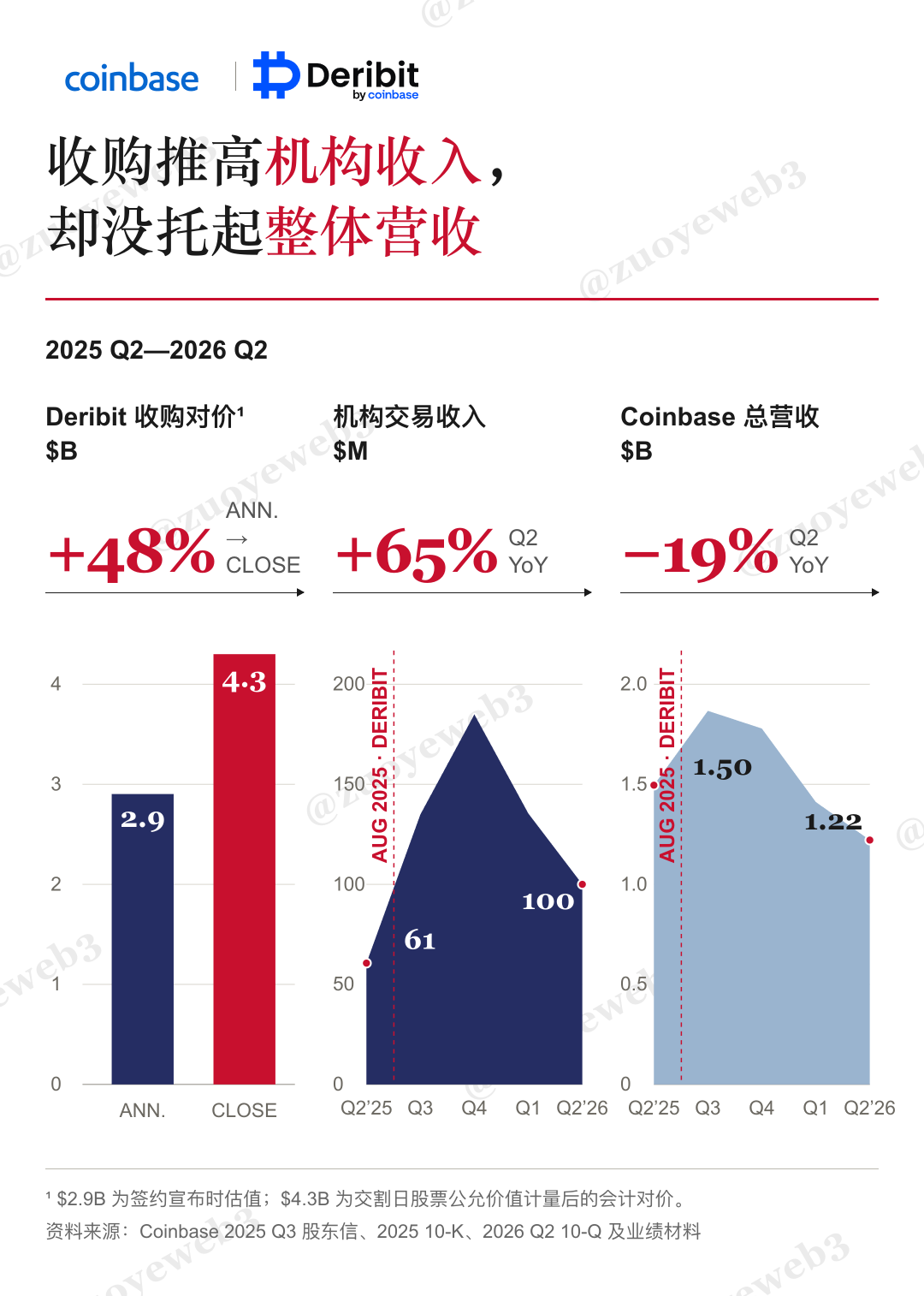
Image Description: Insufficient Combat Power
Image Source: @zuoyeweb3
If one were to calmly analyze Coinbase's financial data, I would talk extensively about institution-focused DeFi lending protocols, the money of banks, pension funds, amounting to trillions of dollars, but how much liquidity can they bring, please observe Coinbase.
As for encouraging institutions to bet against the market or participate in Stock Perp tournaments, it is almost a moment of fantasy.
Everyone needs to be clear, referring to the resurrection of the Wall Street Alliance Chain Canton, Robinhood's Meme, NFTs, DeFi, and even the introduction of dYdX for Perp DEX new product Arcus, it is obvious that only more coin-play can survive.
To cater to others is never as good as sticking to oneself.
The Western Coinbase and Robinhood are gradually showing signs of a divided court, marking a major change unseen in a decade since Binance's dominance in 2017.
But this is not based on the iterative upgrade of American product strength, but on the weak growth of Chinese offshore exchanges such as Binance.
There is no need to use data to prove Binance's dilemma, just to know that as the standards of Binance VIP drop further and further, Binance's BTC trading volume has been suspended multiple times.
Of course, there are also surprises, with a new change in the options business long monopolized by Deribit.
Bitget is attempting to launch business lines such as FCN fixed coupon note (FCN) and others, in fact, this is the transformation of dual-currency winnings, similarly, Bybit's options product line is also making rapid progress, with Deribit even hampered by Coinbase, its overall share is declining.
But this is not a story of ups and downs. When it comes to options and other complex derivatives, compared to the simple and understandable Perp, the share has always remained below 5%. We need to consider, can the simplified distribution of complex financial products support the next stage of a trading platform?
This is not a proposition that can be decided immediately, but it is very likely the rational choice in the post-crypto era.
The so-called full-service brokerage business is a business that Binance needs to consider. Most second and third-tier small firms need to rely on the richness of SKU to find regional markets where they can survive and barely earn a channel fee.
If the Alpaca behind bStock is already considered a Mini partner, then behind the Bitget Stock+ business, the channel Atomic Vaults may have less than 10 people. Welcome to the real business world.
What will be separated after a long time together, and how much will the exchange of identities gain or lose?
“Dual-currency mining and perpetual contracts prove that yield products and trading products can be mutually converted.”
The current CEX is undergoing a round of soul swapping:
· DeFi and CEX, TGE business dying down, on-chain DeFi needs to go through CEX distribution for real business, such as R25 distributing the Phraos token through Binance, backed by Southeast Asian bros consumer credit;
· CEX and TradeFi, RWA Perp/Stock Perp are just the most dazzling representatives. On-chain TradFi is already in progress, but CEX does not have much business increment facing them.
This is different from CZ's view in 2021 that Binance will eventually become a DEX. The current DeFi financial stack is no longer just a few forms like DEX Lending that can summarize.
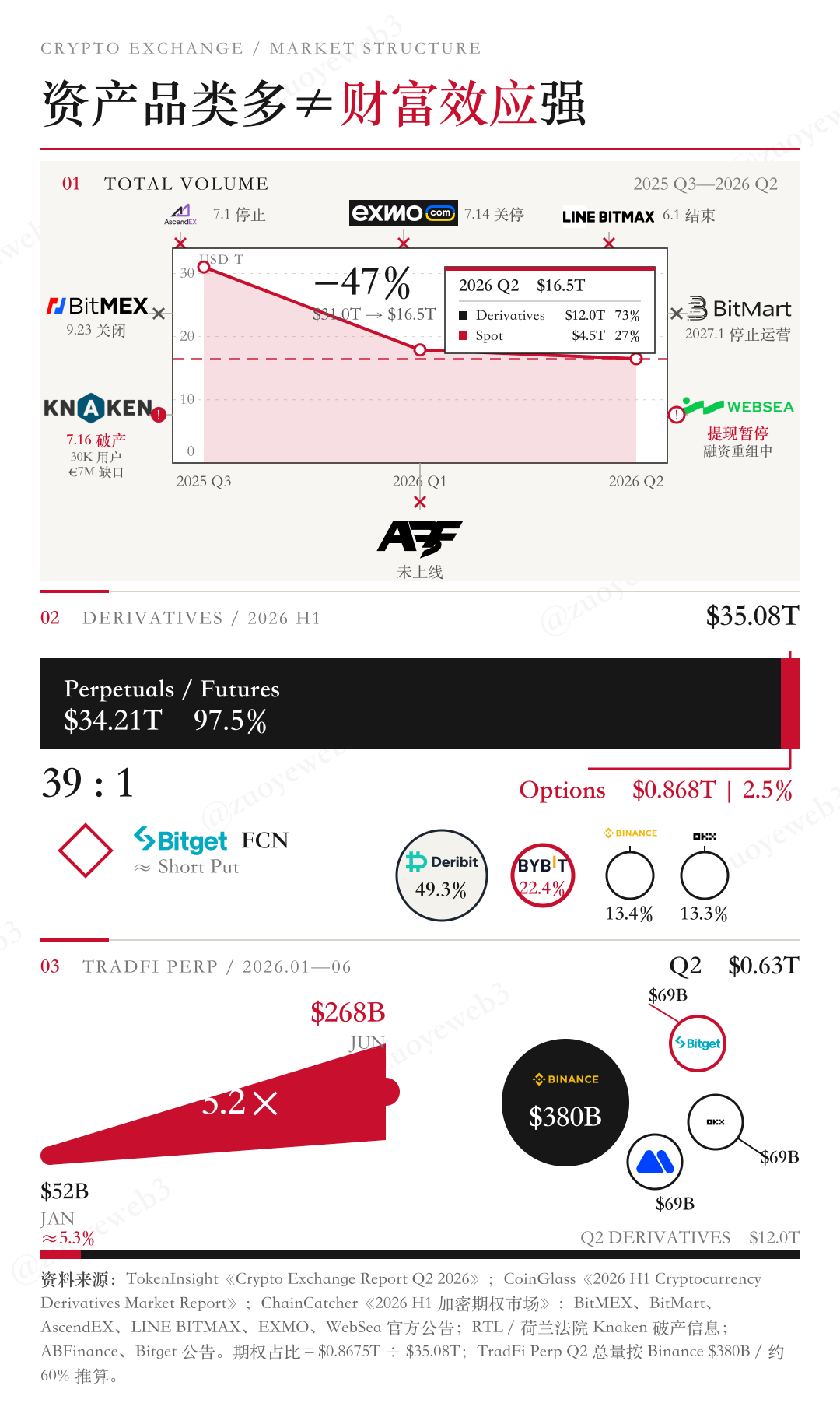
Image Description: The Vanishing Wealth Effect
Image Source: @zuoyeweb3
For a trading platform, Coinbase has proven that retail trading is indispensable, while Binance has proven that new assets do not need an old platform.
The incremental innovation of centralized exchanges (CEX) is mainly focused on a few businesses such as stocks. However, apart from Key Opinion Leader (KOL) tweets and paid reports, the overall trading volume of trading platforms has nearly halved. In a declining market, dominance cannot make up for the collective blood loss.
Even the million-dollar marketing of the Bitget Wallet's BD essentially conveys a chill. The department of recruiting new users needs to prove itself profitable, much like how junket operators support the turnover of Macau's VIP rooms.
Here, we will not analyze the destined failure of trading platforms for Pre-IPO and Stock Perp. Rushing to shore up unlisted assets: The battle for pricing rights in Pre-IPO has been introduced to the trading platform's Prime Brokerage (PB) business.
The reason can be summed up in one sentence: trading platforms do not have pricing power over stocks and other new assets.
However, this does not mean that the crypto industry will completely lose the possibility of pricing. We have been filled with the logic of trading platforms, often not daring to imagine other possibilities.
Yet, Changxin, which focuses on memory, was preemptively priced by TradeXYZ. Just like Yushu Technology, which specializes in robots, can they once again be traded globally at a reasonable price? We can just watch.
The problem is no longer complicated, but how to regain the pricing power "stolen" by Wall Street has become the starting point of all games, and Pre-IPO is just the opening chapter of this grand exam.
This is not to say that Pre-IPO and Stock Perp are not important. However, please note that the underwriting, IPO subscriptions, trading, and PB services of IPOs are still fully controlled by the traditional financial system. The occasional on-chain activity is just a superficial change.
Don't say that trading platforms, public blockchains, and stablecoins haven't benefited much. Even after Robinhood Chain completes its cold start relying on memes, it will still move towards real financial business.
However, trading platforms cannot do this. What trading platforms truly offer is the "wealth effect," or more bluntly, the multiple of skyrocketing prices. Only under this premise can Perp/DOGE coin and PumpFun find common ground.
But after the cooling of the Token Generation Event (TGE) system, trading platforms do not have the capacity to aggressively boost prices and can only passively enjoy the crumbs left behind by Wall Street.
It must be selling a feature of the crypto industry to the mass market, rather than selling something from the mass market to the crypto industry. The crypto market is too small to support this kind of consumption, leading to a lack of innovation and being resold to the mass market.
Unity after a Long Separation: Hijacking the Traditional Trading System
“24-Hour Trading, Dragging Exchanges into a More Familiar Battlefield”
The previous discussion was about the dilemma of exchanges, mainly betting on the dead end of institutional DeFi. Here, let's add a bit: CB mentioned that institutional DeFi is reasonable, which is a story Wall Street can understand.
Combined with America's natural control over public opinion industries, it naturally evolved into an industry consensus. We have survived in this environment for many years, and the understanding is not that complicated.
One-dimensional individuals cannot imagine a story without exchanges. If there were no Wall Street, we wouldn't even have the concept of imagination.
If we break free from all this, trying to envision a survival path beyond American consensus would feel challenging. So, let's start from the most fundamental aspect of liquidity.
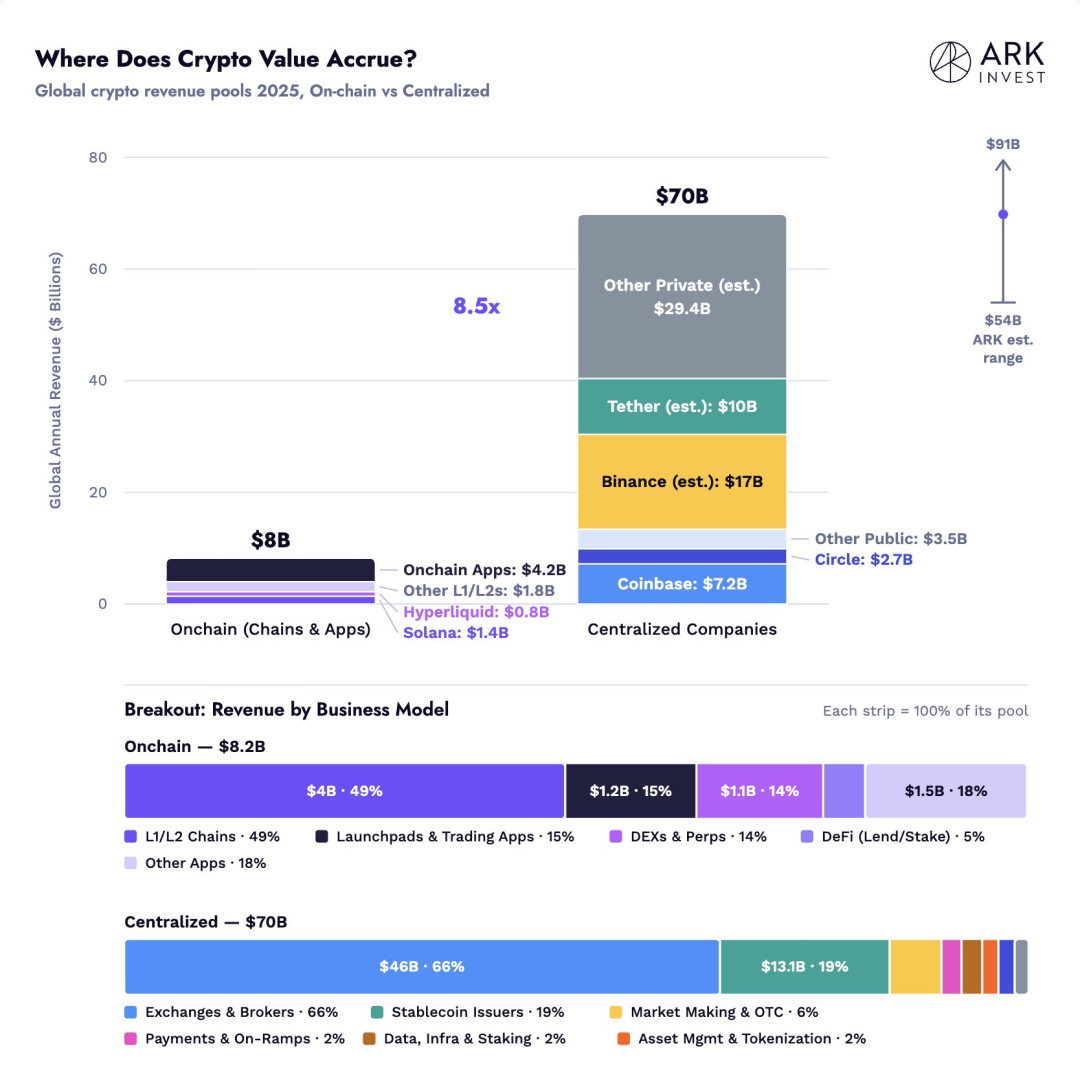
Image Description: Exchanges are still making money
Image Source: @LorenzoARK
Let's correct a misconception: the difficulty exchanges face is not about not making money but about persisting in not making excessive profits. In the entire industry distribution landscape, exchanges still make more money than DeFi and stablecoins combined.
It can even be further deduced that the institutionalization of American finance is the established path, and crypto is just following the footsteps of the U.S. stock market. This is not surprising.
In the exchange between CEX and TradFi, Nasdaq plans to have after-hours trading and has thoughtfully designed it during the daytime in Asia, operating 5 x 23 hours to meet the needs of Asian investors. The new Cold War is a tech (stock) war. The struggle between the two sides for each other or for international liquidity will create many new opportunities.
As a result, Binance launched Changxin's contract, but the demand from Asian investors has never been for leverage. A shares do not allow short selling, which has never led to a market frenzy or depression.
Therefore, the apparent hijacking is the exchange's reverse domestication of Wall Street, selling Pre-IPOs and super security firms to American institutions. But the real hijacking lies in—how to arbitrage globally in a regulated financial market.
Conclusion
The trading platform is gradually stepping back as a matchmaker and record keeper, ultimately transforming into a first release platform for various Pre-IPOs and Stock Perps, forming a new financial stack alongside the stock market and DeFi.
The historical mission of the trading platform does not end with OKX's compliance, nor does it rely on Bitget's belated C2C; instead, it lies in CZ's market manipulation behavior, still using memes. The trading platforms are no longer able to create a new asset issuance paradigm.
An era comes to an end. What we see now is nothing but the last-ditch struggle of a sinking ship. Look ahead, don't look back, and seek a new asset issuance method.
Original Article Link
Welcome to join the official BlockBeats community:
Telegram Subscription Group: https://t.me/theblockbeats
Telegram Discussion Group: https://t.me/BlockBeats_App
Official Twitter Account: https://twitter.com/BlockBeatsAsia

 Related Articles