Goldman Sachs Bullish on Broadcom: AI Revenue Could Increase by 130%, Can the ASIC Leader Maintain Its Dominance?
TL;DR
Goldman Sachs maintains a "Buy" rating on Broadcom with a $525 price target, representing about 34% upside from the report's referenced stock price of $392.43.
Goldman Sachs expects Broadcom's FY27 AI semiconductor revenue to reach $133 billion, more than double FY26, and about 12% higher than the market consensus.
Custom ASICs and data center network chips form Broadcom's core moat, but competitors such as MediaTek and AMD are increasing uncertainty in gaining customer share.
The $133 billion revenue forecast is heavily reliant on cloud customer capital expenditure and deployment acceleration, but the report does not break down the specific contributions of shipments, pricing, and new customers.
The $525 price target is based on a 30x normalized EPS, but the report does not disclose the exact normalization EPS calculation, which cannot directly correspond to adjusted EPS in financial forecasts.
AI spending slowdown, ASIC share loss, non-AI chip inventory adjustments, and VMware competition are the key risks to this high valuation thesis.
In a performance preview report released on August 18, Goldman Sachs maintained a "Buy" rating on Broadcom (NASDAQ: AVGO) with a 12-month target price of $525. With the referenced stock price at $392.43 in the report, this implies a potential upside of about 34%.
Goldman Sachs anticipates that Broadcom's next quarter performance may exceed expectations, although its AI semiconductor revenue is still in an accelerating phase. Broadcom's FY27 AI semiconductor revenue is projected to reach $133 billion, more than double the approximately $57 billion in FY26 and about 12% higher than market consensus expectations.
However, as MediaTek, AMD, and other companies intensify their entry into the custom ASIC market, the key to Broadcom's valuation sustainability has shifted from whether AI demand is growing to whether the company can retain key customers and project share.
AI Revenue Outlook at $133 Billion, Goldman Sachs More Bullish Than Market
Goldman Sachs forecasts that Broadcom's FY26 AI semiconductor revenue was about $57 billion, and it will further rise to $133 billion in FY27, representing an increase of over 130%. In comparison, the market's FY27 estimate is around $118.8 billion, with Goldman Sachs surpassing by approximately $14.2 billion.
This indicates that Goldman Sachs is not only optimistic about continued AI capital expenditure growth but is also betting on large cloud customers' custom chips and data center network deployment speed surpassing market expectations.
Broadcom's role in AI infrastructure is mainly divided into two parts: first, providing custom ASICs for hyperscale cloud customers, which are dedicated chips designed for specific computing tasks; second, providing high-speed network connectivity for large AI clusters through products like Tomahawk. As cluster sizes grow, both the computing chips and network equipment need to be upgraded simultaneously, allowing Broadcom to benefit from both the expansion of computing power and network upgrades.
Goldman Sachs believes that Tomahawk 6 is entering a volume ramp cycle and is expected to become another growth driver beyond AI revenue. Compared to only offering a single chip product, Broadcom's product portfolio covering computing, switching, and interconnectivity has also strengthened its competitive position in large data center projects.
However, $133 billion is still a rather aggressive forecast. The report does not further break down how much of the revenue growth comes from increased shipments, price improvements, or customer expansion but primarily attributes the growth to customer capital expenditure and deployment progress. Therefore, this number is first and foremost Goldman Sachs' assessment of the pace of demand fulfillment and not an official revenue guidance from Broadcom's management.
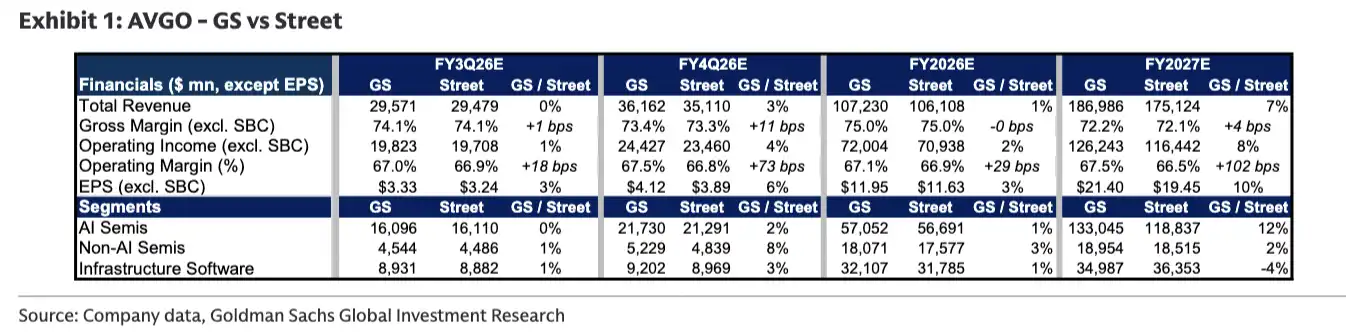
Goldman Sachs' comparison of AI semiconductor revenue versus market expectations. Goldman Sachs's forecasts for Broadcom's FY26 and FY27 AI semiconductor revenue are about 1% and 12% higher than market consensus, reflecting its more optimistic view on cloud customer capital expenditure and deployment speed. The related figures are all analyst forecasts and not company guidance.
MediaTek and AMD Enter, Customer Share Becomes the Biggest Suspense
The main controversy Broadcom faces comes from custom ASIC competition.
As cloud providers continue to increase their AI investments, the custom chip market is attracting more participants. In the report, Goldman Sachs discussed the competition pressure that MediaTek and AMD could bring, with market concerns that these manufacturers would participate in new-generation ASIC projects for hyperscale cloud customers, potentially affecting Broadcom's orders and market share.
Goldman Sachs believes that some of these concerns are already reflected in the stock price, but the competitive risks have not been fully validated yet.
Custom ASICs, unlike standardized chips, require suppliers to be deeply involved in customers' architecture design, chip development, validation, and mass production. The longer project cycles and higher migration costs provide barriers for Broadcom; however, cloud providers also have an incentive to introduce a second supplier to lower costs, enhance bargaining power, and diversify the supply chain's risk.
Therefore, MediaTek or AMD announcing entry into the market does not immediately mean that Broadcom's revenue will be impacted. What truly needs to be observed is whether the competitors can pass customer validation, secure mass production projects, and ultimately translate these into actual revenue.
For Broadcom, whether FY27 AI revenue can meet Goldman Sachs' forecast depends on both the continued expansion of the overall market and how much market share the company can capture. If AI infrastructure investment grows but major customers begin to diversify their orders, Broadcom's revenue may still fall below Goldman Sachs' optimistic forecast.
AI Semiconductor Becomes the Absolute Main Driver, Software Ensures Stable Cash Flow
In addition to AI chips, infrastructure software remains a key pillar of Broadcom's performance.
Goldman Sachs expects Broadcom's infrastructure software revenue to increase from around $32.1 billion in FY26 to around $35 billion in FY27. Compared to the more than doubling growth rate of AI semiconductor revenue, the growth of the software business is relatively moderate but can provide more stable revenue, profit, and cash flow.
This structure enables Broadcom to have a two-tier growth structure: AI semiconductors are responsible for driving revenue and profit growth, while infrastructure software is responsible for mitigating the impact of the traditional chip cycle on overall performance.
Goldman Sachs predicts that Broadcom's total revenue will rise from $107.2 billion in FY26 to $187 billion in FY27; during the same period, the proportion of AI semiconductor revenue will increase from around 53% to about 71%. The adjusted EPS is expected to increase from $11.95 to $21.40.
If this forecast materializes, Broadcom will further transition from a diversified semiconductor and software company to a company highly driven by AI infrastructure investment. This can bring higher growth but also means that its revenue, profit, and valuation will increasingly rely on the capital expenditures and deployment pace of a few large customers.
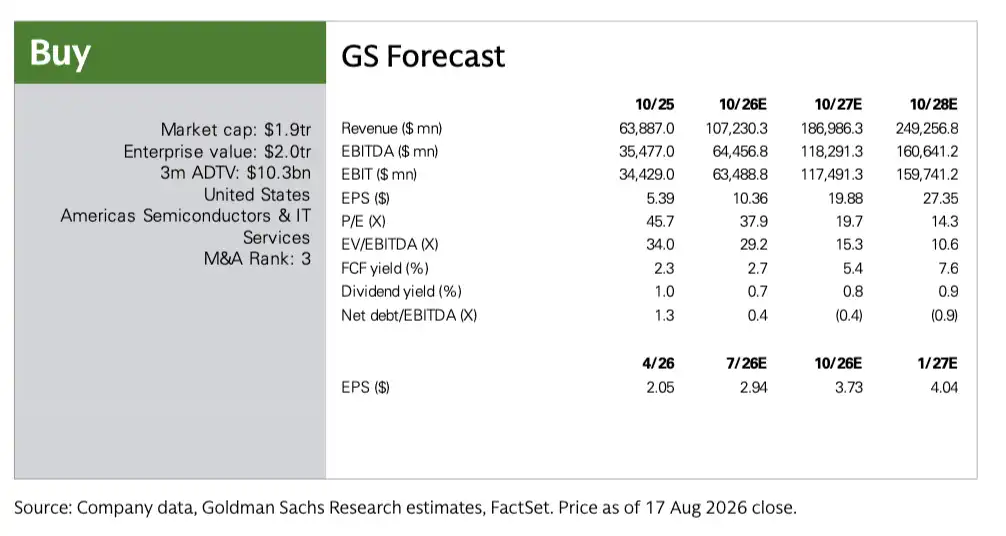
Broadcom Financial Forecast Table. Goldman Sachs expects Broadcom's total revenue to increase from $107.2 billion in FY26 to $187 billion in FY27, with a significant increase in the proportion of AI semiconductor revenue; at the same time, the adjusted EPS is expected to rise from $11.95 to $21.40. All data are Goldman Sachs' forecasts.
What Does a 30x Valuation Bet On?
Goldman Sachs has given Broadcom a $525 price target, based on a valuation of 30 times normalized earnings per share of $17.5.
The calculation itself can be directly recalculated, but the report did not specify which adjustment items are included in the $17.5 normalized EPS, and which specific forecast period it corresponds to. This number falls between the FY26 adjusted EPS forecast of $11.95 and the FY27 forecast of $21.40, so it cannot be directly equated to any EPS data in the financial forecast table.
This also means that simply multiplying the FY27 adjusted EPS by 30 and then assessing whether the $525 target price is conservative is not possible. Both the selection of normalized EPS and the 30x valuation multiple are part of Goldman Sachs' analyst judgment, not Broadcom's guidance.
The 30x valuation reflects the market's AI growth premium for Broadcom and also implies two key assumptions: that AI semiconductor revenue can sustain rapid growth and that the company's competitive position in the custom ASIC market will not significantly deteriorate.
If there are customer deployment delays or if Broadcom loses project share, the impact may be felt on two fronts simultaneously: on one hand, revenue and EPS forecasts will be cut, and on the other hand, the valuation multiple given to the AI business may also contract.
Goldman Sachs has identified key downside risks, including a slowdown in AI infrastructure spending, loss of ASIC market share, non-AI semiconductor inventory adjustments, and intensified competition in the infrastructure software market. However, the report does not quantify the likelihood of these risks occurring or their potential impact.
Looking at the target price history, Goldman Sachs has raised Broadcom's target price multiple times since 2024. Following the company's stock split adjustment, the target price has gradually increased from $240 in December 2024 to $525 in June 2026. It is worth noting that the $525 target price is not a new upward revision in this report but has been maintained by Goldman Sachs since June 4.
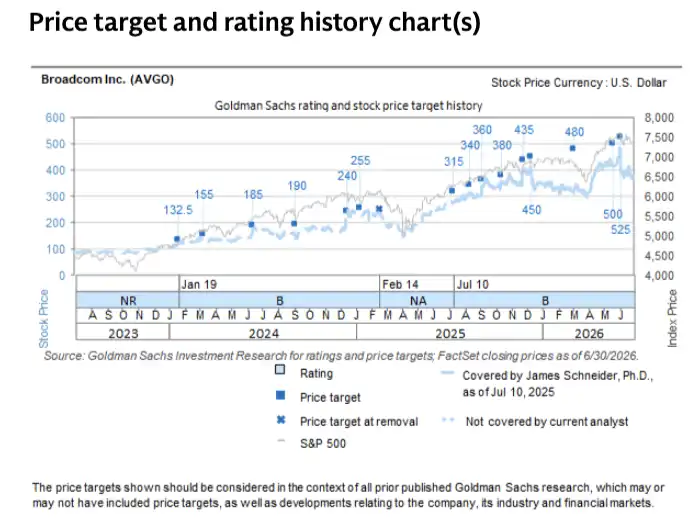
Goldman Sachs' history of target price adjustments for Broadcom. Goldman Sachs has raised Broadcom's target price multiple times in recent years, reflecting continuous growth expectations in AI revenue and profitability; the latest $525 target price has remained unchanged since June 4, 2026.
Going forward, what investors most need to focus on is not whether AI demand remains strong, but how much of this demand can ultimately translate into Broadcom's orders and revenue.
Goldman Sachs' forecast for FY27 AI semiconductor revenue is 12% above the market average, leaving room for further upside in Broadcom's stock price and raising the bar for performance realization. Customer deployment progress, custom ASIC share, and competitors' actual production capacity will collectively determine whether the $133 billion revenue forecast and $525 target price can be achieved.
Welcome to join the official BlockBeats community:
Telegram Subscription Group: https://t.me/theblockbeats
Telegram Discussion Group: https://t.me/BlockBeats_App
Official Twitter Account: https://twitter.com/BlockBeatsAsia