AI Price Plunges Again as OpenAI and Anthropic Hit Snags?

TL;DR
· OpenAI's second-quarter revenue and loss figures are from investor materials, but the market is more concerned about growth quality.
· Anthropic operates with a more aggressive stance, but audit revenue, gross margin, and channel caliber still need validation.
· Related subjects: MSFT, AMZN, GOOG, ORCL, NVDA.
According to media reports such as The Wall Street Journal, OpenAI's second-quarter investor materials show revenue of approximately $6.7 billion, up 18% QoQ, with operating losses expanding to $12.3 billion. Almost simultaneously, preliminary revenue and annualized run rate for Anthropic were also disclosed, showing higher numbers and a faster growth rate.
These figures are putting AI transactions into a more specific question: whether cloud providers' upfront investment in data centers and computing power for large models can recoup costs on the original timeline.
The market does not deny the demand for AI. The revenue scale of OpenAI and Anthropic still indicates willingness by enterprises and individual users to pay. However, for Microsoft, Amazon, Google, Oracle, and Nvidia, revenue growth is just the first step. Investors are now looking to see if this revenue can translate into high gross margins, stable cash flow, and be sufficient to absorb the massive capital expenditure of cloud demand.
OpenAI's Pressure Comes from Growth Trajectory
OpenAI's second-quarter revenue is approximately $6.7 billion, compared to around $5.7 billion in the first quarter, an 18% QoQ growth. For a typical software company, this would already be a strong performance. However, OpenAI is not valued according to the playbook of a typical software company.
It has ties to Microsoft, potential public listing aspirations, and high market expectations for the speed of commercializing cutting-edge models. Within this framework, an 18% QoQ growth is compared against steeper revenue curves. The issue is not whether OpenAI has demand but whether the growth rate can cover the cost expansion.
More sensitive is the loss metric. The reported $12.3 billion is the operating loss including items like equity incentives, which cannot be directly equated to cash outflow or audited net losses. However, it still serves as a reminder to the market: model training, inference, talent, and infrastructure costs are still consuming revenue increments at a faster pace.
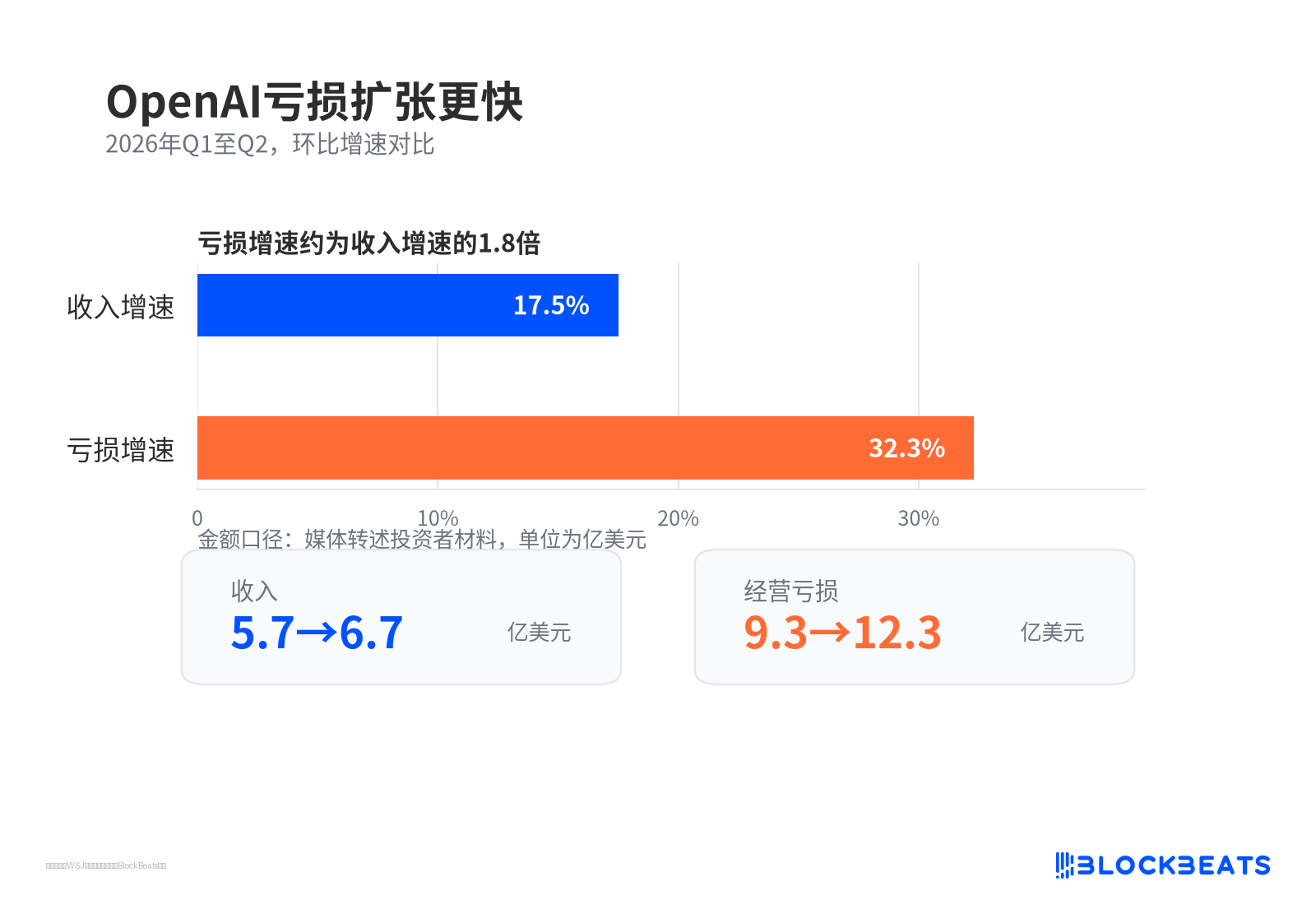
OpenAI Losses Expanding More Rapidly
This is also one of the reasons why tech stocks are under pressure according to related reports. Selling pressure may not only come from OpenAI, as interest rates, earnings expectations, and crowded AI sector positions are all simultaneously impacting the market. However, OpenAI's numbers provide a clue: the commercialization of AI labs is still advancing, but the path to profitability has not materialized in sync.
Anthropic's Run Rate Needs to Be Discounted
Anthropic's disclosed figures are more aggressive. Documents show that Anthropic's preliminary revenue exceeded $11.5 billion in the second quarter, up from $4.73 billion in the first quarter. By the end of July, its annualized revenue run rate exceeded $65 billion, higher than around $47 billion in May.
The annualized revenue run rate is prone to misinterpretation. It is a calculation of the full-year scale based on the current revenue rate, not equal to audited confirmed annual revenue or locked-in long-term contracts. If a major customer's usage increases in a month, prepayment tokens increase, or cloud channel sales are recognized on a gross basis, the run rate will be magnified.
The bull case emphasizes that the enterprise scenario is turning into revenue. Code generation, customer service, office automation, and enterprise workflows indeed transition models from trials to purchases. Enterprises are willing to pay for stability and task completion rates, providing a realistic basis for Anthropic's high growth.
The cautious camp, on the other hand, looks at a different set of accounts. ARR and run rates cannot substitute for audited revenue. What determines the quality of valuation is gross margin, customer concentration, retention rate, cash flow, and whether revenue from sales through Amazon or Google Cloud is recognized on a total or net basis.
This difference will directly affect comparability. The Wall Street Journal previously mentioned that Anthropic's treatment of technical revenue sold through cloud partners is not entirely consistent with OpenAI's criteria. In other words, the revenue numbers of the two labs can be equally large, but the quality and profit content may not be the same.
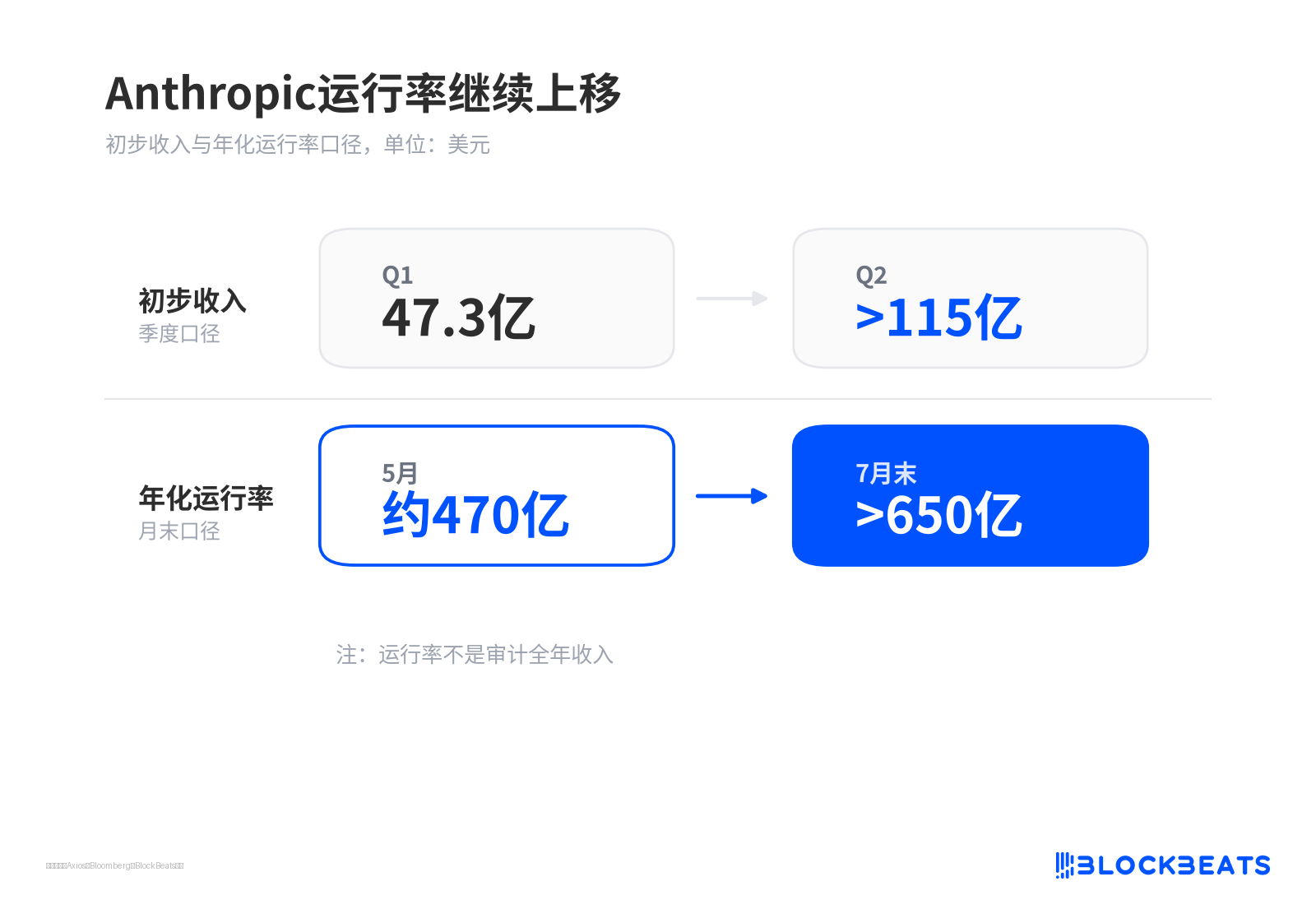
Anthropic Run Rate Continues to Rise
Cloud Titan Earnings Need to Be Split
The financial changes of AI labs will affect large-cap tech stocks because they are no longer just cloud customers but also part of cloud titans' investment gains and capital expenditure plans.
Microsoft is deeply tied to OpenAI, while Amazon and Google are more closely linked to Anthropic. Cloud titans both invest in labs and sell computing power and cloud services to them. During the upswing of the market, this relationship will amplify the narrative: investment appreciation, cloud revenue growth, AI order increases, all seem to mutually validate each other.
However, this structure has also made the income statement complex. In the second quarter of this year, Amazon disclosed a net profit of $62.6 billion, including $53.4 billion of pre-tax other income, mainly from Anthropic investments. Alphabet disclosed a significant amount of unrealized gains on equity securities, reportedly related to assets such as Anthropic and SpaceX. In the second quarter of its 2026 fiscal year, Microsoft also disclosed that the net income from OpenAI investments increased GAAP net profit and earnings per share.
While these gains can indeed boost current-period profits, they are not the operational return of the core cloud business. Paper gains from investment revaluation cannot substitute for data center utilization, cloud margins, and customer payment capabilities.
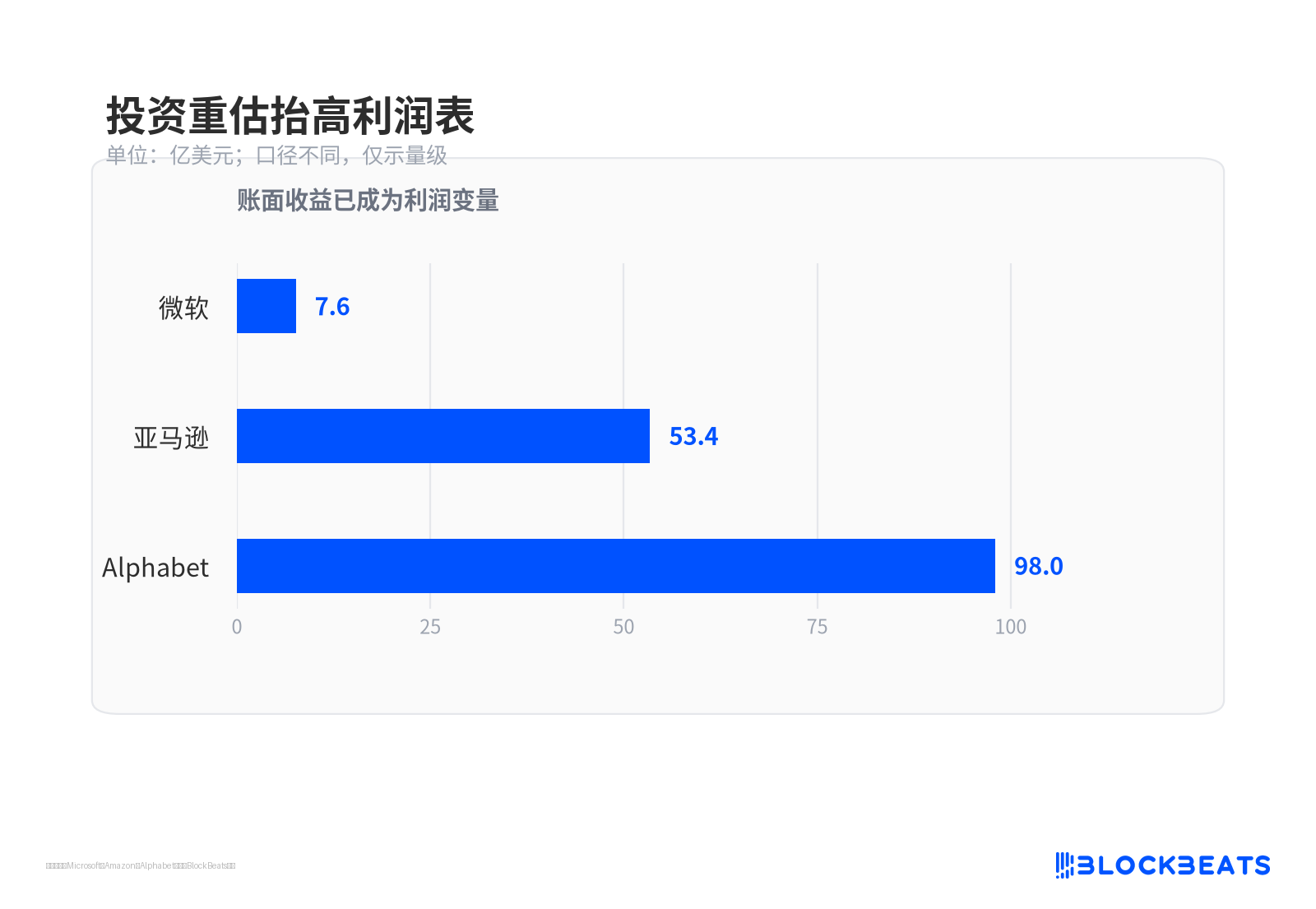
Investment Revaluation Boosts the Income Statement
So, the market is now looking at a two-tiered account. Can lab revenue growth support its own valuation, is the core of OpenAI, Anthropic potential financing, and IPO. Whether lab revenue can translate into long-term returns for cloud providers is the valuation anchor for MSFT, AMZN, GOOG, ORCL, and NVDA.
Gross Margin Will Set the Valuation Pricing
The current more prudent judgment is that AI lab commercialization has not failed, but the market is starting to reprice growth quality and payback time.
OpenAI needs to prove that revenue growth can continue to rise while slowing down operating loss expansion. Anthropic needs to prove that a run rate of over $65 billion is not a short-term peak usage and not a result of channel caliber amplification, but rather enterprise revenue that is sustainable, renewable, and has a sufficiently high margin.
The validation points will ultimately fall into more comprehensive disclosures. Investors need to see revenue recognition criteria, gross margins after deducting computational costs, customer concentration, long-term computational procurement obligations, and the gap between adjusted operating revenue and actual cash flow.
If these numbers exceed expectations, there is still room for the AI cloud transaction to be revised upward. If margins and cash flow do not keep up with the operating rate, cloud providers' capital expenditure payback period will need to be extended, and the valuation of AI infrastructure can no longer be calculated based on the original script.
Welcome to join the official BlockBeats community:
Telegram Subscription Group: https://t.me/theblockbeats
Telegram Discussion Group: https://t.me/BlockBeats_App
Official Twitter Account: https://twitter.com/BlockBeatsAsia