Samsung and SK Hynix buying interest is limited to buybacks, and Korean stocks are starting to decouple from the global AI rally.

TL;DR
· On October 8, Samsung Electronics announced a preliminary third-quarter operating profit of KRW 107.4 trillion, a record quarterly high for a global tech company; on the same day, the KOSPI closed down 2.62%, about 27.3% below its all-time high.
· Samsung Electronics and SK Hynix together account for more than half the index weight. Foreign investors are concentrated in selling these two stocks, the won’s appreciation is eroding foreign investors’ dollar returns, retail investors are turning to U.S. stocks, and the two companies’ combined buybacks of about KRW 55 trillion are nearing completion. The index is losing its last stable net buyer.
· Related tickers: Samsung Electronics, SK Hynix, KOSPI.
On October 8, Samsung Electronics announced a preliminary third-quarter operating profit of KRW 107.4 trillion and revenue of about KRW 195 trillion, with quarterly profit exceeding KRW 100 trillion for the first time. On the same day, the KOSPI closed down 2.62% at 6,625.93, about 27.3% below its all-time high of 9,114.55. In the first half of the year, it was still one of the world’s best-performing major stock indices. In the second half, while U.S., Japanese, and Taiwanese stocks continued to hit new highs, it fell alone.
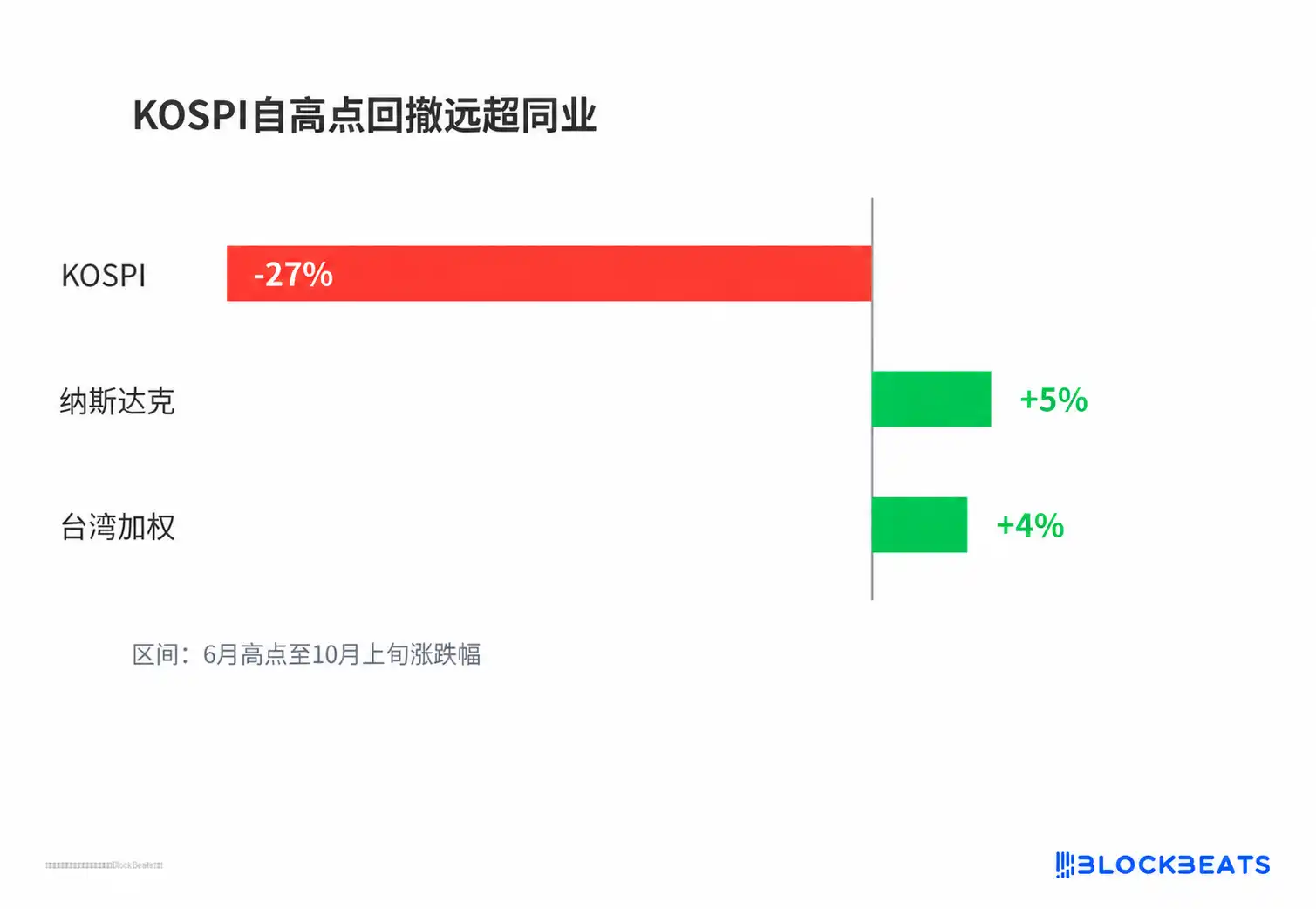
KOSPI’s drawdown from its high far exceeds peers
What the market is repricing is not Samsung’s profitability, but the buyer structure. For an index with such concentrated weights, who is buying matters more for short-term prices than how much is earned. Samsung Electronics and SK Hynix together account for more than half of the KOSPI’s weight, so the index’s rise and fall is almost equivalent to the rise and fall of the memory sector.
Half the index is two memory companies
In the first half of 2026, demand for HBM (high-bandwidth memory) from AI data centers pushed Samsung and SK Hynix into one of the world’s most crowded trades and also pushed the KOSPI to the top of major stock indices. A weight of more than half means there is no diversification to speak of in this index: if the two fall, Korea falls.
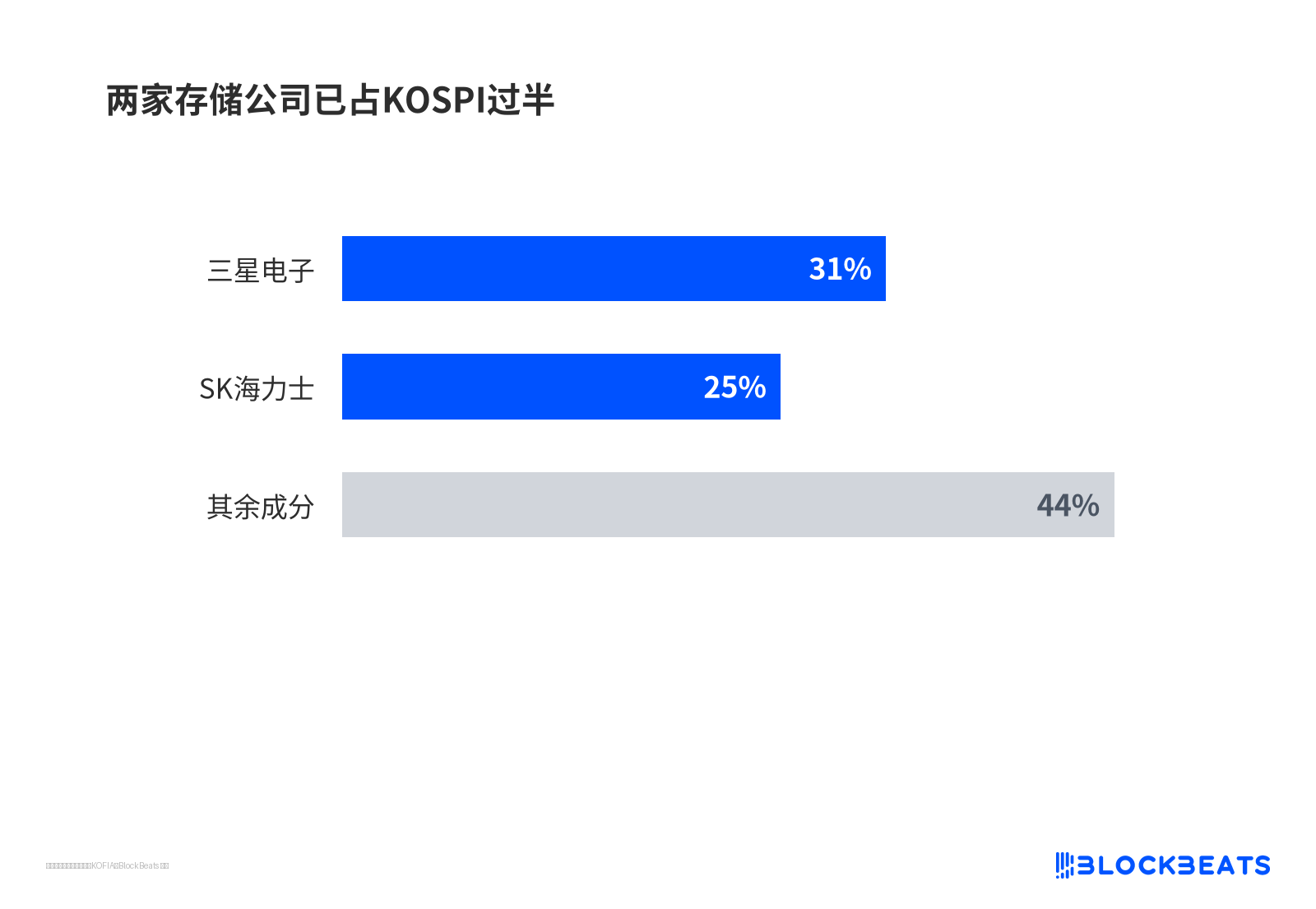
Two memory companies now account for more than half of the KOSPI
Deleveraging is faster than the rally. Data compiled by Bloomberg show that KOSPI turnover has fallen about 70% from its late-May peak, while margin balances have dropped from a June high of about KRW 38.6 trillion to about KRW 33 trillion. Earnings have not collapsed; the problem is the liquidity gap left after the leverage tide receded.
Foreign Selling Pressure Concentrated in Two Heavyweight Stocks
Foreign investors net withdrew approximately $131 billion from the South Korean stock market this year, the largest outflow among major Asian markets. In September alone, Samsung Electronics and SK Hynix together accounted for 76.6% of net foreign selling. Foreign ownership has fallen to approximately 46.38% for Samsung and 49.59% for SK Hynix, near lows not seen since the 2008 financial crisis.
The Korean won appreciated over the same period, rising from about 1,550 won per dollar in early July to around 1,338 won in early October. For foreign investors holding Korean stocks, currency appreciation directly erodes returns when converted to dollars — even if share prices stay flat, dollar-denominated gains shrink. This round of appreciation was driven by exporters converting foreign earnings rather than foreign capital inflows, as South Korea's September semiconductor exports surged year-on-year and the trade surplus hit a record. The stronger the earnings, the more conversion occurs, and the thinner foreign investors' book returns become.
Buybacks Are the Only Steady Net Buyer, and Ammunition Is Nearly Exhausted
South Korean statistics record corporate buybacks under "other legal entities," making it the most direct way to track changes in buying. The amount announced for purchase and the funds actually entering the market each day are not the same thing. Regulatory disclosures show that in the first nine months of this year, KOSPI companies' buyback decisions were approximately 5.45 times the level of the same period last year, with the two chip giants accounting for over 90% of that. Excluding these two companies, buyback amounts for all other companies declined year-on-year. Support buying was never a market-wide phenomenon.
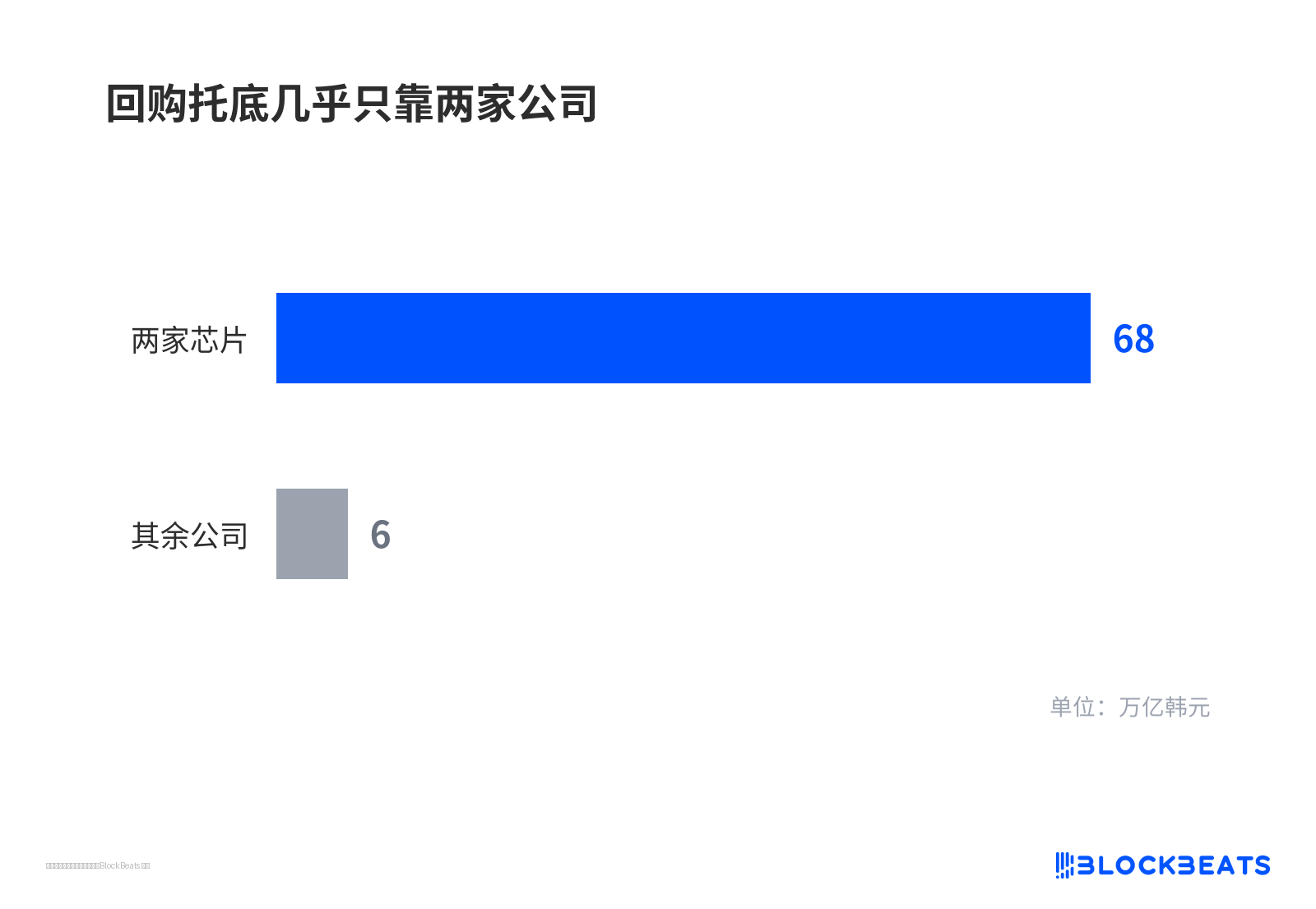
Buyback support relies almost entirely on two companies
Execution is even more critical. Samsung's approximately 15 trillion won buyback launched in August, intended for employee performance and special bonuses, was substantially completed by early October, with share counts even exceeding the plan. SK Hynix's approximately 40 trillion won buyback, intended for share cancellation, was about 80% complete by early October, with daily buying already slowing. Goldman Sachs' Seoul trading desk estimated that in the four weeks through September 22, corporate buybacks absorbed approximately $27 billion in selling pressure — this is a trading desk estimate. The two companies' primary motivation is capital allocation and compensation arrangements, not index stabilization.
Retail Investors Sell Korean Stocks to Buy US Stocks; Institutions Have Not Uniformly Abandoned Korea
Individual investors net sold 5.5902 trillion won on KOSPI in the third quarter, including net selling of 14.197 trillion won in September alone, while net buying approximately $7.632 billion in US stocks during the same period.
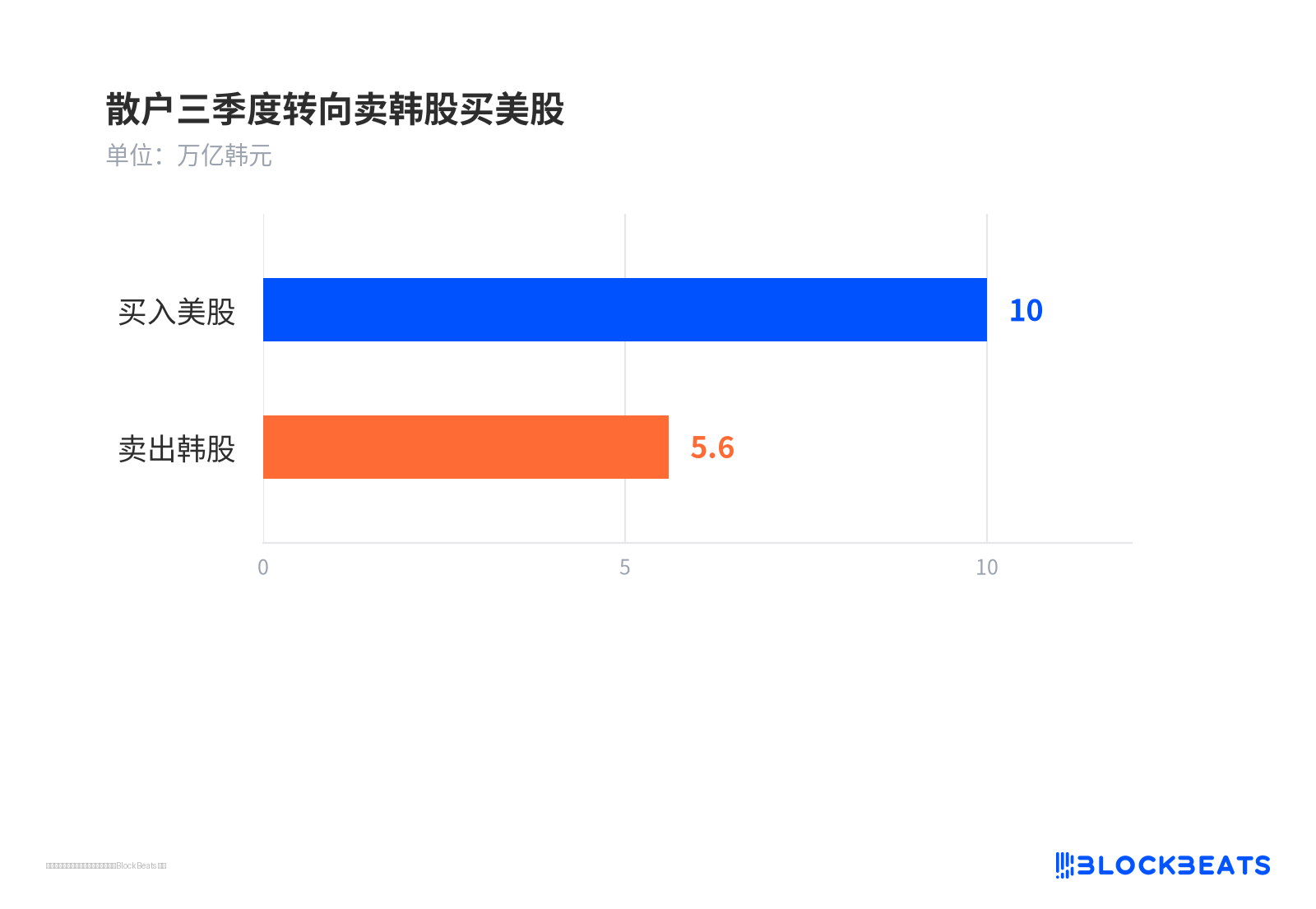
Retail investors shifted to selling Korean stocks and buying US stocks in Q3
In the first half of the year, they were still net buyers of KOSPI to the tune of about KRW 99.17 trillion, roughly 8 times their net purchases of US stocks over the same period. In the first 8 trading days of October, they swung back to net buying of about KRW 3 trillion. The tilt is toward US stocks, but it is not a one-way, permanent exit.
The divergence between overseas and domestic institutions is also widening. Some portfolio managers believe the "easy money" in memory has already been made and have reduced allocations to Samsung and SK Hynix. Others on trading desks warn that an early end to buybacks will leave a buyer vacuum. Target prices are just as split, with overseas investment banks still broadly high on their 12-month KOSPI targets, while domestic brokerages have cut theirs on concerns over fund flows.
Whether pensions and corporates can fill the gap will determine if volatility expands or converges
After buybacks exit, whether domestic pensions such as the National Pension Service and corporate entities will step up buying is an open variable, with no usable data available for now. If HBM orders and memory prices stay strong, new buyers may gradually emerge. If prices weaken first, price discovery without official buying will amplify volatility. US inflation data in mid-October will also directly affect foreign risk appetite for won-denominated assets.
This round of adjustment is concentrated in the most crowded memory segment. What foreign investors cut is mainly these two heavyweight stocks, which does not mean Korean assets as a whole are being removed, nor does it mean the AI supply chain narrative is over. TSMC and memory sit at different parts of the chain.
Welcome to join the official BlockBeats community:
Telegram Subscription Group: https://t.me/theblockbeats
Telegram Discussion Group: https://t.me/BlockBeats_App
Official Twitter Account: https://twitter.com/BlockBeatsAsia