Wang Xingxing, a Butterfly, and a Robo-Dog

Original Title: "Wang Xingxing, a Butterfly and a Robo-Dog"
Original Author: WatcherBeating
As the music played, a row of silver humanoid robots and martial arts school children threw punches, kicked, and spun simultaneously, with every move executed flawlessly. This took place on New Year's Eve at the CCTV Studio 1.
As the performance entered its latter half, the robots started performing consecutive somersaults—front flips, backflips, and mid-air 360-degree spins, landing securely each time. Midway through, one robot stumbled and fell, only to quickly get back up and continue the routine. 600 million people watched the entire performance through their screens.
The man behind creating them is named Wang Xingxing. He is not fond of speaking.
Butterfly
Over thirty years ago, at a kindergarten in Yuyao, Zhejiang, Wang Xingxing drew his first-ever painting.
A butterfly.
He had never received any formal art training. He copied the butterfly from an art book. A child from a kindergarten, never having attended a single day of art class, drew a steady line, unlike anything people of his age group were capable of drawing. The teacher showed it to other teachers, who then showed it to parents. Many years later, Wang Xingxing still remembered this incident.
During a later interview, he voluntarily mentioned this butterfly. There was no tale of genius behind this story, only a struggle, a struggle with being overly sensitive to details.
In everyday objects, whether the lines were straight, or if the glue was applied evenly, he could perceive it all, always wanting to erase any imperfections.
This acute sensitivity to specific details stayed with him throughout his life.
Wang Xingxing is from Yuyao, the hometown of Wang Yangming, a county town in eastern Zhejiang known for its culture of learning. When Wang Xingxing was five or six years old, too short to reach the stove, he disliked the food cooked at home, so he brought a stool, stood on it, and cooked for himself. Reflecting on these past events, he used the term "overly sensitive" — "a lot of time was spent on mental struggles." He couldn't find a more accurate description, "in simple terms, it's OCD."
However, when it came to language, everything was turned upside down. He couldn't remember English words. Some Chinese characters, when he tried to write them, would suddenly escape his memory. In high school, out of hundreds of English exams, he only passed three times. He applied for the entrance exam at Zhejiang University, failed the English section, and was reassigned to Shanghai University.
Wang Xingxing had extremely good hands-on skills. In elementary school, he invented a small wind-powered car. In junior high, he handcrafted a miniature turbojet engine. At the age of ten, he saw Boston Dynamics' robot on television for the first time, a metal quadruped that took steps. At that time, no one knew that many years later, the robots he created would step onto the same stage.
In 2009, he was admitted to Zhejiang University of Technology to study mechatronics engineering. He said that he attended an ordinary university and once felt very inferior. During university, he became interested in artificial intelligence and neural networks, turning everything in the textbooks into reality step by step.
He enjoys eating alone because he feels that eating with others is a waste of time. He doesn't read biographies or much science fiction. Many tech professionals see science fiction as a prophecy, but he doesn't. Instead, he reads the "Feynman Lectures on Physics," a book that directly discusses how the world operates. On the book's opening page is a quote from the author, "What I cannot create, I do not understand." During his break time, he loves to watch anime.
Until a little over a year ago, his phone number was still public online. When asked about socializing, his response was very straightforward: "I don't like socializing; it's meaningless."
In an interview, he talked about himself.
When he was young, he thought he was somewhat clever but rarely received attention and affirmation, often feeling suppressed. For a long time, his inner self was in constant struggle, always seeking a way out and opportunities, wanting to "break out of the cocoon."
He said that the world didn't give him many real opportunities.
Pausing for a moment, he added:
"But it's okay; I'm having a lot of fun."
$200
During his first-year winter vacation, Wang Xing Xing created the first humanoid robot of his life. The cost was $200.
A purely handcrafted robot. With two legs, it could take a few steps, that's all. After completing it, he was not satisfied. In his words, "It was far from my expectations." At that time, global humanoid robot control technology was not ideal, the performance was not there, and there was no vision of robots replacing humans. He temporarily set aside this obsession.
However, he did not give up on robots themselves.
While pursuing his master's degree, he joined Professor Jia Wenchuan's research group at Shanghai University. Professor Jia had just started leading a National Natural Science Foundation of China (NSFC) youth project. The project sounded like a scenario from a science fiction novel: using a non-invasive brain-machine interface to control the high-performance motion of a quadruped robot.
The project had limited funding and a shortage of manpower. After the master's admission interview, the two met for the first time. Wang Xing Xing showcased several mechatronic projects he had done during his undergraduate years and discussed his views on robots. He did not have a high GPA or any impressive award certificates. However, Jia Wenchuan nodded and let him join the group.
“His presentation and expression were a bit nervous, but very sincere,” later recalled Jia Wenchuan.
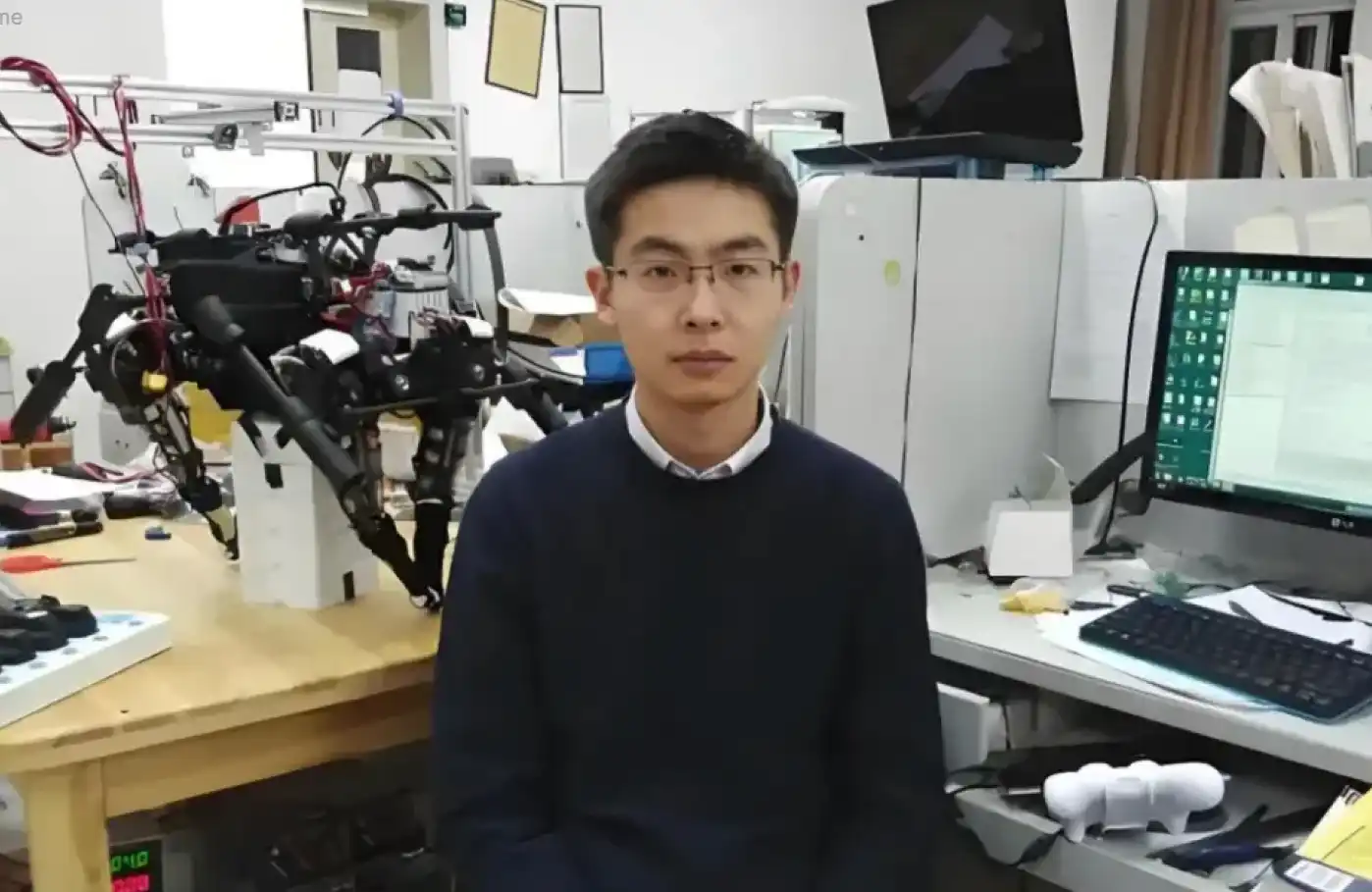
After joining the group, Wang Xingxing almost always sat in front of the lab bench, even on holidays. He put a blue icon of a little dog on the lab bench, which was the name he gave to the robot he was going to build — XDog, an infinitely versatile robotic dog.
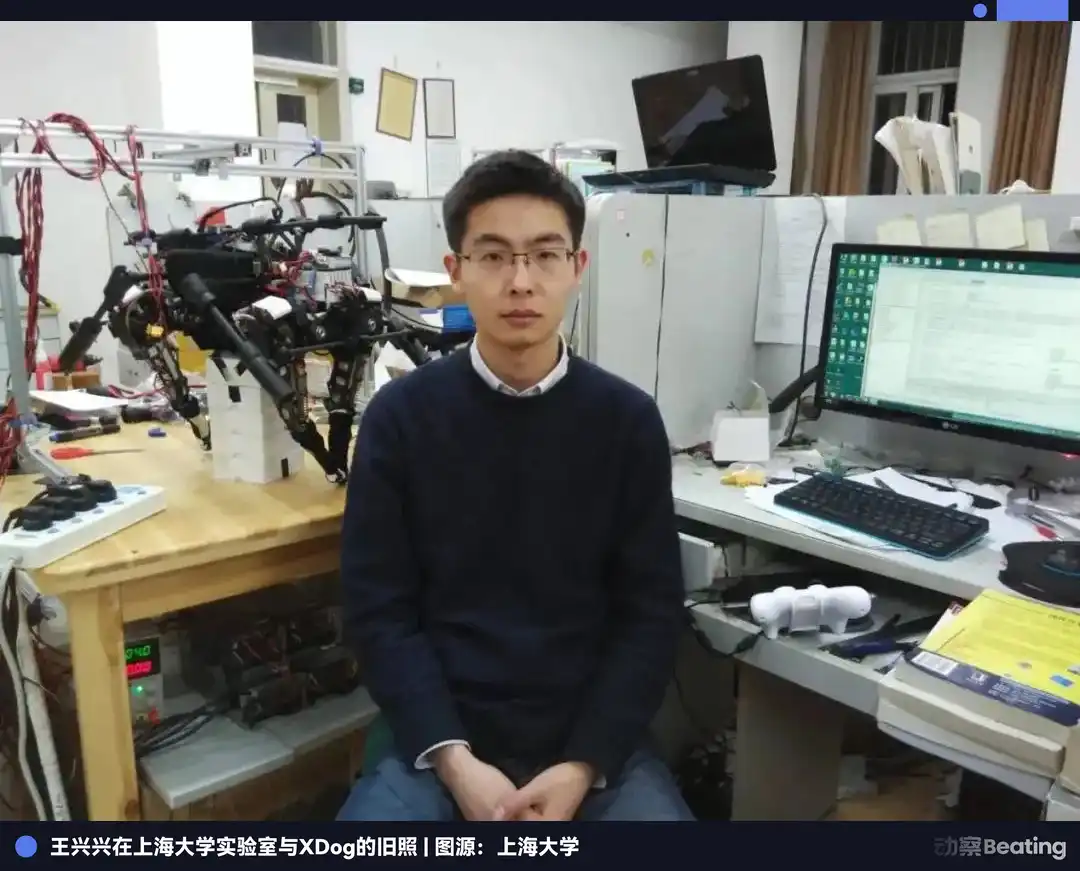
He didn't use expensive hydraulic drive like Boston Dynamics; instead, he chose motor drive, the most cost-effective option. The entire machine was developed with only one to two thousand yuan. In fact, he had thought of this solution when he just started his postgraduate studies, even considering dropping out to start a business like Bill Gates and Steve Jobs. It was just a thought back then, and no plan was made.
In 2015, XDog participated in a competition in Shanghai and won second prize, receiving 80,000 yuan as a reward. That was the first time in his life that he earned money by building something.
He later called it “the first pot of gold.”
The journalist who reported on the competition that year used a camera to capture his small, equipment-packed laboratory, with the caption reading, “Compared to the research environment of Google and MIT, with financial support easily reaching millions to tens of millions of dollars, the difference is like heaven and earth.” Google backed Boston Dynamics with billions of dollars. Wang Xingxing’s dog was put together step by step with parts costing only a few thousand yuan and countless late nights in front of the lab bench.
Jia Wenchuan always remembered two moments. One was when XDog was featured in the IEEE Spectrum after which this usually unassuming student said:
“Teacher Jia, I really have done my best.”
The other was his later casual remark, “Even those top university people are only so-so.”
As it turned out, the robotic dog developed by Wang Xingxing was even better than what top overseas professors’ labs had created.
There was once a question on Zhihu: “How do you view the XDog made by Wang Xingxing from Shanghai University?” Wang Xingxing himself replied below: “I guess I was quite lucky.” After a while, he added: “Really lucky.”
After completing his master's degree, he went to Shenzhen and joined DJI. Two months later, he resigned. In 2016, he founded TreeTech. All the chips were XDog, along with 2 million yuan from an angel investor. Based on this money, TreeTech's valuation at the time was 13.33 million yuan.
“We started a business in 2016, and the robotics industry was very niche then, which is a complete contradiction to now. At that time, TreeTech was valued at just over 10 million yuan, and we raised 2 million yuan. That amount of money almost lasted for a year and a half, and by the end, we were almost unable to pay salaries. But by 2018, when we started shipping products, fundraising became a bit smoother.”
During the early days of the startup, an investor asked him, "What is the use of a robotic dog?"
He replied, "First, build the product, and research institutions will surely buy it."
When you can't explain it clearly, just create the thing first. For Wang Xingxing, the product needed real-world validation, and an individual's thinking also needed to be assessed through specific problems.
According to elsewhere's compilation, in the early days, Yushu had a set of strange interview questions. Every applicant had to answer 12 questions in writing, including the receptionist. The questions included: Most significant technological advancements made by humans in the past few hundred years have originated in the West, what do you think is the reason for this? How do you view and evaluate Traditional Chinese Medicine? Lastly, there was a picture puzzle of "find the differences."
These questions were personally formulated by Wang Xingxing. There were no correct answers. He validated the product in the market and also used these questions to assess those who were about to join him in creating the product.
Sleeper Berth
In 2018, Yushu found itself on the brink of a cliff.
The early-stage financing was running out, and the next round of investment fell through unexpectedly. The company had less than two hundred thousand yuan left in its accounts. Wang Xingxing stopped taking his salary, used his savings, and maintained the employees' wages. The technical roadmap remained unchanged.
That year, DJI briefly entered the picture. Two years after leaving DJI to start his own venture, Wang Xingxing's former employer acquired around 10.1286 million yuan worth of Yushu's shares, representing about 17% of the company at that time, becoming the largest external shareholder. The following year, DJI reduced its investment and exited.
It was also during this phase that GeekPark's Variable Capital provided Yushu with its first institutional investment, 2 million yuan.
A year later, Sequoia Capital came knocking. Li Yannan, an analyst at Sequoia Capital China's seed fund, heard about Yushu from his senior at Zhejiang University. He visited Yushu's official website and only found a QQ email. He traced back to a WeChat ID through the email and sent a friend request. Three days later, he made his first visit.
A month later, Yushu was presented to Sequoia's investment committee. Prior to the investment decision, Wang Xingxing proactively suggested bringing a robotic dog to Beijing for an on-site demonstration—a four-legged robot named A1, compact enough to fit into a 20-inch suitcase. The battery exceeded limits, preventing it from being taken on a plane or a high-speed train. He endured over ten hours on a sleeper train ride from Hangzhou to Beijing for the demo, then returned via sleeper train.
Before the trip, he asked Li Yannan, "Can I bring a little dog there?"
The day before the investment decision meeting, he wrote on his Moments (social media), feeling that he couldn't continue with the entrepreneurship journey, and if things didn't work out, he would go back to Shenzhen to work for someone else.
The next day, he stood in the meeting room. He presented the product, answered questions, and from start to finish, he didn't seem like a person ready to give up. Partner Cao Xi gave him a score of 8, the highest among those present. According to Sequoia's rule, a score of 8 means a definite investment. The investment memo still had a line that said, "Really like this person."
Later, Li Yannan found that whenever there was an opportunity to showcase the product, Wang Xingxing was very enthusiastic. For several years in a row, he voluntarily offered to take the robot dog to the Sequoia CEO Summit and LP Conference. One year, when there was no booth on-site, he brought the dog and waited outside the venue.
On the day of the investment decision meeting, he also expressed a wish. He wanted to build a robot larger than Ultraman, even bigger than a mountain. He hoped that one day, he could enable robots to manufacture robots.
At that time, no one knew where these imaginations would lead. In December 2019, Sequoia subscribed to $15 million to acquire about 10% of UBTECH's shares. The company survived.
Spring Festival Yangko Dance
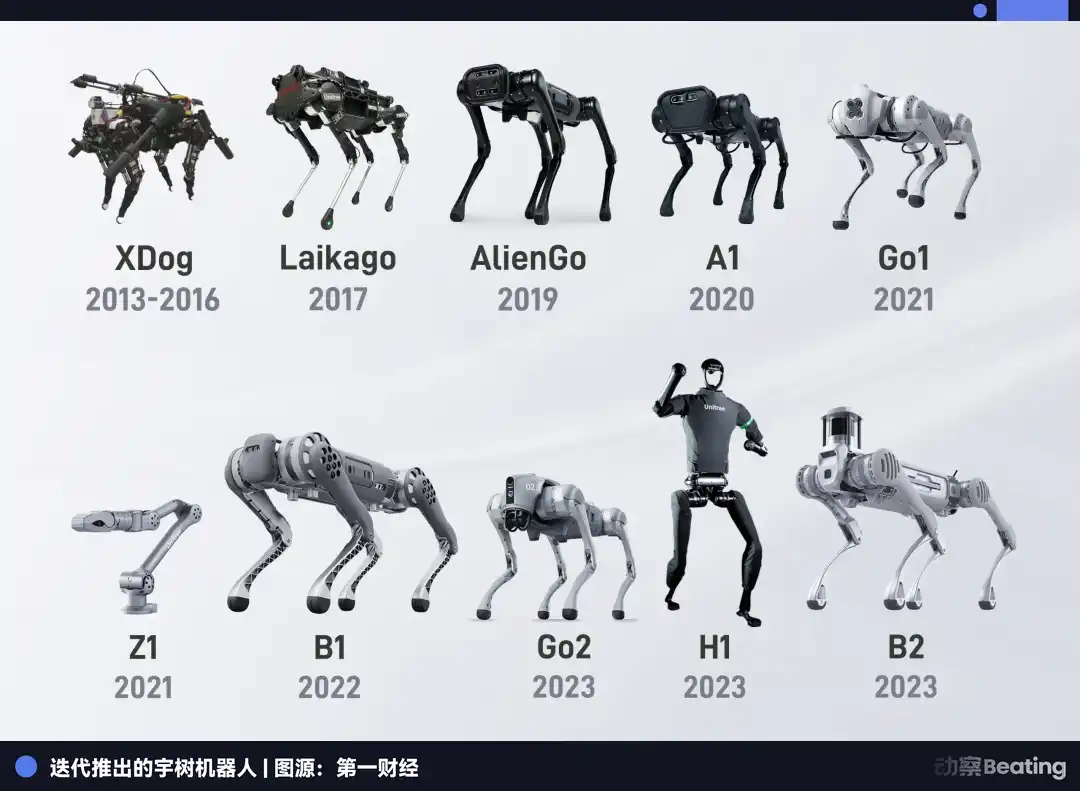
UBTECH's first commercially available robot dog is named Laikago, the Laika Dog.
Laika was the dog sent into space by the Soviet Union in 1957, the first living being on Earth to orbit the planet. A stray dog from the streets of Moscow, it was captured, trained, placed in a satellite, and sent into space. Hours later, it died in the overheated spacecraft.
Wang Xingxing gave this name to his robot dog, "Space Dog," symbolizing humanity's aspiration to explore the unknown. The real dog never returned. The dog he built fell time and time again, was helped back up, had its programming rewritten, and ran again.
In 2017, a journalist from The Paper ran to Hangzhou Binjiang to interview him. 27-year-old Wang Xingxing stood in front of the camera, a little shy and unsure. He was originally wearing a hoodie and sneakers. To respect the camera, he temporarily put on a shirt he had bought online and left unopened for a long time.
The journalist asked him: Given the opportunity to work at Boston Dynamics or start his own business, how would he choose?
He smiled and said, "I won't have this dilemma because my English is poor, so it may not be easy for me to go abroad, so this situation will not happen, and I don't need to consider this issue."
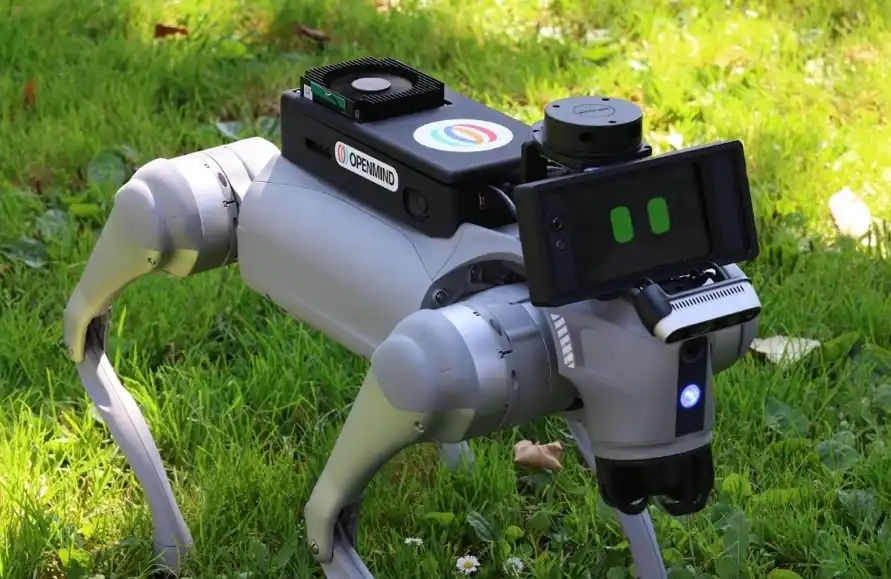
Laikago weighs 22 kilograms, has a peak power of 18 kilowatts, and a power density higher than a typical supercar. Its four legs can fold up to fit in a suitcase.
In 2020, UBTECH had 18 employees, with seventy percent in technical positions. The customer list was divided into two columns: 30 domestic, mostly laboratories of universities and research institutes; 12 overseas, including Google, Nvidia, Apple, and the father of Android, Andy Rubin.
In 2019, Yu Shu had an annual revenue of $11.83 million with a net profit margin of 26.5%. At that time, Boston Dynamics' similar products were rented out monthly for nearly $10,000. Yu Shu's Laika Dog was sold for around $20,000 to $30,000 RMB.
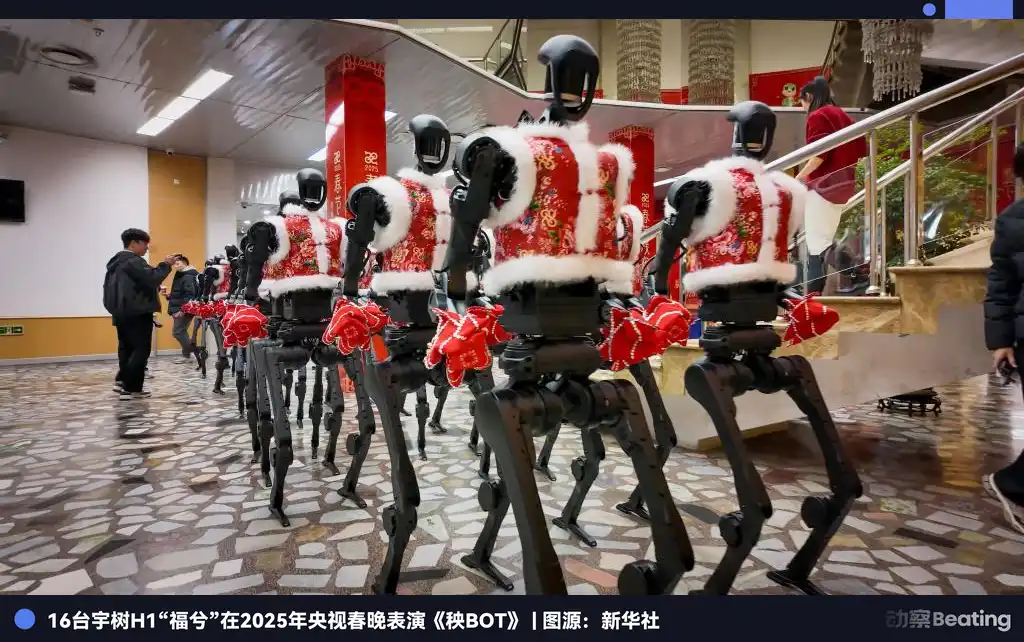
Next was the Spring Festival Gala.
In 2025, robots performed a yangko dance. The program, named "Yangko BOT," was directed by Zhang Yimou. 16 units of H1, Yu Shu's first full-size humanoid robot with two legs, wearing a red floral padded jacket, performed handkerchief tricks alongside 16 dancers from Xinjiang Arts Academy, engaging in a human-robot dance.
The creative idea of the floral padded jacket came from Zhang Yimou. For the performance effect, the team removed all the robot's outer shells, revealing the mechanical skeleton, and then dressed it in the floral padded jacket, a process called "weight loss." They had a stage name, "Fu Xi," a homophone of Fuxi.
The rehearsal took nearly three months. The night the program aired, the "yangko dancing robot" became one of the hottest topics in all of China. Handkerchiefs were thrown up, spinning in the air, falling, then caught again. From the audience's view, it looked like a group of red butterflies circling around. Prior to this, there had never been such a large-scale AI-driven cluster of humanoid robots on live television.
Four years back in time, Yu Shu's robots had also appeared on the Spring Festival Gala. At that time, they were four-legged machine cows named "Ben Ben," performing "Rise of the Cow" with stars like Andy Lau and Wang Yibo. That machine cow was based on the A1 model, the same model as the dog that was fitted into a 20-inch suitcase and taken to Beijing in 2019.
On New Year's Eve 2026, in the opening scene, the model was changed to H2, standing at 1.82 meters tall, all silver-gray. Facing it were a line of Tagou Wushu School students, engaging in a human-robot fight, with perfectly synchronized movements.
Midway through the Drunken Fist routine, one robot fell to the ground, sparking online discussions. Wang Xingxing came out to explain that the fall was part of the director's scripted storyline.
After the release of G1, a video surfaced showing a robot jumping high, getting its legs swept by a person, stumbling, then regaining balance. Zhao Zihao, an engineer involved in developing Mobile ALOHA, warned his peers on his own page, "Silicon Valley can continue to believe that they are the best in software and artificial intelligence until a Chinese hardware startup achieves the best AI-driven motion control in mass-producible humanoid robots."
The robots were becoming increasingly powerful. In early 2026, a training video of H2 showed the robot delivering a flying sidekick, shattering a hanging watermelon with one kick. In the footage, Wang Xingxing standing nearby unconsciously stepped back to dodge.
Outside the lens, the progress of robots has left its mark in another way.
The training ground for Boston Dynamics' robot dog is on the rooftop. The robot dog climbs the stairs from the office every day. After countless climbs and falls, the edges of the steps on those few floors of stairs have been worn down. While someone cleans up the debris, the stairs themselves have not been renovated, just swept clean and used again.
Boston Dynamics has an internal requirement: R&D colleagues must write documents and manuals that can be understood by at least a freshman undergraduate student; for consumer-grade products, they should be user-friendly for middle-aged and elderly users. Wang Xingxing criticizes many engineers' work as "not intended for ordinary people."
Over the years, the price of robots has continuously decreased. The robot dog's price has dropped to just over 9,000 yuan. The humanoid robot G1 was reduced to 99,000 yuan. The R1 further decreased to 39,900 yuan. Some call him the "Price Butcher."
He doesn't particularly like this label, saying, "Actually, I don't think we have reached the level of a 'butcher.'"
In July 2026, Wang Xingxing appeared on the cover of Time magazine. The cover featured big letters stating, "The Era of Robots is Coming."
In the image, his manned mech GD01, nearly 2.7 meters tall, almost filled the entire page. He stood on the right side of the mech, slim, wearing glasses, looking like a footnote. The idea for this mech partly came from movies he watched in his youth, and he admits he took reference from the machine in "Avatar." Initially, he even thought about building a larger robot for boxing matches.
Time described him as slender, bespectacled, lacking the ostentatious arrogance of many tech founders; when discussing robot technology, he exuded a quiet yet resolute belief.
The last Chinese entrepreneur to grace the cover of this magazine was Li Yanhong, 8 years ago.
Trending
During the private enterprise symposium, he was the only entrepreneur representative in his 90s.
The list of shareholders is getting longer: Meituan, Xiaomi, Tencent, Alibaba, ByteDance. Sequoia, Matrix Partners, GGV Capital. On the list for strategic allocation is DeepSeek.
Li Wangfeng made a debut investment of 180 million, with a first-day gain exceeding 1.1 billion. Lei Jun earned 15.2 billion. The Meituan group had a gain of 33.3 billion.
If DJI hadn't exited that year, the shares would be worth 25 billion. The original angel investor who gave him 2 million, Yin Fangming, still has about 280 million at the issue price, an increase of about 140 times.
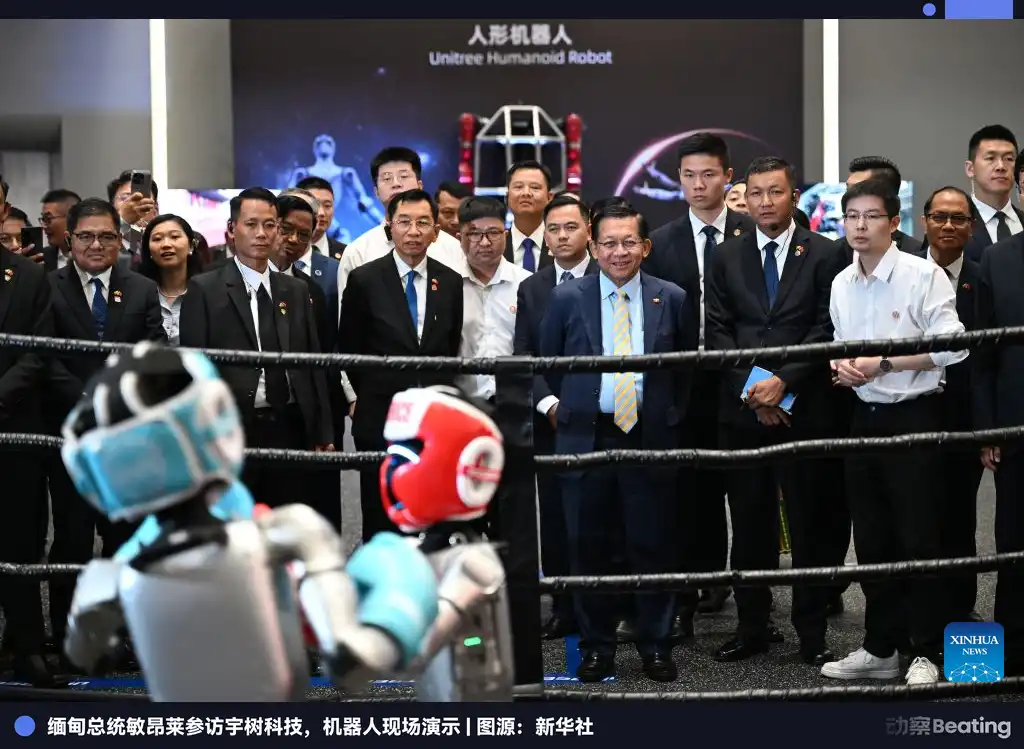
Foreign dignitaries also came. German Chancellor Merkel brought 30 German company executives to visit, watching the Spring Festival Gala's "Warrior BOT." Several months later, Burmese President Min Aung Hlaing made the final stop of his visit to China at Ubtech. In the exhibition hall, a robot picked up a brush and wrote a calligraphy piece, while Wang Xingxing stood beside, explaining.
Machines began to enter the lives of investors as well. Sequoia's Cao Xi placed two Ubtech products at the office entrance: a front desk G1 wearing Monolith overalls and a bow tie, and a robotic cow named "Niubian," a gift from Wang Xingxing after the 2021 Spring Festival Gala. Genesis Capital's Zhu Jia ordered an R1 and waited for nearly half a year. On the day it arrived, the person and the machine shook hands. In the spring of 2025, G1 and the Ice King of Hometown Hotpot stood together at the Meituan Dragon Ball investor conference to welcome guests.
People lined up to meet Wang Xingxing. He said:
"It's too hot, too hot. There are too many people coming to see me, I can't even keep up with the messages."
In an interview with Time magazine, when asked about the flip side of his popularity, he replied:
"Because the hype has been too intense, it has brought considerable pressure to the company and the entire industry. Everyone expects your technology to make a leap at an extremely fast pace. But the fact is, breakthroughs in hardcore technology take time."
Six Hours
On the day of the IPO online roadshow, in less than 2 minutes, over 20 questions flooded the interactive area. For three hours, questions came one after another.
Someone asked, what would the company do if someone inflated your stock price?
Someone compared it to Tesla's Optimus and asked about strategic differences.
Someone said "the robot looks cool," and he replied, "Thank you for the recognition."
Someone applied for a job online and asked if the company's logo needed to be redesigned.
In the live broadcast, he looked a little nervous, like he did many years ago during an interview. The opening speech was very short, less than five minutes.
Three hours passed. The roadshow ended. Wang Xingxing did not leave.
He carefully read through each unanswered question, considered his words, and then responded word by word. He stayed for another three hours.
This was the longest time he had ever spent interacting with others.
He said, "I hope investors buy our stock because they believe in the company's value, not for speculation."
He also mentioned that the embodied intelligence industry is still in its early stages of development, similar to the early days of home computers.
August 19, 2026, STAR Market. Yushu's initial market cap was 61 billion RMB. IPO price was 150.8 RMB. P/E ratio was 219x. The stock opened 629% higher.
With one lot, he made 470,000 RMB.
Wang Xingxing's net worth has exceeded 130 billion RMB.
He likened the IPO to a college entrance exam. Someone who only passed high school English three times is now facing the exam again. During the preparation period, he was not only communicating with investors and regulators but also developing new products. His way of reviewing was still the same—building things.
In an interview on the eve of the IPO, when asked what he saw now, he responded, "At least I see the 'light of dawn' right in front of me."
In February 1988, physicist Feynman passed away at the California Institute of Technology. On the blackboard in his office, there was a line of chalk handwriting:
What I cannot create, I do not understand.
What I cannot create, I do not understand.
In a kindergarten in Yuyao, a child finished a drawing of a butterfly and held it up for the teacher to see. The drawing was there for everyone to see.
On a university lab bench, he placed a robot in front of everyone and let it take two steps on its own.
And it walked.
Later, it learned to run, jump, go up and down stairs, write with a brush, do somersaults, and perform Drunken Fist Kung Fu.
It fell down, but then stood back up again.
Original Article Link
Welcome to join the official BlockBeats community:
Telegram Subscription Group: https://t.me/theblockbeats
Telegram Discussion Group: https://t.me/BlockBeats_App
Official Twitter Account: https://twitter.com/BlockBeatsAsia

 Related Articles