Nomura Bullish on Cosmic Micro: Three-Year Revenue Increases Nearly 8-Fold
TL;DR
· Nomura initiates coverage of Ubtech Robotics with a "Buy" rating and a target price of 370 yuan, about 145% higher than the IPO price of 150.8 yuan, but the report contains inconsistencies in the calculation of market-to-sales ratio, market cap, and per-share price.
· Nomura believes that Ubtech's core strength lies in its in-house design and manufacturing capabilities of high-value hardware such as joints and electronic control, enabling a cycle of low cost, low selling price, and scale delivery.
· Ubtech's humanoid robot revenue has surpassed that of quadruped robots. Nomura expects the company's revenue to increase from 1.699 billion yuan in 2025 to 13.184 billion yuan in 2028, mainly driven by sales volume expansion.
· The company has achieved profitability and positive free cash flow. However, humanoid robot revenue still heavily relies on research institutions, and current shipments do not yet prove that industrial demand has matured.
· The future valuation depends on three variables: repeat purchases from non-affiliated industrial customers, progress in embodiment models and real-world data, and changes in U.S. market access.
Nomura released its initial coverage report on August 19, giving Ubtech Robotics a "Buy" rating and a target price of 370 yuan. Based on the IPO price of 150.8 yuan disclosed by the Shanghai Stock Exchange, the target price is approximately 145% above the IPO price. Ubtech was listed on the Sci-Tech Innovation Board on the same day.
Nomura's bullish thesis can be summarized into one main theme: Ubtech reduces costs through a higher proportion of in-house hardware design and manufacturing, expands shipments at a low price, maintains profits through economies of scale, and accumulates real robot data. Revenue and cash flow from quadruped robots support the R&D and market expansion of humanoid robots.
However, this logic still has a key gap: while Ubtech has proven its ability to manufacture and deliver robots, it has not yet fully demonstrated that industrial customers will continue to make purchases. Research institutions remain the main source of revenue for humanoid robots, and industrial deployment, embodiment models, and repeat orders will determine whether its growth can be sustained.
In-House Hardware Development Lowers Costs, Leading Ubtech to Achieve Mass Production and Profitability First
Nomura believes that Ubtech's most critical competitive advantage is not that all performance parameters are leading in the industry, but the vertical integration capability of core hardware.
Based on the report's scope, Ubtech's humanoid robots have approximately 80% to 90% of materials designed in-house, with about 50% simultaneously designed and produced in-house; externally sourced modules account for about 10% to 20%. Quadruped robots have a design coverage rate of about 90%, with a proportion of about 55% to 60% in in-house design and production.
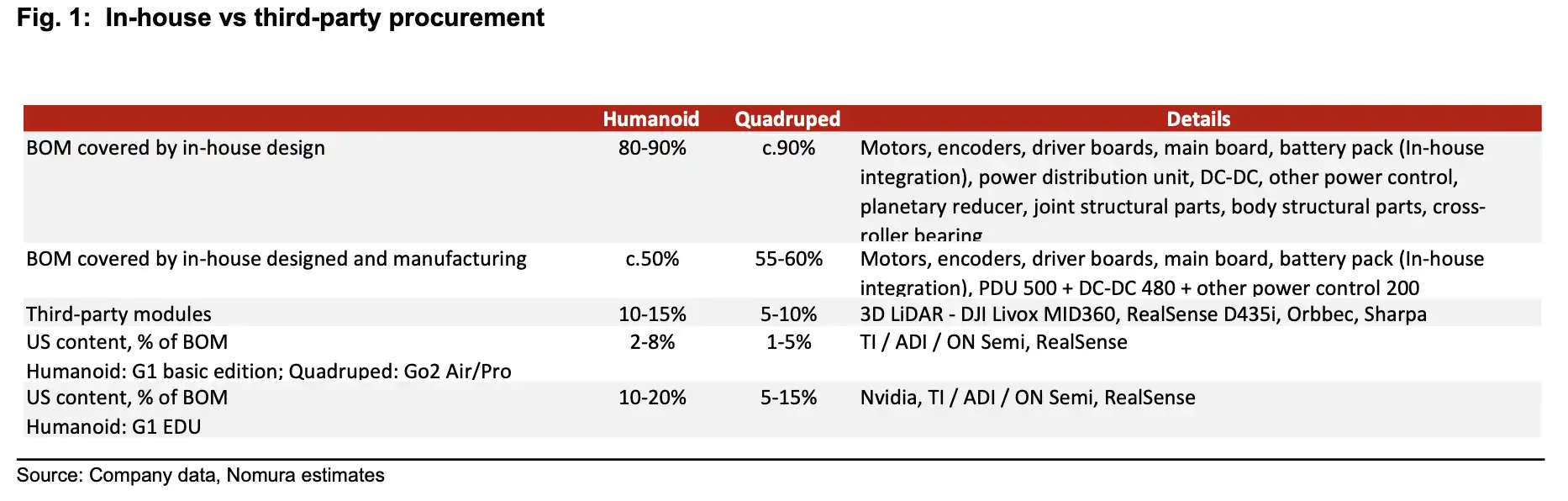
Ratio of in-house developed vs. externally sourced humanoid and quadruped robots. Approximately 80%–90% of the materials for humanoid robots are designed in-house by Ubtech, but the proportion of items that are both designed and produced in-house is about 50%; some educational products have a higher reliance on U.S. suppliers such as Nvidia and Intel.
It is important to differentiate between "in-house design" and "full self-production." Ubtech controls key high-value components such as motors, gearboxes, driver boards, encoders, and power management, and has also introduced a self-developed lidar product, but some robots still use third-party sensors like DJI Livox and Intel RealSense.
For example, with the G1 humanoid robot, Nomura estimates its material cost to be around 41,600 yuan, with the total cost of the large and small joint modules accounting for over 66%. Ubtech has more control over the highest-cost joint system internally, enabling them to actively reduce the overall machine price: the price of the consumer-grade Go2 quadruped robot has dropped to below 10,000 yuan, the starting price for the R1 humanoid robot is 29,900 yuan, and the launch price of the H2 is around 199,000 yuan.
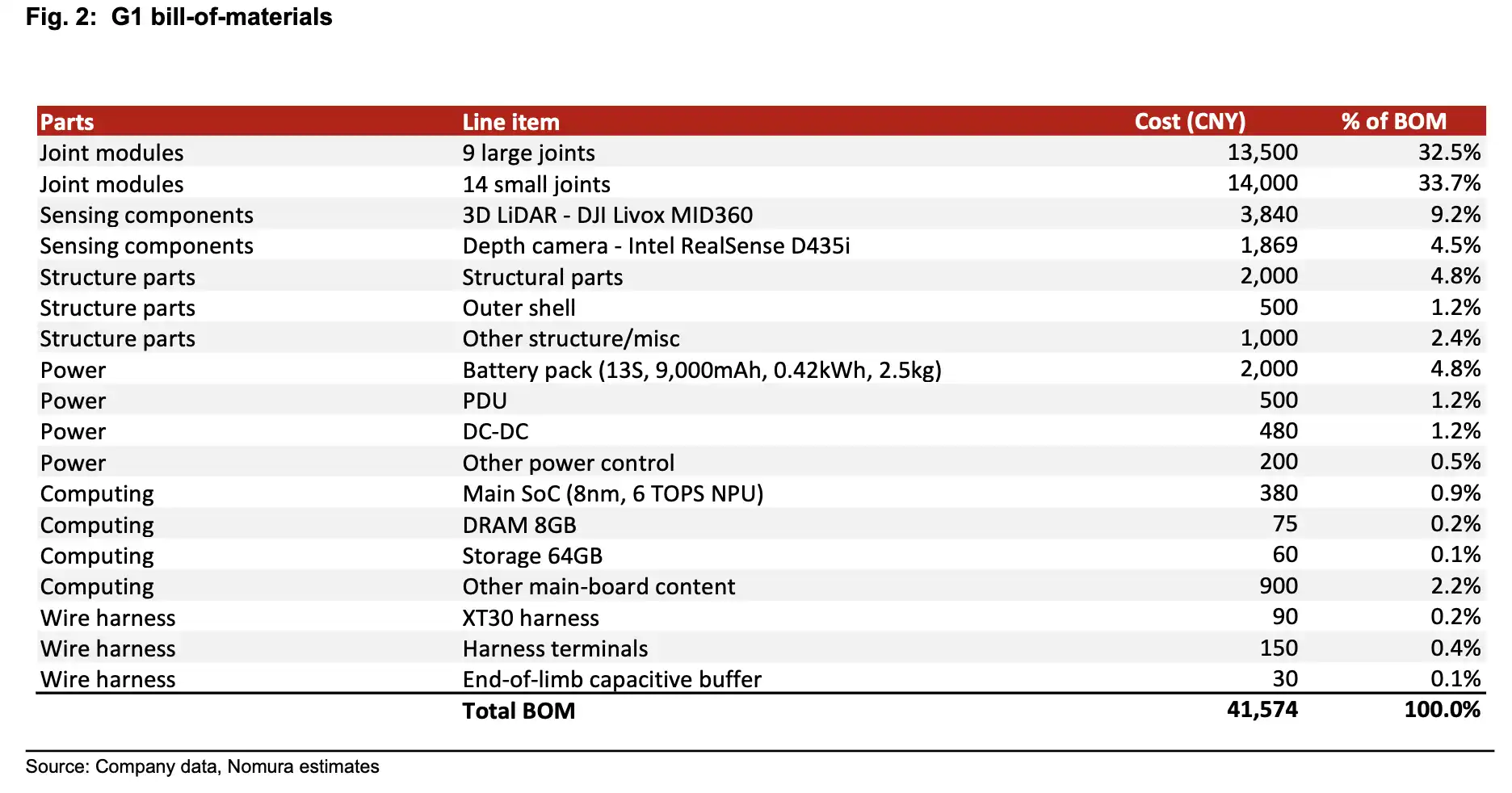
Cost breakdown of G1 humanoid robot materials. Nomura estimates the total material cost of the G1 to be around 41,600 yuan, with the large and small joint modules totaling about 27,500 yuan, accounting for approximately 66.2% of the total cost, making it the main cost driver of the entire machine.
The price decline has not immediately undermined the company's overall profitability. Ubtech's main business gross margin has increased from about 44% in 2022 to 60.1% in 2025. The report provides two different statements regarding the 2025 gross margin of humanoid robots, 63.2% and 66.9%, both of which lead to the same conclusion: despite the decrease in average selling price, the gross margin of this business segment still exceeds 60%.
Humanoid Robots Take Over from Quadruped Robots, Growth Bet on "Price Reduction for Volume Increase"
Ubtech's revenue structure has completed a transition in just two years.
The company's revenue increased from 159 million yuan in 2023 to 393 million yuan in 2024, further reaching 1.699 billion yuan in 2025, representing a compound annual growth rate of approximately 227% over two years.
Specifically, revenue from humanoid robots increased from about 300,000 yuan in 2023 to 868 million yuan in 2025, accounting for 51.8% of the main business revenue in 2025, surpassing quadruped robots at 41.6% to become the largest business segment. Robot component revenue is around 104 million yuan, accounting for 6.2%.
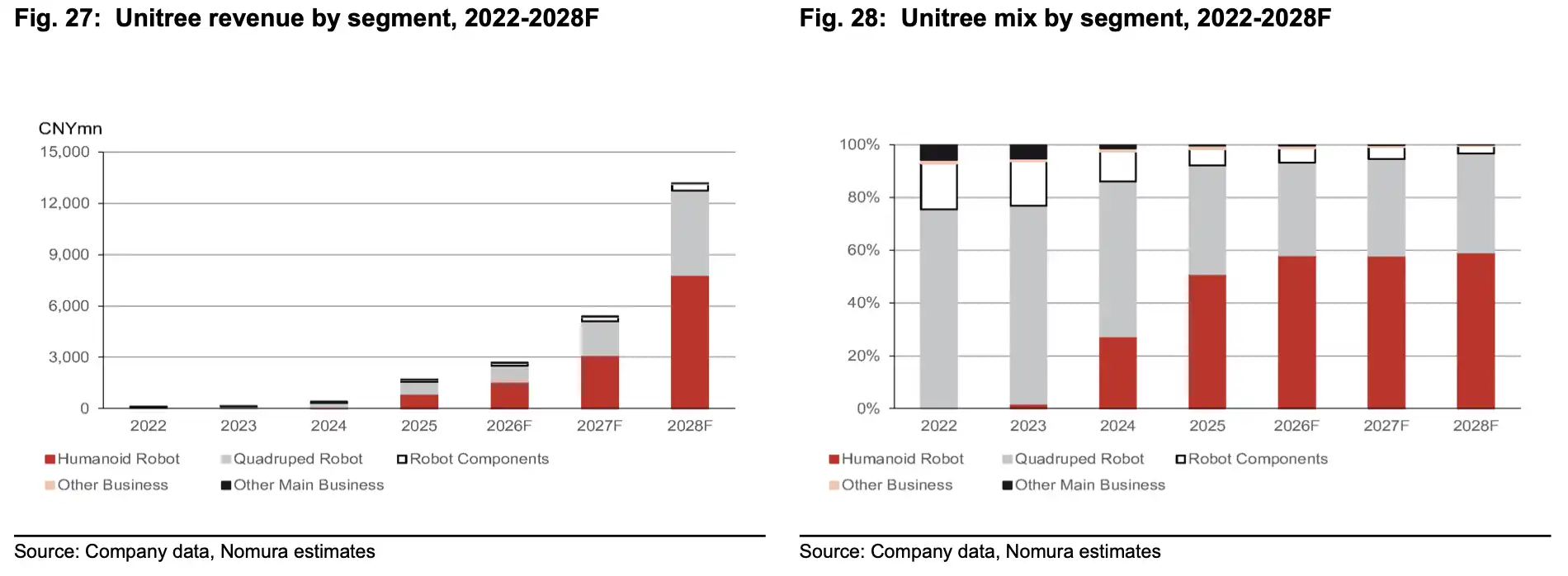
Yutree's Business Revenue and Income Structure, 2022-2028. By 2025, humanoid robots will surpass quadruped robots to become Yutree's largest revenue source; according to Nomura's forecast, the additional revenue from 2026 to 2028 will also be mainly contributed by humanoid robots. The data after 2026 is Nomura's forecast, not the company's guidance.
The growth is mainly driven by sales volume rather than price. Financial analysis reports that Yutree sold 5,215 humanoid robots in 2025, up from 412 in 2024; the average selling price decreased from 260,400 RMB to 166,400 RMB. The report also cited the prospectus stating that the company shipped over 5,500 humanoid robots in 2025. It is important to note that sales volume and shipments are different and should not be directly mixed.
Nomura predicts that Yutree's humanoid robot shipments will reach 15,600 units, 39,100 units, and 115,000 units in 2026, 2027, and 2028, respectively; with an estimated average selling price decline of 40%, 20%, and 15% during the same period.
Under this assumption, Nomura expects the company's revenue to reach 2.687 billion RMB, 5.396 billion RMB, and 13.184 billion RMB in 2026, 2027, and 2028, respectively, with year-on-year growth of 58%, 101%, and 144%. The 2028 revenue is about 7.8 times that of 2025, and the growth highly depends on shipment volume.
Capacity is a key assumption supporting this forecast. The prospectus shows that the company plans to invest around 624 million RMB in building a production base, and Nomura expects the additional capacity to be released starting in 2027. If factory construction, supply chain, or order growth falls short of expectations, the sales volume forecast for 2027 and 2028 will need to be revised accordingly.
Yutree currently has some internal financing capabilities. In 2025, the company's net profit attributable to equity holders was 278 million RMB; after deducting approximately 349 million RMB of share-based payment expenses, the adjusted net profit reported was 591 million RMB. During the same period, operating cash flow reached 670 million RMB, capital expenditures were about 50.4 million RMB, free cash flow was approximately 620 million RMB, and cash at the end of the year was about 1.419 billion RMB.
However, increased investment has started to impact short-term profits. In the first quarter of 2026, Yutree's revenue increased by 68.5% year-on-year, but the adjusted net profit decreased by 52.6% year-on-year. Nomura attributes this to the rise in research and development and sales expenses, implying that the company will need to rebalance between growth, algorithm investment, and profit margin in the next phase.
Shipping Proof Validates Manufacturing Capacity, Industrial Repurchase Is Demand Validation
Nomura is optimistic about Yushu, but more cautious about the maturity of the humanoid robot industry's demand.
According to its industry research, the humanoid robot industry's shipment volume in 2026 is estimated to be around 45,000 to 50,000 units, lower than the narrative of about 100,000 units. The demand is expected to mainly come from entertainment and performance, consumer, government procurement, and education, with industrial and commercial scenarios accounting for only about 5%.
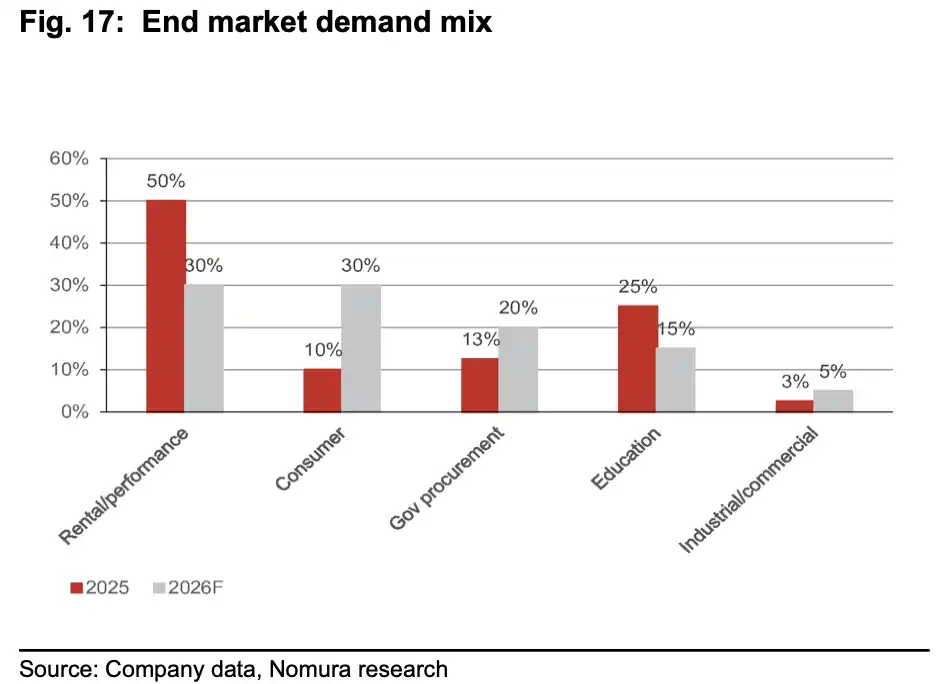
Humanoid Robot End Demand Structure, 2025–2026. According to Nomura's industry research, in 2026, entertainment and performance, consumer, government procurement, and education are still expected to account for the vast majority of demand, with industrial and commercial scenarios expected to represent only about 5%. This chart follows Nomura's research and forecasting methodology and is not based on official industry statistics.
This structure indicates that the current humanoid robot industry is closer to a supply-side mass production inflection point rather than a demand-side full-scale breakout. Manufacturers are already able to mass produce robots, but many orders still come from research, exhibitions, government projects, data collection factories, or enterprise pilots, and have not yet entered stable production operational budgets.
Yushu also faces a demand concentration issue. The report shows that in the first three quarters of 2025, 73.6% of humanoid robot revenue came from universities and research institutions. The research market can support early product iterations but may not necessarily be able to sustain shipments at the hundred-thousand-unit level in the long term.
When industrial customers purchase robots, they are more concerned about mean time between failures, production cycle time, and return on investment. At this stage, many robot projects are still part of pilot budgets rather than daily operating expenses replacing labor. Therefore, the true sign of industry demand maturation is not the manufacturer's announcement of reaching a certain production volume, but non-related industrial customers starting to form repeat orders paid for by operational budgets.
The competitive focus is also shifting from motion capabilities to embodiment models and data. Nomura estimates that the industry's demand for high-quality physical interaction data in 2026 is about 10 million hours, while the global high-quality stock is only about 500,000 hours. This number comes from the report's industry research and estimation and is not based on official industry statistics.
Yushu's larger fleet of in-service robots helps accumulate real data. The company is advancing WVLA 2.0 and the industrial-grade model UnifoLM-X1-0, with the latter already being tested in the internal motor assembly process. However, model development also requires more algorithm talent, data, and computing power investment, which may continue to drive up cost rates.
¥370 Target Price Includes High-Growth Premium, but Report Valuation Arithmetic Not Fully Closed
Nomura has set a price target of $370 for Ubiquitous Energy, stating that it is based on a 25x multiple of the 2027 projected P/S ratio, which is higher than the average level of about 9 to 10 times for comparable Chinese robotics companies. The report believes that Ubiquitous Energy can command a premium due to factors such as leading shipments, faster revenue growth, existing profitability, and a more focused business on complete robots.
However, there are significant inconsistencies in the valuation calculation in the report.
Based on Nomura's projected revenue of ¥5.396 billion for 2027, a 25x P/S ratio corresponds to a market value of about ¥134.9 billion; based on approximately 404.46 million shares outstanding post-IPO, this translates to a price per share of about ¥334. The $370 price target, on the other hand, corresponds to a market value of about ¥149.6 billion and a P/S ratio of approximately 27.7x for 2027.
Therefore, while $370 is the formal price target given in the Nomura report, the "25x 2027 P/S ratio" cannot be directly recalculated based on the simultaneously disclosed revenue and post-IPO share capital. Unless Nomura has undisclosed share capital or valuation adjustment criteria, this difference needs further explanation.
Another risk is access to the U.S. market. In July 28, 2026, the FCC included foreign-produced advanced robotic equipment on the Covered List. According to the report and company disclosures, authorized models such as G1, H2, R1, Go2, B2, and A2 can still be sold in the United States, while new models may not receive equipment authorization.
However, existing authorization does not guarantee permanent exemption. Subsequent FCC proposals involve a more streamlined authorization revocation process and a potential 10-year timeframe, with final rules subject to change. In 2025, the U.S. market accounted for approximately 13.3% of Ubiquitous Energy's total revenue, and overseas revenue accounted for about 43.7% of core business revenue. The ability of future overseas expansion to rely more on markets outside the U.S. is worth monitoring.
Overall, Ubiquitous Energy has demonstrated cost reduction in hardware, mass delivery capability, and profitability. Nomura is further betting on a significant increase in sales volume from 2027 to 2028. The most critical observation variables going forward are whether new production capacity can be released on time, whether non-affiliated industrial customers can generate repeat purchases, and whether the embodied model can transform low-cost "bodies" into production tools that create economic value.
Welcome to join the official BlockBeats community:
Telegram Subscription Group: https://t.me/theblockbeats
Telegram Discussion Group: https://t.me/BlockBeats_App
Official Twitter Account: https://twitter.com/BlockBeatsAsia