Institutional Insight on Gold Price: $4,000 Sustains Support, Has Gold Bottomed Out?

TL;DR
· State Street maintains $5000 gold price target for early 2027, despite a 11.7% drop in spot gold price in June.
· Central bank gold purchases, global debt pressure, and physical demand from China are the key supports for the bullish view in the report.
· Expectations of Fed rate hikes, rising real yields, and ETF redemptions could lead to gold price oscillating in the $4000-4750 range initially.
State Street Investment Management, in its July "Monthly Gold Monitor," maintains its target of $5000 per ounce for early 2027, even as gold fell 11.7% in June and tested support near $4000 per ounce multiple times.
This view does not imply that gold is without the risk of a pullback. In June, silver fell by 22.2%, Bitcoin by 20.4%, and U.S.-listed gold ETFs saw net outflows of approximately $5.3 billion for the month. The interest rate front is also turning against gold, with the U.S. OIS curve pricing in about 1.5 rate hikes by 2026, whereas back in February, the market was betting on 2-3 rate cuts.
However, from an institutional standpoint, the sharp decline has not altered the most critical buying structures for gold over the past few years: central banks continue to accumulate, fiscal and debt pressures are still on the rise, and Chinese and Asia-Pacific demand is still absorbing some outflows from the West. In the base case scenario, there is still a 70% probability that the gold price will rise to the $4750-5500 range in the next 6-9 months. The probability of a more conservative oscillation scenario has been raised to 25%, corresponding to $4000-4750.
$4000 Might Not Be the Bottom, Western Funds Still Retreating
$4000 is now more than just a psychological barrier. It is simultaneously being tested from a technical, ETF fund flow, and rate expectation perspective.
Following the significant drop in gold price in June, U.S.-listed gold ETFs saw net redemptions of around $5.3 billion. After North American investors poured in a record $11.5 billion in January-February, they have liquidated $18.7 billion in the past four months, indicating a waning patience of Western funds with high gold prices.
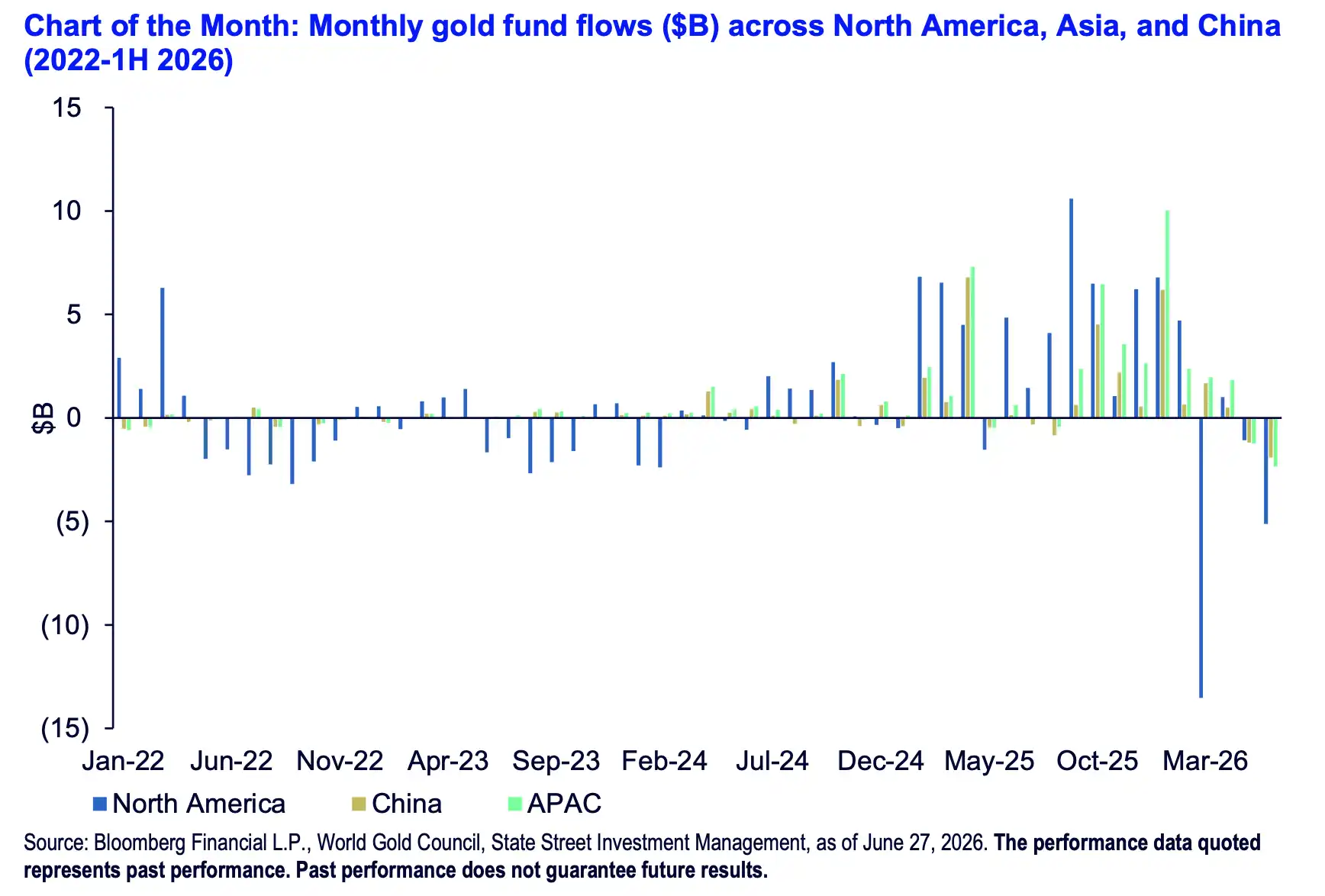
Monthly fund flows for gold funds in North America, Asia, and China; North America has seen net outflows of $18.7 billion in the past four months, China has had net inflows of $5.9 billion year-to-date, and the Asia-Pacific region has had net purchases of around $12.6 billion in the first half of the year.
Interest rate pressure is more direct. Rising real yields and a stronger dollar will increase the opportunity cost of holding gold. The report also notes that the assets of money market funds have risen to $7.9 trillion, making cash itself more attractive.
This is also why State Street did not shy away from short-term downside. It has placed strong support for the gold price in the $3750-$4000 range and raised the probability of a $4000-$4750 price range oscillation to 25%. U.S. Bank technical analyst Paul Ciana has also suggested recently that the gold price may still test support around $3600, but the dip may provide a staggered buying opportunity for medium- to long-term investors.
Can $5000 be achieved? It all depends on central bank buying
The most stable buying support for gold bulls still comes from central banks.
World Gold Council data shows that in the first quarter of 2026, global central banks net purchased 244 tons of gold. State Street stated that this scale increased by 17% quarter-on-quarter, 3% year-on-year, and was 8% above the five-year quarterly average. It is expected that the full-year net gold purchases by central banks in 2026 will be between 680-820 tons, with a baseline forecast of 765 tons. If achieved, this will mark the 17th consecutive year of net purchases since the global financial crisis.
This kind of demand may not drive the gold price up every day, but it will provide a more stable bottom buying support for the market. Central bank gold buying is usually not for short-term trading but for reserve asset adjustments, aiming to reduce reliance on the U.S. dollar and U.S. debt and to increase holdings of an asset not dependent on the credit of the issuer.
The World Gold Council's 2026 Central Bank Gold Reserves Survey also reinforces this point. Among the surveyed central banks, 89% expect global gold reserves to increase in the next 12 months, 45% expect holdings to increase at their institutions, 84% expect gold to account for a higher proportion of total reserves within 5 years, and 74% expect a decrease in the share of U.S. dollar reserves.
Specific buyers are still in action. The report states that Poland purchased 14 tons in April, totaling 45 tons so far this year. The People's Bank of China increased holdings by 10 tons to 2332 tons as of May, marking 19 consecutive months of gold purchases.
The macro backdrop has not eased either. In the first half of 2026, global debt rose to $353 trillion, with government debt accounting for close to a third. As long as fiscal deficits, inflationary impulses, and the need for reserve diversification coexist, the demand for gold as a currency hedge tool is unlikely to dissipate due to a single pullback.
Gold Rises to Reserve Core as U.S. Treasury Status Slips
A longer-term shift is coming from within official reserve assets.
Citing estimates from the European Central Bank, State Street projects that by the end of 2025, gold's share of global official reserves will rise to around 27%, surpassing U.S. Treasuries for the first time at 22%. By 2026, this percentage will further approach 28%, while the U.S. dollar reserve share will drop to about 40%.
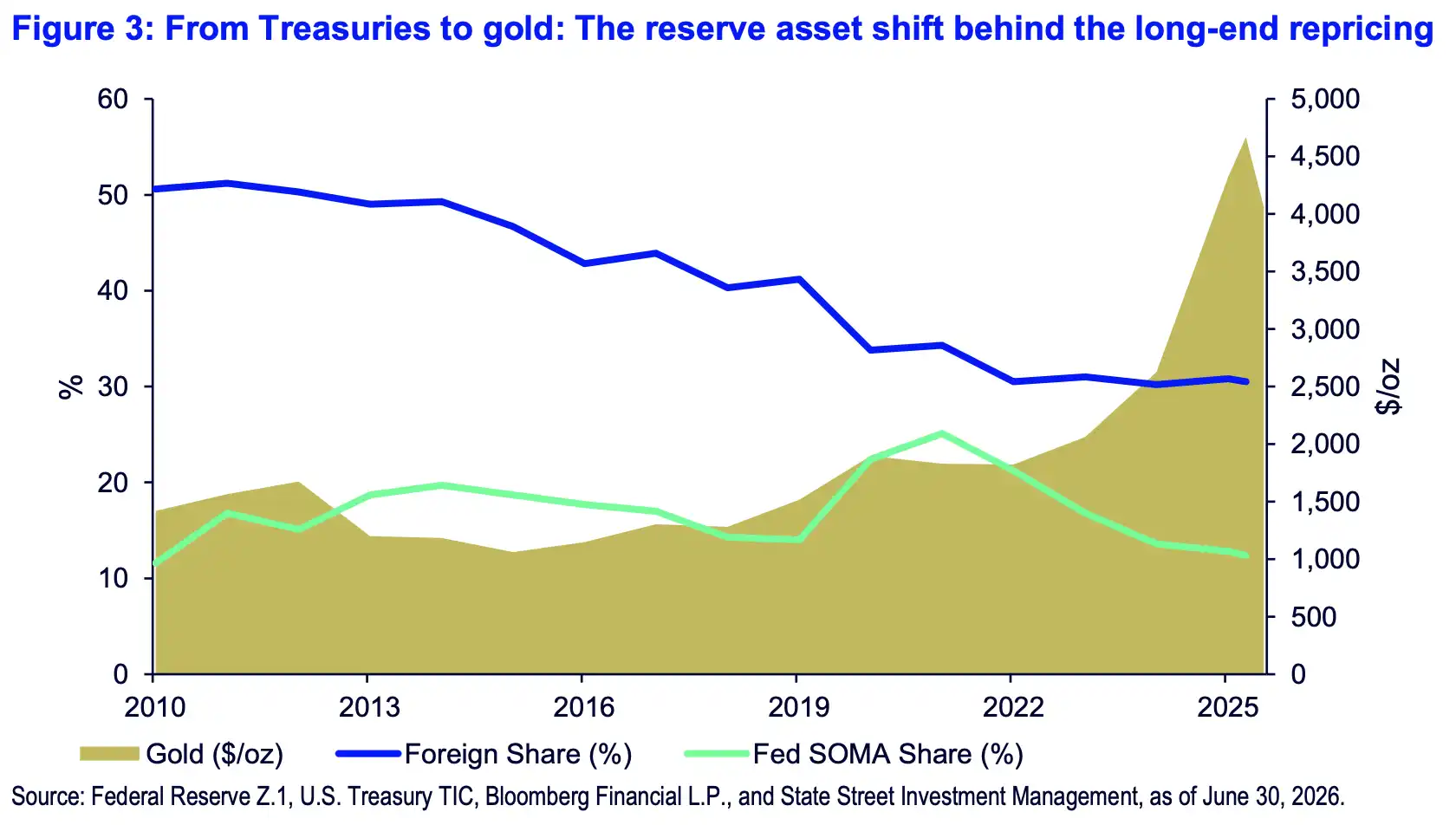
Reserve assets shifting from U.S. Treasuries to gold; gold's share of reserves rose to 27% from 2010 to 2025, surpassing U.S. Treasuries for the first time at 22%, and foreign holdings of U.S. Treasuries decreased from about 50% to 31%.
This shift has a dual impact on the gold price.
First, central bank gold purchases mean that gold demand is no longer solely reliant on individual investors and ETF inflows. When Western fund outflows occur, official buying and Asian physical demand can cushion the pace of the decline.
Second, there has been a change in the U.S. Treasury buyer structure. Foreign holdings of U.S. Treasuries decreased from about 50% to 31%, while the Federal Reserve's SOMA holdings shrank from a peak of 25% in 2021 to 13%. With the U.S. debt continuing to expand and traditional external buyers relatively declining, reserve managers are more motivated to reallocate some assets to gold.
This is also the key logic behind the $5000 target. The gold price is not just being driven higher by safe-haven sentiment but is collectively supported by the global reserve structure, debt pressure, and central bank allocation.
China's Demand Can Only Provide a Floor, Rebound Awaits ETF Inflows
In addition to central banks, China's physical demand and regional fund flows are another pillar of support.
Reports indicate that China's non-monetary gold imports reached 160 tons in April, a 25% year-on-year increase. In May, it reached 163 tons, up 63% year-on-year. In June, the average premium of the Chinese local gold price was 1.0%, the highest level since April 2025.
This suggests that even as global gold prices pull back, the Chinese domestic market has not completely weakened. A rising premium usually corresponds to stronger local buying interest, indicating ongoing import demand support.
Fund flows are also markedly divergent. North American funds are exiting gold funds, but China has seen net inflows of $5.9 billion year-to-date, with the Asia Pacific region witnessing net purchases of around $12.6 billion in the first half of the year. Asian outflows of about $3.6 billion in May-June were observed, but with local premiums rising, there is still room for fund inflows in the second half of the year.
The boundary is still here. Physical demand strength does not guarantee continuous inflow of ETF funds. A rising local premium does not immediately translate to a rebound in the international gold price. For the $5000 target, the key question is whether Chinese physical demand can continue to be converted into fund purchases and whether Western ETF redemptions will stop expanding.
Long-Term Bullish Thesis Unchanged, High Rates Initially Suppressing Upside Momentum
Gold is now facing a situation where long-term buying interest has not disappeared, but short-term holding costs are rising.
If the Fed's rate hike expectations continue to increase, real yields keep rising, the dollar remains strong, gold will find it challenging to immediately break free from the pressure around $4000. State Street has raised the probability of a $4000-$4750 range-bound scenario to 25%, acknowledging this resistance level.
The base case scenario remains at $4750-$5500 with a 70% probability. The probability of an extreme bull market scenario has decreased to 5%, corresponding to $5500-$6250. The $5000 target is still in sight, but the upward movement is more likely to involve a period of consolidation and recovery, rather than a unilateral surge.
The most realistic risk of this pullback is that Western gold ETF redemptions continue to expand, while the dollar and real yields suppress gold valuation. If these pressures do not ease, even with central bank and Chinese buying support, the gold price may need to digest the sharp drop in June within a wider range first.
Welcome to join the official BlockBeats community:
Telegram Subscription Group: https://t.me/theblockbeats
Telegram Discussion Group: https://t.me/BlockBeats_App
Official Twitter Account: https://twitter.com/BlockBeatsAsia