$868 Leveraged $500M Scale MicrStrategy Contract Market, Hyperliquid Needle Insertion Truth

Under thin liquidity, actual trades may not reflect accurate prices.
In the early morning of July 28, 2026, in a thinly traded South Korean pre-market, only one share of SK Hynix was transacted at 1,272,000 Korean Won, approximately $868. This sub-$900 trade was subsequently brought into TradeXYZ's pricing system, causing the SKHX perpetual contract to plummet from $1,128.2 to $927 within one minute.
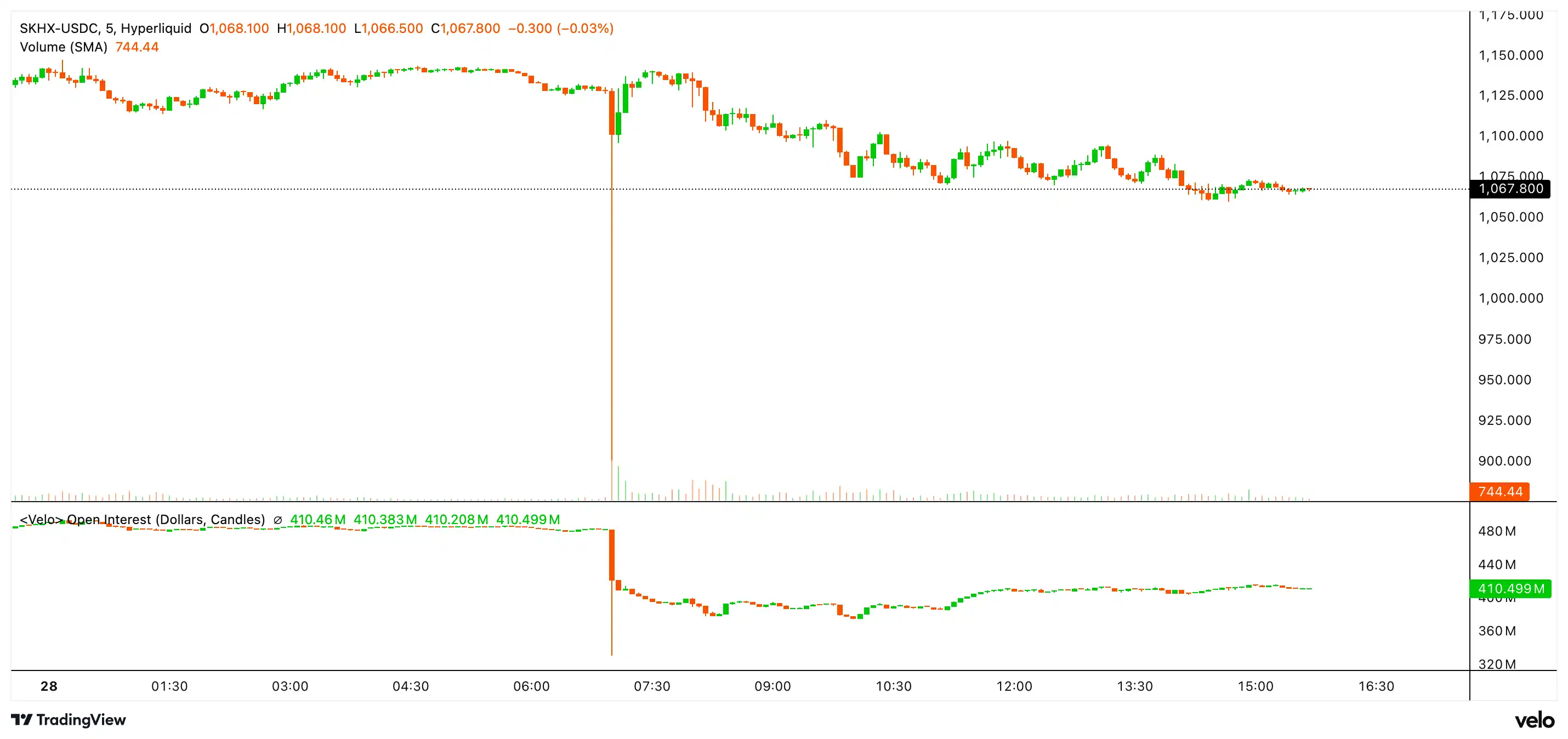
In less than three minutes, hundreds of accounts were liquidated by the system. Over the next four hours, the liquidation size expanded to around $80 million.
A mere $868 triggered the liquidation of a $500 million Hyperliquid Hynix perpetual contract market.
South Korean Pre-Market Pricing
The event originated on Nextrade, an alternative trading system outside of the KRX known as NXT.
NXT's pre-market adopts a continuous auction. When the bid exceeds the ask, the order is immediately filled. It does not deviate from South Korean stock circuit breakers, with price limits based on the previous KRX closing price, fluctuating approximately 30%.
SK Hynix's prior day's closing price was around 1,816,000 Korean Won. After a 30% downward adjustment and considering South Korea's minimum tick size, 1,272,000 Korean Won fell right around the legal lower price limit.
This trade did not violate market rules. The issue lay in the order book depth: NXT's pre-market buy orders were thin, causing a single low-priced sell order to only fill one share and drive the last transaction price to the lower limit.
Source: @yourquantguy
Whether the seller mistakenly placed the order, intentionally pressured the price, or genuinely wanted to sell at that price, there is currently no evidence to confirm. For subsequent settlements, subjective intent becomes less critical. It was a genuine trade and fell within an acceptable price range, so external market systems had justification to acknowledge it.
The danger begins from here.
Transmission Chain of Mispricing
According to TradeXYZ's official documentation, SKHX tracks the USD value of one share of SK Hynix common stock. The calculation is straightforward: dividing the price of 000660.KS by the USDKRW exchange rate yields SKHX's oracle price.
TradeXYZ has divided the South Korean stock into an external oracle price feed and an internal pricing period. The period from 8:00 to 8:50 a.m. Korea time belongs to the pre-market external pricing period, corresponding to 7:00 to 7:50 a.m. Beijing time. This means that as soon as NXT starts pre-market trading, TradeXYZ obtains an executable quote from an institutional data provider and uses it as the external price input.
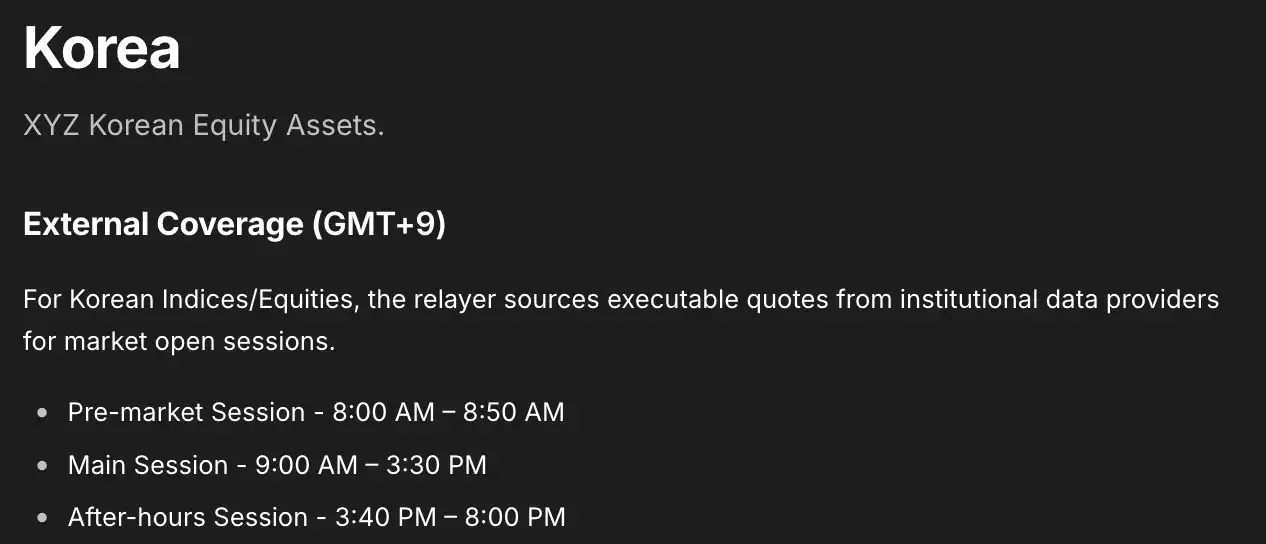
Before 7:00 a.m. Beijing time, SKHX is still in the internal pricing stage, and the oracle mainly adjusts based on TradeXYZ's own order book's impact price. At exactly 7:00 a.m., external data resumes, and the oracle will revert to the external price on the next update.
This transition coincided with a single-stock trade at $868.
According to on-chain records, at 07:00:21.678, TradeXYZ's "Oracle Update Component" submitted an update to HyperCore: SKHX's external price was $868.17, the oracle price was $908.21, and the two "Mark Price Components" were $921.96 and $954.98, respectively.

The "Mark Price" is the price that TradeXYZ presents to users and actually uses. TradeXYZ takes the median of three figures: the oracle price; the oracle price plus a 150-second EMA of the deviation of the perpetual contract's mid-price from the oracle; and the median of the best bid price, best ask price, and last trade price on the order book.
This design incorporates a time-smoothing mechanism with TradeXYZ's order book, which can delay abnormal price transmission. However, it did not anticipate the hidden risk: the external pricing may also rely on a market with inadequate liquidity.
In the first minute of 07:00, SKHX opened at $1,128.2, dropped to a low of $927, with a contract trading volume of 40,978 (lots) and a total of 7,501 trades. The internal pricing period, meant to limit price discovery within a ±10% boundary, did not prevent this decline, as external pricing had already recovered, and the system's reference anchor switched to the new external price.
Settlement from Traders to System Accounts
Settlement figures need to be split into two streams.
According to HyperInsight's on-chain address-by-address analysis, the nominal amount of SKHX settled in a short period was approximately $79.398 million, with the open interest dropping from $481 million to $331 million, a decrease of around $150 million. The top three addresses on the settlement leaderboard were collectively settled at $14.7754 million, with the largest loss of approximately $3.957 million incurred by the address starting with 0x320, realizing a loss of about $2.045 million.
In this settlement, approximately $26.26 million flowed to a special address: 0x4000000000000000000000000000000000000001.
From 07:00:21 to 07:00:48, it took over 406 long positions, totaling 27,098.687 SKHX contract units, with a weighted average price of around $969.05.
The liquidation process usually starts by submitting the forced liquidation orders to the order book. If the market buyers can absorb the sell orders, positions are closed in the open market; if the order book cannot be cleared immediately, the account's margin deteriorates further, and the system must transfer the remaining position out. 0x400...0001 acted as the backstop taker and liquidation intermediary in this event.
It passively became a long.
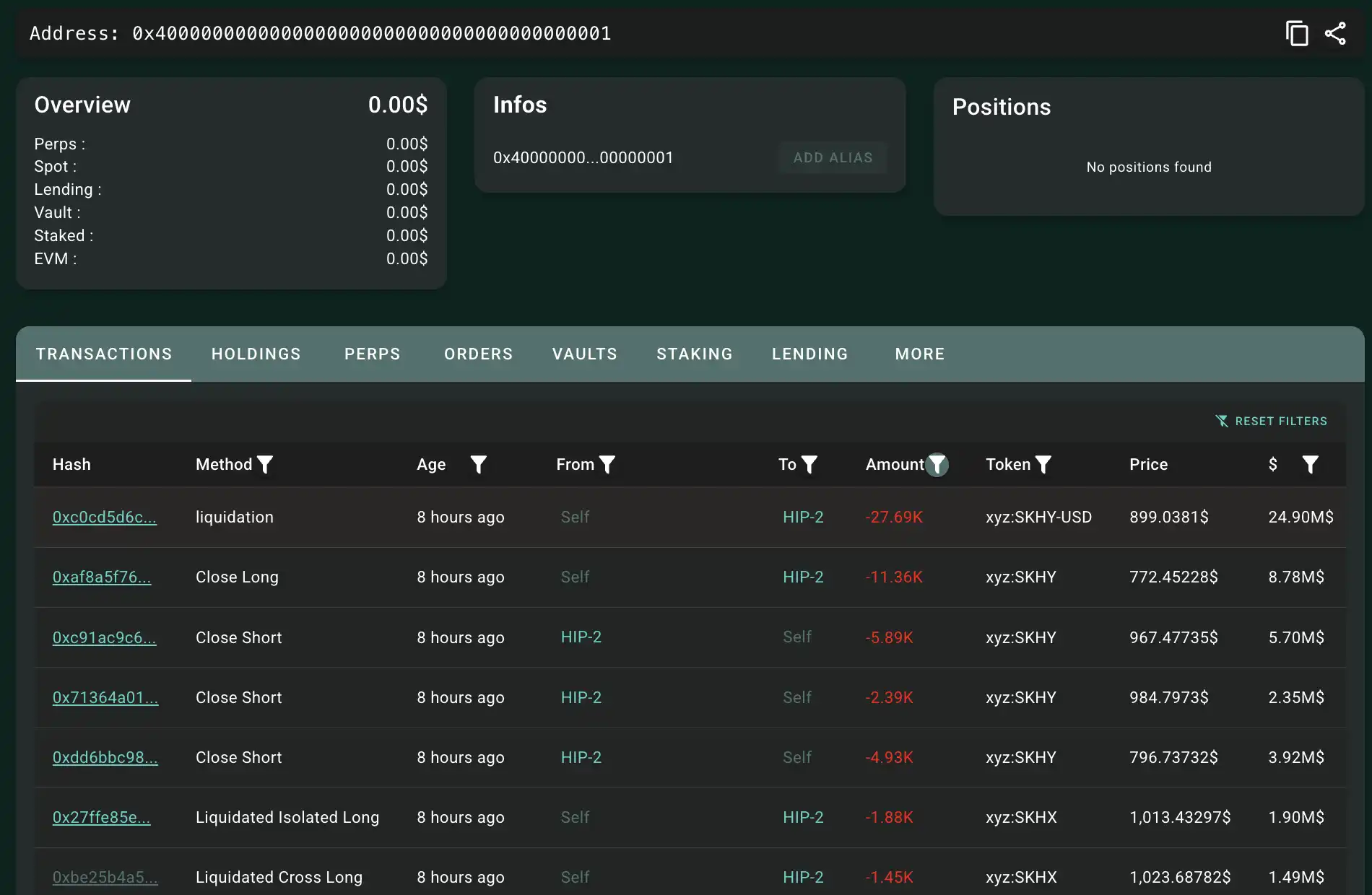
The takeover did not eliminate the risk. As the price continued to decline, on-chain records began to list 0x400...0001 itself as a liquidated account. This address had a total of 26,560.549 long positions entering the next wave of liquidation, corresponding to a notional value of around $24.7374 million, resulting in a realized loss of $1.001 million.
There is also a documentation issue. TradeXYZ's public page still states that the XYZ asset is not protected by the HLP Liquidator Vault and currently has no backstop liquidator; however, the actual on-chain data marks these positions as backstop. Therefore, 0x400...0001 cannot be directly equated with the HLP vault. A more cautious definition is that it is the system's backstop account that HyperCore invoked in this SKHX event. The public documentation has not yet explained the relationship between this current process and the old instructions.
Binance Skips an Hour of External Pricing, Escapes This Time
The same Korean spot trade also affected Binance's SK Helios Perpetual Contract, but with much less impact.
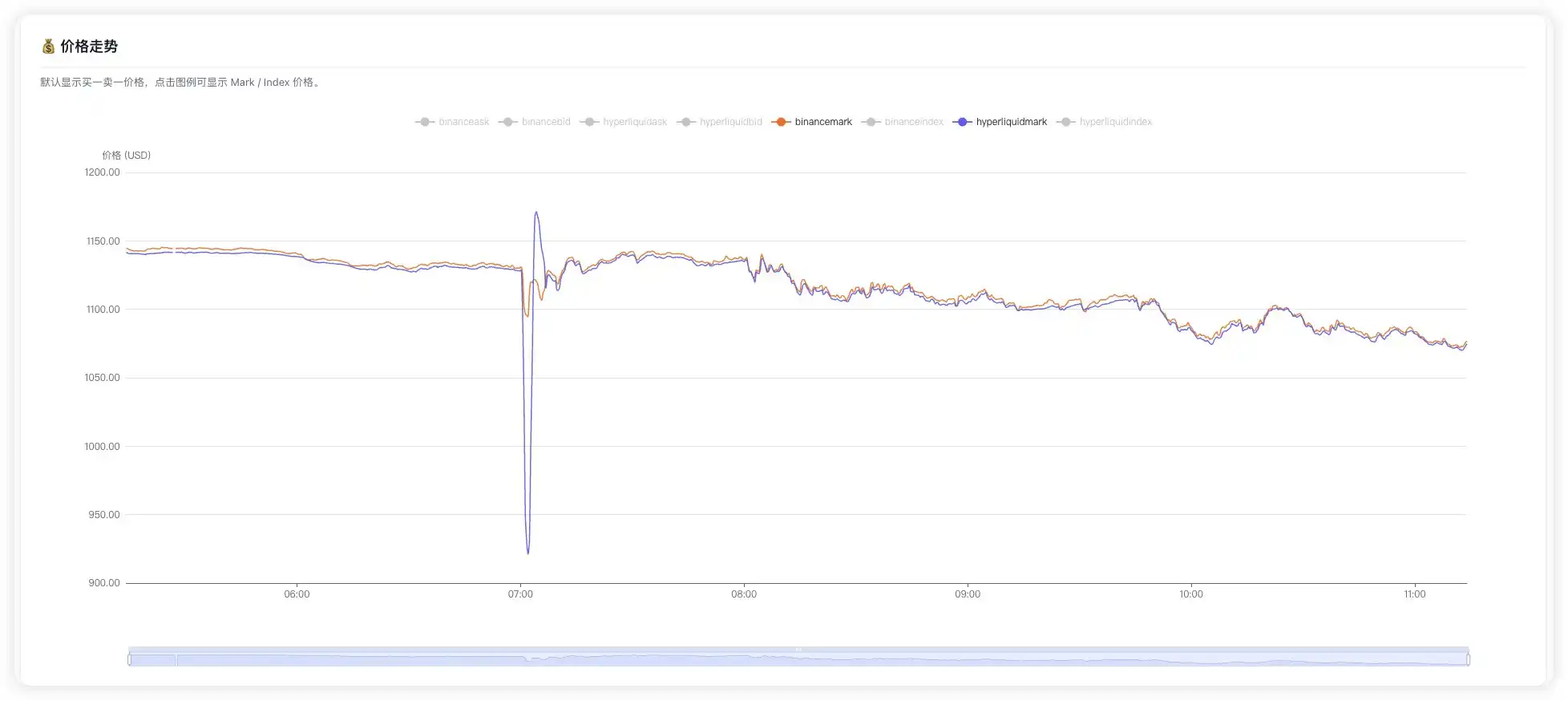
High-frequency trader Boywus made a direct comparison between the two mechanisms: at 7 a.m. Beijing time, TradeXYZ on Hyperliquid had already accessed the Korean pre-market external quote; Binance was still in the internal pricing phase at this time and only switched to external pricing around the opening of the Korean main market at 8 a.m.
Binance's official documentation states that the stock perpetual contract uses order book impact mid-price when external markets are closed and uses EWMA smoothing, with the aim of reducing opening slippage and liquidation risks during low liquidity periods. In the first minute at 7 a.m., the SKHYNIXUSDT index only dropped from $1,132.49 to $1,130.66;
TradeXYZ took on the earlier price discovery at 7:00, with Binance forgoing the external quote for that hour, sacrificing some timeliness but avoiding a $868 direct hit into the settlement system.
This has nothing to do with centralization or decentralization. The difference solely comes from when the external price takes over, how smooth the transition process is, and whether the settlement price has independent outlier protection.
Source: @Boywus
At This Point
Some may argue that TradeXYZ simply faithfully reflected the real market situation. Indeed, 1,272,000 Korean Won was actually traded, the data provider did not make an error, and various modules of the trading platform followed the established rules to upload the price to the chain. From this perspective, it is difficult to obtain a clear rule-based basis for compensation.
However, correct price discovery does not mean the settlement design is reasonable.
The traditional market has long distinguished between the latest transaction price, the index price, and the fair price used for risk control. The significance of the "mark price" is to prevent a partial transaction from directly determining the life or death of a high-leverage account. In this event, although the external quote was restricted by the median, EMA, and update range, it still triggered a liquidation of about $80 million within a minute, indicating that the existing protection mechanisms do not match the depth of the reference market.
Having multiple quote providers cannot solve this problem individually. Multiple data sources are all observing the same NXT pre-market order book, and a single low-priced transaction will simultaneously enter their quotes, with the median finally approaching the same outlier price. Service providers may be diversified, but the underlying liquidity is not.
Hyperliquid has already delegated the oracle definition and operation responsibility of the HIP-3 market to the deployer, but the settlement is executed by HyperCore, and the risk and reputation will not be limited to the HIP-3 deployer alone.
Earlier and broader price discovery has value, but it also comes with a cost. Hopefully, Hyperliquid and TradeXYZ can learn from this experience.
Welcome to join the official BlockBeats community:
Telegram Subscription Group: https://t.me/theblockbeats
Telegram Discussion Group: https://t.me/BlockBeats_App
Official Twitter Account: https://twitter.com/BlockBeatsAsia