Behind ENA's surge, how big is the impact of Ethena connecting to US stock perpetuals?

TL;DR
· On September 25, Ethena partnered with Binance to extend USDe's basis strategy from crypto perpetuals to equity perpetuals, buying tokenized equity certificates bStocks in spot while hedging with short positions in USDT-denominated equity perpetuals on the same platform.
· Founder Guy Young called this the most important expansion of the funding mechanism since USDe launched, while Kairos Research, which authored the eligibility framework, capped deployable scale at order book depth and noted that the supplementary agreement remains unsigned and US equity market close pricing is the biggest structural risk.
· Related tickers: USDe, sUSDe, ENA, Binance equity perpetuals (NVDAB, TSLAB, etc.).
On September 25, synthetic dollar protocol Ethena announced a partnership with Binance to extend USDe's basis strategy from crypto perpetuals to equity perpetuals. It buys tokenized equity certificates bStocks issued by a Binance affiliate in spot, while hedging by shorting USDT-denominated equity perpetuals on the same platform.
Founder Guy Young called this the most important expansion of the funding mechanism since USDe launched. Kairos Research, which authored the eligibility framework for this rollout, offered a different take, capping deployable scale directly at order book depth and warning that the supplementary agreement has yet to be finalized and that US equity market close pricing is the biggest structural risk. The disagreement comes down to two things: how much money this structure can absorb right now, and whether the legal status of the underlying assets is solid enough.
Crypto funding rates dry up, same structure moves to equities
USDe is not a "cash plus Treasuries" stablecoin like USDT. It is closer to packaging a neutral strategy into a dollar: buy spot while shorting the corresponding perpetual, earning the funding rate that longs pay to maintain leverage. Price moves are hedged out, and the yield comes from the funding rate itself.
This engine ran well last year. Bitcoin funding rates, weighted by open interest, annualized at about 11.0% for all of 2024, and USDe supply peaked at about $14.8 billion in October 2025. By August 2026, the same metric was down to about 2.2%, crypto basis contributed only about 1% to yield, and supply shrank to about $4.9 billion.
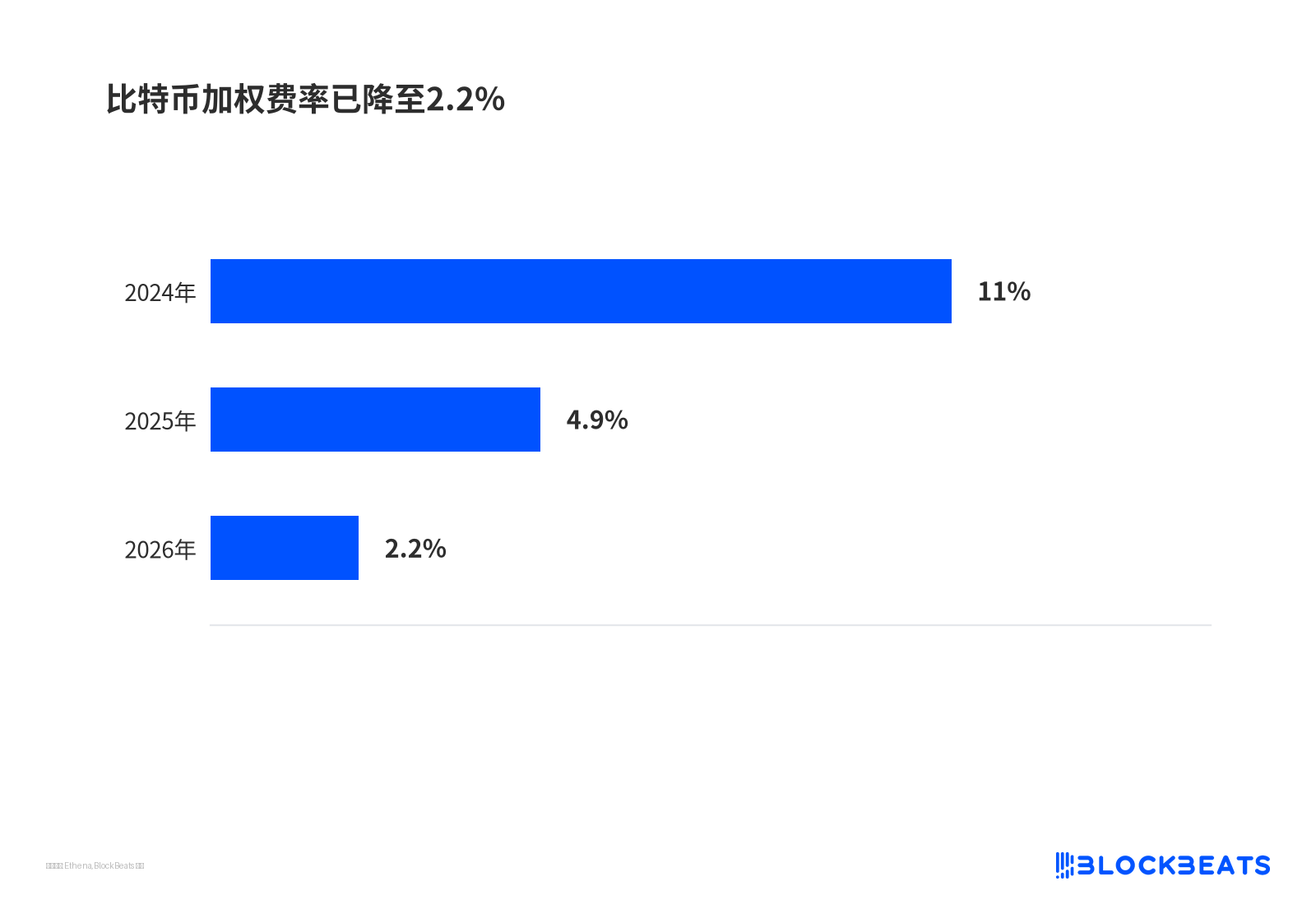
Bitcoin weighted funding rate has fallen to 2.2%
Ethena's answer is to switch underlying assets. Guy Young's rationale is that equity perpetuals offer higher funding rates, lower correlation with Bitcoin, and a more pronounced tendency for longs to pay. He expects that within 12 to 24 months, real-world asset (RWA) perpetuals will account for a larger share of USDe reserves than crypto perpetuals.
Kairos Research, which gatekeeps admissions, provides quantitative thresholds. Its framework submitted to the risk committee on August 28 requires that the underlying asset have a 14-day average one-sided open interest of no less than $25 million, a 30-day funding rate history, and a matching tokenized spot on the same platform. As of August 26, the combined one-sided open interest of equity perpetuals across four platforms was approximately $2.9 billion. Binance had 17 contract pairs pass the screening, but only a dozen or so were truly usable, including Nvidia, Tesla, Apple, and Meta.
Binance is the first platform to go live, and same-exchange matching reduces execution deviation between spot and perpetuals.
bStocks' legal identity is closer to a warehouse receipt
USDe is not backed by shares of Nvidia or Apple. bStocks is issued by Binance-affiliated BTech Holdings Limited, purportedly with 1:1 corresponding custody shares, but holders do not enjoy proprietary rights over the underlying, the issuer retains significant discretion over corporate actions, and legally it is closer to a warehouse receipt.
Kairos therefore wrote its approval as "conditional on a supplemental agreement," requiring coverage of custody and lending restrictions, out-of-group inventory verification, audit and upgrade keys, and dividend and corporate action rules. As of September 25, whether this supplemental agreement had been signed was not disclosed. Reports that day noted that before signing, the spot is closer to unsecured credit exposure to a Binance affiliate.
Yield figures differ by threefold, and scale is determined by order book depth
The yield figure is where the two sides diverge most obviously. Ethena officially claims equity basis has been above 11% over the past 6 months, while some measures put it at 3.56% annualized, a difference of about threefold. The reproducible current anchor comes from Kairos: on August 26, the funding rate of approved contracts was about 7%, two of which had turned negative, while 17.5% was the window high from May to August.
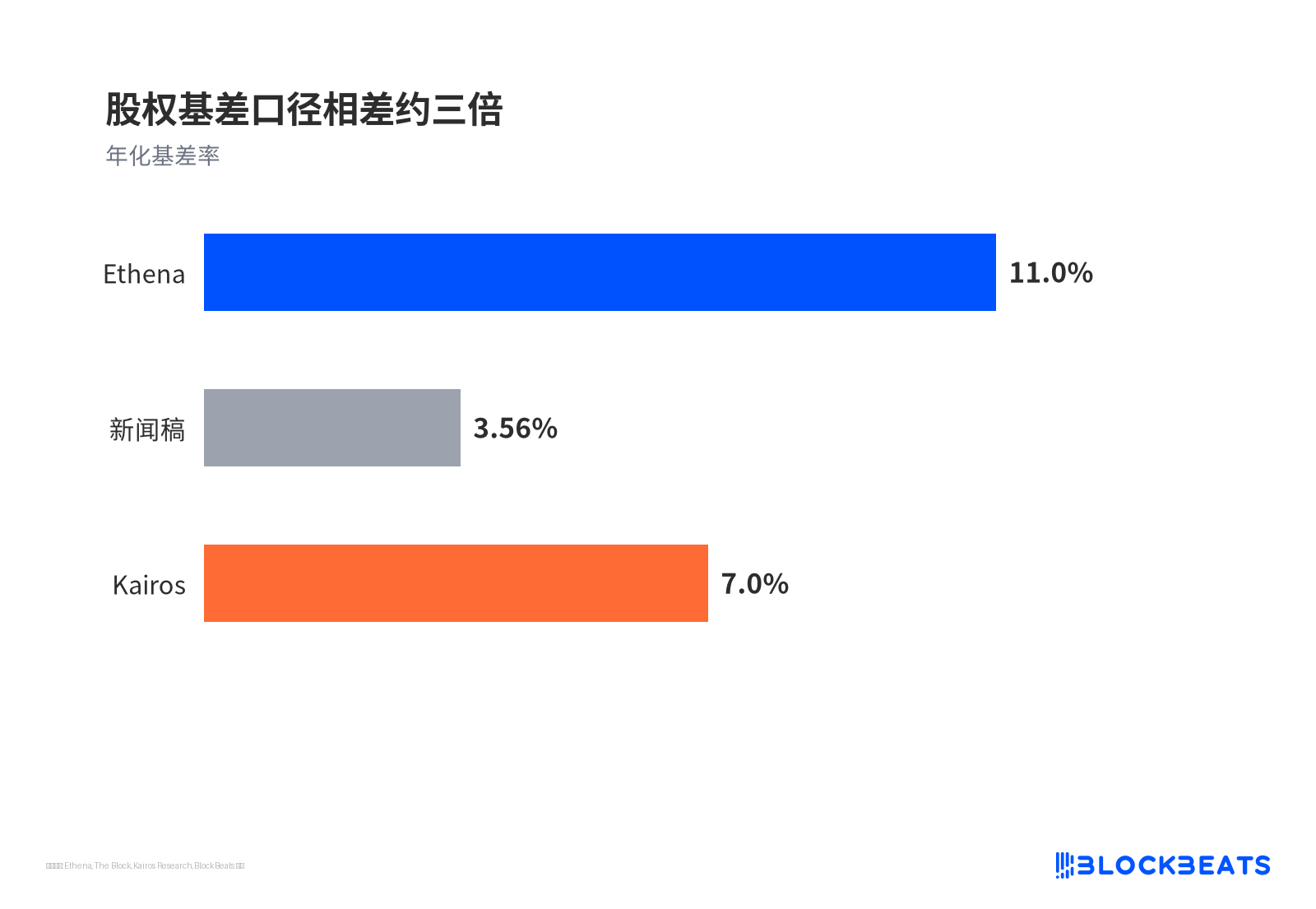
Equity basis figures differ by about threefold
The scale constraint comes from order book depth. Kairos recommends positions not exceed 10% of the corresponding perpetual open interest and 10% of any single day's trading volume. Based on its order book estimates, Binance's deepest instrument has one-sided depth of about $560,000. Even after passing the open interest threshold, the deployable amount is far below 1% of USDe's outstanding supply.
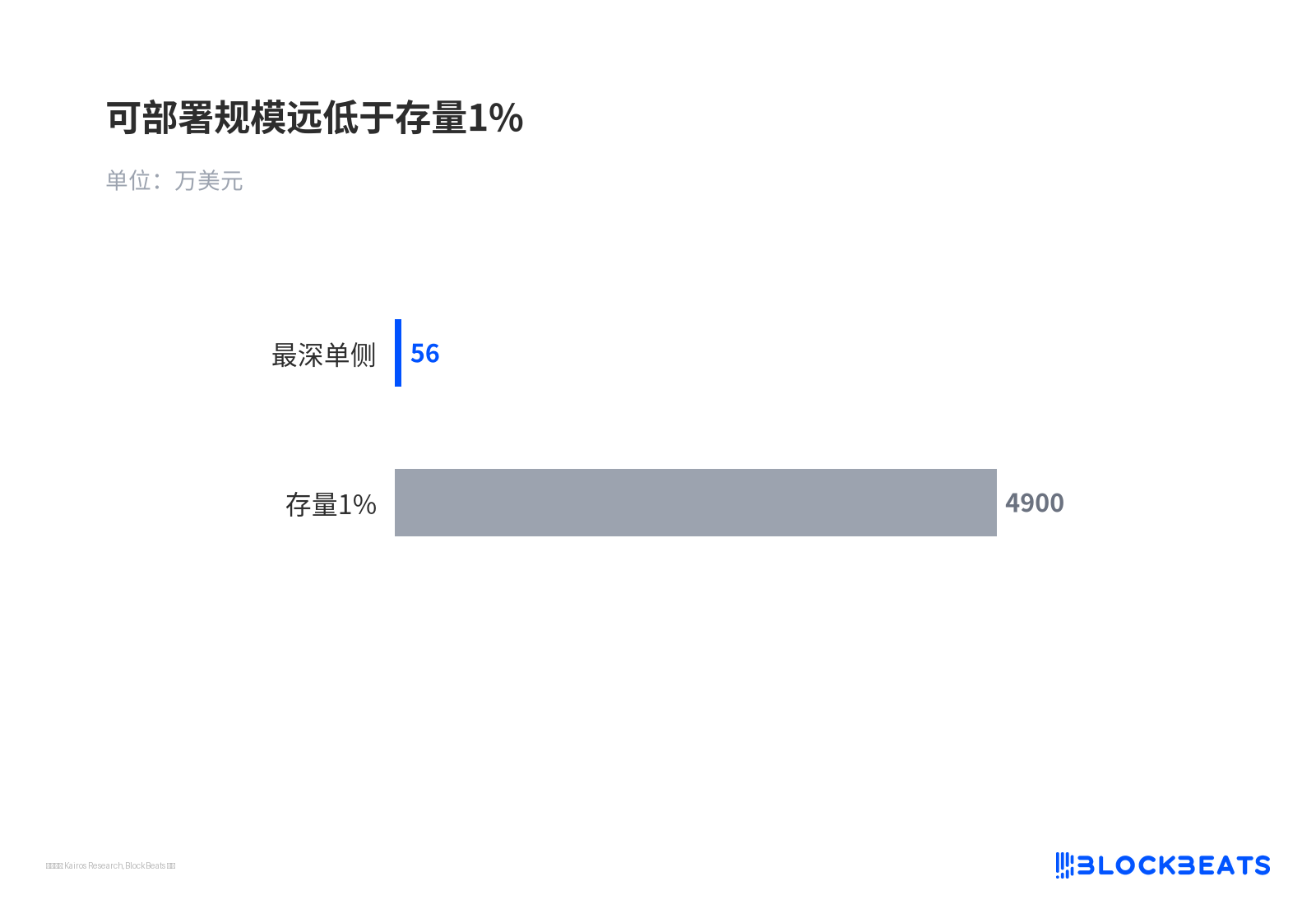
Deployable scale far below 1% of existing holdings
When US stocks close, pricing splits
The more practical gap isn't Nvidia dropping 10%, but that perpetuals keep trading when US stocks are closed. US stocks are closed roughly 70% of the time each week, during which Binance's index is generated from the perpetuals' own order book. Shorts could be liquidated in thin markets, while bStocks cannot be liquidated at equivalent scale.
Kairos backtesting shows that across more than 400 weekend and holiday windows, the average deviation was 14.9 basis points, and across 37 earnings windows, the hedging portfolio's maximum drawdown was 81.7 basis points. The rules require adding at least 10% stablecoin margin during these periods, or halving positions or closing out before the market close.
Putting all links on the same platform reduces cross-exchange slippage, but also binds spot issuance, perpetual trading, liquidation, and the index into the same ecosystem. The risk type shifts from coin price volatility to related-party credit, closed-market pricing, and single-venue concentration.
USDe supply still about $2.6 billion short of the buyback trigger
These constraints together point to one judgment: what launched on September 25 is a strictly capped pilot. How much was actually deployed, whether supplementary agreements were signed, and when the second venue will meet standards have all not been disclosed.
The more direct window to watch is supply itself. USDe is currently about $4.9 billion, still about $2.6 billion short of the $7.5 billion needed to trigger the ENA buyback switch.
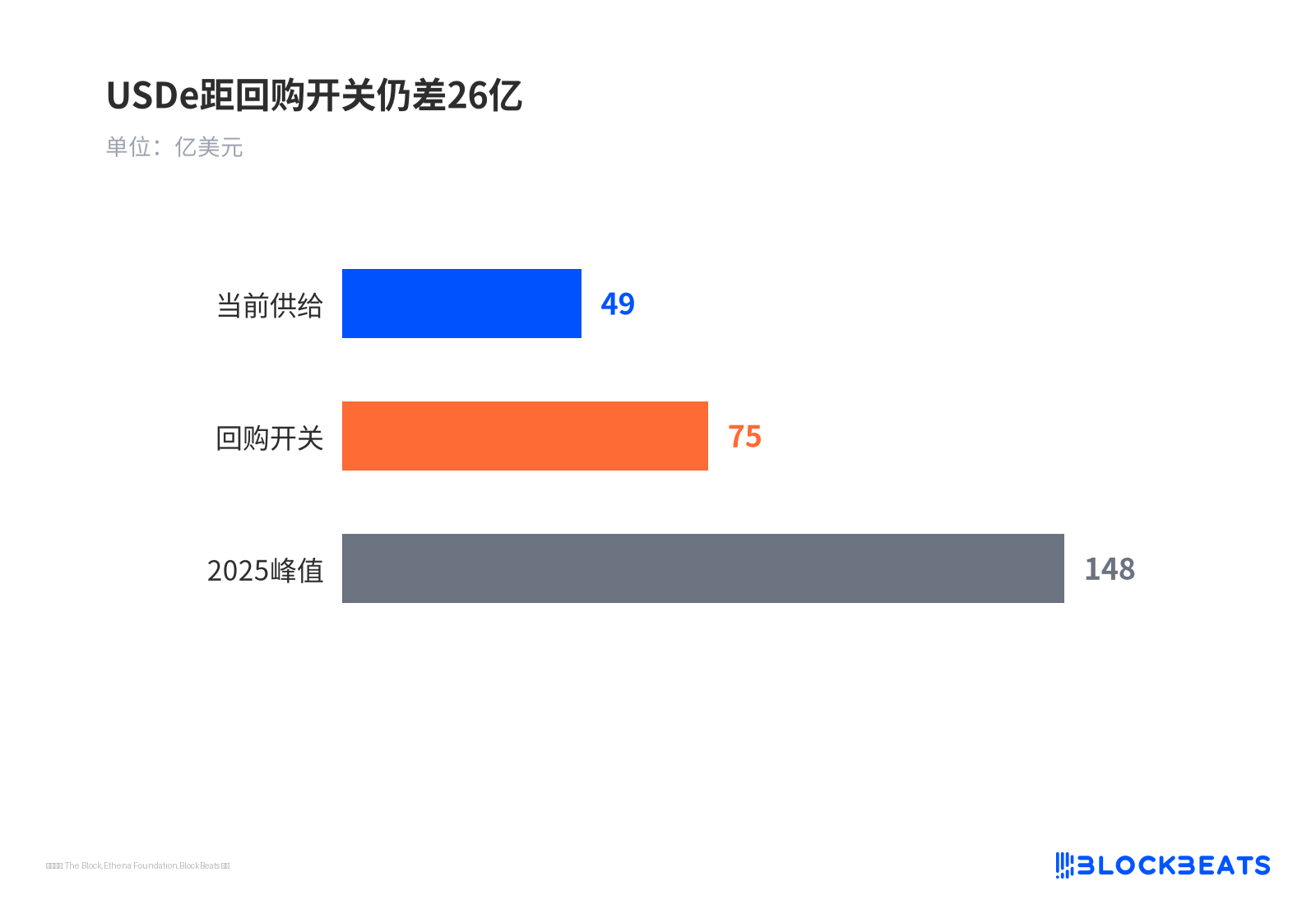
USDe still $2.6 billion short of the buyback trigger
If the equity basis can steadily contribute positive returns, this number should start moving first. ENA's recent rebound is trading both buyback expectations and longer-term imagination, and the timing of their realization is not the same.
Welcome to join the official BlockBeats community:
Telegram Subscription Group: https://t.me/theblockbeats
Telegram Discussion Group: https://t.me/BlockBeats_App
Official Twitter Account: https://twitter.com/BlockBeatsAsia