$12.3 billion, Meta Issues Debt to Data Centers Again

On July 27, entities related to BlackRock sold a $12.3 billion bond for Meta's data center project in El Paso, Texas. According to Bloomberg, the bond had already increased in the gray market before formal pricing, with the yield at pricing running about 2.60 percentage points higher than U.S. Treasuries. It seems the buyers did not walk away.
However, the same report also included a less enthusiastic detail. The final order book was around $20 billion, only equivalent to 1.6 times the issuance size, lower than the Bloomberg-reported average of around 4 times subscription levels for 2026 bonds. More crucially, at the formal pricing of the bond, it was around 40 basis points higher than the Beignet 2049 bond issued last year for Meta's Louisiana data center financing.
40 basis points may sound small. In the context of a multi-decade project bond, it means the market is willing to lend money but at a slightly higher price. This price increase does not imply a sudden deterioration in Meta's credit. The full terms, collateral, and structuring of the two bonds have not been fully disclosed in public filings. It's more like the bond market probing a new thing – AI data centers are no longer just capital expenditures for tech companies but are starting to emerge as a class of infrastructure debt that needs a separate valuation.
Let's first see how the market "bargained down" this bond.
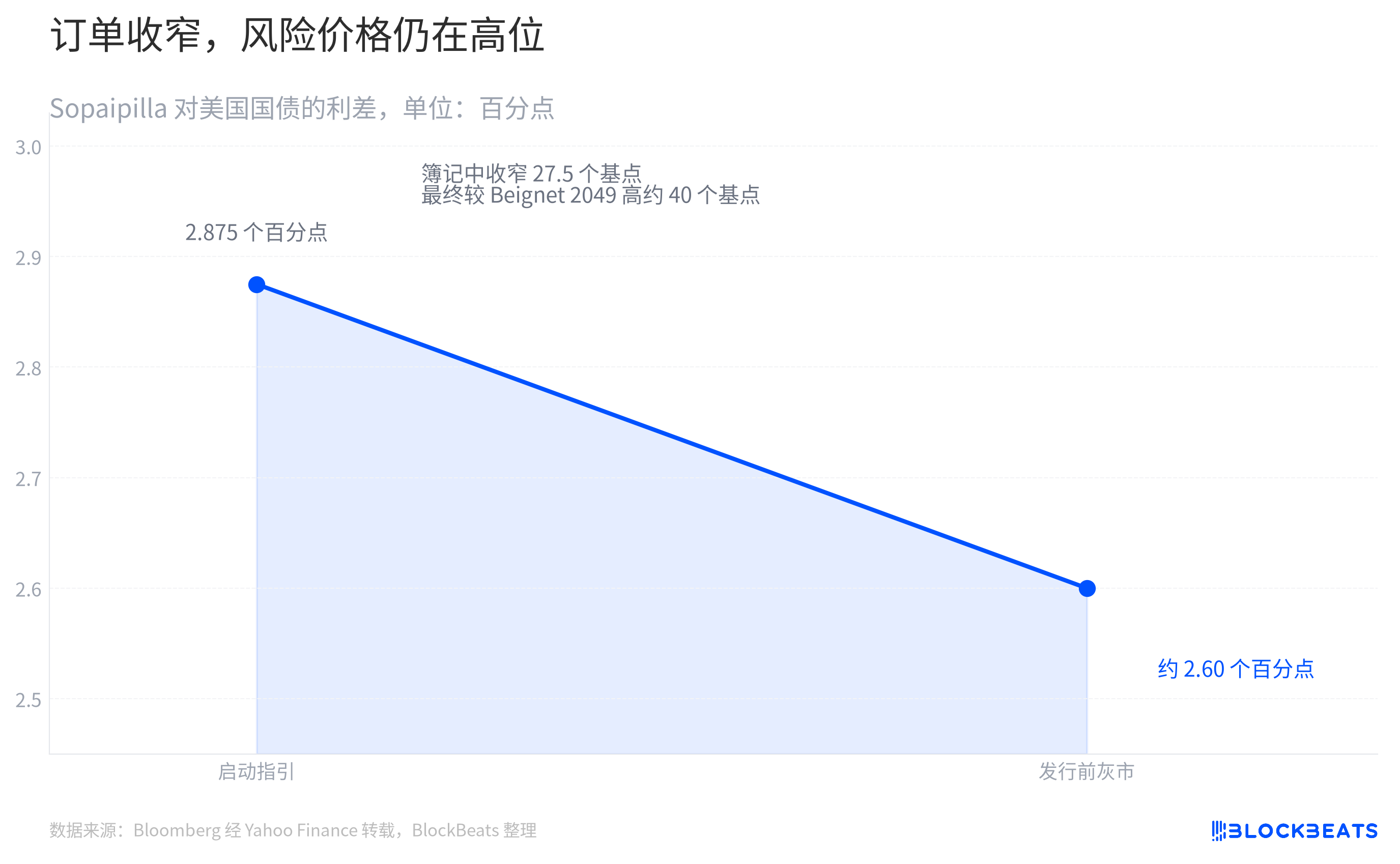
According to Bloomberg, the initial guidance from Sopaipilla Investor was around 2.875 percentage points above U.S. Treasuries, which then narrowed to about 2.60 percentage points after the bookbuilding process. The order book's progression from zero to completion resembled a roadshow for scoring the project. The underwriters initially offer a higher rate to attract risk-taking funds, then gradually lower it based on the order size.
The most easily misinterpreted aspect here is the word "narrowed." It indicates that buyers were willing to take on this bond but does not mean that buyers viewed it as a standard tech company bond. Bloomberg also mentioned that the premium at formal pricing compared to the Beignet 2049 bond was around 40 basis points. The market's response is not a rejection but rather an admission ticket with an extra cost.
Where does this additional cost come from? Partly from the supply side. Bloomberg states that large tech companies issuing bonds are tightening the available funds for asset managers. Another part comes from the project itself. Data centers need to address land, electricity, construction, and equipment first, then wait for tenants to fulfill long-term contracts. Creditors are not facing a business already reflected in Meta's financials but a set of arrangements where future cash flows may or may not materialize as planned.
So, why did Meta not issue the bonds itself and add another layer of a project company? The answer lies in the deal structure.
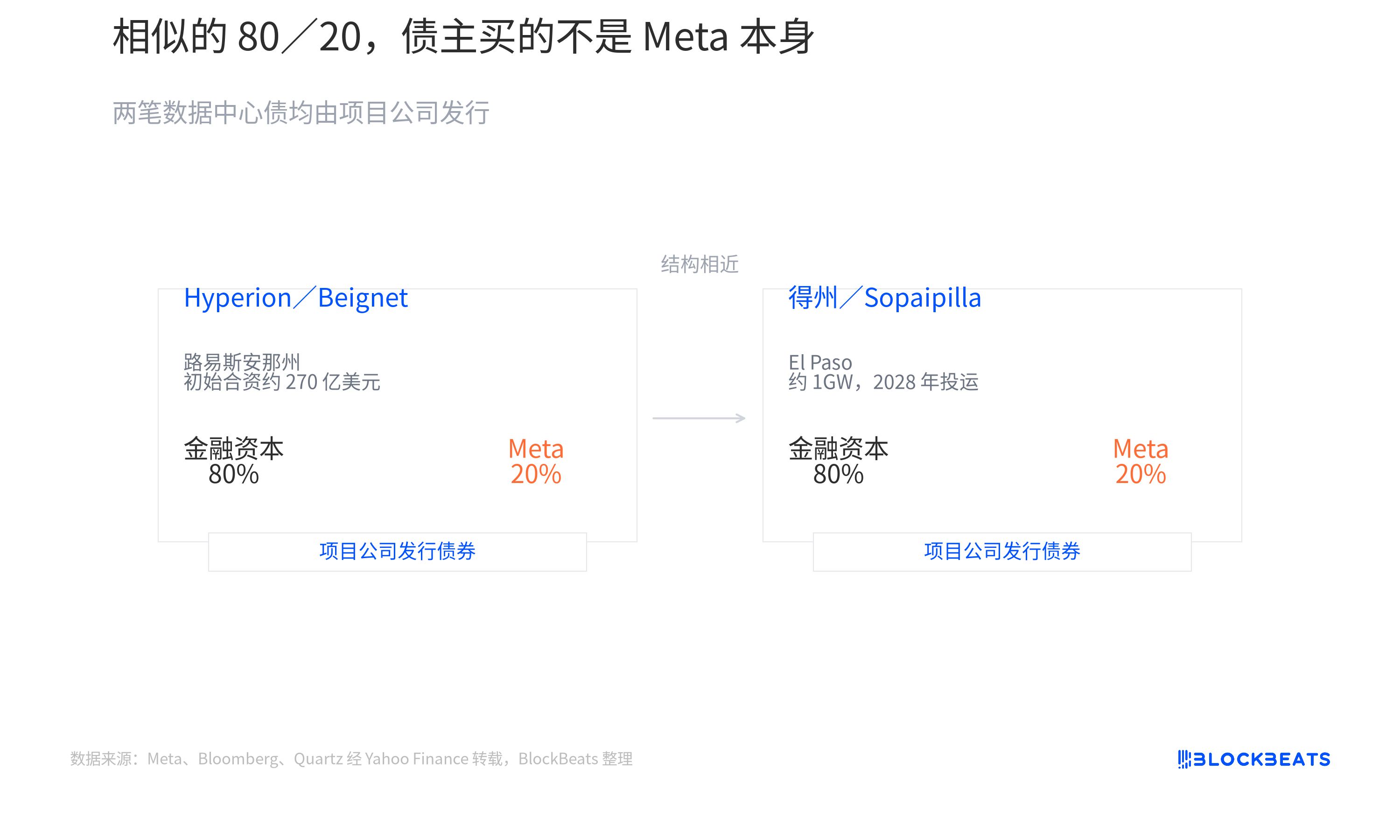
According to Quartz on July 21st citing Bloomberg, the Texas project is financed by a Belelde-related entity called Sopaipilla Investor, with Belelde-related entities holding an 80% stake in the project and Meta holding the remaining 20%. The project is expected to be around 1GW and to come online in 2028. The bonds are issued by a holding company, with the funds going into the project, not Meta's balance sheet.
This is not Meta's first time using this kind of structure. According to announcements by Meta and reports from Quartz, the initial joint venture scale of the Hyperion project in Louisiana is around $27 billion, also following an 80% financial capital and 20% Meta arrangement, with some funding coming from private debt offerings targeted at institutional investors. The two structures look almost like copies of each other.
However, the term "project company" changes what bondholders are looking at. Buying Meta corporate bonds, the key issues are advertising cash flows, buybacks, and the overall company's debt-servicing ability. Buying project bonds shifts the focus to whether the data center is built on time, power can be connected, leases are enduring, and what the equipment will be worth many years from now. Having only a 20% stake, sponsors don't automatically answer these questions.
Think of it like an office building. Both the developer and major tenant are well-known, but not every loan in the building is guaranteed by them. Ultimately, lenders will still review the contract, look at when rent starts flowing in, who covers the gap during vacancies, and what happens if funding falls short halfway through construction. AI data center servers are pricier, get updated quicker, so this contract naturally receives more scrutiny.
That's why a 40 basis point move can't simply be translated as "market bearish on Meta." It's primarily an offer on project structure, construction timeline, remaining value, and concentrated supply. Similar equity stakes only provide a comparable starting point, not glossing over the differences in bond terms.
Going a step further, why is this structure now commonplace? Because the money Meta needs to spend has begun to outstrip the traditional capital expenditure rhythm.
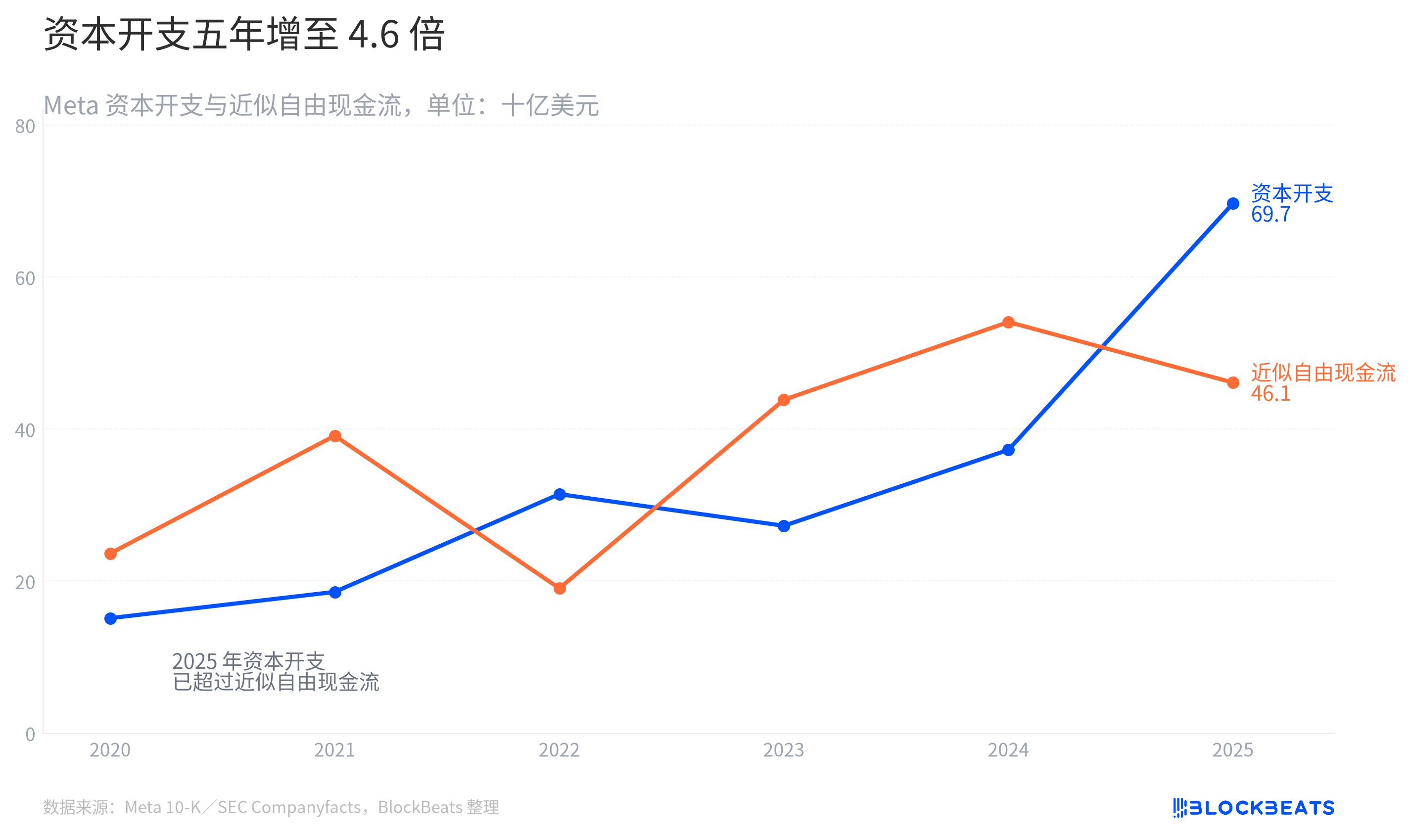
According to Meta's annual filing with the U.S. Securities and Exchange Commission, the company's capital expenditure in 2025 was $69.691 billion, approximately 4.6 times that of 2020. Using the same metric, the approximate free cash flow, calculated as operating cash flow minus capital expenditures, has decreased from $54.072 billion in 2024 to $46.109 billion. The company doesn't lack cash, but the construction speed is devouring more freely disposable cash.
The key of this image is not where the two lines cross in which year. It shows the evolution of fund speak. In the past, data centers were more like an annual rolling update to a budget. Now, projects like Hyperion bundle land, power, the facility, and a lot of accelerators into a long-cycle build. Meta announced this year that Hyperion will scale to over $500 billion and 5GW, with the expansion part owned solely by the company. According to Quartz on July 13, this is a much larger scale than the original joint venture.
Project financing provides a form of spreading the load. Financial capital takes on most of the equity and debt, tech companies retain the right to use with some equity, and the capex doesn't need to be all squeezed into one fiscal year. Spreadability doesn't mean it goes away. The risk has shifted from "How much money Meta spent" to "Who will price the cash flow for an underutilized data center."
So, the true value of Sopaipilla is not another large funding round. It's more like a mini stress test. The order is enough to conclude the bond issuance, but the price tells onlookers that the AI infrastructure fund is now differentiating "big tech participation" from "worthy of borrowing against big tech credit."
When data centers move from a corporate budget to the project bond market, the risk also transitions from a financial report to a longer contract.
Welcome to join the official BlockBeats community:
Telegram Subscription Group: https://t.me/theblockbeats
Telegram Discussion Group: https://t.me/BlockBeats_App
Official Twitter Account: https://twitter.com/BlockBeatsAsia