How much more expensive will SK Hynix ADR be?

TL;DR
· SK hynix ADS will initially trade on NASDAQ as SKHYV before expected switch to SKHY.
· UBS bets on US listing premium, with Douglas Kim cautioning that arbitrage trading may already be crowded.
· Related tickers: SKHY, SKHYV, 000660.KS, MU, NVDA, TSM
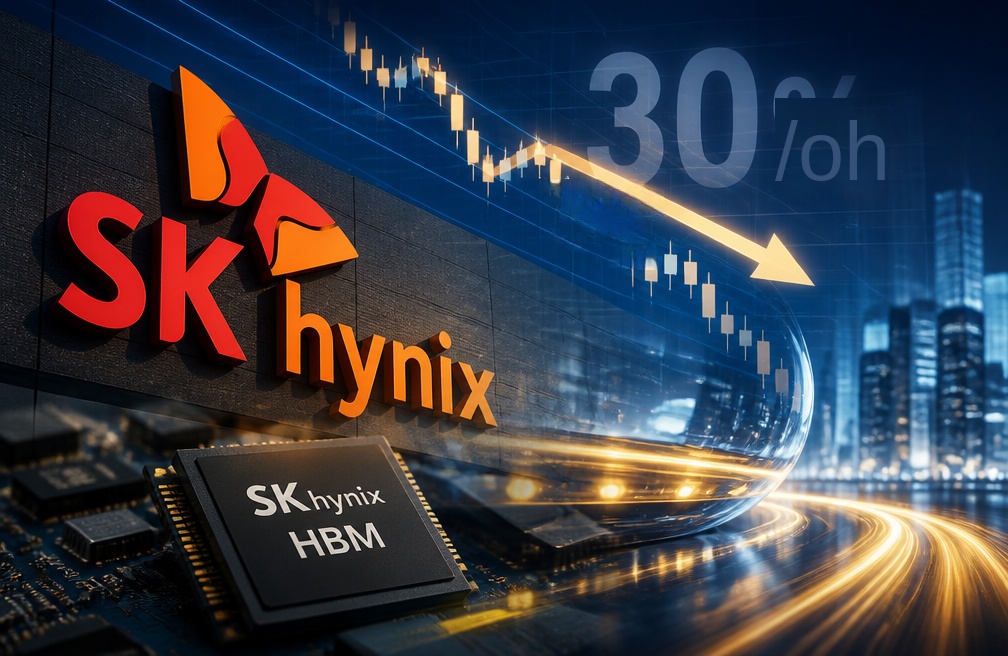
After SK hynix's ADS issuance in the US, the market's focus has shifted from "can it be sold" to "if the same company shifts to trading in the US market, will it be more expensive in the long run."
According to a Nasdaq Trader announcement, SK hynix's ADS will begin trading on July 10 on a when-issued basis on NASDAQ under the symbol SKHYV. The expected switch to regular-way trading under the symbol SKHY is planned for July 13 with settlement on July 14.
Reports from Bloomberg and others indicate that the offering price for this issuance is $149 per share. With approximately 177.9 million ADSs issued, the fundraising amount is estimated to be around $26.5 billion. Sources familiar with the matter claim the issuance was oversubscribed by more than 7 times. This indicates that global funds are still chasing after the AI memory exposure, but it does not directly prove that an ADR premium can last in the long term.
The controversy lies here. UBS recommends buying ADRs and shorting Seoul-listed shares, betting that US market access and trading efficiency will bring a premium. Douglas Kim, an independent analyst who has long tracked Korean tech stocks, warns that this trade may already be crowded, and even if the initial premium surges to double digits, it could quickly compress.
This Offering Sells the Dollar Entryway
ADS can be understood as certificates for buying foreign stocks with US dollars. Investors can obtain exposure to SK hynix shares on NASDAQ without directly engaging in Korean market trading and settlement.
The key to this offering is not moving existing shares to trade in the US but rather new stock financing. According to SEC filing summaries and reports from Yonhap News Agency, the company plans to issue up to 17.79 million new common shares, representing approximately 2.5% of the outstanding shares. Each ADS represents one-tenth of a common share.
For the company, this is a fundraising opportunity for AI capacity expansion in the US capital markets. For investors, this is a pricing experiment for the same AI semiconductor leader between two markets.
If the ADR can consistently trade above Seoul common stock, it indicates that US funds are willing to pay a higher price for trading convenience and AI exposure. If the premium quickly converges, it is more like a short-term arbitrage trade rather than a valuation system change.
Funds Are Grabbing HBM, Along with Trading Convenience
SK hynix is being chased by global funds, with the underlying reason still being HBM (High Bandwidth Memory). It is the high-speed memory that collaborates with the GPU on AI accelerator cards, affecting whether data can be delivered fast enough to the chip.
In the AI infrastructure chain, Nvidia provides the computing chips, and HBM is responsible for ensuring an adequate data supply to these chips. SK hynix is in a leading position in this link and naturally becomes a target that global funds cannot avoid when allocating AI hardware.
But the incremental inflow from this issuance is not just based on fundamentals. Many overseas institutions could originally buy Korean stocks but faced settlement, time zone, market access, and internal authorization restrictions. ADR reduces these frictions, making SK hynix closer to an AI semiconductor asset that can be directly placed in a US stock portfolio.
This is also the other side of the "Korean discount." Korean companies are often undervalued by global funds due to governance structures, geopolitical risks, local market liquidity, and other reasons. ADR may not eliminate the discount, but it can provide a more familiar trading channel.
UBS Betting on Price Spread, Douglas Kim Worried About Crowded Trades
The formation of the ADR premium is not complex. The same company is traded in two markets, and if the US demand is stronger, the initial float supply is limited, and the conversion is not smooth enough, the ADR may be more expensive than the local stock.
The core variable is convertibility, meaning whether the ADR and Seoul common stock can be efficiently exchanged for each other. If the conversion is smooth enough, arbitrage funds will buy the cheap side and sell the expensive side, and the price difference will quickly converge. If there are conversion frictions, the premium may persist longer.
UBS's trading recommendation is precisely betting on this: buying ADRs and selling Seoul common stock. Its logic is that US investors' demand for SK hynix is indeed real, the initial tradable supply of ADRs is limited, and the US market may offer an additional price.
Douglas Kim's rebuttal does not deny the demand but questions whether this price spread trade has already been targeted by too many people in advance. If a significant amount of funds simultaneously go long on ADRs and short on local stocks, the post-listing price spread may actually compress more quickly.
The crux of the disagreement lies not in whether SK Hynix is a leader in AI, but whether the "U.S. listing premium" is a new valuation anchor or a short-term supply-demand mismatch. The former supports a long-term higher ADR price, while the latter points to a higher first-day pop leading to greater subsequent downward pressure.
Financing Strengthens AI Capital Expenditure, but Retains Cyclical Risks
Once SK Hynix receives USD funding, the most direct use will be towards AI memory capacity expansion. For the company, with a more global investor base and deeper financing channels, it also helps to translate HBM demand into factory, equipment, and advanced packaging investment.
For the secondary market, capacity expansion always has a dual nature. When demand is strong, capital expenditure is proof of growth. However, once future supply catches up with demand, additional capacity may also depress prices and profit margins.
Therefore, this issuance cannot simply be seen as a deterministic upward revision in AI memory. Current evidence can support strong global funds chasing SK Hynix's AI/HBM exposure, but it does not prove that the supply-demand balance will remain tight in the coming years.
A more cautious understanding is that the ADR debut has elevated SK Hynix from a local Korean leader to a dollar-traded asset within the global AI portfolio. It enhances fund accessibility and valuation imagination but does not eliminate the semiconductor cycle.
First Week Price Spread Will Determine Trading Characteristics
Currently, the most crucial variable is not whether the fundraising size can refresh market impressions but whether the actual premium of the ADR over Seoul stock can stabilize.
If the ADR maintains a high trading volume and premium even after a strong opening week, it indicates global funds are willing to continue paying for trading convenience and AI exposure. UBS logic will be reinforced, and market discussions will shift from the successful issuance to whether the Korean discount is being partially reassessed.
If the premium quickly converges, Douglas Kim's crowded trade framework will be more explanatory. It indicates that a large amount of capital has bet in advance on the same spread, with the debut becoming an arbitrage realization window, rather than the starting point for long-term valuation reassessment.
Strong subscription can prove the existence of demand but does not automatically prove the longevity of the premium. The value of SK Hynix's U.S. transaction this time will ultimately hinge on a specific question: How long and how much of a premium are global funds willing to pay for the same AI memory asset. The first-week premium and trading structure will provide the initial answers.
Welcome to join the official BlockBeats community:
Telegram Subscription Group: https://t.me/theblockbeats
Telegram Discussion Group: https://t.me/BlockBeats_App
Official Twitter Account: https://twitter.com/BlockBeatsAsia

 Related Articles