Goldman Sachs Calls for Long China AI: Behind the $4 Trillion Market Cap, Global Funds Only Allocated 1.2%

TL;DR
· Goldman Sachs recommends buying into the Chinese AI value chain, covering energy, semiconductors, AI infrastructure, models, and applications.
· Goldman Sachs estimates the total market value of China's AI sector to be around $4 trillion, with revenue representing about 16% of global AI-related revenue, yet global mutual funds have only allocated around 1.2% to China in their technology exposure.
· The core of this trade is not a single AI application takeoff, but a reassessment opportunity brought by underweighting, policy investments, and hardware demand together.
· Risks lie in the need for continued data center investments, storage expansion, IPO financing, and AI hardware exports.
Goldman Sachs' thematic research team is putting the "Chinese AI Value Chain" at the center of the trading radar.
According to their report titled "Trading Strategy: Long the Chinese AI Value Chain," Goldman Sachs recommends going long on a Chinese AI basket covering energy, semiconductors, AI infrastructure, models, and applications. In the past two years, global AI trading has been dominated by large U.S. tech stocks, the NVIDIA supply chain, and cloud capital expenditure; what Goldman Sachs is now eyeing is the misalignment of Chinese AI assets in terms of market value, revenue contribution, and global fund holdings.
Goldman Sachs estimates that Chinese AI-related companies already have a market value of around $4 trillion, contributing about 16% of global AI-related revenue, but as of January 2026, global mutual fund managers have only allocated about 1.2% to China in their global technology exposure.
These figures form the most crucial trading logic in the entire report: if the Chinese AI industry already holds a double-digit share on the revenue side, yet global fund allocation remains significantly low, then there is room for the repricing of the Chinese AI value chain.
Major Discrepancy: High Revenue Contribution, Low Global Fund Allocation
Goldman Sachs' breakdown of global AI assets provides a very direct comparison.
Since the end of 2022, global AI-related stocks have created a market value of around $34 trillion, with Chinese AI-related market value accounting for about $4 trillion, representing approximately 10% of global AI-related market value. In terms of revenue, China has contributed approximately 16% of global AI-related revenue.
However, fund allocation is far below this ratio. Goldman Sachs estimates that as of January 2026, global mutual fund managers have only allocated about 1.2% to China in their global technology exposure.
This is also the core reason Goldman Sachs has put forward for going long on the Chinese AI value chain. U.S. AI assets have been repeatedly bought into by global funds, with NVIDIA, cloud providers, semiconductor equipment, and energy infrastructure all included in AI trading. In contrast, although Chinese AI assets have achieved a certain scale of revenue, they are still underweight in global fund positions.
In other words, Goldman Sachs is not just betting on the "China AI narrative" but on a more specific funding gap: revenue contribution has materialized, but global holdings have not caught up.
This is not a traditional KWEB trade; hardware and infrastructure are more prominent
Goldman Sachs particularly emphasized that this trade is different from the traditional KWEB trade.
KWEB typically corresponds to China's internet and platform economy exposure, where investors would think of e-commerce, advertising, online entertainment, and local services. However, Goldman Sachs has constructed the GS China AI Value Chain (GSXACART) basket this time, covering a range from power, semiconductor, AI infrastructure to models and applications, closer to a complete China AI supply chain.
In this framework, hardware and infrastructure play a more upfront role.
As China advances its tech self-reliance and advanced computing capabilities, AI hardware, data centers, power supply, and semiconductor sectors have all received policy, industry, and capital attention simultaneously. Goldman Sachs believes that the value of these sectors has not been fully reflected in the stock market.
Based on its research, it estimates that the potential economic benefits brought by AI through efficiency improvement and new profit creation may be 50% to 100% higher than the level already reflected in current AI stock prices. This is also why power, AI infrastructure, and semiconductors are at the core of the basket.
Whether models and applications can take off ultimately depends on computing power, storage, power supply, and equipment provision. These are precisely the areas where China has the capacity for large-scale manufacturing, engineering construction, and industrial support.
Exports, policies, and IPOs are strengthening the AI hardware narrative
The transformation of China's AI hardware chain is moving from a concept to more specific orders, exports, and financing milestones.
On the demand side, customs data quoted by multiple media outlets shows that China's May exports grew by 19.4% year-on-year, the strongest increase in three months; among them, integrated circuit exports increased by about 111% year-on-year, with only a slight increase in export volume. Behind the price and structural changes, AI hardware demand is seen as one of the key driving factors. For storage, semiconductor equipment, and upstream materials, this kind of data points to the possibility of improvements in orders and capacity utilization.
On the policy investment side, according to Reuters citing a Bloomberg report, China is preparing a five-year plan of about 2 trillion yuan, approximately $295 billion, for the construction of a nationwide AI data center network. Although this plan has not been formally announced, if implemented, it will directly boost domestic demand for storage chips, semiconductor equipment, power supply, and data center infrastructure.
On the capital market side, publicly available reports indicate that A-shares, H-shares, and some global indices will increase the weights of AI and semiconductor sectors in the 2026 adjustment. This will enhance the visibility of relevant companies to passive funds and attract more domestic and foreign funds to the field of advanced computing and semiconductors.
Individual stock and industry cases are also reinforcing this trend. In the first quarter of 2026, YMTC's revenue skyrocketed by about 445% year-on-year, increasing its global NAND flash market share from 8% a year ago to 13%, ranking tied for fourth place. This progress has also propelled its domestic IPO plan to support capacity expansion.
CXMT is considered a key player in China's DRAM industry. Third-party estimates suggest that its revenue in 2026 may exceed $50 billion. According to the company's prospectus, revenue for the first quarter was 50.8 billion RMB, with revenue guidance for the first half of the year ranging from 110 billion to 120 billion RMB.
These cases do not mean that Chinese storage companies have completely caught up with foreign giants, but they demonstrate that the Chinese AI hardware chain is transitioning from a "policy concept" to more observable revenue, market share, financing, and capacity expansion milestones.
Funds Starting to Shift, U.S. AI Still the Main Reference
Goldman Sachs also mentioned that the Chinese AI sector has outperformed other Chinese-related assets and shown signs of fund allocation shifting. However, compared to U.S. AI, Chinese AI assets still lag significantly behind.
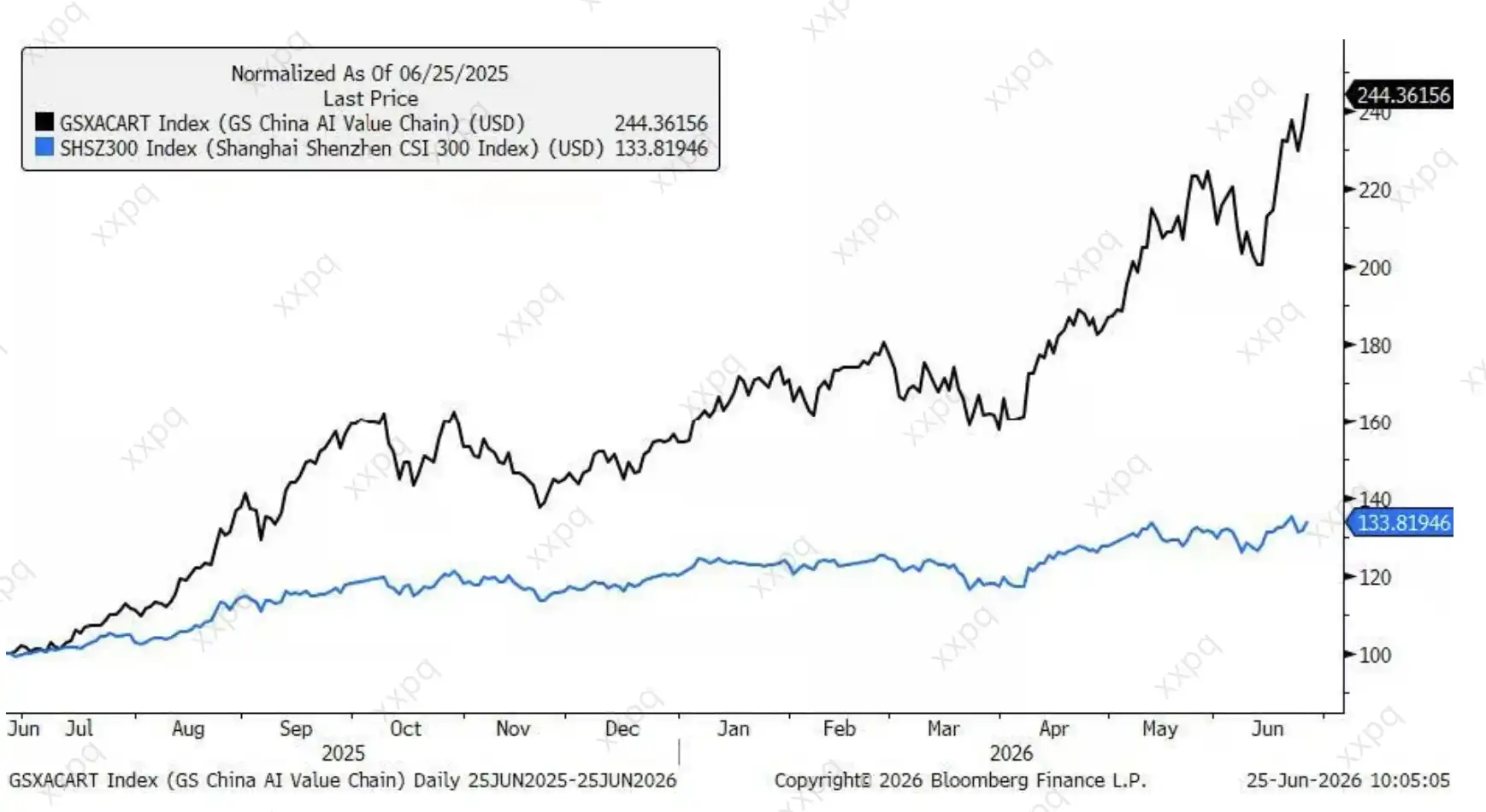
This is also where trading attractiveness and risk boundaries exist simultaneously.
The attractiveness lies in the fact that if global investors continue to seek growth beyond U.S. AI, the underweight status of Chinese AI may provide room for fund transfers. Especially in a scenario where valuations of U.S. AI leaders are already high and capital expenditure expectations have been thoroughly discussed, the market naturally seeks under-owned supply chain and application assets.
The risk is that this is still a trading proposition, not a realized industry conclusion. The success of the 2 trillion RMB AI data center plan depends on policy details and actual execution; the IPOs, capacity expansions, and profit improvements of companies like CXMT and YMTC also take time. Whether chip exports and sales data can be sustained depends on the global AI hardware cycle and trade environment.
U.S. AI remains the main reference for global funds. Whether in terms of model capabilities, cloud vendor capital expenditure, GPU ecosystem, or enterprise application revenue, the U.S. market still holds more mature benchmarks. For Chinese AI to attract more global funds, it must not only prove to be "undervalued with low holdings" but also consistently deliver revenue, profit, and technological advancements.
The key point of Goldman Sachs' long position in the Chinese AI value chain this time is not to announce that China has caught up with the United States in AI, but to bring a market anomaly to the forefront: a market worth about $4 trillion, contributing approximately 16% of global revenue, yet only accounting for about 1.2% of China's allocation in global mutual fund tech exposure.
Whether funds can fill this gap will depend on policy investments, hardware demand, and whether corporate profitability can continue to materialize.
Welcome to join the official BlockBeats community:
Telegram Subscription Group: https://t.me/theblockbeats
Telegram Discussion Group: https://t.me/BlockBeats_App
Official Twitter Account: https://twitter.com/BlockBeatsAsia
 Related Articles