Musk to Wage Price War, Grok Willing to Take Loss on $4.5 Million Deal with Claude - Is it Good News for SpaceX?

TL;DR
· SpaceXAI released Grok 4.5 on July 8, integrating Cursor, Grok Build, and API.
· While not necessarily leading OpenAI or Anthropic comprehensively, its competitive pricing is challenging high-end API premiums.
· Related tags: SpaceX/SPCX exposure, OpenAI and Anthropic-related proxies, AI developer toolchains.
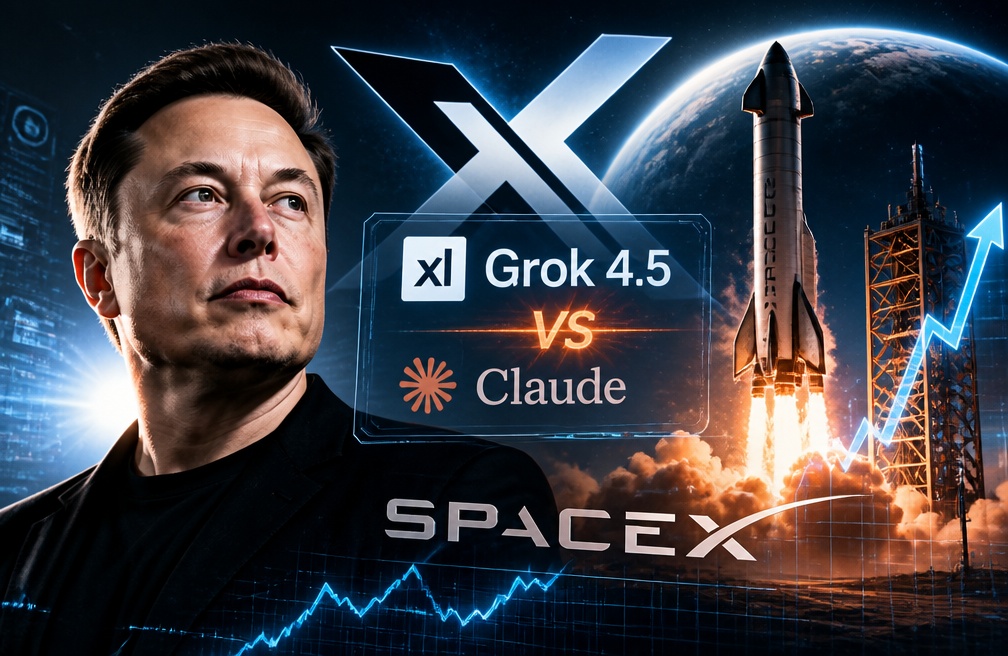
SpaceXAI released Grok 4.5 on July 8, integrating it with Grok Build, Cursor, and SpaceXAI/xAI API. The official documentation states that Grok 4.5 is geared towards coding, agent tasks, and knowledge work, priced at $2 per million input tokens and $6 per output token.
Grok 4.5 is positioned against Claude Opus 4.8, with the latter priced at $5 per input and $25 per output.
This release has drawn attention from developers and investors, not just because the market has gained another cutting-edge model. The more immediate question is, if a model that is close to top-tier in coding and agent tasks can perform similar tasks at a lower cost, how long can OpenAI and Anthropic sustain their high-end API premiums?
Here, tokens can be understood as units of text and code snippets in AI billing. An agent is an AI assistant that can break down steps, call tools, and iteratively refine results. For enterprises, while model rankings are crucial, the actual cost of writing a piece of code, fixing a bug, or running an automated workflow is becoming equally important.
Low Pricing Reigniting Task Costs Competition
The first impact of Grok 4.5 comes from its pricing. Both the official documentation and the Cursor blog confirm that its API is priced at $2 per million input tokens and $6 per output token, lower than the common price range of some high-end models.
But this is not simply about being “cheap.” The pricing of AI coding tools is usually not based on a per-query basis, but rather on a per-task basis. A complex task may involve actions such as reading code, writing code, running tests, fixing errors, and submitting the results in multiple rounds. The more efficient the model is at planning and the fewer detours it takes, the fewer tokens are actually consumed.
Therefore, the cost per task is a more accurate representation of enterprise procurement logic than the price of a single token. If Grok 4.5 can maintain a high completion rate in real engineering tasks, the low unit price will be further magnified into a lower total task cost.
The evaluation by Artificial Analysis has provided a basis for this narrative. The organization stated that Grok 4.5 ranks 4th in the Intelligence Index, following Fable 5, GPT-5.5, and Opus 4.8, but is at the forefront of performance and cost-effectiveness, demonstrating a lower coding agent cost.
This also explains why the market discussion has centered around the “price anchor.” In the past, competition among cutting-edge models was often framed as who was the strongest, and users were willing to pay for the strongest capabilities. In the coding and agent scenarios, if models close to the top tier are affordable enough, businesses will start to compare which one is more cost-effective.
Cursor Provides an Entry Point for Low-Cost Models
If Grok 4.5 were just a low-cost API, it would resemble more of a pricing war. After integrating with Cursor, the issue shifts to a competition of models, distribution, and developer workflows.
Cursor is a commonly used AI coding tool for developers, and its position is not a typical call interface but rather the daily workspace for developers to write code, make changes, and debug projects. Once models enter this entry point, they are more likely to be used frequently and become the default choice.
This also holds strategic significance for SpaceX's acquisition of Anysphere, the parent company of Cursor. SpaceX plans to acquire Anysphere for $60 billion in an all-stock transaction, with the deal expected to close in the third quarter of 2026. This caliber of acquisition needs to be viewed with boundaries, more suited to be understood as an anticipated completion of equity linkage rather than realized financial synergy.
From a product logic perspective, Grok 4.5 has already demonstrated the problem this integration line aims to solve. Model companies are no longer just selling APIs; they are trying to embed the models into the most frequently used developer workflows.
This could potentially set in motion a data flywheel. Developers using AI to code in Cursor generate real task data. If this data can be ethically used to enhance engineering capabilities, the models will have a better understanding of code scenarios, subsequently increasing the stickiness of Cursor's usage.
However, the flywheel is still a potential outcome, not a moat that has already formed. It requires real usage, retention rates, and task completion rates to validate. A single release can only indicate that SpaceXAI is starting to integrate the model with the interface, but it does not yet indicate mass developer migration.
OpenAI and Anthropic Face Price Elasticity Test
For OpenAI and Anthropic, the short-term impact of Grok 4.5 may not necessarily result in core customer churn. When enterprises choose a model, they consider not only the price but also security, stability, contextual ability, tooling ecosystem, compliance support, and service responsiveness.
What is being tested is the price elasticity of high-end APIs. In the past, top-tier models could rely on their strongest capabilities to maintain higher prices, especially in complex reasoning, code generation, and enterprise automation scenarios. Now, if models like Grok 4.5 are sufficiently close to top-tier capabilities in most engineering tasks, customers will start to split their requirements.
A more likely change is tiered usage. Enterprises may still assign the most difficult, sensitive, and complex tasks to the strongest model, but migrate a large number of daily coding, testing, documentation, and office automation tasks to lower-cost models.
This will not immediately diminish the value of high-end models but may compress their space to cover long-tail tasks. For OpenAI and Anthropic, the issue may not be losing the most critical scenarios, but rather having mid-to-low complexity tasks that could have been covered at a high price now taken by cheaper models.
Musk and the media have described Grok 4.5 as an "Opus-level" model, with Axios also mentioning its focus on top-tier capabilities while noting that it does not surpass all of OpenAI and Anthropic's largest or latest models. This limitation is crucial. The impact of Grok 4.5 is not that it has already taken the lead across the board but that it is prompting customers to reassess the balance between "powerful enough" and "affordable enough."
For investors, this will affect the valuation narrative. The high valuations of OpenAI and Anthropic rely on cutting-edge model capabilities, enterprise subscriptions, and API revenue expansion. If the prices of high-end APIs are forced downward, the market will pay more attention to revenue quality, gross margins, and customer stickiness, not just model capability iterations.
Adoption Rates Determine Whether the Price Anchor Can Loosen
As of now, Grok 4.5's support indicates that it has established a narrative of high performance at a low cost in coding and agent scenarios and has shifted the competitive focus from the model capabilities leaderboard to unit task costs. It cannot yet be written that SpaceXAI has reshaped the AI coding market.
The harder variable lies within the Cursor. Whether developers set Grok 4.5 as the default model, whether enterprises are willing to migrate high-frequency tasks, whether the task completion rate can be consistently replicated in real-world projects, these are more important than the hype on the day of release.
Competitors' response speed will also determine the impact scope. If OpenAI or Anthropic introduce lower pricing tiers, adjust caching prices, or strengthen enterprise security and proprietary data advantages, Grok 4.5's cost advantage may be partially absorbed. Conversely, if competitors' prices remain strong and Cursor usage continues to grow, the price anchor for the high-end API will loosen more quickly.
This release has not yet provided a definitive conclusion. It is more like pushing AI encoded model competition to a new stage: cutting-edge capabilities are still important, but investors need to focus on unit task costs, distribution channels, and real adoption rates simultaneously. Grok 4.5 has laid out this arithmetic problem first.
Welcome to join the official BlockBeats community:
Telegram Subscription Group: https://t.me/theblockbeats
Telegram Discussion Group: https://t.me/BlockBeats_App
Official Twitter Account: https://twitter.com/BlockBeatsAsia