The "China SMIC" that Makes $400 Million Profit per Day, Even Apple is Eager to Buy
Author | Jialiu, Rising Beat
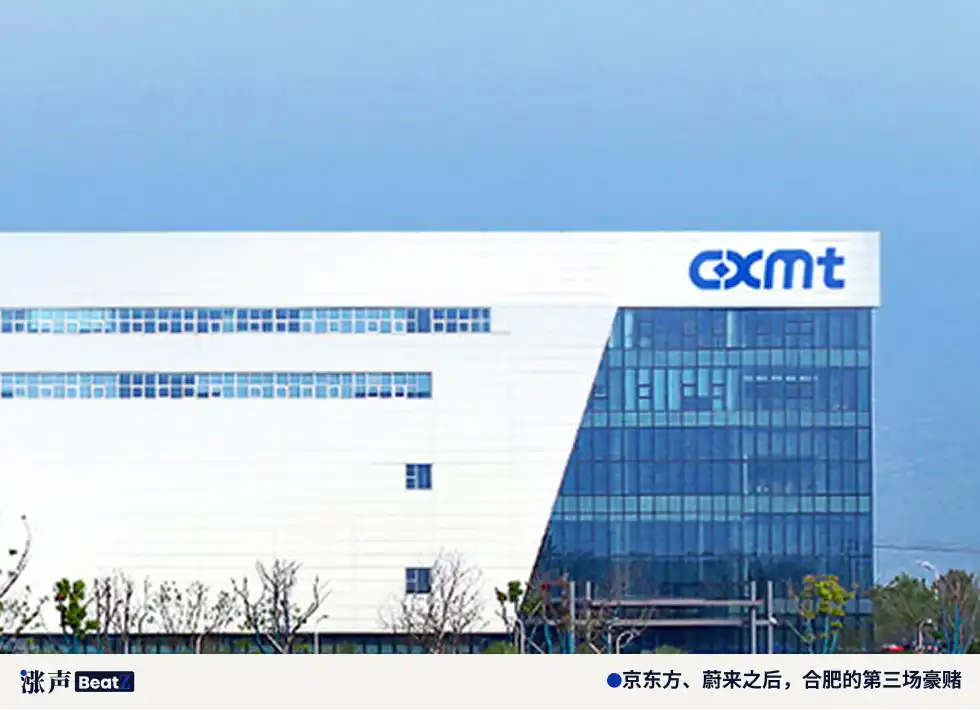
When it comes to the global storage industry, many people only know about Samsung, SK Hynix, and Micron. However, what many people don't know is that the company ranked fourth globally is an unlisted Chinese enterprise called ChangXin Memory Technologies (CXMT).
On July 9, ChangXin Technology updated its latest Sci-Tech Innovation Board IPO prospectus. Looking at the timeline, the IPO will open for subscription on July 16, with payments due on the 20th, and the earliest possible trading on the Sci-Tech Innovation Board by the end of the month.
China's leading storage giant will arrive by the end of the month.
Data shows that the forecasted revenue for the first quarter of 2026 is 50.8 billion yuan, a year-on-year increase of 719%. The net profit is 33 billion yuan. With a daily profit of nearly 400 million, its profitability surpasses that of Moutai, and the market has assigned a trillion-dollar valuation to it, potentially challenging the title of the largest A-share market value.
By the end of 2025, this company had accumulated losses of 36.65 billion yuan.
In other words, ChangXin Memory Technologies recovered nine years of losses in just half a year. This domestic chip company that has been losing money for nearly a decade has suddenly become one of the most profitable hard-tech companies in the A-share market.
Over the past week, the name ChangXin Memory Technologies has appeared frequently in global tech media. Apple is lobbying the U.S. government for a special license to include ChangXin Memory Technologies in the memory supply chain for Mac and iPad. Google has initiated an evaluation of ChangXin's DRAM for procurement, and there are reports that HP and Dell are validating ChangXin's DRAM. Acer and Asus are also requiring more adoption of local storage chips by Chinese partners. In the same week, Reuters revealed that Tencent had signed a long-term server DRAM supply agreement with ChangXin Memory Technologies for over 20 billion yuan, with a term of three to five years. The customer list disclosed in ChangXin's prospectus also includes Alibaba Cloud, ByteDance, Lenovo, Xiaomi, OPPO, vivo, and Honor.
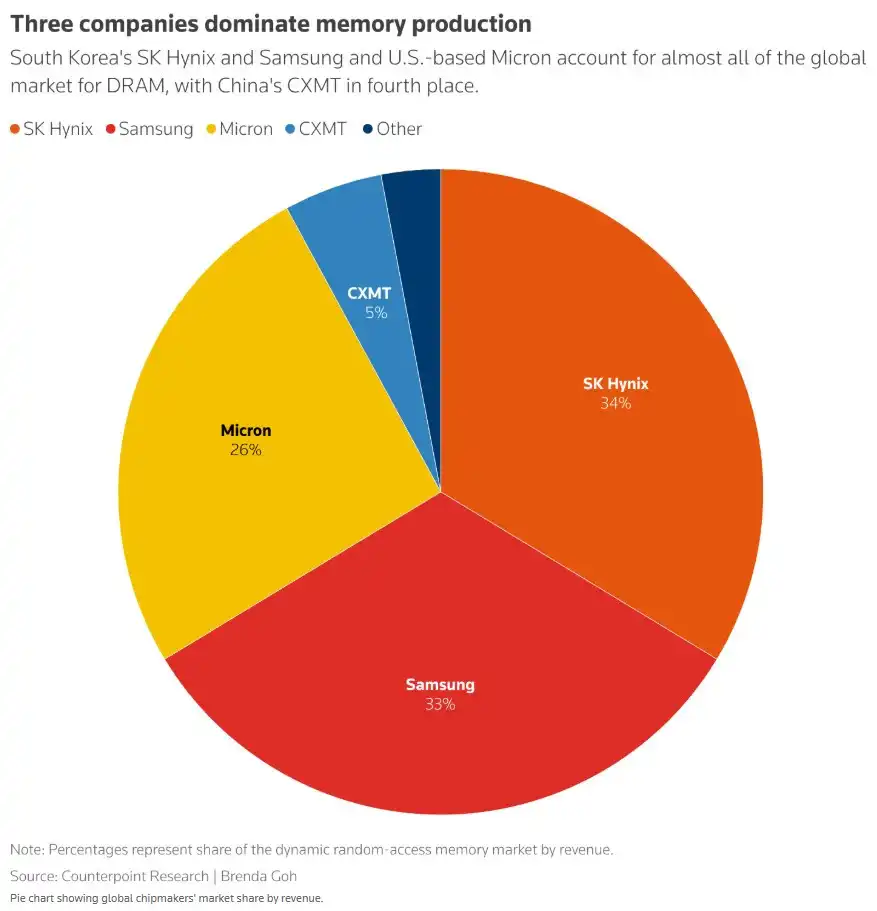
A leading global player in the memory production field, ChangXin, ranks fourth globally, following Hynix, Samsung, and Micron. Image Source: Reuters
At one moment, ChangXin Memory Technologies has become the darling of almost all major factories at home and abroad.
How did ChangXin manage to rise from nothing to become the fourth globally? How much of its current earnings are based on its strength, and how much on luck? Can its trillion-dollar valuation hold?
The Future of ChangXin Memory, Zhiyuan Innovation
To understand the origins of ChangXin Memory, we must first talk about why China has always been short of DRAM.
There are many types of memory chips. NAND Flash is non-volatile memory, used in devices such as mobile hard drives, SSDs, and USB drives. DRAM is volatile memory used during operation; data is lost when the power is off, but it is fast and serves as the workspace for CPUs, GPUs, mobile SoCs, and AI accelerator cards.
Both NAND and DRAM are bulk semiconductors, but DRAM is more like a steel plant with highly precise layering. Each generation of the process must push the capacitor, transistor, wordline, and bitline to the limit, and billions of uniform units must be replicated on a single wafer. A slight deviation leads to yield loss and cost escalation. When costs soar, coupled with a downturn in the memory market, money flows out like water.
This is why the DRAM market ended up with only three giants: Samsung, SK Hynix, and Micron. This game is not about simply saying, "I have a skilled technical team," but about enduring price wars, capacity wars, patent wars, equipment restrictions, and customer certifications over a period of more than ten years.
ChangXin Memory was initiated around 2016 and settled in Hefei. The key figure behind it is Zhu Yiming.
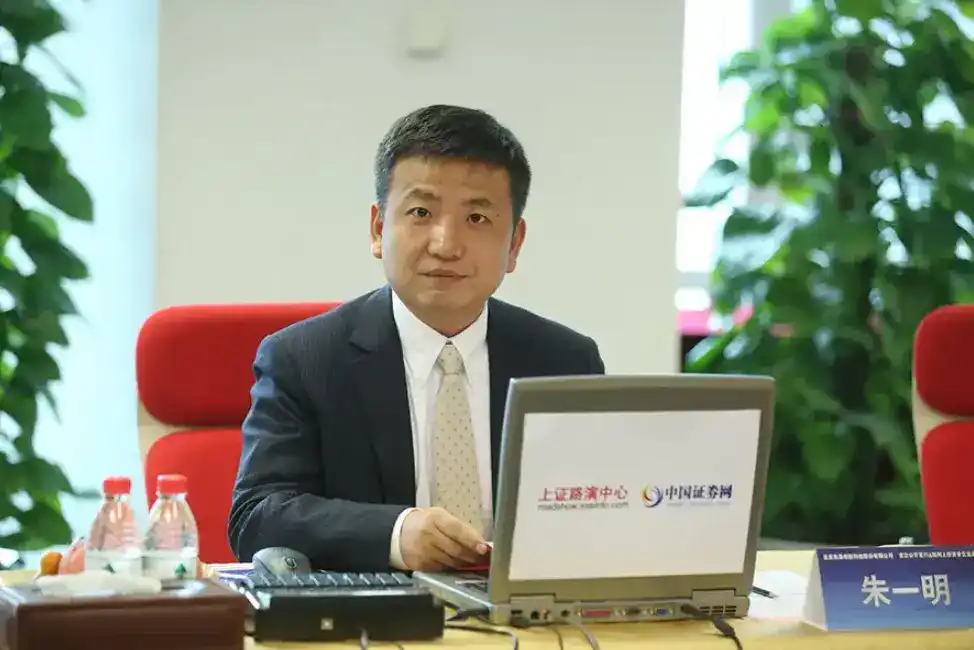
Zhu Yiming Conference Photo
The name Zhu Yiming is not unfamiliar in the Chinese semiconductor industry.
Zhu Yiming, born in 1972, was a teenage prodigy who entered the physics department of Tsinghua University at the age of 17. Although he studied physics, he excelled in programming. By helping other companies write programs, he earned over 300,000 yuan in just one year at the end of the 1990s. During his work, he realized that chips were all designed by the United States at that time. Believing that chip technology had higher value, he went to the United States to study electronic engineering. After graduation, he worked in Silicon Valley.
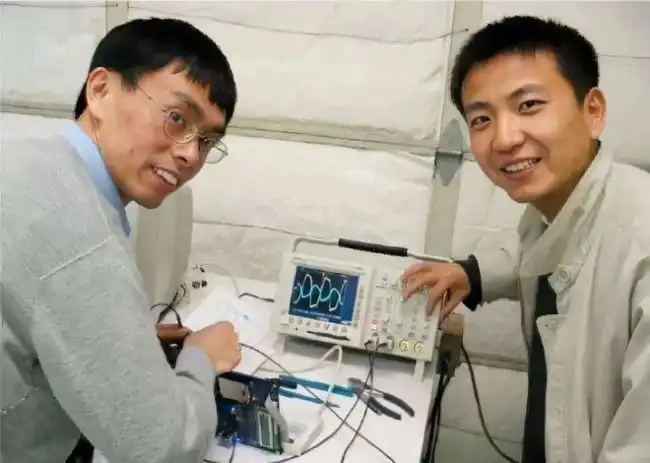
Zhu Yiming (right) Early Photo
In Silicon Valley, Zhu Yiming noticed that the storage industry had shifted from the United States to Japan, then to South Korea, and Taiwan, China. He believed that the mainland of China also had the opportunity to shine in the future and might even have the possibility of creating a "Chinese version of Samsung." He designed an SRAM (Static Random-Access Memory) chip, returned to China in 2005, and founded a company called Zhiyuan Innovation.
Zhaoyi Innovation has been a pure design company since its establishment, not producing chips on its own, with wafer manufacturing outsourced to foundries. Its main products are NOR Flash (storage chips used in routers and game console boot programs) and MCUs (microcontrollers that control refrigerators and washing machines). Zhu Yiming and his team developed China's first static RAM and IP technology, the first serial flash memory product, and the first 32-bit general-purpose MCU based on the ARM Cortex-M3 architecture. When it went public in August 2016, it was already the largest code-type flash memory chip design company in mainland China, with revenue growing from 14.89 billion RMB in the listing year to 92.03 billion RMB.
With light assets, high gross margin, and no need to build its own factory, this was the smartest way to operate in the Chinese IC design industry at the time.
However, this model had one premise: foundry capacity must be ample and prices stable. In the second half of 2020, Zhu Yiming encountered a hurdle. SMIC's 8-inch capacity was severely constrained, forcing Zhaoyi Innovation to transfer some NOR Flash orders to Huahong Semiconductor's 12-inch fab, increasing the outsourcing cost. The gross margin in the fourth quarter of 2020 plummeted from over 37% to 29.49%. The consequences of foundry capacity constraints were directly reflected on the profit and loss statement for the first time.
During the same period, Zhaoyi Innovation was also working on another acquisition deal. In 2019, it acquired Shanghai Silan Microelectronics for 1.7 billion RMB, a 16x premium, resulting in 1.305 billion RMB in goodwill. Silan Micro specializes in under-display fingerprint chips, and Zhu Yiming aimed to integrate memory, controllers, and sensors to create a platform-based design company. However, it was sued by Goodix Technology for patent infringement, leading to a price war. Silan Micro only achieved 58% of its three-year performance commitment. From 2020 to 2023, Zhaoyi Innovation has continuously impaired goodwill for Silan Micro for four years, totaling about 900 million RMB, with 1.3 billion RMB of goodwill almost entirely written off. The horizontal acquisition of another design company to expand its product line also proved unsuccessful.
The lesson Zhu Yiming learned from these two incidents is that the ceiling of a light-asset design company lies not in its design capabilities but in its production capacity. The real battleground for storage chips is not in the NOR Flash category, which only holds 2.5% of the global market, but in DRAM. Unlike NOR Flash that can be produced by general foundries, DRAM's process is highly proprietary, with each manufacturer's cell structure, capacitor design, and wordline process being customized. Samsung, SK Hynix, and Micron all operate on a design-manufacturing integrated model. To enter the DRAM market, the only path is to build its own fab.
This is the background and reason for the birth of ChangXin Storage.
JDI Uses、NIO followed by Hefei's Third Big Bet
SMIC's financial report and shareholder structure cannot withstand the investment scale of a DRAM fabrication plant. After all, with a Phase One investment of 18 billion RMB, a total investment exceeding a trillion, and consecutive losses for nearly a decade, this money can only come from another type of capital.
In 2016, the Hefei government extended an olive branch.
Hefei is often referred to in the market as the "city best at venture capital." Hefei's most successful venture capital story is BOE Technology, the starting point where this global leader in LCD panel shipments, with an annual revenue exceeding 200 billion RMB, and a Chinese panel company holding a 70% share of the global LCD market, is located in Hefei.
In September 2008, BOE Technology and Hefei signed a framework agreement for a 6th generation production line. The total project investment was 17.5 billion RMB, with a registered capital of 6 billion RMB contributed by Hefei, injected through a directed share issuance by BOE Technology and then entirely invested in the project company. Not only did Hefei provide a simple subsidy to BOE Technology, but it also used local platforms to hold shares, provide bridge financing, offer subsidized loans, and provide land and energy support, shouldering BOE Technology through the most difficult construction period. Building around BOE Technology, Hefei continued to attract glass substrates, polarizers, driver chips, equipment materials, and earned the title of the "City of New Display."
The second typical story is NIO. In April 2020, just as NIO had emerged from the brink in 2019, Hefei Construction Investment, Anhui Province Emerging Industry Investment, and others collectively invested 7 billion RMB in cash in NIO China. NIO China's headquarters settled in Hefei Economic Development Zone. Later, NIO became one of the representative brands of high-end electric vehicles in China, with a market value once surpassing $100 billion.
Seeking leading heavy assets, using transaction structures to replace simple subsidies, helping companies through the construction period, and then using these leading companies to drive the upstream and downstream to take root locally.
By 2016, Hefei continued the next bold bet using the same investment logic.
Yuan Fei, a key figure in the early days of Hefei Production Investment, later said: "Whether it's Hefei Production Investment or the industry side, everyone who participated in ChangXin's early days bore unprecedented risks and pressures."
After all, DRAM is more challenging than panels and complete vehicles, with higher risks in technology, equipment, yield, patents, and export controls. However, from the perspective of local industrial organization, just like BOE Technology and NIO, it is a short-term money-eating project, but if successful in the long term, it will significantly alter the supply and demand relationship of an entire industry chain.
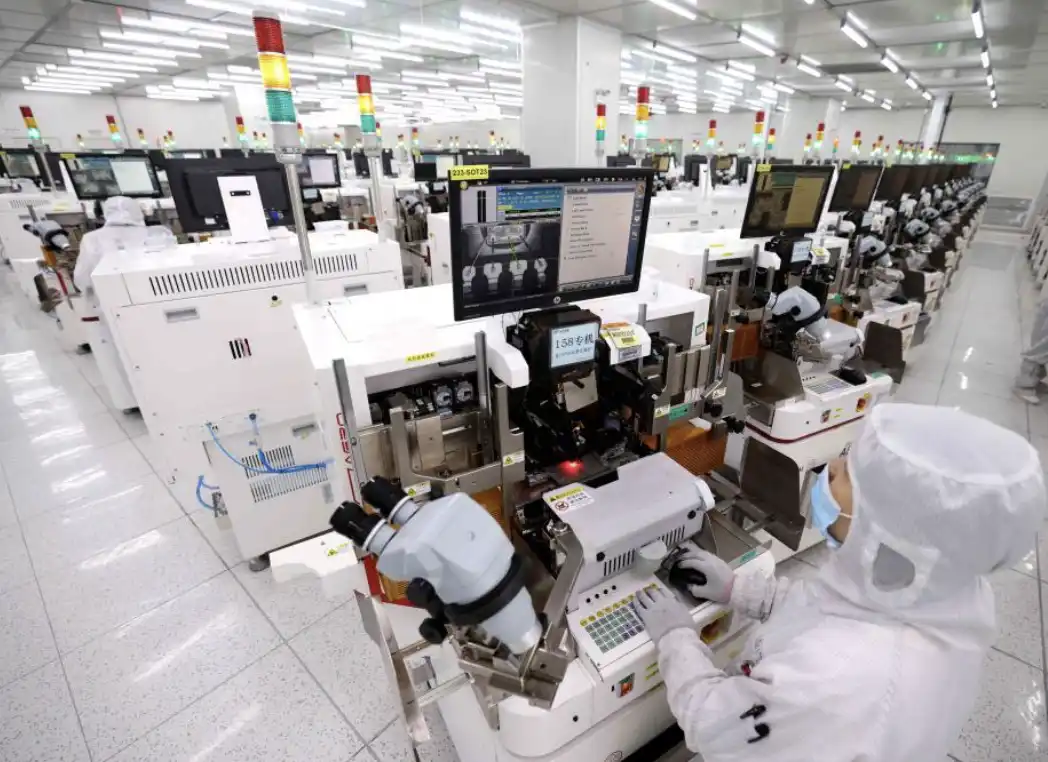
Hefei, Anhui, advances the semiconductor industry
Hefei Production Investment has invested 14.4 billion RMB in the first phase of ChangXin Memory, with a total project investment exceeding a trillion.
In July 2018, Zhao Weiguo announced his resignation as the CEO of Tsinghua Unigroup, retaining only the position of Chairman, and officially took on the role of Chairman and CEO of ChangXin Memory Technologies. The industry refers to this as Zhao Weiguo's "second entrepreneurial venture."
The current shareholder list already reveals the players in this gamble. The top five shareholders are Tsinghua Holdings at 21.67% (fully controlled by Hefei State-owned Assets), ChangXin Integrated Circuit at 11.71%, National Integrated Circuit Industry Investment Fund Phase II at 8.73%, Hefei Juxin at 8.37%, and Anhui Provincial Investment at 7.91%. Hefei State-owned Assets collectively hold over 36% of the shares.
Among other shareholders, Alibaba Cloud holds 3.85% (invested 6.1 billion yuan, corresponding to a valuation of 158.4 billion yuan), and Tsinghua Unigroup holds 1.8%. The list of investors also includes China National Integrated Circuit Industry Investment Fund, China Jianyin Investment, Junlian Capital, China Merchants Capital, Yunfeng Fund, Tencent, and Alibaba.
The money and influence are all in place. However, Zhao Weiguo, in his "second entrepreneurial venture," is still missing one thing: core technology.
The Technological Legacy of a Bankrupt German Company
Around 2016, Samsung, SK Hynix, and Micron collectively controlled over 90% of the global DRAM market, the result of a decade-long tournament of elimination.
The DRAM industry has been eliminating players every few years since the 1980s.
Japan once held over 80% of the global DRAM production capacity, but by the 2010s, only Elpida remained standing, ultimately acquired by Micron in 2012. Europe once had Qimonda under Infineon, which went bankrupt in 2009.
Zhao Weiguo's solution lies within this German company that went bankrupt in 2009.
The name Qimonda is a combination of two words. "Qi" is the Chinese word for "energy," symbolizing flowing energy. "Monda" is from Latin, meaning "world." The direct translation is "the key to open the world."
The name is beautiful. The company's fate was tragic.
Qimonda was spun off from its parent company Infineon in May 2006 and went public on the NYSE with the stock symbol QI on August 9 of the same year. By the time of its IPO, it was already one of the major global memory product suppliers and a leader in 300mm wafer manufacturing technology. By 2008, Qimonda had developed a 46nm stack technology based on Buried Word Line, increasing capacity by 100% compared to the previous 58nm technology, just short of mass production.
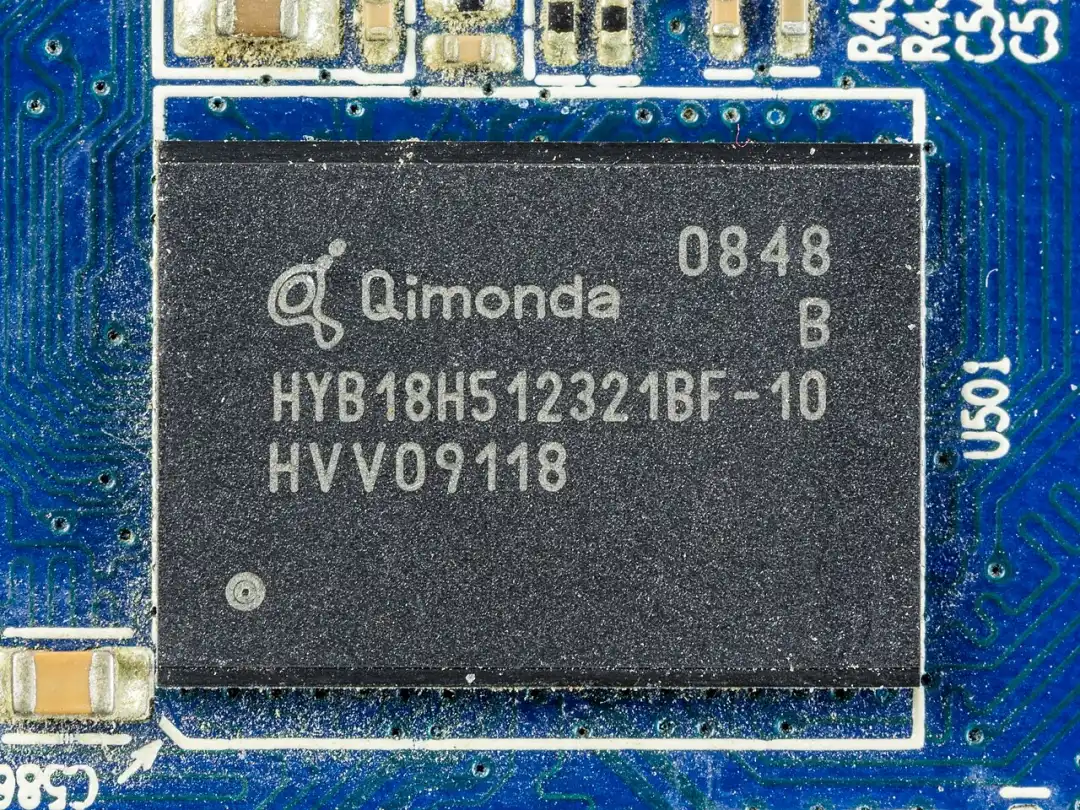
Qimonda DDR2/GDDR Chip Product Image
But then the financial crisis hit. DRAM prices plummeted, and Samsung ramped up production at a loss to squeeze out its competitors. Qimonda's new technology was not ready for mass production when the funding dried up. In 2009, the company went bankrupt. The last memory chip manufacturer in Europe went dark. The R&D center in Munich was left empty, 12,000 employees scattered, absorbed by Samsung, Micron, and SK Hynix. In 2012, Qimonda's bankruptcy trustee began selling off 7,500 patents.
Zhu Yiming saw his opportunity in this history.
Qimonda died from the market cycle, not from its technology. The 2.8TB of technical documents and tens of thousands of patents it left behind were a legacy that had been shelved for nearly a decade. In today's DRAM products from Samsung, Micron, and SK Hynix, traces of Qimonda's buried shared bitline and honeycomb capacitor structure can be found, indirectly entering the three giants' processes through partners like UMC and Winbond.
But how to obtain this legacy and how to use it to build a fab posed a significant challenge, given the brutal lesson learned in the past.
For China, 2016 was the "first year" of the memory resurgence. Prior to this, the Chinese DRAM industry had declined across the board, facing technological monopolies from American and South Korean foreign companies, leaving China powerless to fight back.
At that time, when China launched its memory national champions, in addition to ChangXin Memory Technologies (CXMT), there were two other paths: Wuhan XMC making NAND Flash and Fujian Jinhua Integrated Circuit making DRAM.
In 2017, Micron sued both UMC and Jinhua in the United States and Taiwan simultaneously, alleging that three former Micron employees who had moved to UMC had stolen Micron's DRAM trade secrets, with one individual accused of taking more than 900 technical documents. In October 2018, the U.S. Department of Commerce placed Fujian Jinhua on the Entity List citing national security reasons, leading to export controls. UMC subsequently announced the suspension of its technical cooperation with Jinhua. With equipment cut off and technical cooperation frozen, the project came to a standstill. The U.S. Department of Justice also filed criminal charges against Jinhua and UMC, accusing them of economic espionage and facing fines of over $20 billion. It was not until the end of 2023 that Micron and Jinhua reached a global settlement, ending a six-year dispute.
Jinhua's lesson was clear: embroiled in disputes related to Micron's trade secrets, it was added to the Entity List, resulting in equipment cutoff and project suspension. A new DRAM company that steps on the landmine of intellectual property rights will find itself shunned by commercial customers, starved of equipment supply, and entangled in international lawsuits, eventually leading to its demise.
Therefore, when the Qimonda trustee began selling 7,500 patents, Zhu Yiming quickly made his move, acquiring over a million DRAM technology documents (about 2.8TB of data), while there were already 16,000 patent applications. He then spent around $2.5 billion on a comprehensive redesign of the original architecture, advancing Qimonda's 46nm process all the way to the 10nm level. Subsequently, he signed patent license agreements with WiLAN's subsidiary Polaris and the U.S. company Rambus to complement around 5,000 U.S. patents and applications.
Initially, among the three domestic storage routes, Hefei Changxin was the least promising. Wuhan Yangtze Memory had the backing of Tsinghua Unigroup, and Fujian Jinhua, near Taiwan, had relatively advanced technology. In comparison, Hefei had no advantage.
However, no one expected Changxin's production speed to be so rapid, a rarity in the entire semiconductor industry.
Established in 2016, the 12-inch wafer fab construction was completed in just 14 months. In January 2018, Phase 1 of the fab was completed, and equipment installation began. By the end of 2018, the 19nm 8Gb DDR4 engineering samples were rolled out. In the first half of 2019, 15,000 test wafers were completed.
On September 20, 2019, at the World Manufacturing Convention, Changxin announced the official mass production of 8Gb DDR4 using the 19nm process. This was China's first self-developed DDR4 memory chip. The Phase 1 design capacity was 120,000 wafers per month, with a total investment of about 150 billion RMB, making it the largest single industrial project investment in Anhui Province. In the same year, LPDDR4X went into mass production.
Wei Shaojun, leader of the National Key Project 01 Expert Group and director of Tsinghua University's Institute of Microelectronics, commented: This marks China's achievement of mass production technological breakthrough in the memory chip field, establishing independent production capacity for this key strategic component, something that has never happened before.
But mass production is not the end. DRAM customers will not place orders after just one demo. Mobile phone, PC, and server manufacturers need to validate stability, compatibility, lifespan, temperature, voltage, and failure rate, and also assess mass production consistency. Changxin's most challenging period is from 2020 to 2023: ramping up production capacity, customer validation, process iteration, enduring continuous losses, and facing escalating U.S. export controls.
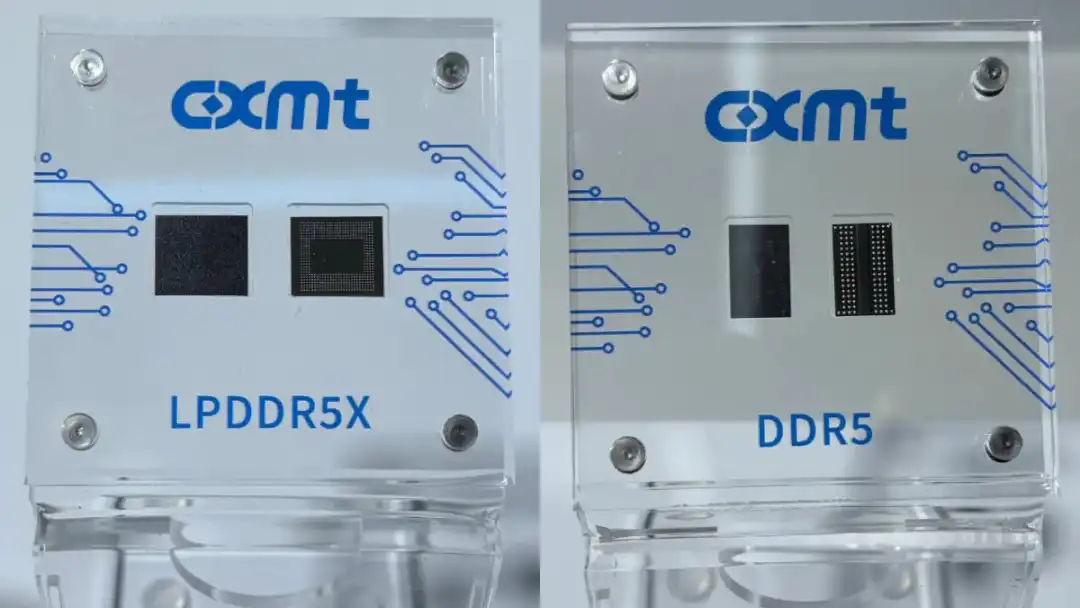
Changxin LPDDR5X, DDR5 display samples
By 2025, Changxin had completed mass production of the first to fourth generation process technology platforms. High value-added products such as DDR5 and LPDDR5 saw a significant increase. In November, it launched new DDR5 chips and modules with a maximum speed of 8000Mbps and a maximum single chip capacity of 24Gb. The industry's evaluation is close to the high-end products of Samsung and SK Hynix. In 2026, it is accelerating the reduction of DDR4 capacity, fully transitioning to DDR5 and LPDDR5. It is expected that more than 90% of its capacity will be allocated to the new process throughout the year.
STAR Market IPO, Impacting A-Share Market Cap Leader
On December 30, 2025, Changxin Technology Group submitted an IPO application to the STAR Market of the Shanghai Stock Exchange, becoming the first project accepted after the pilot IPO pre-review mechanism of the STAR Market. It plans to raise 29.5 billion RMB, setting the record for the highest planned fundraising amount in a STAR Market IPO, second only to SMIC's actual fundraising of 53.2 billion RMB in 2020. The sponsoring institutions are CICC and CSC Financial, the accountants are Deloitte, and the lawyers are King & Wood Mallesons.
The IPO process experienced a setback. In March 2026, the audit was suspended due to outdated financial data. The prospectus was updated on May 17, and the audit resumed. On May 27, it passed the review of the Listing Committee of the SSE and submitted the registration on the same day. The process took 148 days from acceptance to approval.
Use of funds: 7.5 billion RMB for the storage wafer manufacturing line technology upgrade project, 13 billion RMB for the DRAM memory technology upgrade project, and 9 billion RMB for forward-looking technology research and development projects. The total investment amount is 34.5 billion RMB. The market generally expects the company to be listed officially in August 2026.
The current valuation anchor is the last round of financing before the IPO: Alibaba Cloud invested 6.1 billion RMB to acquire a 3.85% stake, corresponding to a total valuation of 158.4 billion RMB.
However, the market's expectations far exceed this number. Institutions estimate Changxin's net profit attributable to shareholders in 2026 to be between 150 billion and 200 billion RMB. Based on a P/E ratio of 20, the market capitalization corresponds to 3 trillion RMB, with some institutions even suggesting over 4 trillion RMB. From 158.4 billion to trillion-level valuations, this range can be seen as a stress test by global capital on China's memory industry.
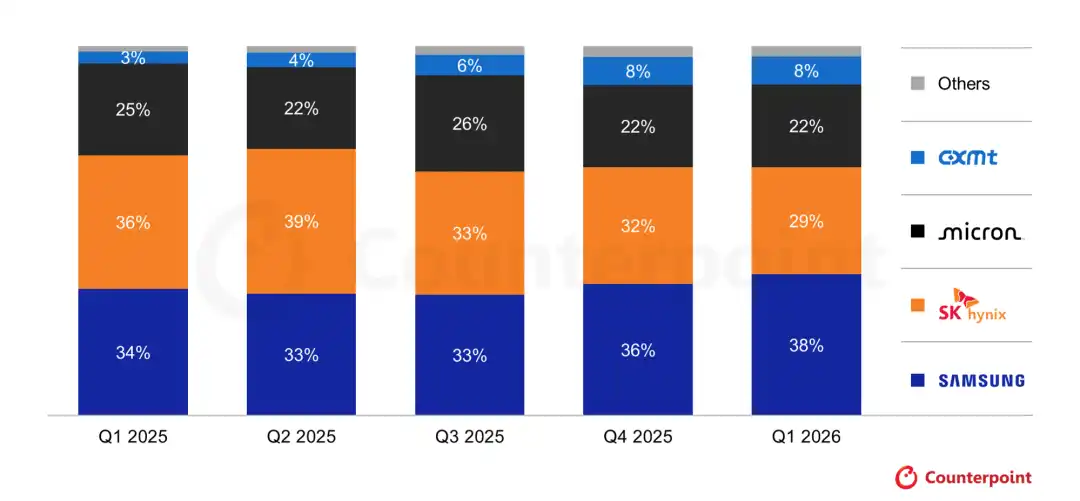
Global DRAM revenue market share from 2025 to the first quarter of 2026, Changxin's share increased from 3% to 8%, Source: Counterpoint Research
Xperi's financial trajectory may also be the most dramatic turnaround in the A-share semiconductor sector.
A loss of $8.3 billion in 2022. A loss of $16.3 billion in 2023. A loss of $7.1 billion in 2024. Capital expenditures over the three years were $43.7 billion, $71.2 billion, and $49.7 billion, respectively. The accumulated loss by the end of 2025 was $36.65 billion.
Then the supercycle of memory storage arrived. Starting in the second half of 2025, global DRAM faced a supply shortage, leading to a significant price surge. The National Development and Reform Commission's Price Monitoring Center pointed out that from September 2025 to February 2026, both DRAM and NAND prices hit their highest levels since 2016. TrendForce data shows that DRAM contract prices in the first quarter of 2026 increased by 93% to 98% compared to the previous quarter. Goldman Sachs raised its full-year price increase expectation for 2026 from 150% to 250% to 280%.
Xperi rode this price wave. In the entire year of 2025, the net profit attributable to equity holders was $1.875 billion, marking the first profit turnaround. An explosion occurred in the first quarter of 2026: revenue of $50.8 billion, a net profit of $33 billion, and a net profit attributable to equity holders of $24.8 billion. The company expects revenue in the first half of 2026 to be between $110 billion and $120 billion, with a net profit attributable to equity holders of $50 billion to $57 billion.
Recovering the losses of nine years in half a year. However, a calm analysis reveals that the current profit mainly stems from the cycle.
In the first quarter of 2026, Xperi's actual shipment volume only increased by about 11%. The average selling price rose by about 57%. The quarter-over-quarter growth rates of ASP in the first two quarters were 63% and 68%, respectively. Profit improvement mainly came from the upturn in DRAM prices, rather than Xperi suddenly catching up with the big three in terms of cost, yield, and product structure.
This is a crucial point that all investors must soberly consider when evaluating Xperi's valuation: in today's windfall profits, the cyclical contribution outweighs structural progress. Pricing Xperi as a "steady growth stock" may lead to an overestimation of profit sustainability. Understanding it as an "emerging variable in the cycle" brings us closer to the truth.
However, Xperi will face many challenges in the future.
At 54 years old this year, Zhu Yiming has been on the semiconductor path for 37 years since entering Tsinghua University at the age of 17. Zuel Innovation proved that Chinese people can design memory chips, while Xperi Memory proves that Chinese people can manufacture memory chips.
Samsung used loss-making expansion to kill Qimonda during the 2008 financial crisis and a price war to force Elpida into a corner in 2012. When the next downturn cycle arrives, Xperi will also sit at the same table facing more threats.
By then, what will determine Changxin's fate is not today's daily profit of $400 million, but rather its yield rate, customer stickiness, product line breadth, and the thickness of its cash reserves.
After all, during the same period, Samsung's operating profit is about $260.4 billion, and SK Hynix's is about $183.6 billion. Changxin's scale still lags by an order of magnitude, leaving plenty of room for growth.
Zhu Yiming understands this better than anyone.

Welcome to join the official BlockBeats community:
Telegram Subscription Group: https://t.me/theblockbeats
Telegram Discussion Group: https://t.me/BlockBeats_App
Official Twitter Account: https://twitter.com/BlockBeatsAsia

 Related Articles