Goldman Sachs Insight: On the Eve of Microsoft's Earnings Report, Can Azure's High Growth Support AI Investment?

TL;DR
· Goldman Sachs maintains a Buy rating on Microsoft with a $610 price target, implying about 59% upside based on the July 9 stock price.
· Azure growth remains a financial report highlight, with Goldman Sachs expecting a 40%-41% growth rate in the fourth quarter, higher than the company's previous guidance.
· Increased capital expenditure will amplify the return rate debate, while Copilot fees, Maia chip, and new capacity release are yet to materialize.
Goldman Sachs maintained a Buy rating on Microsoft ahead of the company's fourth-quarter earnings report on July 29 and provided a 12-month target price of $610, while also raising expectations for medium to long-term capital expenditures. For investors, the focus of the financial report is not whether Microsoft is the AI winner, but rather whether Azure can maintain high growth while continuing to increase computing power, and whether higher data center, chip, and power investments can be translated into revenue instead of weighing down free cash flow and profit margins.
Behind the $610 Price Target, Azure is Expected to Continue Outperforming Expectations
As of July 9 UTC, Microsoft's stock price was approximately $383.34. Based on this price, the $610 price target represents about 59.1% potential upside.
This calculation is based on several conditions: cloud demand maintains high growth, new data center capacity comes online as planned, Microsoft's internal AI development and external customer computing allocation do not squeeze each other, and AI products like Copilot start contributing more clear revenue and profit.
Azure is still the focus of the financial report.
Microsoft's FY26 Q3 official call showed that Azure and other cloud service revenue grew 40% year-over-year or 39% on a constant currency basis. The company's previous FY26 Q4 guidance was for a constant currency growth of 39%-40% and stated that customer demand continues to exceed available capacity.
Goldman Sachs' report states that Azure's year-over-year growth in Q4 is expected to reach 40%-41% on a constant currency basis, with the next quarter's guidance also likely to remain at 40%-41%. This forecast is slightly higher than the company's previous guidance, but market expectations are already high. If Microsoft only delivers cloud growth that meets high expectations, the stock price may not necessarily continue to support further AI investment.
Microsoft also needs to explain where the growth is coming from. It could be from new data center capacity releases, continued expansion of enterprise AI demand, or smoother computing resources allocation between internal applications and external customers.
Over the past few quarters, the constraint on Microsoft's AI business has not been insufficient demand but rather supply constraints. Azure must serve external clients like OpenAI while also supporting Microsoft's internal Copilot, MAI model development, and first-party applications. When computing resources are tight, cloud growth is limited by delivery capabilities. If capacity release is too slow, capital expenditure will first reflect in cash flow and depreciation pressures.
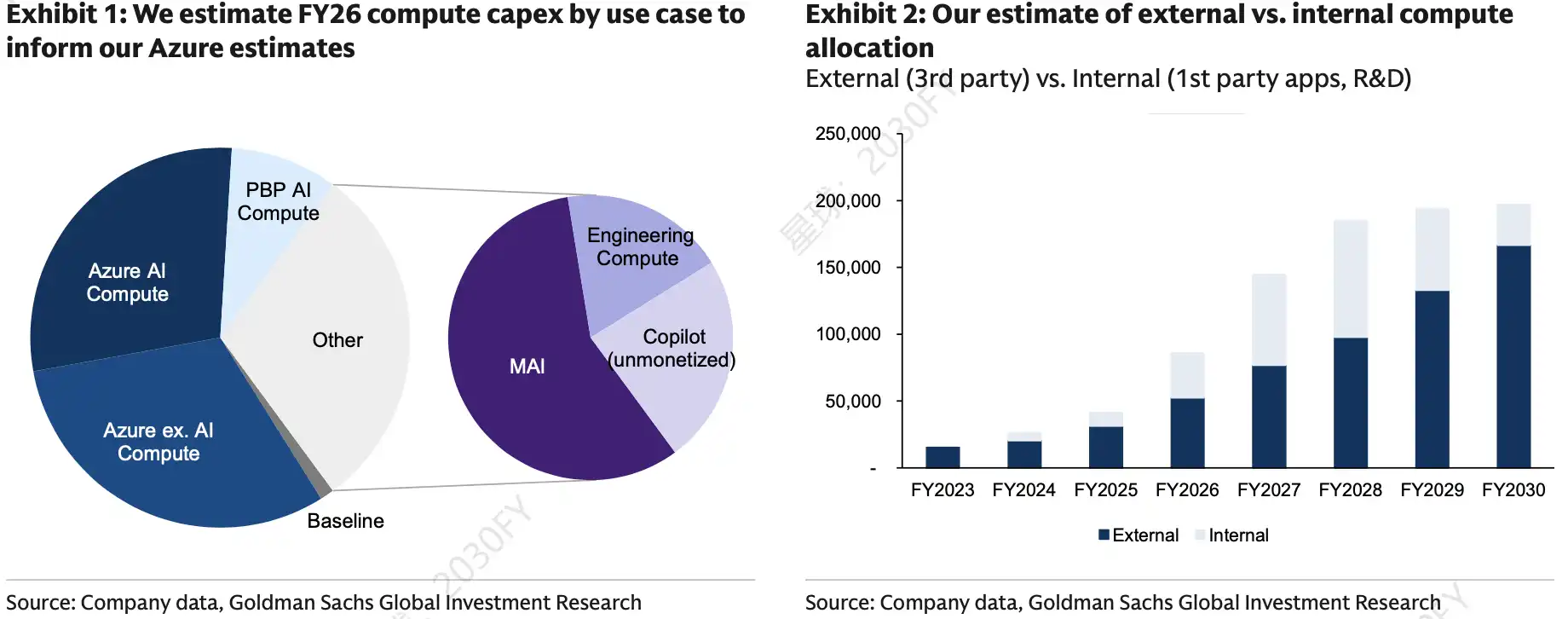
Microsoft's FY26 Compute Capex Breakdown by Use Case and External/Internal Compute Allocation. High proportions are allocated to AI Compute, MAI, Copilot, etc., with internal compute investment stabilizing after a 12-month uptrend, a key factor in assessing Azure's ability to simultaneously support customer demand and internal AI research and development.
Capital Expenditure Continues to Increase, AI Compute Race Shows No Sign of Cooling
Microsoft has signaled increased investment. FY26 Q3 capital expenditure was $31.9 billion, with guidance that Q4 capital expenditure will exceed $40 billion and an outlook for approximately $190 billion in calendar year 2026, including around $25 billion from higher component prices.
A Goldman Sachs report stated that Microsoft's FY28-30 capital expenditure expectations have been raised by about 10%. According to the report's calculations, the adjusted annual capital expenditure is assumed to be higher than the market's consensus expectations, reflecting a more aggressive view on Microsoft's future compute investment.
This is not a decision exclusive to Microsoft. Guidance from chip manufacturers such as NVIDIA, Broadcom, AMD, as well as capital actions from cloud and internet giants like Google and Meta, all indicate that the demand for AI compute has not significantly cooled off. Super-scale cloud providers are still preparing to expand data centers, chips, and power resources for the coming years.
For Microsoft, high investment has a dual nature.
On one hand, Azure and AI product cycles continue to be valuation supports. The Goldman Sachs report suggests that by the middle of 2030, Microsoft's compute capacity could potentially expand to around 40GW. On the other hand, the higher the capital expenditure, the more investors will question whether the additional compute can translate into cloud revenue, AI subscriptions, and higher-margin businesses, rather than just bringing heavier depreciation and cash flow pressures.
The Goldman Sachs report also predicts that Microsoft's FY26 revenue will be $329.4 billion, with an EPS of $16.75, FY27 revenue will be $387.1 billion, with an EPS of $19.32. These forecasts imply the premise that AI investments can both drive revenue and not continue to suppress profit release speed.
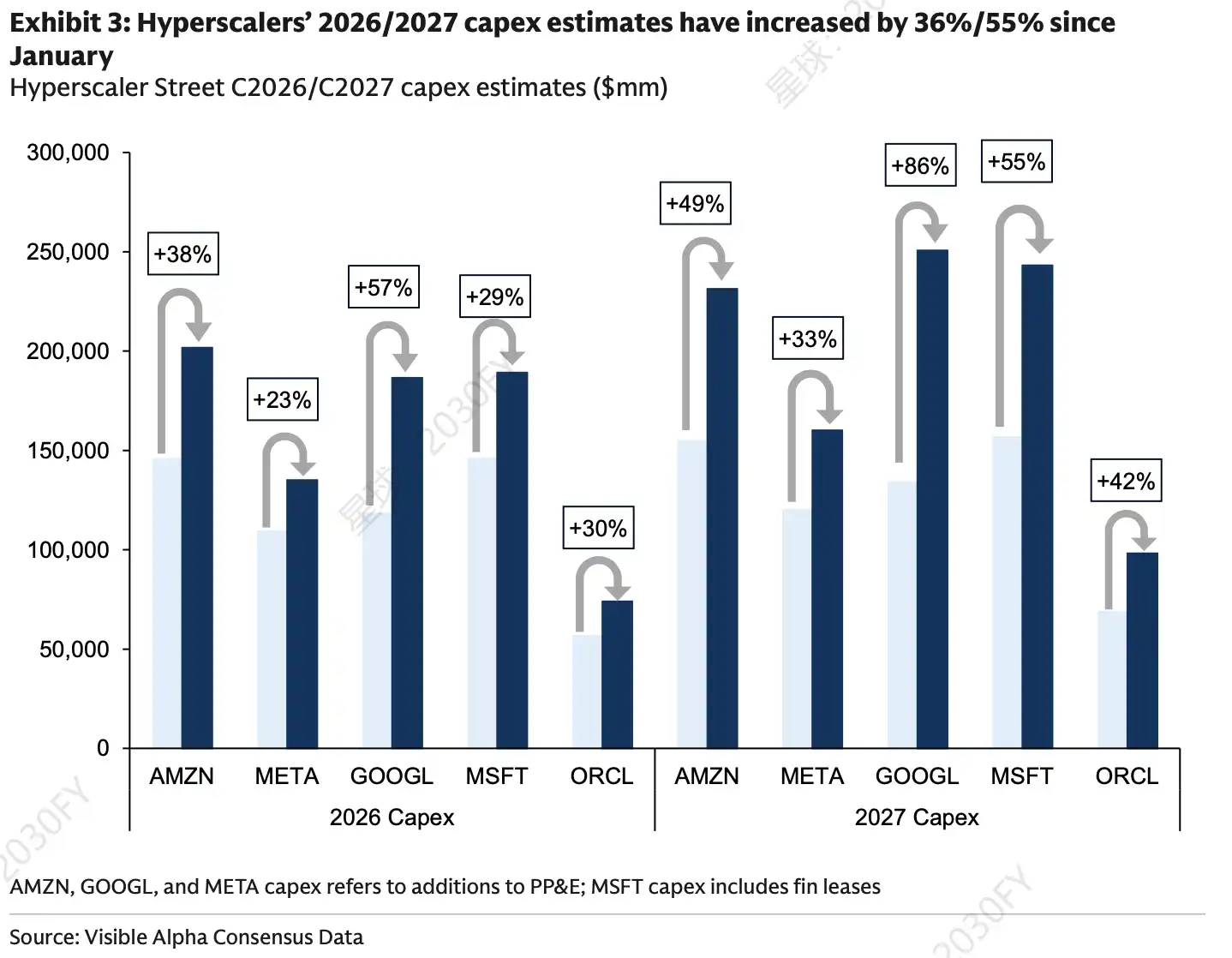
Super-scale cloud providers Street Capex Expectations for 2026/2027. Since January, capital expenditure expectations for AMZN, META, GOOGL, MSFT, ORCL have all been significantly raised, with MSFT's 2027 expectations increasing by 55%.
Copilot to Introduce Fees, Maia to Reduce GPU Dependency
Microsoft's AI investment success ultimately hinges on two key factors: the monetization of Copilot and the maturity of in-house chip development and alternative chip supply.
The logic behind Copilot's monetization is relatively clear. Long-term growth in usage is beneficial for expanding software revenue and may also help improve the profit margin. However, the short-term challenge lies in the fact that increased usage does not directly translate to realized revenue.
Microsoft's FY26 Q3 report revealed that M365 Copilot's paid seats have surpassed 20 million. GitHub Copilot is also shifting towards more usage-based and value-based pricing. The company has also introduced fair usage terms for high-usage scenarios, attempting to closely tie higher inference costs to the payment mechanism.
The market is not just looking for continued seat growth, but also for user engagement, renewal willingness, and actual enterprise payment expansion. If Copilot's user experience and monetization pace cannot improve in sync, the realization of AI software's high gross margin may be delayed.
Another aspect is the chip and supply chain strategy. Microsoft's in-house AI chip Maia is still playing catch-up, lagging behind some competitors in maturity. Improvements to Maia 300, progress in production with AMD as a second source, and memory procurement costs will all affect Microsoft's ability to reduce reliance on external GPU supply chains.
The company has previously mentioned that additional supply needs to be balanced across Azure, first-party applications, R&D, and server replacements. If the new supply is released smoothly, Microsoft can deliver more computing power to external Azure customers while continuing to invest in internal AI development. If the release is uneven, there will still be pressure among Azure growth, internal model training, and Copilot inference demands.
Xbox Restructuring Just Touches Valuation Perimeter
Outside the AI mainline, a Goldman Sachs report also estimated Microsoft's gaming business to be worth around $30 billion using the SOTP method.
On July 6, Microsoft announced a restructuring of its Xbox business. Several media reports indicated that Microsoft is laying off approximately 4,800 employees, with around 1,600 immediate layoffs in Xbox and an additional 3,200 expected by FY27. Studios like Compulsion, Double Fine, Ninja Theory, and Undead Labs have departed from the Xbox management system, and the company has reportedly streamlined some of its management structure.
This segment appears more like a business realignment and is not the focal point of financial transactions. Microsoft's gaming business still holds value, and the restructuring demonstrates the company's efforts to streamline inefficient assets and reduce some non-core investments. However, in the short term, it is unlikely to replace the key drivers of Azure, Copilot, and AI capital expenditure returns as the main factors explaining the direction of the stock price.
According to a Goldman Sachs report's Sum-of-the-Parts valuation, Intelligent Cloud remains the largest contributor to Microsoft's enterprise value. The implied enterprise value of the M365 Commercial and Consumer business is approximately $492.0 billion, corresponding to about 4x EV/Sales or 6x GAAP EBIT by 2027, incorporating a certain degree of derisking assumption.
Can $610 Be Achieved? Depends on Three Things
The outlook presented in this earnings preview still leans optimistic: Microsoft is well-positioned in AI horsepower, Copilot, and the agent orchestration layer, with the opportunity to continue benefiting from the AI product cycle. However, whether the $610 price target can be achieved depends on whether the earnings report and conference call can provide more verifiable progress.
Azure needs to sustain its high growth and clarify whether the new capacity can support external customer demand post ramp. If the growth merely aligns with already high market expectations, increased capital expenditure might ironically become a point of contention.
M300 and AMD as the second source need to present clearer progress. Supply chain tightness, rising memory costs, and chip immaturity will all affect the unit economics of Microsoft's AI investments.
Copilot must demonstrate real monetization capability. Surpassing 20 million paid seats is just the beginning; expansion of enterprise-side monetization, usage-based billing, and user feedback will determine whether it can evolve from an AI onramp to a revenue stream.
The key point of Microsoft's earnings report is not whether AI investment will continue, but whether increased investment can translate into accelerated Azure growth, AI software revenue, and sustainable profit margins. If this evidence remains insufficient, the debate over capital expenditure ROI will continue to weigh on the stock price.
Welcome to join the official BlockBeats community:
Telegram Subscription Group: https://t.me/theblockbeats
Telegram Discussion Group: https://t.me/BlockBeats_App
Official Twitter Account: https://twitter.com/BlockBeatsAsia
 Related Articles