Syntiant's AI Chip Story to IPO, Initially Propped Up by a Microphone

When Syntiant submitted its S-1 to the SEC, the keywords were clear. With entities related to Intel and Microsoft participating in funding rounds, specializing in AI chips and software, the company is preparing for a listing on the Nasdaq Global Market under the ticker symbol SYTN.
A detail in the prospectus stands out. According to Syntiant's S-1 filing, in the most recent quarter, around 95% of the company's revenue came from sensors, specifically digital and analog sensors. The majority of these sensors came from the consumer MEMS microphone business of Knowles, an acoustics components company acquired by Syntiant at the end of 2024.
This twist gives Syntiant's IPO story a bit of a tangled narrative. While the capital market sees the AI chip label, the income statement propped up in the S-1 is all about microphones.
The filing fee table indicates that the maximum offering amount is $100 million. This is the registration fee calculation basis and does not equate to the final amount raised. The initial S-1 does not yet provide the offering price range or the number of shares to be issued.
For the three months ending on March 31, 2026, the company's net loss was $20.88 million, with a net loss attributable to common stockholders of $26.21 million.
So, how does this company actually make money?
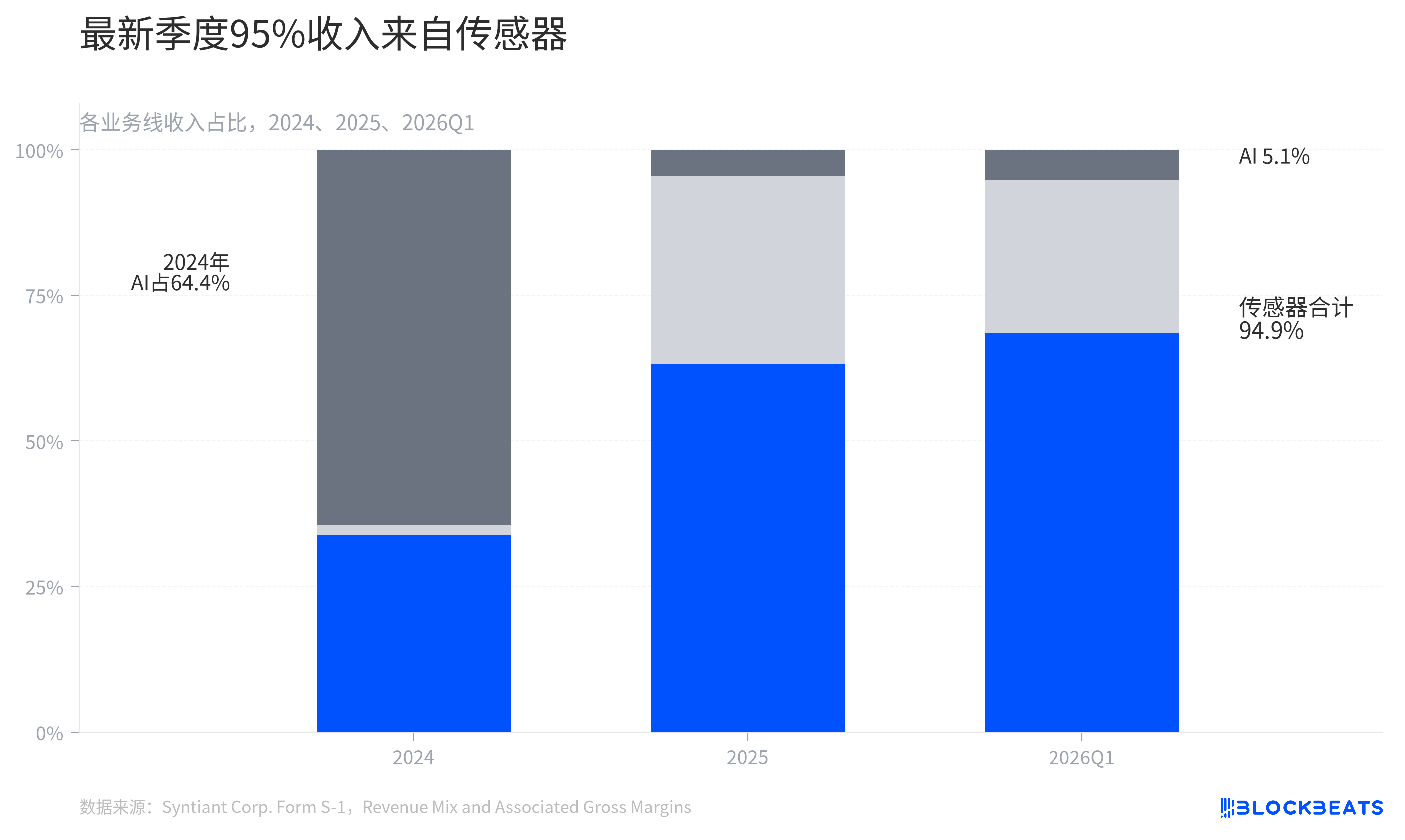
Syntiant's early revenue structure indeed resembled that of an AI chip company. The S-1 shows that in 2024, the AI business accounted for most of the company's revenue. By the first quarter of 2026, the AI business represented only around 5%, and digital and analog sensors combined to form the true revenue foundation.
This shift cannot simply be explained with the phrase "business diversification." The AI line still exists and remains the future story Syntiant wants to tell, but the revenue statement has been taken over by something else. For investors, this is akin to walking into a company labeled with AI but finding that the hottest item at the counter is microphones.
Why did revenue suddenly surge? The answer also lies in this acquisition.
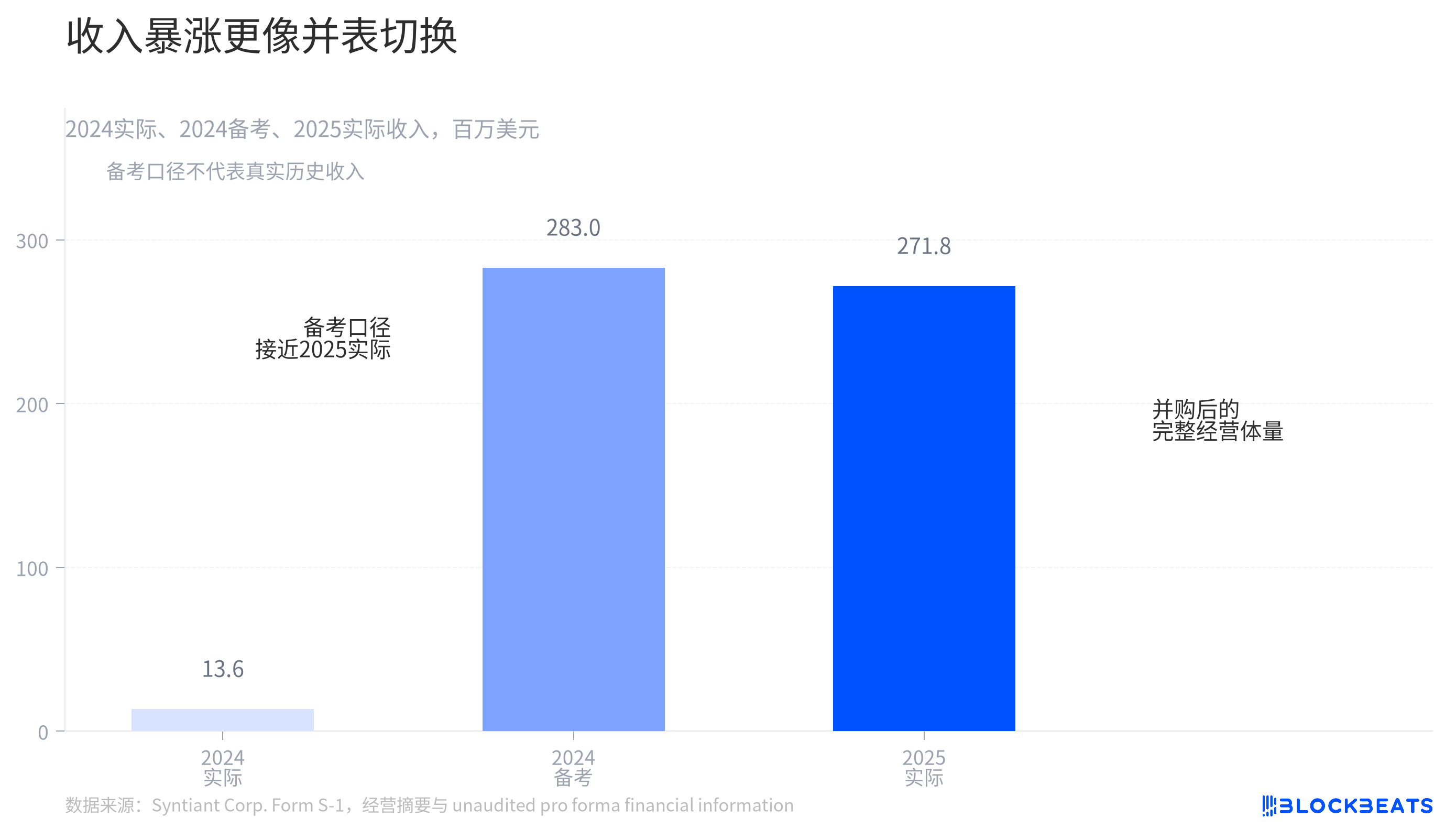
The S-1 shows that Syntiant's revenue in 2025 reached $272 million, approximately 20 times the actual revenue in 2024. Looking at these numbers alone, one could easily interpret it as substantial growth in the AI business.
However, the S-1's footnotes provide a different perspective. Assuming that Knowles' consumer MEMS microphone business was merged from January 1, 2024, Syntiant's pro forma revenue for that year would be close to $283 million. This calculation is not actual historical data but rather spreads the impact of the acquisition over the entire year. It indicates that the revenue leap in 2025 mainly resulted from an operational volume shift due to the acquisition and not a sudden surge in the existing business.
This is also the key contrast in this S-1. AI is the narrative; Knowles' sensor business brings the scale.
The problem is, scale does not equal quality.
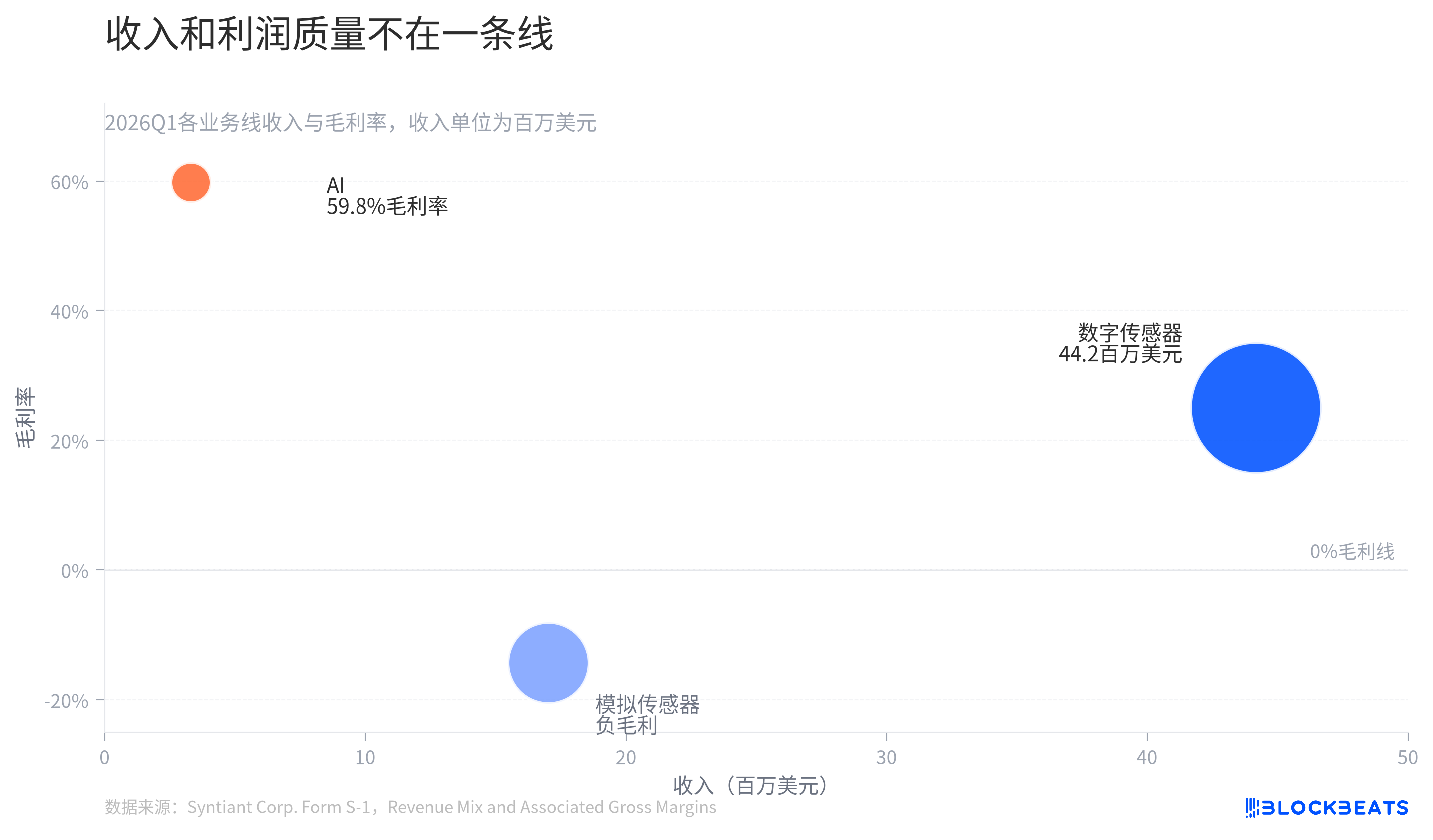
The S-1's segmented gross margin table shows that in the first quarter of 2026, the AI business's gross margin was close to 60%. This is the most attractive of the three business lines, but with a very small revenue volume.
The digital sensors that contribute the majority of the revenue have a gross margin of only about one-quarter. Analog sensors are even more troublesome, with a negative gross margin during the same period. In plain business terms, the most profitable counter is still very small, the busiest counter has a thin gross margin, and the other counter is still in the red.
However, this does not mean that the sensor business has no value. It has brought customers, shipments, cash receipts, and a revenue scale that can be demonstrated at the time of listing for Syntiant. In the S-1, Syntiant also mentioned that sensor shipments exceeded 1 billion units in 2025. For a chip company that only had early AI revenue, it is difficult to talk about scale in the same way.
But the sensors also bring the story back to reality. In the first quarter of 2026, the company's total revenue was $64.5 million, with a net loss attributable to common stockholders of $26.21 million. Pre-IPO, Syntiant is not a company that has already proven a profitable model with AI chips but a company that has combined sensor scale and AI options in the same prospectus.
Why does it still talk about Physical AI?
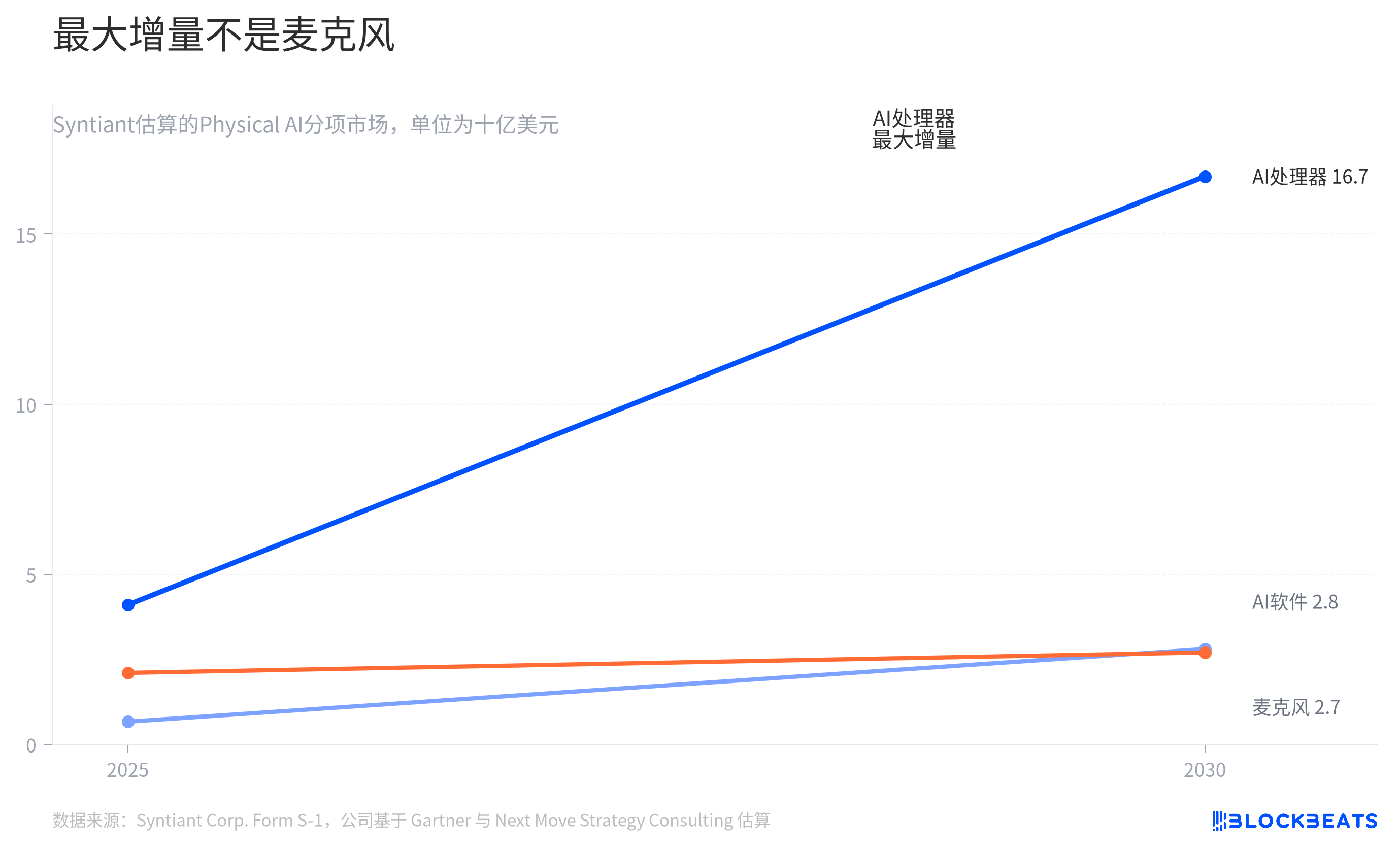
The answer lies in the market space narrative. In the S-1, Syntiant estimates that the total addressable market related to Physical AI will increase from $7 billion in 2025 to $22 billion in 2030. This estimate is based on relevant data from Gartner and Next Move Strategy Consulting and company calculations, not an independent third-party valuation endorsement for Syntiant.
Breaking it down, what Syntiant most wants to approach is AI processing semiconductors and AI software models. The company estimates in the S-1 that the former will reach $16.7 billion by 2030. In comparison, the MEMS microphone market will only reach $2.7 billion during the same period, with a much lower compound annual growth rate.
This explains why a company whose current revenue is supported by microphones still writes its prospectus as a Physical AI story. The microphone business is responsible for thickening the financial statements, while the AI chips and software are responsible for expanding the market's imagination.
The names of Intel and Microsoft also need to be seen in this context. The S-1 filing shows that the Series D-1 funding round totaled approximately $79.9 million, with Intel Capital purchasing about $2.5 million and Microsoft Global Finance purchasing about $2.96 million. This indicates their participation in the funding and shareholder structure, but it should not be written as if they dominated the company.
Syntiant's IPO is not just a story of an AI chip going public. It is more like a company that acquired revenue through a microphone and then placed itself back on the shelf of Physical AI.
Welcome to join the official BlockBeats community:
Telegram Subscription Group: https://t.me/theblockbeats
Telegram Discussion Group: https://t.me/BlockBeats_App
Official Twitter Account: https://twitter.com/BlockBeatsAsia