South Korea's Stock Market Turns into "Squid Game": Samsung and SK Hynix Support Stock Prices While Foreign Investors Retreat
TL;DR
· According to WSJ estimates, the KOSPI surged by around 165% in the past year, but foreign investors net sold about $100 billion worth of KOSPI stocks in the first half of 2026.
· Samsung Electronics and SK Hynix led the index's movements, with single-stock leveraged products further amplifying chip stock volatility for retail investors.
· Korean regulators have warned about excessive leverage risks, suggesting that while the market may not immediately reverse, the pullback losses are more likely to be borne by local investors.
According to a July 6 article in WSJ Markets A.M., the South Korean benchmark stock index KOSPI has surged by approximately 165% in the past year, becoming one of the most eye-catching major indexes globally. On the other hand, foreign investments have been retreating from the market's highs. Data from the Korea Exchange indicates that foreign investors net sold about 1.48 trillion to 1.5 trillion Korean won worth of KOSPI stocks in the first half of 2026, equivalent to about $950 million to $1 billion. Those who continue to chase the market within Korea are increasingly local retail investors and individuals leveraging single-stock products for amplified gains.
The stars of this bull market are not hard to find. Samsung Electronics and SK Hynix have benefited from demand for AI servers, high-bandwidth memory, and have been seen as vital gateways for Asian AI trading funds. The issue arises when index gains, foreign divestment, and retail leverage all occur almost simultaneously. When the market is led by a few chip stocks, and the volatility is amplified by high-risk products, the Korean market appears more like a high-reward, high-elimination game: everyone wants to enter when it's rising, but the sharper question is, who will bear the brunt of liquidation and losses when it retraces.
Surged by Around 165% in a Year, but KOSPI's Volatility Far Exceeds that of the U.S. Stock Market
The KOSPI's surface performance is remarkably stunning. Based on WSJ estimates, it has surged by approximately 165% in the past year. Public market data also affirm Korea's stock market's significant upturn over the past year. Data from The Korea Fund shows that the KOSPI rose by 75.6% throughout 2025, closing at 4214 points at the end of 2025. According to Korean media MK, from January 2, 2026, to July 1, 2026, the KOSPI surged from 4309.63 points to 8476.48 points, marking roughly a 96.6% increase.
However, this has not been a smooth steady uptrend. The WSJ article references market data from FactSet and others, stating that in the past year, KOSPI experienced 77 instances of at least a 2% single-day fluctuation, with 44 instances exceeding 3%, and 23 instances exceeding 5%. In contrast, during the same period, the S&P 500 index only experienced 5 instances of at least a 2% single-day fluctuation, with very few instances surpassing 3% or 5%.
For short-term funds, high volatility itself is attractive. For ordinary investors, a single directional error may quickly erase previous gains. The Korean market is not solely driven by macro expectations but is increasingly influenced by a few heavyweight stocks. After the rise in the weighting of Samsung Electronics and SK Hynix in the index, the AI chip narrative will amplify the profit-making effect and also spread selling pressure across the entire index when expectations loosen.
Two Chip Stocks Support the Market, Leveraged Single Stock Products Add Fuel
The core of this Korean market rally is the AI chip supply chain. Samsung Electronics and SK Hynix have benefited from data center investments and high-performance memory demand. For many investors, investing in the Korean market is to some extent a bet on the continued surge in AI memory demand.
The market heat is not only coming from spot stocks. Leveraged single stock products around SK Hynix and other individual stocks are making the rally more exciting and the market more fragile.
The most prominent is the 2x leveraged daily product that tracks SK Hynix. Its mechanism is straightforward: if the underlying stock rises during the day, the product seeks to provide approximately twice the daily return; if the underlying stock falls, the loss will also be magnified. Since such products usually require daily rebalancing, when the stock price experiences significant fluctuations, the product's own buying and selling demand may continue to drive market volatility.
Prior to the approval of similar local products in Korea, some investors participated in trading through products listed in Hong Kong, China. According to the Hong Kong Exchanges and Clearing Limited and CSOP, there are already products such as "CSOP SK Hynix Daily 2x Leveraged Product" in the Hong Kong market. With the strong performance of SK Hynix's stock, these tools quickly became popular, becoming a gateway for retail investors to chase after chip stock resilience.
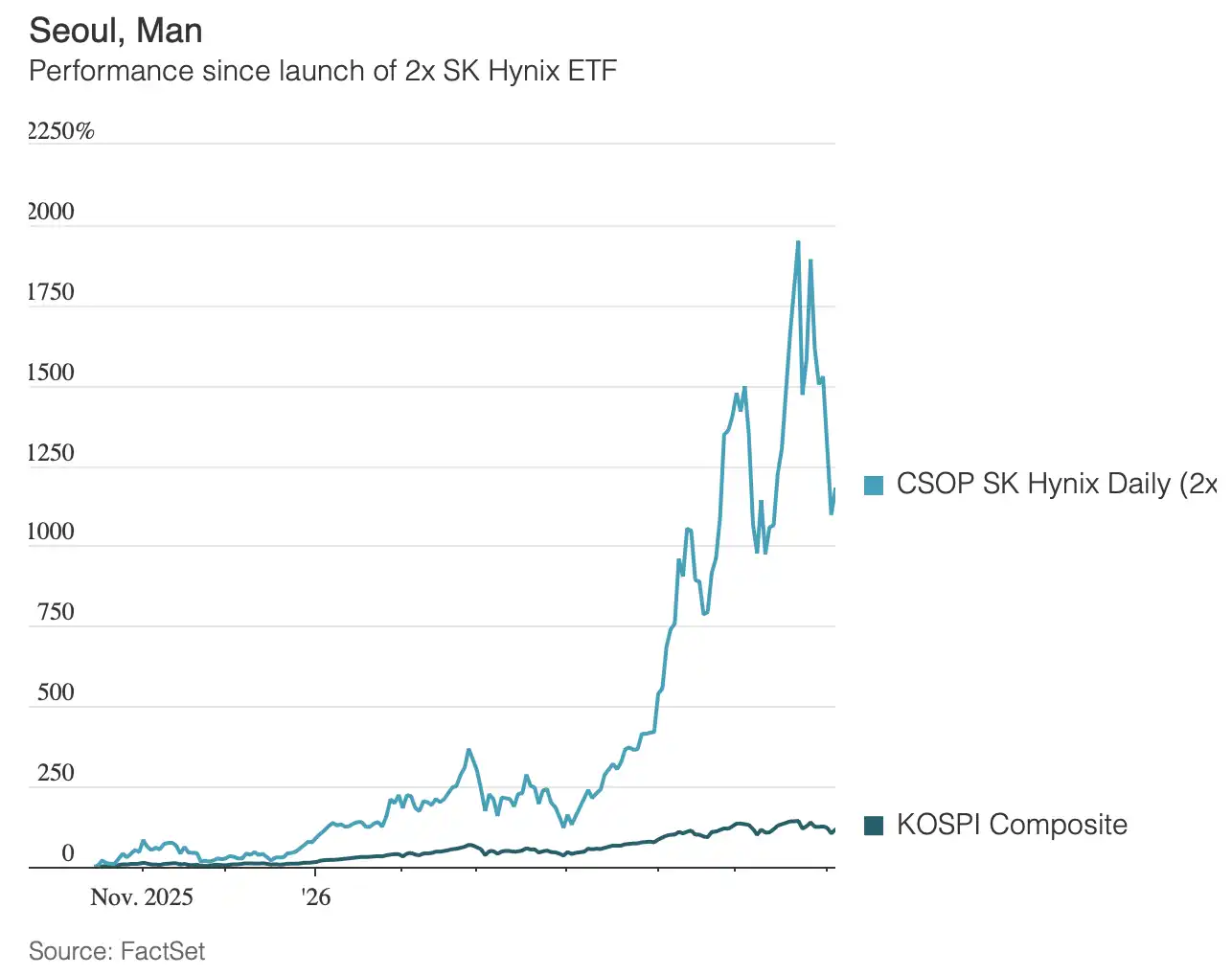
The Korean financial regulatory agency has begun to warn of risks. According to Aju Press, the Financial Supervisory Service of Korea convened institutions on June 17th, highlighting concerns about concentrated bets and excessive leverage. The combined assets of 16 local single stock leverage and inverse ETFs amount to approximately 11.3 trillion Korean won, with a daily average turnover of about 8.3 trillion Korean won, where the SK Hynix single stock leverage ETF turnover at one point was equivalent to 37.7% of the spot market turnover.
This is also the origin of the "Squid Game" metaphor. Maxence Visseau, founder of Arkevium Capital, described in a WSJ article that for a group of thrill-seeking retail investors, "volatility itself is attractive." However, daily leveraged products do not equate to holding stocks long term. A volatile market will incur losses, and in the face of a significant retracement, investors bear not the ordinary stock decline but amplified losses.
Foreign Investors Sell-off Focused on Semiconductor Stocks, While Local Funds Take Over in High-Volatility Market
The most conflicting aspect of this round of the South Korean stock market is that when the index showed astonishing gains, foreign investors did not continue to increase their holdings but rather significantly sold off KOSPI stocks.
According to the Korea Exchange, in the first half of 2026, foreign investors net sold approximately 148 trillion to 150 trillion Korean won worth of KOSPI stocks. Reports from SBS indicate that foreign investor sell-offs were concentrated in two major semiconductor stocks, Samsung Electronics and SK Hynix, which together accounted for about 92% of the foreign net selling amount. MK also reported that Samsung Electronics and SK Hynix saw foreign net selling of 72.6 trillion Korean won and 57.1 trillion Korean won, respectively.
The monthly data also shows that the pressure has not eased. According to Aju Press, foreign investors sold about 47.02 trillion Korean won worth of South Korean stocks in May, equivalent to approximately $30.5 billion. As of the 26th of June, KOSPI still saw significant net selling by foreign investors. It's important to note that these numbers mainly refer to South Korean listed stocks and do not equate to all South Korean assets, as foreign investors were still buying South Korean bonds in some months.
As a result, there has been a divergence in fund structure. While foreign investors remain cautious towards high concentration and high volatility, local retail investors continue to chase after the hottest chip stocks and leverage tools. Regulatory authorities may require more comprehensive risk disclosure, investor education, and suitability management. However, the risk does not come from a single product but rather from several overlapping factors: index reliance on a few chip stocks, the AI narrative attracting chasing funds, leverage tools amplifying short-term volatility, and foreign investors reducing their stock exposure.
As long as the market continues to rise, these factors will be perceived as a strong trend. However, once the trend reverses, they could all become amplifiers of the downturn.
The Market Trend May Not End Immediately, Loss Allocation Issue Has Come to the Forefront
The South Korean market has not yet experienced a crash, and the AI memory demand has not been disproven. Samsung Electronics and SK Hynix remain key players in the global semiconductor supply chain, and AI server construction continues to support high-bandwidth memory requirements. Describing this market rally simply as the eve of a bubble burst would be inaccurate.
The more realistic issue is, after the significant gains, high volatility, and with chips increasingly concentrated in the hands of local retail investors and leverage products, who bears the risk.
South Korea's story has also sounded an alarm for the U.S. market. The U.S. market is larger and deeper, and while similar products may not currently dominate the index trend, the weight of large-cap tech stocks and the AI narrative in the index is equally high. Investor demand for high-elasticity products is also on the rise. When a single theme, a few leaders, and leverage tools are tied together, market upswings can be rapid, and risk accumulation can occur just as quickly.
In the short term, whether the South Korean market can continue its momentum depends on AI chip demand, the profitability of Samsung Electronics and SK Hynix, the return of foreign capital, and whether regulations can cool down high-leverage trading. The issues left by the withdrawal of foreign capital will not disappear automatically. When retail investors are willing to buy the dip, the market looks like a casino; only when the tide turns against them, and the real decision on loss allocation is made, will we reach the final level of this "squid game."
Welcome to join the official BlockBeats community:
Telegram Subscription Group: https://t.me/theblockbeats
Telegram Discussion Group: https://t.me/BlockBeats_App
Official Twitter Account: https://twitter.com/BlockBeatsAsia