Apple announced a price hike, but consumers ended up footing the bill for AI expansion
Original Title: "iPhone Hasn't Increased in Price Yet, But It's Coming Soon"
Original Author: Su Yang, Tencent Technology
「When consumers need devices, but supply is reduced, and memory manufacturers are passing on significant price hike pressure. We absolutely need memory pricing and supply to return to a reasonable level for consumer products. This is the bottom line.」
On June 17th, in an interview with The Wall Street Journal, Apple CEO Cook discussed the cost pressure from memory price increases, but at that time, products had not yet increased in price.
Less than a week later, on June 25th, Cook was interviewed by The Wall Street Journal again, referring to the cost shock as a "once-in-a-century flood," saying, "In more than 40 years, I have never seen a situation like this in any area."
Musk promptly agreed on social media, saying, "Cook told The Wall Street Journal that this surge in costs is something he has 'never seen in over 40 years in any area'. Neither have I; this is the most intense price surge I've ever seen."
Subsequently, Apple announced price increases across its entire product line, including Mac, iPad, HomePod, Apple TV, and Vision Pro. Looking back at the two interviews, it seems more like a prelude to a product price adjustment.
Just the day before Apple took action (June 24th, local U.S. time), Micron announced its latest quarterly performance: a gross margin of 84.9%, revenue quadrupled, and the stock price surged 16% after hours. The next day, Apple's stock price fell by 6.1%, with a market capitalization evaporating over $100 billion, marking its largest single-day decline since April 4, 2025.
Upstream memory manufacturers are making huge profits, while downstream Apple is forced to pass on the costs.
An Apple spokesperson stated in a price increase announcement: "The rapid expansion of AI data centers has led to a sharp increase in demand for memory and storage chips. We have never experienced such a rapid and substantial increase in component prices. Previously, we have always tried to avoid passing on this part of the cost to consumers. But under the current circumstances, we have had to adjust prices for multiple products."
Lei Jun, Richard Yu, not a single one isn't saying "it's tough," and now it's Cook's turn to complain.
01 Backlash of Price Pressure
Taking the iPad and Mac products sold in mainland China as an example, the starting price of the Mac product line has increased by various amounts, ranging from 900 yuan to 3500 yuan, and the starting price of the iPad product line has increased by various amounts, ranging from 800 yuan to 1800 yuan. The Vision Pro has also increased in price, previously priced at 29,999 yuan, and now priced at 31,999 yuan, an increase of 2000 yuan.
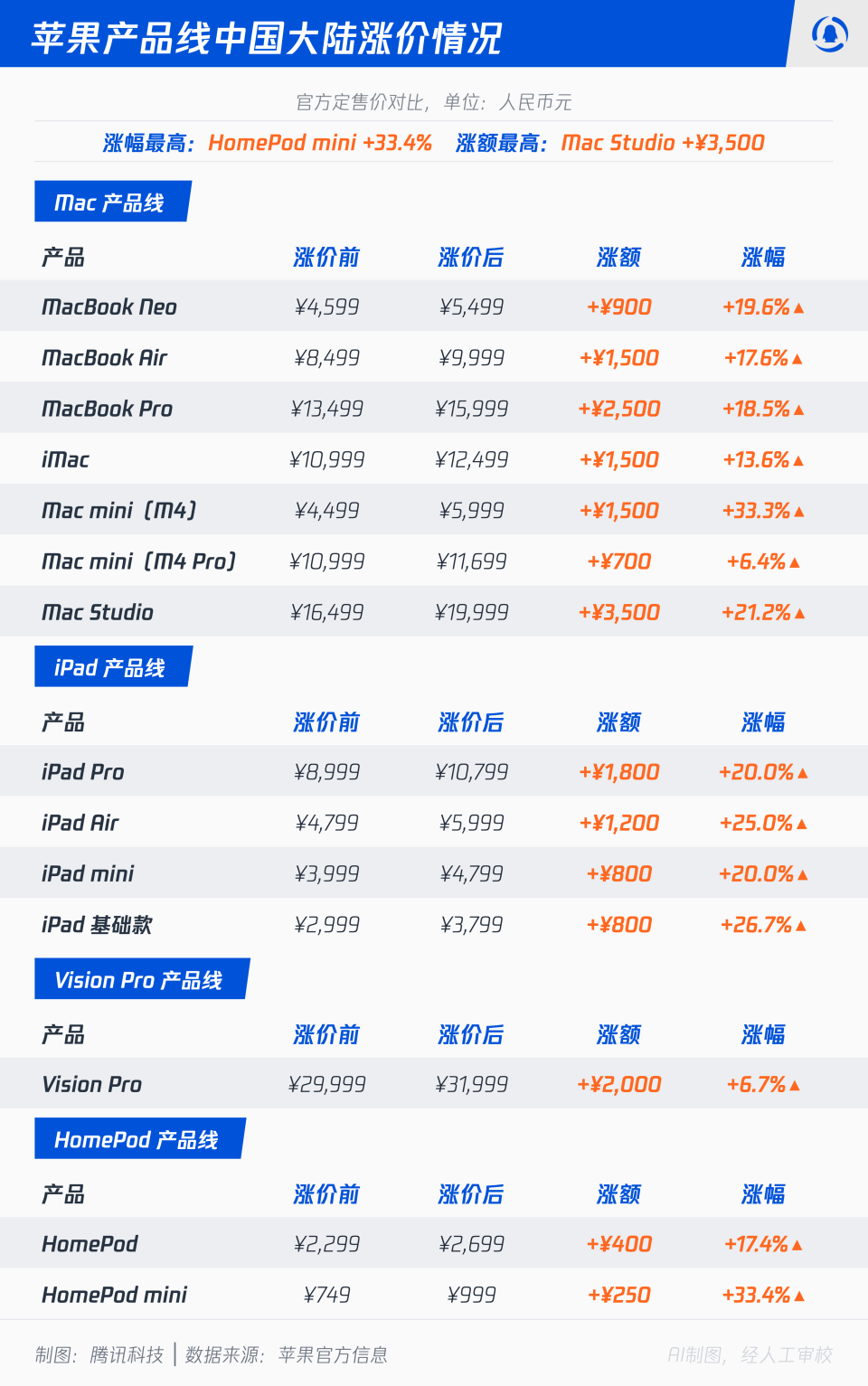
Apple's Price Hike Details
However, Apple has never in its modern history implemented such a large-scale price increase across most of its product line. Looking back at Apple's product pricing, at most there has only been a slight increase, such as last year's iPhone 17 Pro seeing a modest $100 bump.
Counterpoint's Research Director David Naranjo expects that other PC and tablet brands will also follow Apple's lead by raising prices on some products, reducing entry-level model discounts, or further shifting the product focus towards the high end.
The cost pressure mainly stems from the skyrocketing prices of DRAM memory and NAND storage chips, a well-known industry trend. In the last quarter, Counterpoint even mentioned in a report that, apart from price hikes, configuration adjustments and product line reductions are viable options for OEMs in response.
Data from market research firm TechInsights shows that prices of these two types of storage chips have quadrupled over the past 12 months.
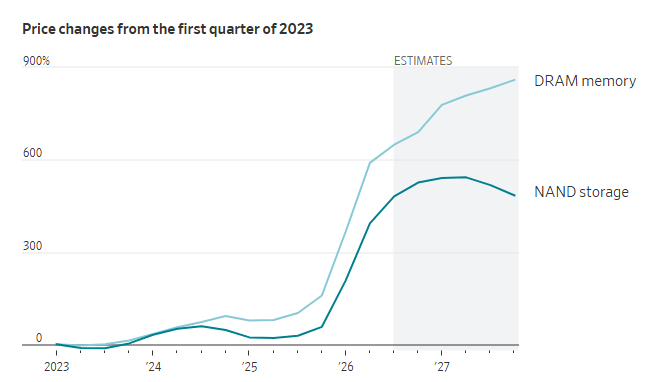
DRAM and NAND Price Increase Trend Since Q1 2023
Micron executives also acknowledged during the earnings call that the tight supply situation will persist beyond 2027. Just three months ago, their assessment was only "until the end of this year."
Interestingly, Micron this time publicly blamed large customers' pricing pressure tactics as the "main culprit" behind the memory price surge.
Sumit Sadana, Micron's Chief Business Officer, said in a post-earnings call interview that during the last memory market downturn, certain major customers aggressively pressured prices, causing Micron's gross margin to turn negative, which in turn hindered capital investment.
Who are these major customers? Some analysts' comments may provide the answer.
Patrick Moorhead, Founder and Chief Analyst of Moor Insights & Strategy, stated: "In this round of memory manufacturers' retaliation, it all came down on Apple. Most of Micron's revenue growth this quarter resulted from price increases rather than volume growth. The price hike has harmed OEMs, ultimately impacting consumers. Is it regrettable? Indeed. But it is important to see the other side of the story. When memory manufacturers' profit margins plummeted by 80% at one point, OEMs continued to push for price reductions, which in itself is a double-edged sword."
Counterpoint Research Vice President Neil Shah pointed out that Apple has maintained stable prices for at least two quarters, but its cost absorption capacity has now reached its limit.
He explained, "An unprecedented AI infrastructure boom is reshaping the global semiconductor supply chain. The AI expansion is driving continuous growth in demand for DRAM, NAND, and compute chips, but capacity is struggling to keep up. This supply-demand crunch is unlikely to see significant improvement for at least the next two years."
Apple's response to a price hike doesn't seem to have a specific timeline either. In its latest statement, a company spokesperson concluded, "We know this is not a popular message, and we are working hard to find a solution."
Cook had already issued a cautionary statement during the April-end second-quarter earnings call, saying, "We are far from being able to say that this situation will end soon."
02 Why Didn't the iPhone Increase in Price
Evercore ISI analyst Amit Daryanani pointed out in a research report, "While a price increase would help protect gross margins, raising prices during a product cycle is extremely unusual for Apple and also increases the risk of resistance to Mac and iPad demand."
The decision to postpone an iPhone price increase is aimed at maintaining the stability of Apple's core product line—on one hand, avoiding the revenue impact from raising prices on the core iPhone product line, and on the other hand, offsetting the negative impact on gross margins from the increase in material costs through price hikes on products like Mac and iPad.
Cook had previously explained the difference in impact between the iPhone and Mac. The iPhone's impact due to the memory issue is less than that of the Mac, with its main challenge being the shortage of main device processors. However, he also indicated that supply constraints may continue for "several months."
Apple has left a clear expectation in its price hike statement: "It has reached a point where many products need to be priced higher." CNET contributing editor Scott Stein emphasized, "They are waiting until the fall to remove this 'temporarily not raising prices' bandage." He added, "I don't think any Apple product will be able to escape this round of price increases."
Market research firm IDC predicts that all new iPhone models will be upgraded to 12GB of RAM to support the full Apple Intelligence feature set. On-device AI features require more significant memory support, and the new Siri experience can only run on updated hardware.
The institution also assessed that, thanks to a more diverse product lineup and the anticipated launch of a foldable iPhone, the average selling price of Apple's phone will increase by 12% this year.
The September product launch event will be a key test of this assessment.
Bloomberg further reinforced the price hike expectations — Apple is expected to launch a foldable model in September with a price tag that could exceed $2,000, along with the new iPhone 18 Pro and 18 Pro Max featuring higher-cost camera components. "We expected iPhone prices to rise, possibly targeting the Pro models, which are less price-sensitive," Bloomberg reported.
03 Who's Paying for AI Expansion
Gene Munster, Managing Director of Deepwater Management, believes that the stock price drop is an "overreaction."
His argument is based on demand elasticity: "In most cases, demand for Apple products is inelastic, meaning that a significant price change only results in a small demand fluctuation. Apple's 1.5 billion consumers are locked into the ecosystem, and more importantly, even after the recent price hikes, they continue to derive significant value from these products."
Munster further broke down the actual impact of the price increase: with a Mac's average lifespan being 4.5 years, the $200 increase over the replacement cycle translates to a monthly ownership cost increase of just $3.70. "Rational buyers may be frustrated but will still make the purchase in the end."
Apple Senior Analyst Mark Gurman believes that the user base of Mac and iPad is sufficient to absorb the impact of the price hike.
He pointed out: "I don't believe that a price increase for Mac or iPad would shock customers or deter them from buying." However, the HomePod and Apple TV are in a different situation, "the smart speaker and set-top box market are highly commoditized, and a price increase may prompt people to switch to cheaper Google and Amazon alternatives."
However, Google and Amazon alternatives may also follow suit in raising prices.
After Apple announced a price increase, Microsoft also announced on the 25th that it would raise prices for Xbox game consoles starting from August 1, with a $100 increase for the 512GB model and a $150 increase for the 1TB model.
Microsoft stated: "Game console storage and memory prices have increased by more than 2.5 times, and we expect another doubling by the fall of 2027. The entire consumer electronics industry is grappling with the current component crisis, but the impact on game consoles is particularly severe."
Micron and Microsoft's forecasts both point to 2027. Cook's statement in the earnings report, "We are far from being able to say it's over," corroborates the suppliers' assessment that "the supply crunch will continue beyond 2027."
According to public data, Apple's stock price has already fallen by 12% in June, on track to mark its worst monthly performance since December 2022. So far this year, the stock has only gained 1.2%, while the S&P 500 Index has risen by 7.5% over the same period.
With Apple's stock price under pressure, cost increases are gradually being passed on to consumers, and the pressure is cascading down from the top. This is also why we said in a previous article that "everyone is footing the bill for a $700 billion tab."
Original Article Link
Welcome to join the official BlockBeats community:
Telegram Subscription Group: https://t.me/theblockbeats
Telegram Discussion Group: https://t.me/BlockBeats_App
Official Twitter Account: https://twitter.com/BlockBeatsAsia

 Related Articles