Goldman Sachs Analysis: Micron's Earnings Report Impressive, Why is Goldman Sachs Maintaining a Neutral Rating?

TL;DR
· Micron's third-quarter revenue, gross margin, and EPS all exceeded expectations, leading Goldman Sachs to raise the target price to $1100 but maintain a Neutral rating.
· Out of 16 strategic customer agreements, 14 correspond to around $100 billion in baseline revenue, with customer deposits and financial commitments totaling $22 billion.
· Long-term agreements improve revenue visibility, but concerns remain about supply growth in 2027-2028 and a slowdown in HBM pricing.
Following a strong earnings report from Micron Technology, Goldman Sachs raised the 12-month target price from $900 to $1100, but the rating remains Neutral.
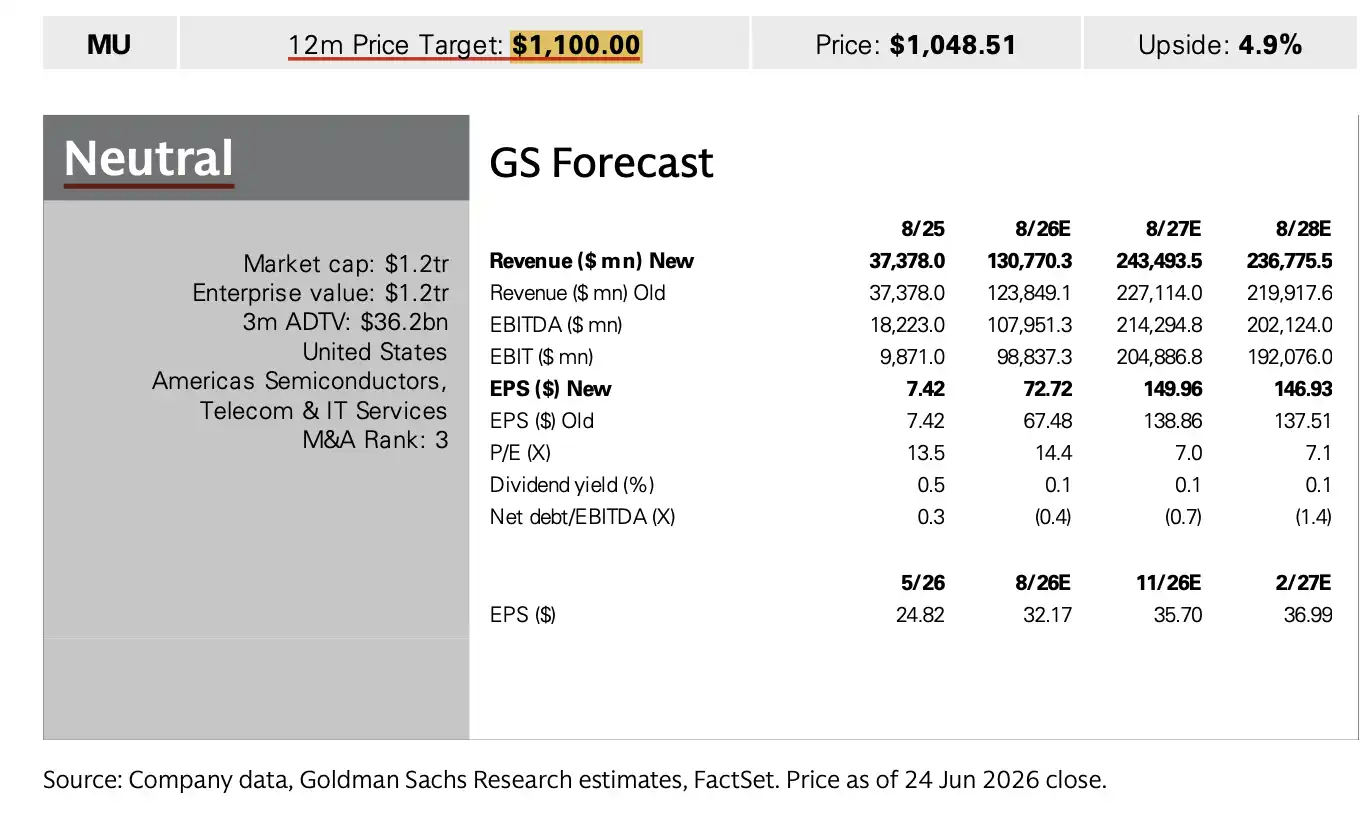
For investors, Micron's third-quarter revenue, gross margin, EPS, and next-quarter guidance were all significantly above expectations, driven by storage demand from AI servers, which continues to boost DRAM, HBM, and NAND prices. Additionally, long-term customer agreements disclosed by the company have made some future revenue more predictable.
However, Goldman Sachs did not upgrade the stock to a Buy. This decision is based on the historical difficulty of the storage industry in obtaining high valuations. It is not that money cannot be made in a cyclical upturn, but rather that the market is unwilling to pay too high a multiple for peak-cycle profits. Long-term agreements can dampen volatility, but Micron has not yet proven it has moved beyond the traditional storage cycle.
Based on Micron's regular closing price of around $1047 on June 24, Goldman Sachs' $1100 target price implies about a 5% upside potential. The post-market stock price briefly rose to around $1199, surpassing Goldman Sachs' target price. This also explains why a target price increase does not equate to a rating upgrade.
Earnings Report and Guidance Both Exceed Expectations, AI Storage Demand Remains Strong
According to Micron's financial report, revenue for the third quarter of the 2026 fiscal year was $41.456 billion, higher than Goldman Sachs' previous estimate of $37.58 billion and the market's expectation of $36.28 billion. The earnings side was equally strong, with a Non-GAAP gross margin of 84.9% and a Non-GAAP EPS of $25.11, both beating market expectations.
Breaking it down by segment, DRAM revenue was $31.33 billion, NAND revenue was $9.94 billion, and both main businesses exceeded expectations. The particularly noteworthy outperformance of NAND indicates that this round of storage prosperity is not solely supported by HBM, as traditional storage prices and the supply-demand environment are also improving.
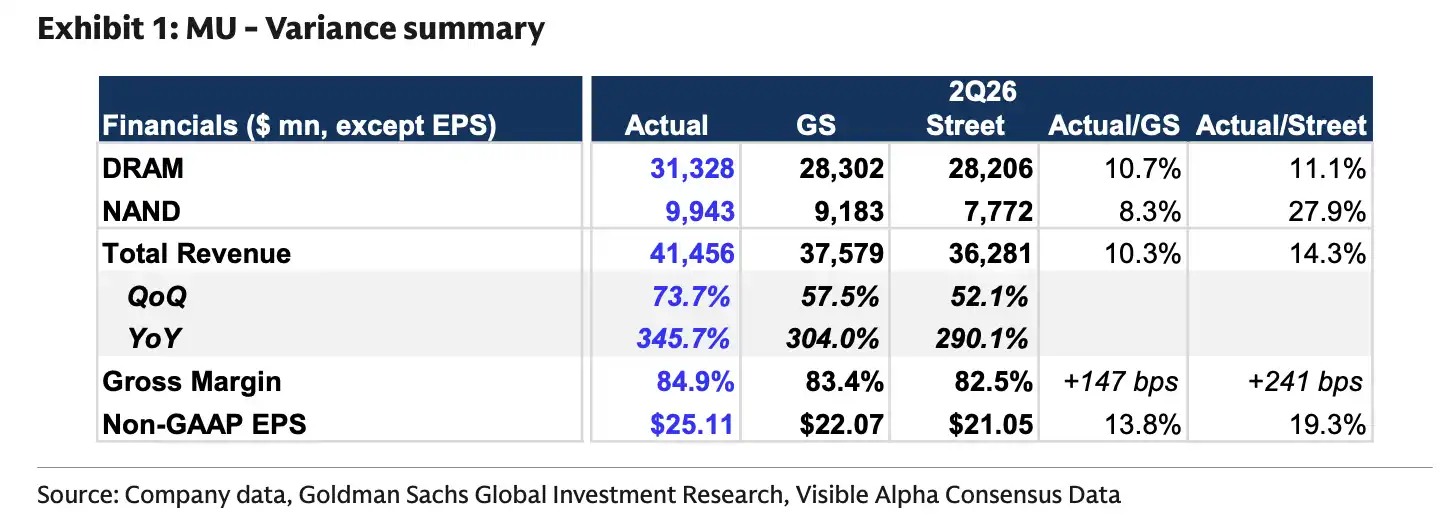
A stronger signal comes from the next quarter guidance. Micron expects FY4Q26 revenue to be $50 billion, plus or minus $1 billion; Non-GAAP gross margin around 86%; Non-GAAP EPS to be $31, plus or minus $1. This guidance continues to exceed market expectations.
These numbers indicate that, at least in the short term, AI servers and high-performance computing demand are still absorbing additional supply, and storage vendors' prices and profit margins have not shown significant loosening. It is also for this reason that Goldman Sachs raised Micron's mid-term profit forecast and increased the normalized EPS used for valuation from $50 to $62. Maintaining the assumption of an 18x P/E ratio, the target price increased from $900 to $1,100.
A Hundred Billion Dollar Long-Term Contract Adds a Buffer to the Storage Cycle
Compared to quarterly performance, what can change valuation discussions more is the strategic customer agreement disclosed by Micron.
In prepared remarks, Micron disclosed that the company has signed 16 strategic customer agreements covering data centers, consumer electronics, automotive, and other end markets. These agreements bring approximately $22 billion in cash deposits and related financial commitments, with 14 agreements based on the lowest price calibre, corresponding to approximately $100 billion in cumulative revenue over the remaining term.
Most of these agreements are for a five-year term, with automotive-related agreements usually for a three-year term, extending roughly until the end of 2030. The agreements typically include annual take-or-pay revenue targets, meaning that even if the customer does not take full delivery, they still need to bear the corresponding procurement responsibility as agreed. Many agreements also set price floors and price ceilings.
This is precisely where Goldman Sachs sees the agreements as "significantly positive." DRAM and NAND have long been affected by supply and demand fluctuations, with profits plummeting quickly when prices fall. In the past, the market was unwilling to give storage manufacturers a higher valuation, essentially worrying that current high profits could not be sustained.
If long-term customer agreements can lock in partial shipments, floor prices, and customer prepayments, Micron's future revenue and gross margin visibility will increase. According to the company's calculation, the gross margins associated with these agreements are higher than in previous cycle peaks, roughly in the low 60% range. For investors, this means that Micron is no longer entirely reliant on spot prices and short-term orders.
Long-Term Agreements Increase Visibility, But Have Not Rewritten the Entire Cycle Yet
However, a hundred billion dollar long-term agreement should not be understood as Micron having already locked in all future revenue.
Currently, these agreements cover about 20% of the expected DRAM shipment volume and approximately one-third of the expected NAND shipment volume. Micron hopes that over time, similar agreements will ultimately cover about 50% or more of the expected revenue, but this is still a goal, not a completed outcome.
The real constraint is still on the execution side. Factors such as whether customers continue to place orders, the strength of take-or-pay provisions, and whether future storage prices remain high will all affect the ultimate profitability of these agreements.
Therefore, long-term agreements are more like adding an extra layer of cushion for Micron rather than completely eliminating the cyclical nature. While demand remains strong, long-term agreements help lock in capacity and cash flow; during future price fluctuations, price floors and customer prepayments may help prevent profits from fully following the spot market. However, if industry-wide supply significantly increases, storage prices may come under pressure again.
Goldman Sachs Maintains Neutral, Key Question Arises Post-2027
Goldman Sachs maintains a Neutral stance, with the key reason still being the supply cycle.
According to Micron's official statement, FY4Q26 capital expenditures are around $10 billion, with full-year FY2026 at about $27 billion. The company has also indicated that FY2027 quarterly capital expenditures will exceed the FY4Q26 level, with over half of the year-over-year increase coming from construction capital expenditures.
Goldman Sachs further assumes that Micron's FY2027 capital expenditures could reach $50 billion. This figure is not guidance from Micron's official statement but rather Goldman's estimate of the company's pace of expansion. If this assumption materializes, it suggests that the storage industry will continue to invest heavily during the high-profit phase. When additional capacity enters the market post-2027, price pressure may resurface.
The capacity timeline is already advancing. Micron states that Idaho Fab 1 is expected to have initial wafer output in mid-2027, while Fab 2 is expected to progress by the end of 2028. Ground has already been broken for the first fab in New York this January. The advanced packaging capacity in Singapore is expected to significantly contribute to HBM packaging capacity starting in the first half of 2027.
These projects are advantageous for Micron's long-term competitiveness, but they do not entirely favor the price cycle. HBM has a higher profit margin and is more likely to attract industry expansion. By 2027 to 2028, as the additional supplies of HBM and traditional DRAM gradually come online, the current high prices and high gross margins supported by AI demand and storage shortages will face a test.
After the Strongest Earnings Report, Focus Shifts to How Long Tight Supply Can Last
The signal from Micron's latest earnings report is overall positive. Strong guidance indicates that AI demand is still driving DRAM, NAND, and HBM. Long-term customer agreements show that some major customers are willing to secure supply with prepayments, minimum purchase commitments, and price terms. The target price increase also reflects Goldman Sachs' upward revision of Micron's profit center.
However, Goldman Sachs did not upgrade the rating to Buy precisely because the more critical issue has not been resolved: how long can this round of storage shortage last?
The bullish thesis is clear. FY3Q earnings and FY4Q guidance were both significantly above expectations, customer agreements provide a floor price protection for some future revenue, and AI servers continue to drive demand for high-end storage.
However, risks are concentrated in several areas. The agreement coverage ratio is still limited, actual customer uptake will depend on end demand; FY2027 capital expenditure will continue to rise, with additional supply in the pipeline; by 2027 to 2028, after the release of HBM and traditional DRAM supply, it is still uncertain whether the current high gross margin and high EPS can be sustained.
Therefore, the conclusion of this report is not that Goldman Sachs is completely shifting to a bullish view on Micron, but rather that Micron is increasing visibility into the industry's hardest-to-value cycle profits through long-term customer agreements and customer prepayments.
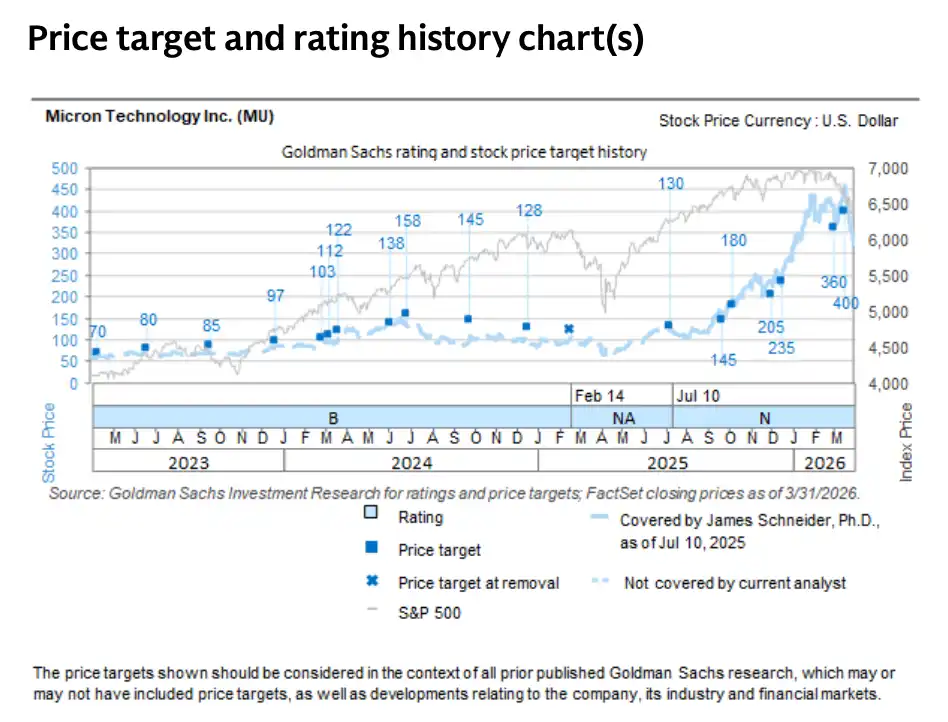
The chart above shows Goldman Sachs' price target and rating history for Micron. As can be seen, Micron's stock price has risen significantly since the second half of 2025, with Goldman Sachs' price target being revised upward multiple times, but the rating has remained Neutral since coverage was resumed.
The issue lies in the fact that the expansion cycle has already begun, and investors still need to confirm that the additional supply from 2027 to 2028 will not bring today's high-profit margins back to a traditional cycle.
Welcome to join the official BlockBeats community:
Telegram Subscription Group: https://t.me/theblockbeats
Telegram Discussion Group: https://t.me/BlockBeats_App
Official Twitter Account: https://twitter.com/BlockBeatsAsia
 Related Articles