BofA Analysis: Raised Target Price for TSMC and ASE, Bullish on AI Inference Driving Server CPU

TL;DR
· Bank of America estimates that the global server CPU semiconductor manufacturing market may increase from $15 billion in 2025 to $49 billion in 2028.
· The key change is the CPU manufacturing outsourcing ratio, which is expected to rise from 52% in 2025 to 71% in 2028, with simultaneous increased demand for advanced processes, advanced packaging, and testing.
· TSMC and ASE will benefit the most directly, but order fulfillment still depends on AI capital expenditure, in-house CPU deployment by cloud providers, and Intel's capacity changes.
Bank of America Securities recently reintegrated server CPUs into the AI supply chain expansion logic and raised the price targets for Asian semiconductor supply chain companies such as TSMC, ASE, and Kinik.
The most eye-catching number in this round of upward revisions is: Bank of America's calculation suggests that the global server CPU-related semiconductor manufacturing market size is expected to increase from $15 billion in 2025 to $49 billion in 2028; during the same period, the CPU manufacturing outsourcing ratio may rise from 52% to 71%. In other words, the server CPU manufacturing, which was previously mostly undertaken by Intel's internal capacity, is continuing to shift towards external foundries, packaging, testing, and material systems.
This is not a bet on cooling GPU demand but a discussion on the overflow of AI computing power requirements. In the past two years, the market has been more focused on GPUs, HBM, and high-speed network chips; but as AI transitions from training to inference, especially with the expansion of agent-based AI applications, CPUs need to take on more task scheduling, control plane, data preprocessing, network I/O, memory access, and system services. AI servers not only need more accelerator chips but also require stronger CPUs to keep the entire system running.
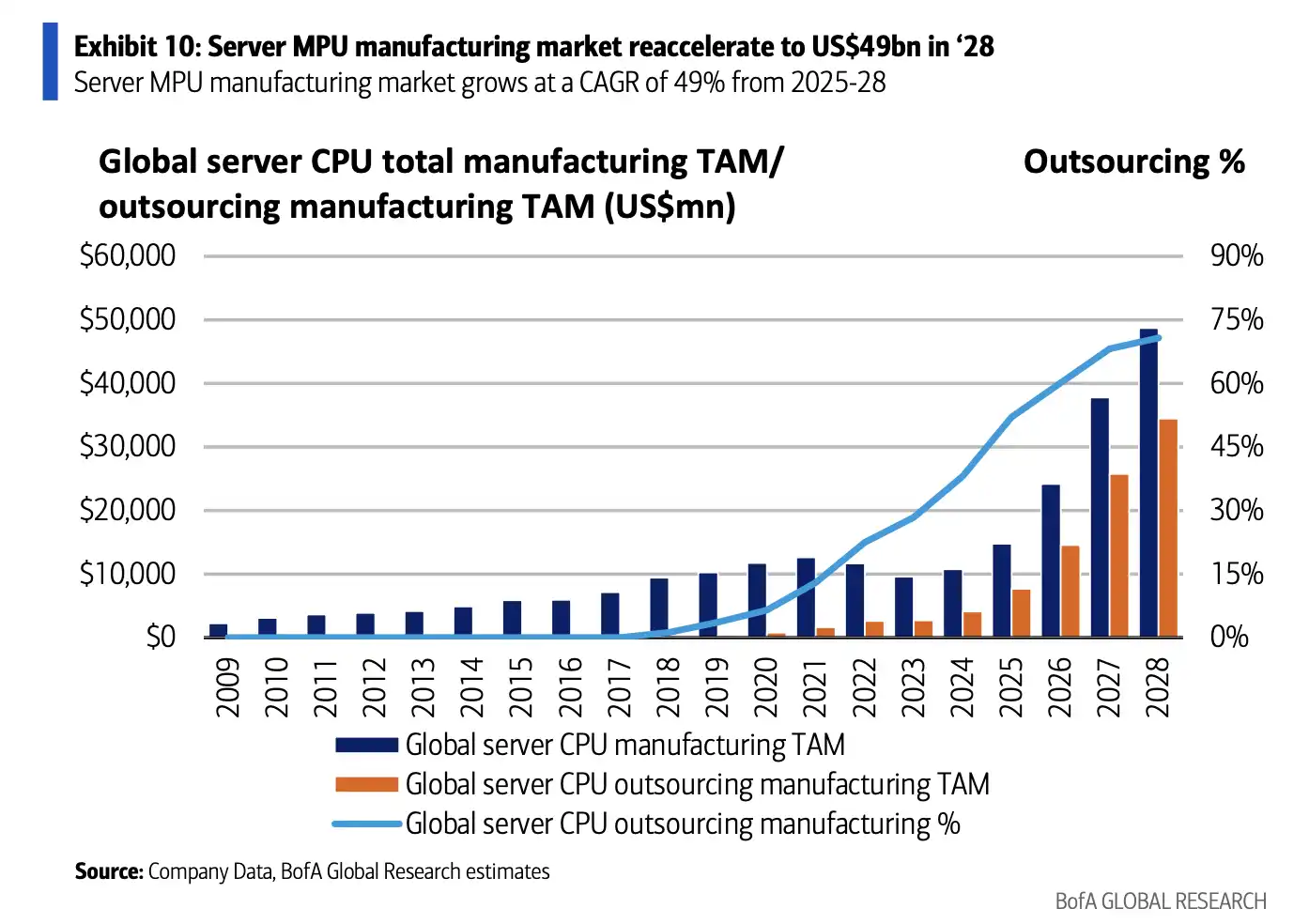
Global server CPU manufacturing TAM is expected to increase from $15 billion in 2025 to $49 billion in 2028, with the outsourcing ratio rising from 52% to 71%.
$49 Billion Opportunity, Stuck in CPU Manufacturing Outsourcing
Server CPUs were not the most dazzling part of the AI supply chain in the past. GPUs and ASICs have received most of the market's attention, with CPUs more seen as complementary chips in AI servers.
Bank of America's assessment goes even further: by 2030, the global server CPU market TAM could increase from around $35 billion in 2025 to over $170 billion, with AI server CPUs possibly accounting for over 80% by 2030. These long-term numbers are still based on report model assumptions, but they explain why Bank of America has separated CPU manufacturing from the traditional server cycle.
The underlying changes are mainly twofold.
First, as AI inference and agent-based AI workloads increase, the importance of server CPUs has risen. During the training phase, the bottleneck is more concentrated on GPU clusters and high-speed interconnects; as the deployment scales to large-scale online inference, CPUs need to handle more system-level tasks. Whether it is an x86 or Arm solution, as cloud providers push AI services to larger deployments, CPUs are finding it challenging to remain merely in a supporting role.
Second, the manufacturing process continues to be outsourced. In the past, server CPU production was long dominated by Intel's IDM model, with a relatively low proportion of external foundries. With AMD shifting to TSMC's advanced process, this landscape has begun to change. If solutions such as AMD Venice, NVIDIA Vera, Google Axion, AWS Graviton, Microsoft Cobalt, etc., continue to ramp up, more CPU wafers, advanced packaging, and testing orders will flow to the Asian supply chain.
According to Bank of America's estimate, the server CPU front-end foundry TAM could increase from $5.8 billion in 2025 to $24.8 billion in 2028, while the back-end packaging and testing TAM could increase from $1.9 billion to $9.6 billion. Within the $49 billion total manufacturing opportunity, the real incremental value is not the abstract heat of AI but the greater proportion of CPU manufacturing processes entering the external supply chain.
TSMC Gains Incremental Value from Advanced Process Nodes, Facing Heavier Expansion Pressure for 3nm and 2nm
TSMC is the most direct beneficiary in this line.
Bank of America has raised TSMC's target price from NT$2560 to NT$3060 and ADR target price from $490 to $590, maintaining a Buy rating. The key support for this adjustment is the increasing consumption of server CPUs on the 5nm and more advanced process nodes.
The report anticipates that the demand for server CPU-related wafers may increase from around 16,000 pieces per month in 2025 to about 50,000 pieces per month in 2028. By 2028, server CPUs may account for 12% of TSMC's front-end revenue, up from 6% in 2025; their percentage share in advanced wafer demand may also rise from 6% to 13%.
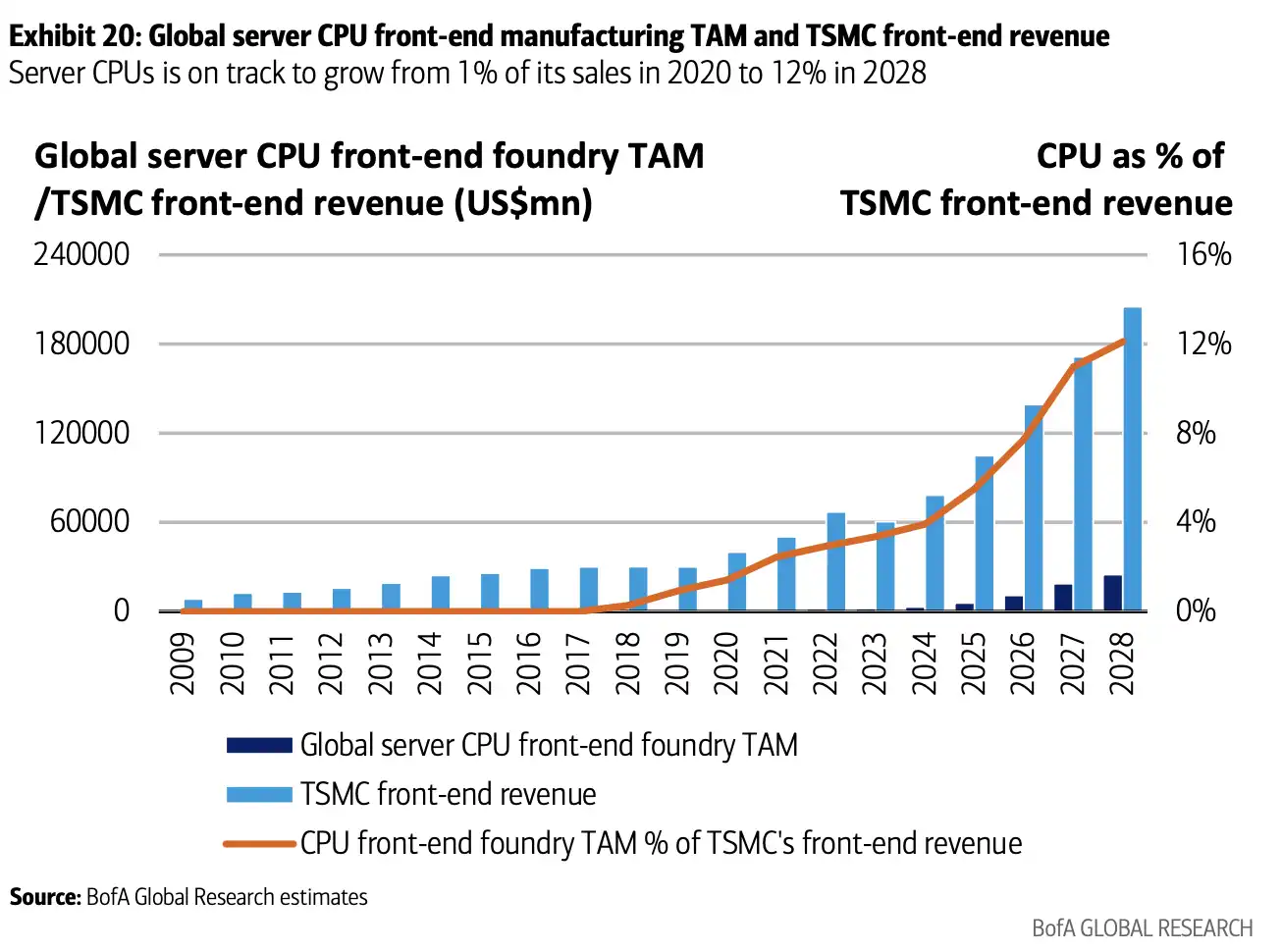
This will continue to drive up the expansion pressure on TSMC's advanced process nodes. The report assumes that TSMC's 5nm and below node utilization will be maintained at over 90%, with 3nm serving as the core node for high-performance computing demands, and even with continuous expansion, the utilization rate will remain close to full capacity. Bank of America estimates that TSMC's capital expenditure in 2027 may reach $75 billion to $80 billion, focusing on 3nm, 2nm, and advanced packaging capabilities such as CoWoS and SoIC.
It is important to distinguish that TSMC's current official Capital Expenditure (CapEx) guidance is around $52 billion to $56 billion for 2026; the $75 billion to $80 billion figures for 2027 are from Bank of America forecasts and not the company's official guidance.
If these assumptions materialize, a tight supply-demand scenario in advanced processes may continue to support TSMC's pricing power. However, capacity expansion not only brings revenue growth. The significant CapEx required for 3nm, 2nm, and advanced packaging will need to be followed by considerations of utilization rates, yield rates, depreciation pressure, and gross margin trends.
Backend Packaging and Testing Also Tightened, ASE Share Seen Bullish
The server CPU manufacturing opportunity extends beyond wafer foundries; backend packaging and testing have also been factored into this upward trend.
According to Bank of America's estimates, the server CPU backend packaging and testing Total Addressable Market (TAM) could increase from $1.9 billion in 2025 to $9.6 billion in 2028, with the major OSAT advanced backend business share rising from 11% in 2025 to 24% in 2028. This shift is being driven by chiplet architectures, higher reliability requirements, and extended data center testing cycles.
ASE emerges as another direct beneficiary. Bank of America has raised ASE's target price from NT$550 to NT$750 while maintaining a Buy rating. With the rising demand for CoWoS, SoIC, and other advanced packaging solutions for server CPUs, the report predicts that ASE's market share in relevant markets may increase from 10% in 2025 to 24% in 2028, while TSMC is expected to retain approximately 63% market share.
CoWoS capacity remains one of the short-term constraints. The report calculates that CoWoS capacity needs to expand at a compound annual growth rate of 54% from 2025 to 2028 to adequately match the requirements of GPUs, ASICs, and next-generation server CPUs. As CPUs start adopting more complex packaging solutions, backend capacity constraints are no longer solely a GPU supply chain issue.
Testing processes will also be amplified. Wafer-level probing, final testing, burn-in, and system-level testing for server CPUs take longer, and testing companies like KYEC may benefit from more intricate CPU validation processes. Design service companies like GUC may also benefit from cloud providers' in-house CPU projects. However, revenue proportions for companies like KYEC and GUC are currently more reliant on source report models, lacking public cross-validation and are more suited to be viewed as scenarios for supply chain resilience.
After Target Price Increase, We Still Need to Wait for Orders to Translate into Capacity
In addition to TSMC and ASE, the source report also listed target price adjustments for supply chain companies such as Kinik, Chroma, Hon Precision, and GPTC. The common logic is that the demand for server CPU manufacturing, packaging, testing, and equipment materials is spreading to the external supply chain.
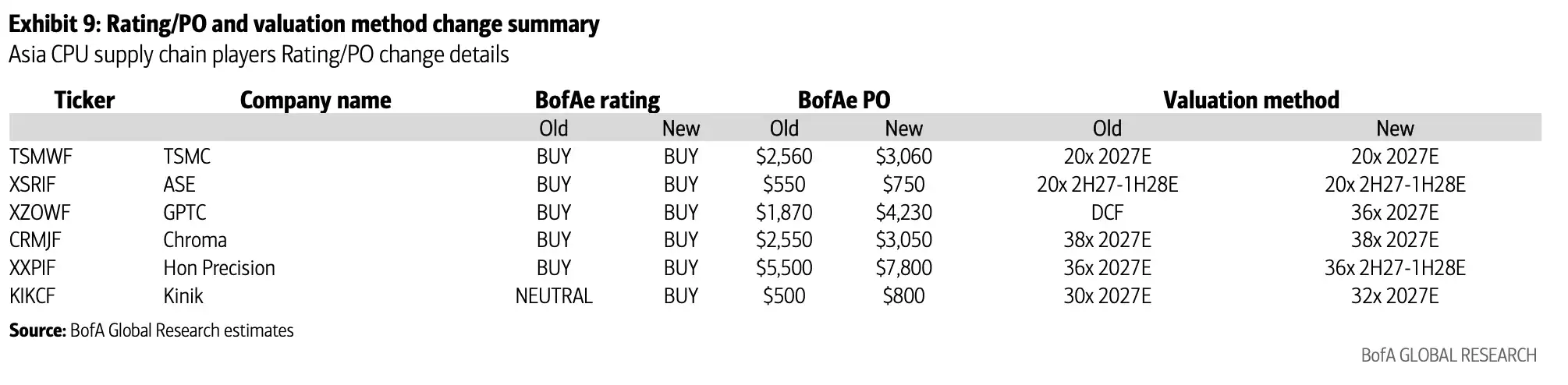
Valuation and target price adjustments in the Asian CPU supply chain, for example, TSMC increased from 2560 NT to 3060 NT, ASE from 550 NT to 750 NT, and Kinik from 500 NT to 800 NT.
However, a target price increase does not mean that orders have been entirely fulfilled.
The first checkpoint is AI capital expenditure. With increased demand for server CPUs, reliance on cloud providers and AI service providers to continue expanding their inference infrastructure. If AI investment slows down, it will affect CPU, advanced packaging, and testing demand.
The second checkpoint is the mass production speed of in-house CPUs. Arm solutions such as Google Axion, AWS Graviton, Microsoft Cobalt have indeed increased external manufacturing opportunities, but the transition from design, validation to large-scale deployment takes time. Even with clear customer plans, the true conversion into wafer, packaging, and testing revenue needs to undergo the scrutiny of production ramp-up.
The third checkpoint is the internal capacity changes at Intel. Bank of America's calculation is based on the premise that the proportion of outsourced manufacturing will continue to increase. If Intel's advanced process progresses smoothly or some CPU orders return to internal manufacturing, the expansion rate of the external foundry and packaging test market may be lower than the scenario reported.
What is most worth noting in this report is not a broad judgment like "Comprehensive Benefit of the AI Industry Chain," but a more specific change: agent-based AI is bringing server CPUs back into the manufacturing capacity expansion discussion and making the proportion of outsourcing a crucial premise for the target price increases of supply chain companies such as TSMC and ASE.
What really needs to materialize next is whether these CPU orders can continuously translate into wafer, advanced packaging, testing, and material consumption demand. The AI capacity competition is no longer just happening in the GPU space but is also beginning to impact the manufacturing chain behind CPUs.
Welcome to join the official BlockBeats community:
Telegram Subscription Group: https://t.me/theblockbeats
Telegram Discussion Group: https://t.me/BlockBeats_App
Official Twitter Account: https://twitter.com/BlockBeatsAsia