Twilight of the Gods (Part I): The End of the Old Financial Era
Original Title: "Twilight of the Gods (Part 1): The End of the Old Financial Era"
Original Author: Long Ye, Just Blockchain News
Article Summary:
· The crypto industry bubble has burst, and the potential success rate and odds of "coin issuance" have dropped to levels weaker than traditional equity financing. Traditional players in crypto and their corresponding strategies will almost be entirely wiped out. Currently, in 2026 Q2, we are still in the mid-early stage of the bear market.
· The four-year cycle still exists, but due to its high correlation with the macro financial market, the amplitude will significantly decrease, and the boundaries will become more blurred.
· In the past 6 months, and the next 6-12 months, the main theme in the crypto space will focus on how to tokenize traditional financial assets to onboard traditional funds to increase the "total market cap of stablecoins." During this period, perp dex will serve as an important ecological entrance and become the best track, among which I most endorse Lighter. It will be difficult to see native innovation narratives in the crypto space in the next 6-12 months.
· The bottom of BTC in this cycle's bear market will appear in 2026 Q4, with a low point of $30,000-$40,000. Following this, a "double bottom" will occur due to the Nasdaq's major crash, meaning the second price low point generated will most likely not be lower than the previous one. Afterward, as the Nasdaq enters a long bear market, BTC will experience a period of low tide before slowly rising into a new cycle.
"In Norse mythology, the gods perished one after another. Three consecutive harsh winters arrived without a summer in between, and the sun could not provide any warmth... The fire giant Surt brandished a flame sword brighter than the sun, incinerating the Nine Realms, and the Rainbow Bridge shattered under the tread of the great army... The gods and giants, in the final battlefield, perished together."
If you have played Warcraft III: Reign of Chaos and are familiar with the term "Twilight of the Gods," it will certainly resonate with you.
In Norse mythology, it is not the death of humans or the destruction of the world, but the death of deities because the old order has completed its mission, and a new era is about to begin.
And what is dying today is not just the set of "rules" of Native Crypto but the entire financial system of the past three decades.
Crypto Space: Winter Is Coming
"In the industry's heyday in mid-2025, there were approximately over 300 projects submitting Binance listing applications per week. Now, this number may only be three."
I believe even the most optimistic veterans of the old industry can only sigh at the current state of the crypto industry. A year and a half ago, I asserted, "Moreover, in my vision up to 2025, the atmosphere of the entire industry determines my pessimistic view on the emergence of milestone" business concept innovations. " (2024&2025, BTC's final mega cycle: BTC's value and price theory"). Looking back now, it remains the same.
Let's take a look at what has happened in the past two years:
Since 2024, when meme became a popular token issuance model, issuing tokens has become a low-barrier affair. In the 2025 industry boom, thousands of tokens are being launched on various launchpads every day. As the entire industry increasingly moves away from fundamentals and the supply side expands unprecedentedly, industry liquidity has been completely diluted, and the token's primary market has been completely killed.
So, unlike traditional finance, where each time the secondary market overheating drives the primary market, and after the secondary market bubble bursts, it takes some time for the cold winter to spread to the primary market. The Crypto industry in 2025 is the opposite.
Therefore, throughout 2025, we all knew that the bull market could end at any time, and I also said the end of 2025 would be the top of the cycle. However, making trading decisions, especially at the moment of trend reversal, determining when the real top is, requires timing, pricing, and positioning.
Reflecting on the core prediction in my article in December 2024 titled "2024&2025, BTC's final mega cycle: BTC's value and price theory":
(1) Timing: I described the end of 2025, that is, October, November, or possibly December. Relatively speaking, at the end of Q3 2025, when I began to lay out the entire cycle's reduction plan, I favored the Q4 cycle, and the final peak appeared on 10/6.
(2) Pricing: For the past decade, I have always used the logic from my paper "Bitcoin Valuation Model under Miner Market Equilibrium: Based on Derivative Pricing Theory" as a benchmark for price range judgment, giving the assessment that the BTC cycle peak is in the range of $160,000 to $220,000. However, entering 2025 Q3, I overlooked an important fact: a large number of mining facilities have become data centers, and the actual machine hash rate involved in mining is far below the results I have always used through statistical calibration.
(3)Momentum: I still believe that, given the momentum at the time, BTC had just broken its all-time high on 10/5 to reach $127,000, and there should have been a window of around a month for the "final bull run." However, this trend was disrupted by the confluence of four events:

First, starting on 10/1, the U.S. government shutdown caused almost all work, including the SEC, to come to a halt. This halted several well-known crypto projects that were already in the final sprint for ETF approval. By the time work resumed, it was close to Christmas, and by the time work restarted in 2026, the trend had already shifted, blocking the influx of additional funds from the traditional markets in October. Second, on 10/10, Trump planned to impose an additional 100% tariff on China, leading to "Tariff War 3.0." This further exacerbated the macro financial markets, which were already jittery due to the "Twitter governance," affecting the entire cryptocurrency space.
Third, on the same day, 10/10, MSCI issued a statement recommending the removal of MicroStrategy from its index. This created doubts among traditional investors about the BTC-stock correlation narrative, leading to a massive exodus of institutional funds that day.
Fourth, under the influence of the previous three events, BTC was shorted, resulting in a sharp overnight plunge. Binance worsened the situation by experiencing technical issues, causing BTC to plummet by over 20% within a few hours, with other altcoins dropping by over 50%. This led to significant losses for many market makers and a drastic reduction in industry liquidity.
This series of four "coincidences," like a chain of accumulating snowballs, ultimately turned into a "confidence disaster," completely shattering the already fragile market sentiment.

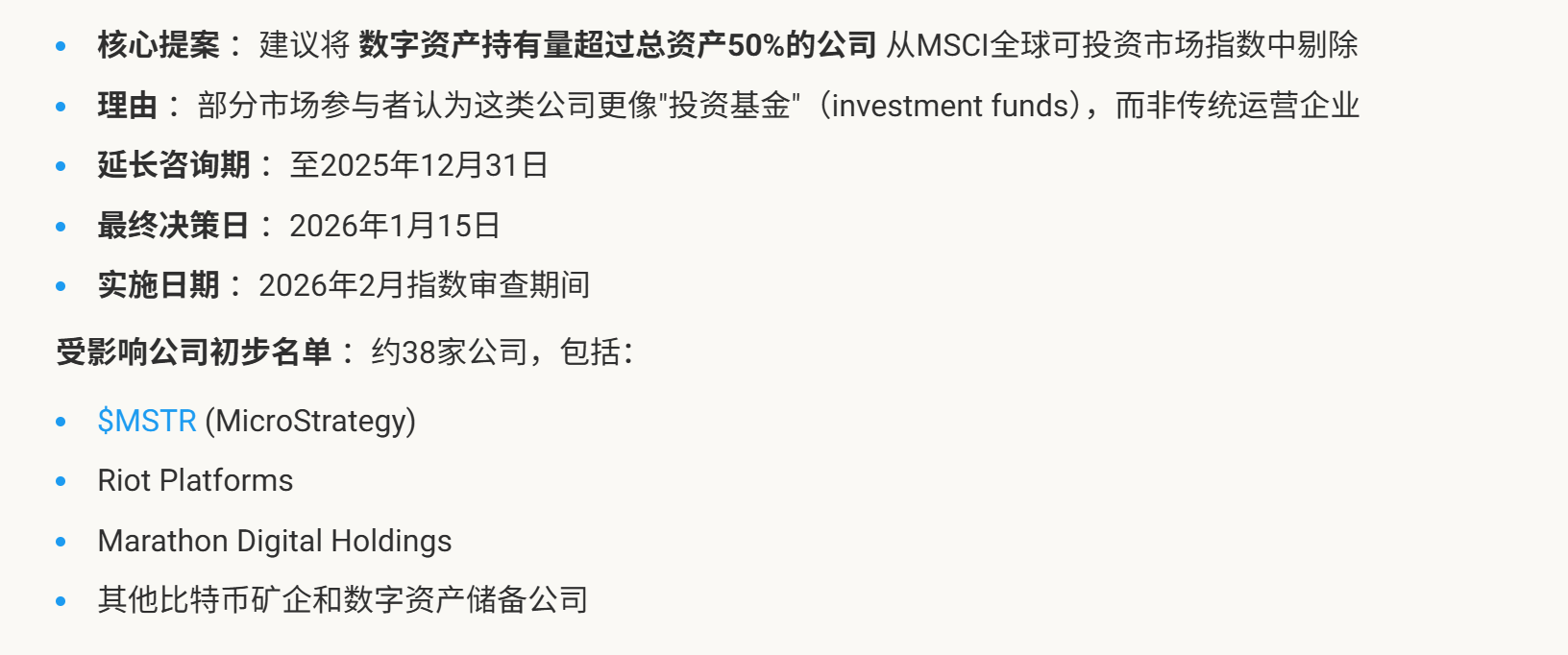
Source: Minara.ai
Date: 10/21/2025
Looking back today, when it comes to making trading decisions, at the juncture of a bull-to-bear transition, I made some mistakes in timing, pricing, and momentum. However, overall, the cryptocurrency market trend completely aligned with the scenarios I outlined in my two articles at the end of 2024 and the beginning of 2025. Although I didn't swiftly liquidate after 10/11, I still "belatedly" began preparing for liquidation in late November and completed the liquidation above $90,000 for BTC and above $3,200 for ETH in the last technical rebound in late November and early December.
Having spent so much time here reviewing that moment in October 2025, I did so not just for the outcome, but also for my understanding of the "Trading Strategy Structure" following my post-game analysis. I will delve into this in detail in my musings on the future of finance in the AI era at the end of this article.
In today's crypto sphere, the bubble has indeed burst. I believe that the current state of the crypto sphere resembles the early 2002 of the Internet era: trading volume has shrunk, overall attention has plummeted to freezing point, and pessimism pervades. The price has not yet dropped to the lowest point of the cycle, and looking ahead, the industry will need at least another year to rediscover its "anchor point" and the wellspring of innovation.
However, I predict that the next generation of innovation that can once again lead the crypto bull market will not just be native blockchain technology or financial innovation; it will inevitably be some breakthrough in mainstream tech circles that can be better leveraged on the blockchain, thus bringing about a whole new wave of growth in the form of "Blockchain +".
Yet, I still stand by my assertion: Tokenization will become the third financial medium after debt and equity. Regarding fundraising and capitalization paths and the difference between choosing equity and tokenization, refer to another series of articles by the author: "Tokenomics: A New Paradigm for Fundraising Through Token Issuance" and "Tokenomics Part Two (Part One): The Battlefield Without Gunpowder: VC or Token Fund?".
The current chaotic scenario of unregulated listings in the crypto industry is akin to NASDAQ in its founding year of 1971, more like an "electronic quotation system." It wasn't until 1982 that NASDAQ introduced the NASDAQ National Market and first established a set of clear financial and size requirements, such as minimum net worth, minimum number of public shareholders, minimum number of stockholders, and minimum stock price.
Now, the trend of stock tokenization within the crypto industry has brought about a whole new form of on-chain asset. In addition to attracting traditional funds into the stablecoin market and increasing the potential on-chain fund capacity, it will also serve to educate traders who used to only follow the trend of trading coins. When these native traders, mostly retail investors in third-world countries, slowly build a value system for asset trading, it will indirectly drive tokenization project issuers, trading platforms, and others to establish industry standards.
It takes time, and when we see the extinction of crypto-native gameplay, it indicates that day is fast approaching.
Talking About the Four-Year Cycle
"Looking back at over a decade of Crypto history, each major cycle has been born from an innovation significant enough to change the industry's structure; and ultimately, each has also died from the failure of that very innovation. It's truly a case of 'praise and blame to the same person.'"
When we talk about the "four-year cycle," we are not only talking about the unshakable "industry axiom" of Bitcoin's halving every four years, but also discussing the "theme" of the rise and fall of each cycle.

The burst of the bubble actually has "homogeneity." In 2025, which was the previous cycle's bull market, it started with favorable U.S. policies, traditional fund inflows like ETFs; grew with Wall Street forces such as DAT entering the scene, publicly traded companies/funds actively engaging with crypto, crazily fundraising under the banner of MicroStrategy; and naturally would also perish due to the "cut-off of external funds" caused by a government shutdown; collapse when ETF approvals were no longer in demand, and the MicroStrategy narrative was completely shattered.
Similarly, the bull market of 2021 began with the rise of DeFi and traditional VCs "running in"; and it ended with the DeFi collapse in 2022 and traditional VCs having a "changed attitude towards tokens": the defining event was the collapse of Luna in May 2022, where globally recognized DeFi public chains and algorithmic stablecoins went to zero; followed by the collapse of FTX in November 2022, leaving mainstream funds in U.S. Silicon Valley and Temasek with nothing, this overnight zeroing of hundreds of billions of assets through "fraud" made traditional VCs unprecedentedly skeptical of crypto projects' credibility.
At that time, within a few weeks, all VCs made a complete U-turn in their attitude, almost entirely ceasing equity investments in crypto projects.
Going back further, the bull market of 2017 started with ICOs and ended with the collapse of the ICO mechanism in 2018. The defining events were in January 2018 when Chinese VCs promoted equity projects that couldn't achieve exits, quickly dumped the coins after issuance, and Fcoin emerged in May only to collapse rapidly in August. This was more like a requiem for an era, marking the end of the ICO era relying on coin issuance financing, traffic reliance, and market manipulation.
It is crucial to correctly understand the foundation of innovation in each cycle.
The battle over the hard fork in the crypto space at the end of 2015 brought more attention, but what truly changed the fundamentals was ETH's ICO maturing towards the end of 2016.
The cryptocurrency market's future
“When Wall Street learns to issue tokens, Crypto is no longer just Crypto.”
Starting in 2024, the industry has lacked original narrative innovation. In 2025, the only driving force for growth is the increasing openness of the United States to crypto compliance, the bridging of the traditional financial market with the crypto industry, and the resulting influx of funds.
The most common strategies for the Wall Street crypto market and stock market linkage are: first, a listed company buys a certain well-known crypto asset to boost its stock price; second, a well-known crypto project merges with a shell company to indirectly enter the stock market; third, a well-known crypto project foundation, since some have been classified as "commodities" rather than "securities," raises a bond fund, pumps up its coin price, sells at a high price, and then repays the principal and interest.
By 2026, the flow of funds has completely changed. As the number of tokens through ETFs continues to increase (as of June 2026, there are already about a dozen cryptocurrency assets available for ETF purchase), traditional funds have lost interest in continuing to allocate tokens through ETFs. The flow of funds has shifted from “traditional funds entering native crypto through ETFs” to “traditional financial assets such as stocks, oil, etc., entering the chain through tokenization to attract traditional funds to trade on the chain.”
In the article "History Doesn't Repeat Itself, But It Does Rhyme: Don't Miss It This Time," I mentioned early on that the significance of Hyperliquid lies in being the entrance and infrastructure of a new generation of cryptocurrency funds: "Now we face another critical question: After BTC, if you still want to hold an asset, what should you choose? I still hold onto my previous view: For a $500K investment, I choose Hyperliquid."
Now the theme of compliance is even clearer, after Hyper, it's time for Lighter. Looking at today,
If you ask me the same question again:
For those able to allocate $5M, I only believe in BTC;
For $500K, I choose Lighter.
Hyperliquid and Lighter represent new fund entry points. If we consider the perpetual DEX as a pipeline: the assets flowing in are U.S. stocks and various RWAs that are being brought onto the blockchain.

Of course, it cannot be denied that the tokenization of U.S. stocks will definitely experience a large-scale thunderclap.
Now only a few new projects in the cryptocurrency circle are mainly focused on the perpetual DEX. The current approach to tokenizing U.S. stocks mostly involves "synthetic/shadow stocks," and with the liquidity rushing in as the global stock market surges, whether there is a verifiable 1:1 custody behind tokenized stocks, besides a few liquidity providers shoring up, whether there is a more scalable way.
Apart from the reliability of assets, almost all trading venues are heavily leveraged and lack technical audits and legal compliance reviews on various new perpetual DEX platforms: if any underlying asset becomes unpegged or if there is a custodial thunderclap, leverage stacking will lead to a chain of liquidations. Just like a grey rhino, it will come sooner or later.
However, similar to the stablecoin industry that emerged with USDT at the end of 2017, there have been several "unpegging" incidents over the years, and some once well-known stablecoin projects have disappeared into the annals of history after thunderous collapses. Eventually, the survival of the fittest leaves behind the oldest assets like USDT, USDC, and DAI. I believe that stock tokenization and perpetual DEX will also go through such a process, and for me, the safest way to participate in these projects is to look for the next "Circle."
Furthermore, the opening of the funding gate does not necessarily mean that funds will flow in. The "confidence level" of funds is crucial. Businesses need more and more "sentiment value." Only with sentiment value can they attract attention and gain the trust of some people.
Previously, the funds in the cryptocurrency world were limited in entry points, and the wallet operations were relatively complex. This situation only allowed those who truly loved it, had faith in it, and were willing to spend time on it to enter. By 2025, the crypto market had almost everything they had dreamed of, but it experienced the most lackluster "bull market" because the new entrants, who left quickly, left:
You thought you were welcoming God, but it was actually welcoming the devil disguised as God. Traditional financial institutions may view you as "barbarians" and may even take away the group of people that the market was originally expecting.
However, this also means that the industry is slowly moving toward the right track. By filling the gap in legal and accounting infrastructure that was previously lacking, and by raising the overall quality of practitioners, reshaping industry rules can enable a new bull market led by newcomers who "are not native believers."
Of course, who says that the future ruler of the world, the AI agent, or the digital beings, will not be the true "believers" of the crypto market?
Let's project the future price trend for the next few years
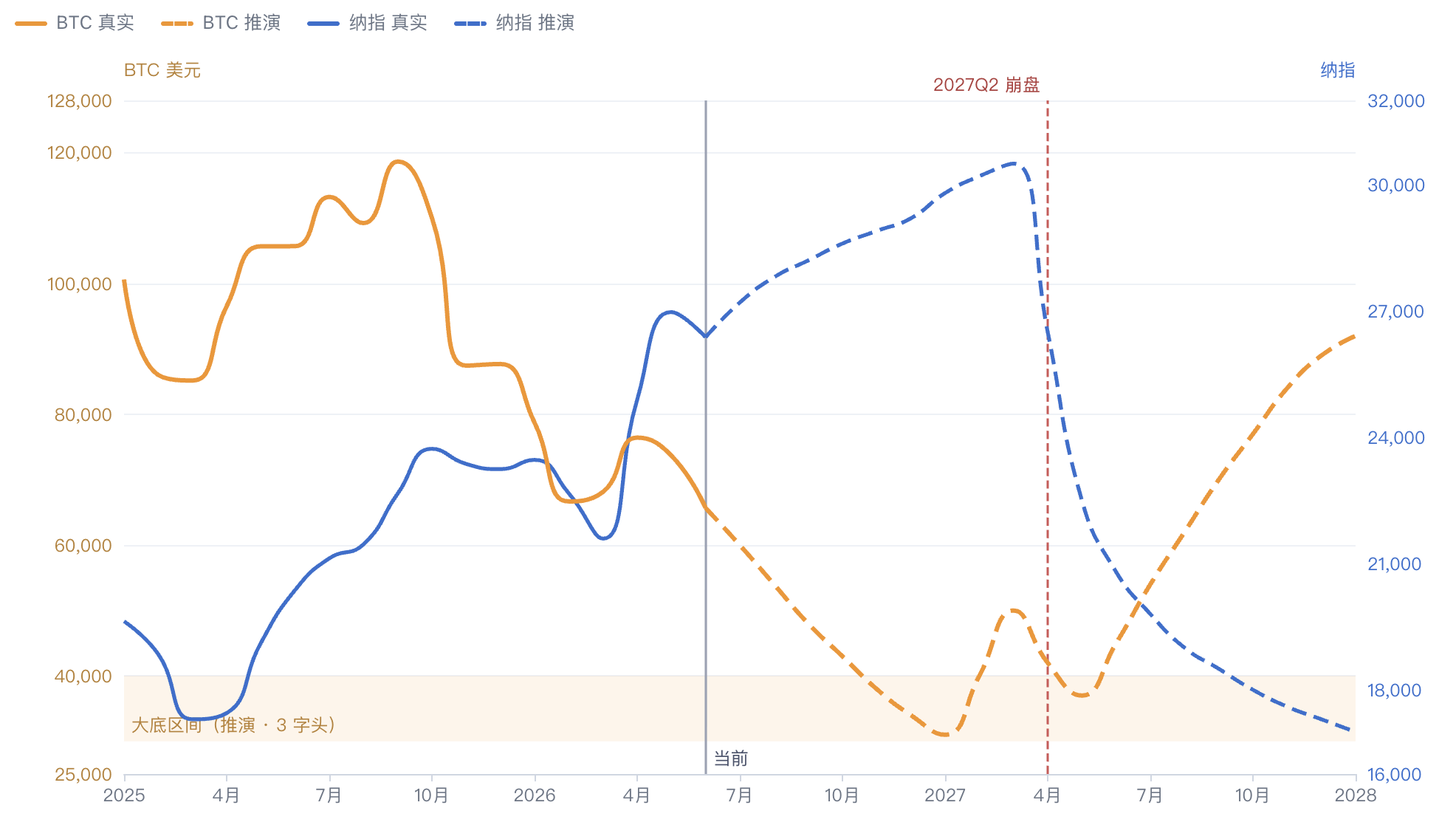
· In six months, by the end of 2026 and the beginning of 2027, BTC will reach the bottom of this four-year cycle, which is expected to be earlier than the end of the Nasdaq bull market, the "peak" day.
· During this six-month period, due to the loss of momentum, BTC will continue to slide, accompanied by intermittent sharp declines, until it reaches the lowest extreme value. The bottom is expected to start with a 3.
· At the beginning of 2027, as the Nasdaq experiences its final frenzy, coupled with the cyclical nature of the cryptocurrency market, there will be a certain resonance and rebound in the short term. However, due to the sharp drop after the Nasdaq peaks, BTC will also follow suit, possibly showing a double-bottom pattern, approaching the previous low, and then, due to external wars or other political events, attracting funds as a safe haven.
· In 2027, the world's focus will be on traditional finance, but with the stock blockchain's comprehensive compliance, AI trading becoming more mature, on-chain funds, the stablecoin reserves that have been "waiting for a long time" and have been steadily increasing, will shift from on-chain stocks to native crypto, which is BTC.
· By 2028, the aftermath of the AI bubble burst slowly subsided, with a few rebounds in between, but the overall tech stocks remained gloomy. In contrast, crypto did not experience a major surge but continued to rise steadily.
Here, we need to clarify a question that I am often asked: Are Bitcoin and the Nasdaq index positively or negatively correlated? This question is not a simple yes or no. The answer is that during sudden events or trend reversals, they initially show a positive correlation, followed by a negative correlation.
The most typical example is war. Every time a war breaks out, whether it was the Russia-Ukraine war at the end of February 2022 or the US-Israel joint strike on Iran at the end of February 2026, just a few hours before the start of the war, due to the panic selling in the traditional financial markets, institutional funds, in addition to mainstream stocks, often allocate some proportion to Bitcoin. This sentiment spills over to Bitcoin, causing a short-term drop. However, often on the second day when the stock market continues to fall, Bitcoin shows its safe-haven characteristic, attracting inflows from other funds, thus driving its rebound, sometimes surpassing its pre-war price within a week or even in the short term.
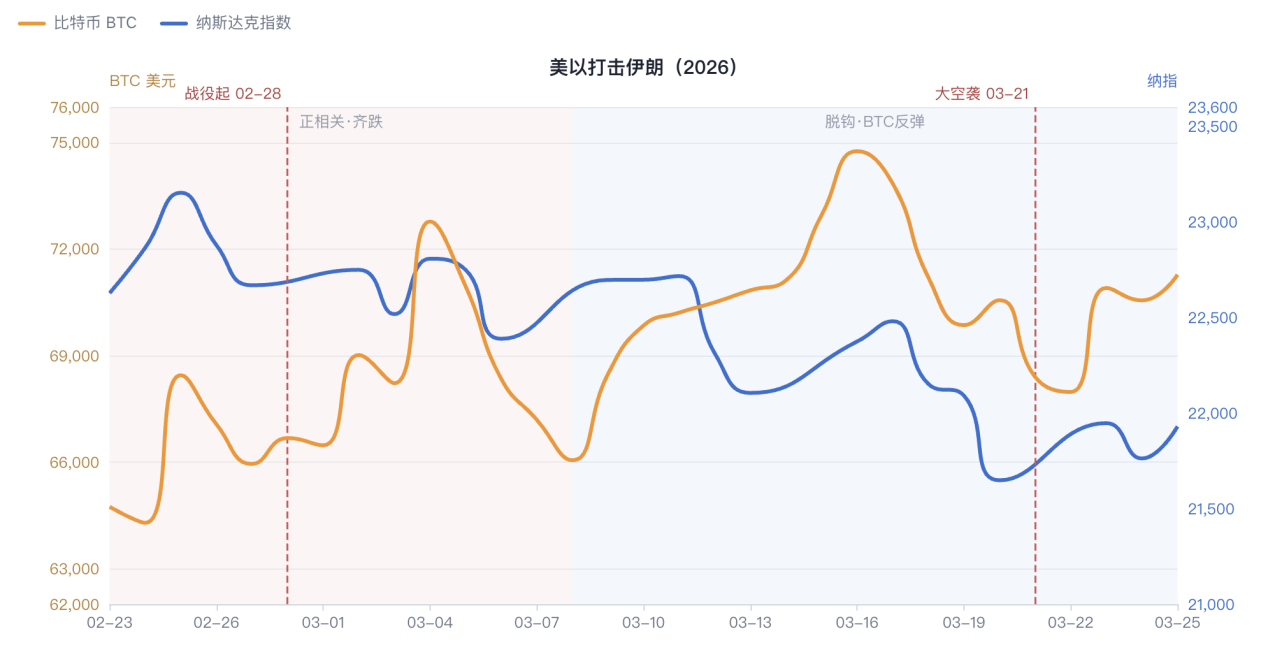
That's why I say, if the AI bubble bursts at the beginning of 2027 and the Nasdaq crashes, Bitcoin will also undoubtedly plummet in the early stage. However, a crash does not happen in a day. As the Nasdaq consolidates, showing slight rebounds that give people hope, before the full crash in the second wave, BTC may retest the lows, approaching the aforementioned major support level (but not necessarily breaking through). Subsequently, as the Nasdaq continues to decline in 2027, on-chain funds will exhibit a demand for safe havens, rotating into BTC, thereby breaking free from the four-year cyclical bottom range.
Wait, what are you talking about? The AI bubble bursting?
Yes, the burst of the AI bubble. Compared to the crypto market, I am more concerned about the global macroeconomy and financial system. Everyone is walking on a tightrope, using the development of technology to forcibly conceal all business issues. The development of AI technology will eventually push the speed of information transmission, reception, and processing to the extreme, triggering larger-scale, and even irreversible chain reactions.
My prediction: The Nasdaq is highly likely to crash from early to mid-2027, ending the four-year bull market that began in early 2023. Global mainstream stock markets will also be affected, heading towards a historic collapse.
Next, let's shift our focus away from the crypto market and turn to the battlefield that I am genuinely concerned about: the global macroeconomy and the inevitable burst of the AI bubble.
Original Article Link
Welcome to join the official BlockBeats community:
Telegram Subscription Group: https://t.me/theblockbeats
Telegram Discussion Group: https://t.me/BlockBeats_App
Official Twitter Account: https://twitter.com/BlockBeatsAsia