Is Bitcoin's Unattended Ecosystem Dealing with Another Meme Coin?

A while back, the new Bitcoin asset protocol Tacit reignited the market's attention on the Bitcoin ecosystem. More recently, a new 10x-level gold dog has emerged in the Bitcoin ecosystem, bringing back the familiar ordi flavor. Why has the Bitcoin ecosystem been so hot recently? Is there really something new happening?
Bound Exchange
This platform's predecessor was radfi, which had previously gained popularity due to the "Node Monkey" strategy coin $NODESTRAT. $NODESTRAT is similar to $PUNKSTR on Ethereum, both utilizing transaction fees to buy back NFTs, set different profit targets for sale, use part of the profit from selling NFTs to buy back tokens and burn them, creating a flywheel.
Previously, radfi and Bound operated as separate entities, with radfi focusing on Bitcoin/Rune AMM and Launchpad, and Bound on stablecoins. Now, the two have merged into Bound. The combined platform's functionality is quite comprehensive, covering trading, lending, Launchpad, and an NFT marketplace.
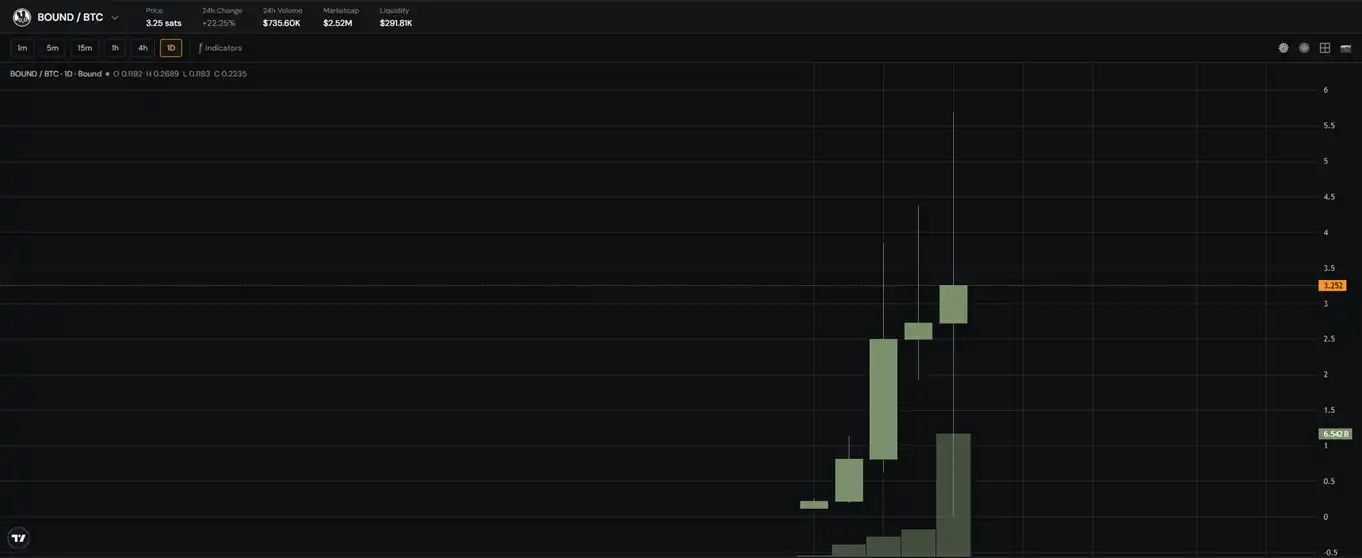
Bound has attracted market attention this time because its token $Bound has surged by approximately 46x since May 21.
As for the project itself, Bound's praised points mainly include the following:
The trading process has been greatly simplified. In the past, Rune AMMs usually required users to first deposit Bitcoin and then wait for several block confirmations. This confirmation time could range from half an hour to over an hour in cases of network congestion. On Bound, besides depositing Bitcoin, users can also deposit SOL/ETH/HYPE/BNB and swap them for BTC through the corresponding BTC trading pair, allowing them to directly trade Rune coins on the platform. The overall transaction time has been significantly reduced, leading to a much-improved user experience.
Instant transaction confirmation. Eliminating the need to wait for lengthy Bitcoin block confirmations to validate transactions has always been a goal of platforms in the Bitcoin ecosystem focusing on Rune. This isn't too difficult; once funds are deposited on the platform and confirmed, transactions are processed internally/off-chain, treating the Bitcoin mainnet as a confirmation layer. However, the key issue is addressing security concerns. Previous platforms such as odin.fun gained traction but ultimately failed due to several asset theft incidents. Bound's solution is to add a 2-of-2 multisig to users' asset deposit addresses, with one key held by the user (a passkey stored on the user's device) and the other held by the platform backend.
In other words, even if the Bound platform is hacked, the assets cannot be stolen because the hacker can only bypass one layer of signature. But there is another question: What if the platform exits scams? Therefore, Bound has added another layer of time lock. If Bound's signature expires after 3 months, users can directly withdraw their assets using their own access key.
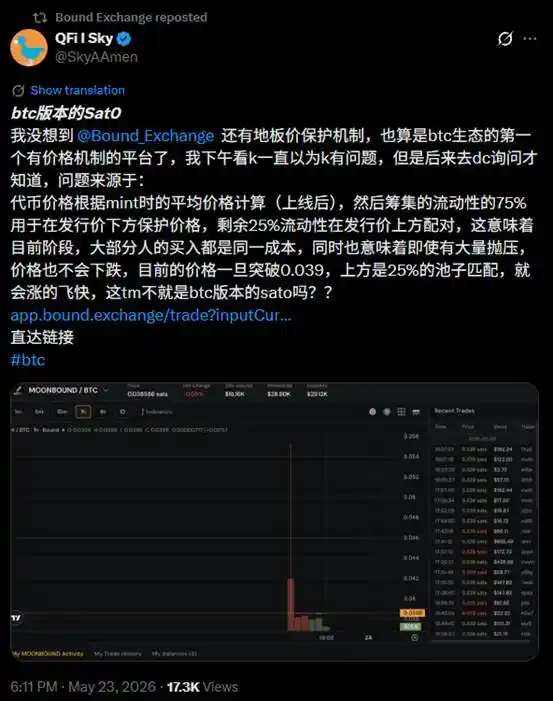
Price protection mechanism. Bound retweeted @SkyAAmen's explanation of this mechanism, stating, "After the launch of the runic token through the Launchpad, the token price is calculated based on the average price at mint, with 75% of the raised liquidity below this price to support against potential selling pressure, and the remaining 25% paired above this price."
In the token issuance part, Bound has also introduced a virtual mempool, which can be understood as a virtual chain tracking the Bitcoin mainnet. Users who mint new runic coins on the Launchpad no longer have to pay miners; instead, the funds are used for the aforementioned price protection and liquidity provision. Furthermore, to reward holders, holders who mint 1 million tokens or more and do not sell can share 50% of the transaction fees.
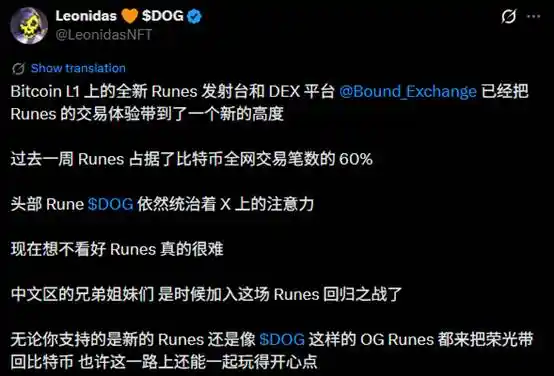
These are the three main advantages. In addition, Leonidas, a well-known figure in the Bitcoin ecosystem, has also expressed support for Bound:
Tacit
BlockBeats previously wrote a detailed introduction to Tacit:
New Protocol Tacit, the ZEC of the Bitcoin Ecosystem
Currently, Tacit's flagship token $TAC maintains a stable price, with a corresponding market value of approximately $5.5 million. Developer @z0r0zzz is still maintaining high-intensity updates and achieved a blind swap on Bitcoin on May 23, further enhancing the protocol's privacy features. Additionally, they are working on an permissionless ETH-BTC bridge implemented through an SP1 zero-knowledge proof.
Alkanes
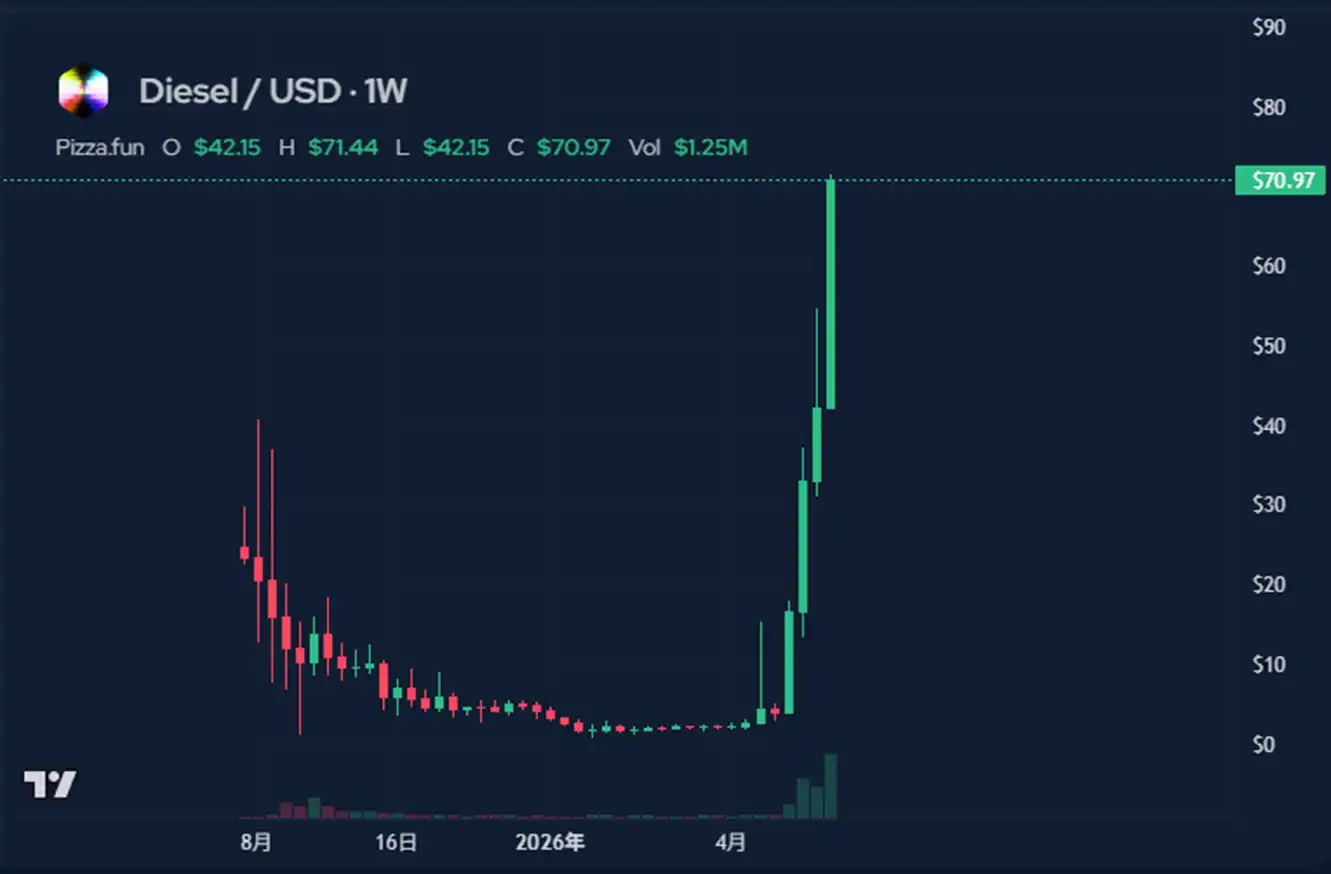
Alkanes was introduced before: Bitcoin Ecology Sees Another 10x, What Is the New Asset Protocol Alkanes? This protocol has attracted attention because $DIESEL has surged approximately 17x from the end of April to now, and is still rising:
Alkanes is not a new protocol, and even the originally dominant Oyl Wallet has stopped, with subfrost now responsible for protocol updates and maintenance, which is essentially the same technical team that was in Oyl Wallet managing Alkanes. Despite Oyl dissolving, the subfrost team has been consistently updating, including major optimizations such as embedding contracts into the indexer.
However, the significant surge of $DIESEL is likely due to the coin's very small circulating supply. In the previous mining mechanism of $DIESEL, the transaction that paid the highest miner fee in each block would take the entire $DIESEL block reward, making it essentially a scientist's game, difficult for regular users to participate in minting. However, in August last year, the mining mechanism was updated so that all transactions successfully participating in minting would receive a portion of the block $DIESEL reward based on their bid proportion. This means that those who believe in the value of $DIESEL will mint more, and mining has become a small beast in each block, with a fixed total amount (the current block reward is approximately 3.125 $DIESEL, synchronized with the Bitcoin halving cycle), but the bidding situation in each block will change.
At the same time, 50% of the $DIESEL funds minted in a block will be converted to $DIESEL and flow to the project's treasury for protocol development. Therefore, although the production of $DIESEL in a single block is around 3.125 coins, the actual number of mints that users can receive is not as many, as some directly go to the project team.
The total supply of $DIESEL is 1.562 million coins, of which approximately 640,000 coins have been mined and are available in circulation, but the actual tradable amount may be less than 10% of the total supply. Given the recent high surge, I would call it the "demon coin" of the Bitcoin ecosystem.
Welcome to join the official BlockBeats community:
Telegram Subscription Group: https://t.me/theblockbeats
Telegram Discussion Group: https://t.me/BlockBeats_App
Official Twitter Account: https://twitter.com/BlockBeatsAsia