CEO Unexpectedly Passes Away, Will ONDO's 'Tokenomics Narrative' Change?
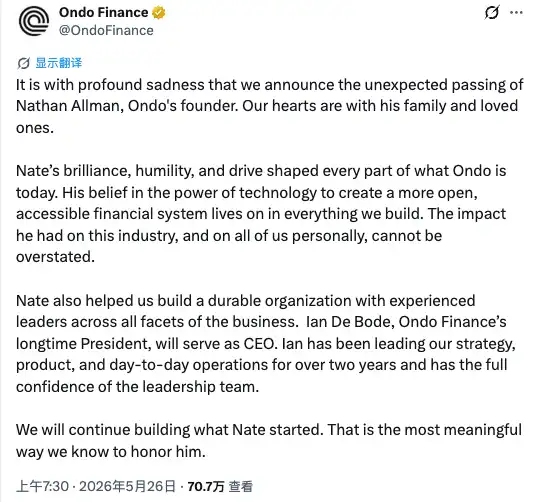
Ondo Finance Founder and CEO Nathan Allman Passes Away Unexpectedly
For the RWA track, Nathan Allman was not just a founder who told stories from the forefront. He was one of the key drivers behind Ondo's transition from DeFi structured yield products to tokenizing US Treasuries, USD-denominated yield assets, stocks, and ETFs. In a sense, when people often mention "the first tokenized asset" in discussions about ONDO today, a significant part of it comes from the product roadmap and institutional narrative that Nathan Allman has been building over the past few years.
According to an official announcement from Ondo Finance, Nathan Allman has tragically passed away, and the specific cause of death has not been disclosed at this time. Ondo has announced that company president Ian De Bode will take over as CEO. The official statement specifically mentioned that Nathan's talent, humility, and execution shaped today's Ondo, and the company will continue to advance the mission he started.
Nathan Allman was not a typical pure crypto entrepreneur. He graduated from Brown University, had prior experience in private credit investing, and later worked at Goldman Sachs's digital assets team. It was this background that gave Ondo a strong traditional financial trait from the beginning: it did not aim to be a DeFi protocol completely detached from the real-world financial system but rather sought to repackage the most mature and liquid assets from traditional finance into products that can be held, traded, composited, and settled on-chain.
In its early days, Ondo did not have the RWA flagship form it is known for today. In 2021, Ondo was more like a DeFi structured yield protocol designed with different yield levels for users with varying risk preferences.
Later, with changes in on-chain yield environments and growing demand for stablecoin and US Treasury yields, Ondo's path became clearer: instead of replicating high-risk returns on-chain, it sought to move the most stable, largest, and institutionally accepted assets off-chain onto the blockchain.
This shift was the true beginning of Ondo's entry into the mainstream spotlight.
OUSG, USDY, Ondo Global Markets basically form the three main lines of Ondo today. OUSG caters to accredited investors, providing on-chain exposure to short-term US Treasuries and money market assets; USDY is more like a USD-denominated yield product for non-US investors; Ondo Global Markets further tokenizes US stocks and ETFs as on-chain assets, allowing investors outside the US to access the traditional securities market on-chain.
In other words, Ondo's narrative is not simply about "Tokenizing U.S. Treasuries." What it truly aims to do is transform Wall Street assets into foundational modules that the crypto world can tap into. While stablecoins tackle the circulation of the dollar on-chain, Ondo seeks to address how dollar-denominated assets, Treasury yields, and securities exposure can enter the on-chain financial system.
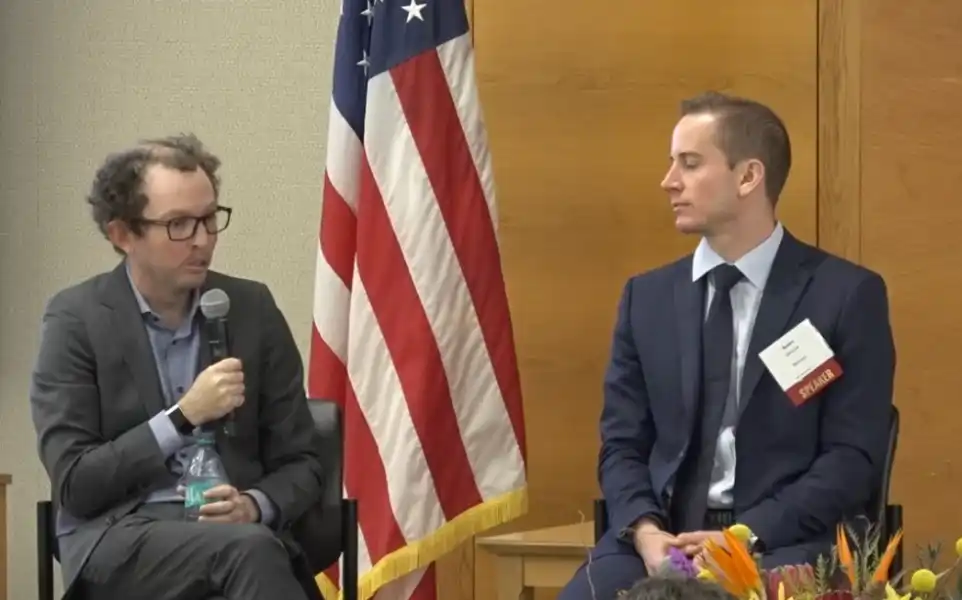
Nathan Allman spoke at the 9th Annual FinTech Conference in Philadelphia in November. Source: YouTube
This is also where Nathan Allman stands in the RWA track. He does not represent the most radical crypto-native route but rather another path: enabling traditional financial assets to settle on-chain and allowing on-chain markets access to traditional financial assets. Over the past two years, RWAs have transitioned from an old concept back into the mainstream narrative, not just because of the empty slogan of "putting everything on-chain" but because products like Treasury yields, money market funds, and tokenized stocks have begun to see real demand, scale, and compliance pathways. Ondo is one of the most typical projects in this trend.
So, will Nathan Allman's passing affect Ondo?
In the short term, there will certainly be an impact. The sudden passing of a founder is a significant event for any project, especially one like Ondo that heavily relies on institutional partnerships, regulatory communication, and a long-term product roadmap. In the short term, the market will be concerned about three issues: first, whether the founder's vision can still be carried forward; second, whether institutional partners will reassess the pace of collaboration; and third, whether ONDO, as a tokenization narrative target, will be repriced due to the departure of a key figure.
However, in the medium to long term, Ondo is not a project solely supported by the personal IP of a single founder. Over the past few years, it has built a relatively complete product matrix and assembled a management team with a strong background in traditional finance. Particularly, the newly appointed CEO Ian De Bode is not a temporary outsider but a key figure within Ondo who has long been responsible for strategy, product, and day-to-day operations.
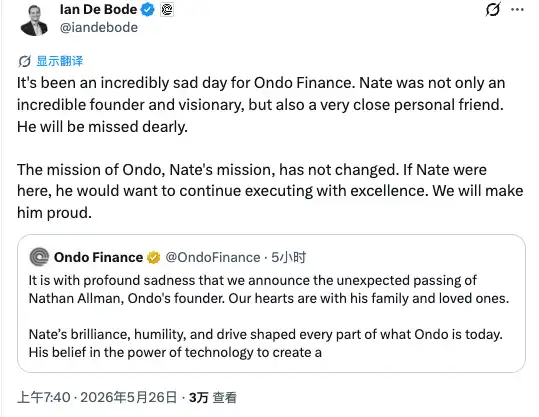
Newly appointed CEO Ian De Bode pays tribute to Nathan Allman
Ian De Bode previously served as a Partner at McKinsey & Company, overseeing its digital asset business. Upon joining Ondo in 2024, he initially held the role of Chief Strategy Officer before ascending to the position of President. Ondo's announcement also noted that Ian has been leading the company's strategy, product, and day-to-day operations for over two years, receiving full support from the management team.
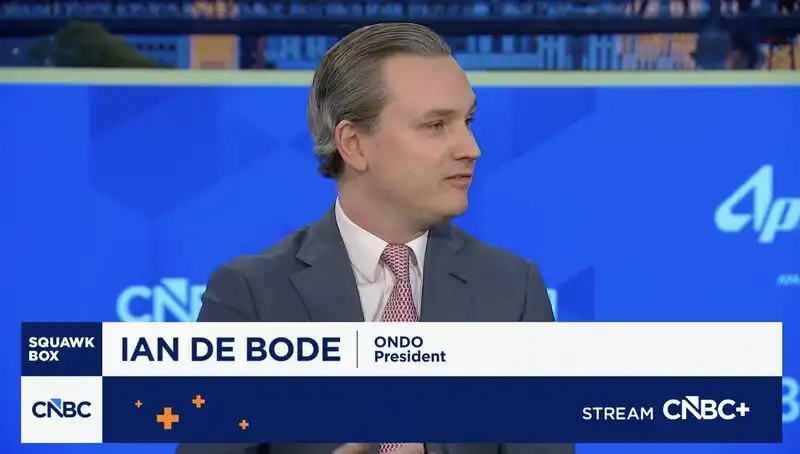
Ian De Bode Introduces ONDO on CNBC
From their backgrounds, Ian De Bode and Nathan Allman share similarities: both do not come from a strictly cryptocurrency background but rather entered the digital asset industry from traditional finance, consulting, and institutional service backgrounds. Nathan appears more like a product and vision-focused founder, responsible for taking Ondo from zero to its current position; Ian, on the other hand, leans more towards institutional strategy and execution, familiar with the genuine demand for tokenization from large corporations, financial institutions, and executives.
This alignment could be crucial for Ondo's next stage. The first half of RWA was about narrative and product validation; the second half will undoubtedly focus on compliance, distribution, liquidity, and institutional partnerships. Those who can scale assets, connect brokers, custodians, market makers, public chains, wallets, and trading scenarios will have the opportunity to transform "tokenization" from a concept into market infrastructure. Ian De Bode's background aligns well with the requirements of this stage.
Of course, this does not mean Ondo is without risks. ONDO holders need to understand one thing clearly: Ondo's product growth does not equate to the ONDO token naturally earning direct revenue sharing. ONDO mainly carries governance, ecosystem, and RWA narrative premiums, rather than U.S. Treasury yield itself. The market refers to it as the "first target of tokenization," where buyers are investing in Ondo's representation and growth expectations in the RWA track, not directly purchasing cash flow from assets under Ondo.
Therefore, Nathan Allman's departure is also a stress test for Ondo. It tests whether this project is truly a founder-driven narrative or has evolved into a sustainable financial infrastructure that can operate continuously.
If Ian De Bode can maintain the product momentum, sustain institutional partnerships, and continue driving the expansion of Ondo Global Markets, USDY, and OUSD, then short-term emotional impacts may gradually be absorbed by business continuity.
However, if future product development slows down, institutional partnership momentum weakens, or the market begins to question ONDO's ability to capture value, then this event may also become a turning point for reevaluating its valuation and narrative.
For the RWA track, Nathan Allman's passing is a loss. What he truly left behind was not just the ONDO project itself, but a clearer path: the crypto industry may not only be about creating new assets on-chain, but also about bringing the world's largest and most mature financial asset market into the on-chain world. The key question for ONDO's future is not just about its position as the "first tokenized target," but what comes next is not just memorial words but whether the new team can continue to deliver products, asset scale, and real-world demand.
Welcome to join the official BlockBeats community:
Telegram Subscription Group: https://t.me/theblockbeats
Telegram Discussion Group: https://t.me/BlockBeats_App
Official Twitter Account: https://twitter.com/BlockBeatsAsia