Han Yi's Latest Interview: My Ambition is to Have a World Worthy of Me
Original Title: "He Yi: My Ambition is to Match My World!"
Original Source: The Money-Making Girl
Original Compilation: DeepTech TechFlow
Key Points Summary
In this episode of "The Money-Making Girl," the host had a conversation with He Yi, Co-Founder and Co-CEO of BINANCE, covering topics from childhood, growth, career choices to ambition, self-awareness, execution, and how women can uplift themselves.
He Yi recalled how being the second child in her family taught her to actively seek opportunities, insisting on going to school at the age of 4, enjoying martial arts and romance novels in her youth, and resisting the idea of returning to her hometown to become a teacher during her normal school years. These experiences collectively shaped her strong sense of agency.
She also discussed why she chose to go all in on Bitcoin during the peak of her hosting career: Bitcoin made her rethink "what money really is" and showed her a financial future based on global consensus and a trust network. Her advice to ordinary people is not complicated: first understand the cost, then boldly try; iterate cognition in execution, as life is either about gaining or learning.
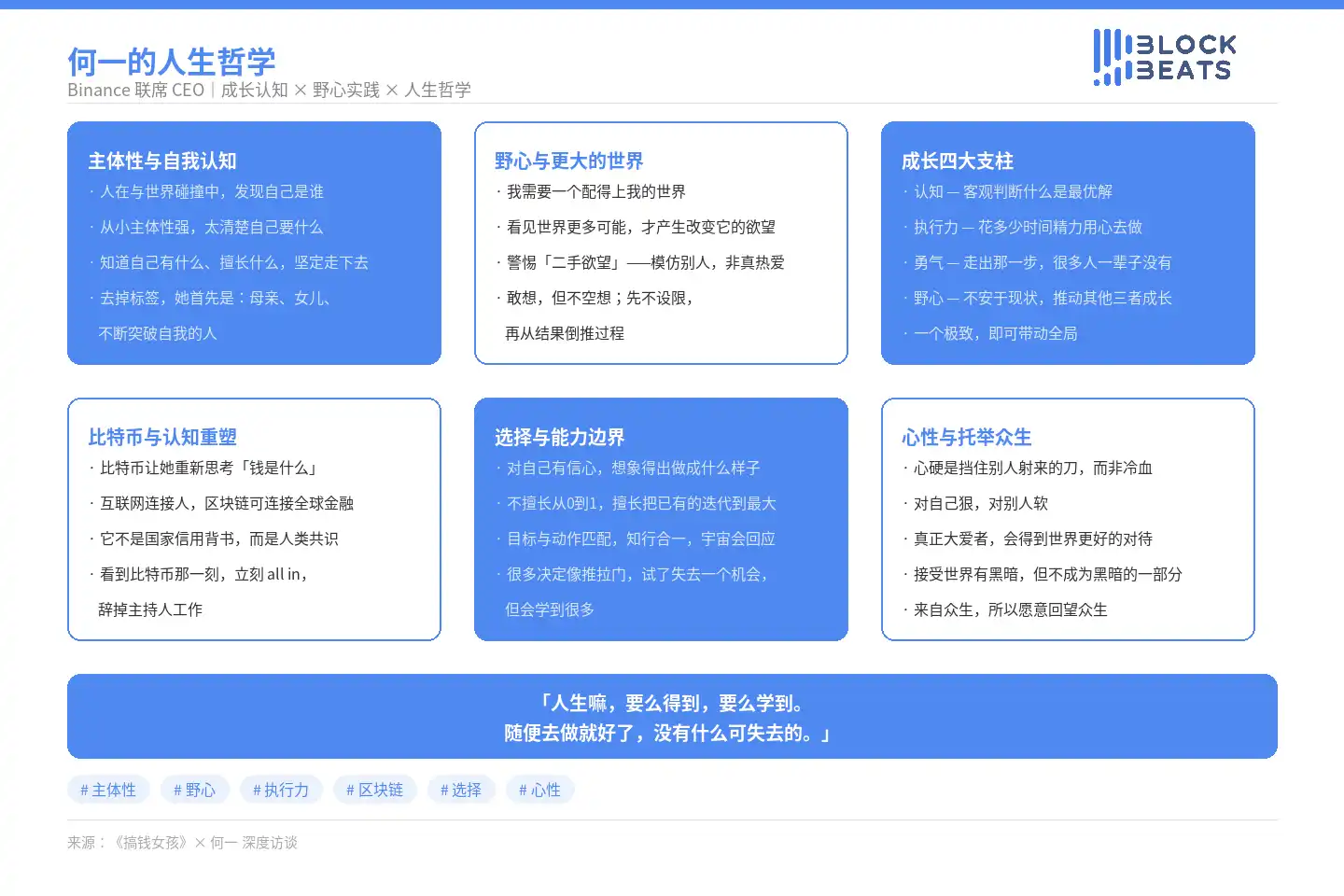
Highlights Summary
On Agency and Self-Awareness
· "People do not exist in isolation. People, through every collision with the world, eventually discover who they are. You will understand more and more about yourself through each interaction, each engagement, by how you face it, and how you deal with it."
· "I think I was quite strong in agency from a young age, very clear on what I want."
· "Why can only city kids like beautiful things, like flowers and plants? Why can't I?"
· "Do you really know what you have, what you don't have, what you are good at, what you are not good at, and whether you can firmly continue down that path, even if knives fall from the sky that you can withstand."
On Ambition and a Greater World
· "I may have always been a bit ambitious, always felt that I need a world that matches me."
· "When you see that there are still many parts of this world that you want to try to change, you will want a larger world and want to try it."
· "Often, our desires are second-hand desires, merely seeing others doing something and then imitating them."
· "You must dare to dream, but you can't just daydream. Start without setting limits, then work backward from the result to the process."
About Cognition, Execution, Courage, and Ambition
· "The so-called four pillars are cognition, execution, courage, and ambition. Among these four aspects, if one is pursued to an extreme, it will drive growth in the other parts. If two aspects are developed, it may further drive you to keep moving forward."
· "Knowing yourself enables you to objectively judge whether this matter is your optimal solution, and whether you truly enjoy this matter. Even if it doesn’t make money, are you willing to keep doing it indefinitely?"
· "Human execution is not just about doing something; it's about how much time, how much effort you put into it. Are you really dedicated? Can you truly endure the long, tortuous process of self-iteration before success?"
· "Many people think they know a lot, but attribute their lack of success to bad luck when they may not even have the courage to take the first step."
· "If you truly love it, you will feel that doing what you love is effortless."
About Bitcoin and Financial Paradigm Shift
· "Bitcoin made me rethink what money really is, and that is what impressed me the most."
· "If the internet can connect people worldwide, there could also be a trust-based network that connects the world's finances."
· "It is not a currency printed by a country or government based on credit endorsement, but rather a human consensus."
· "When I saw Bitcoin, at that moment, I felt it was the right direction. I wanted to enter this circle and be part of this movement."
About Choice, Mission, and Boundary of Ability
· "I have confidence in myself. When joining BINANCE, I could envision what I could do and how I could turn it into a top global platform; it's just a matter of time."
· "I may not be the best at creating something entirely new from 0 to 1, but I excel at continuously optimizing and iterating on something that already exists."
· "Everyone who envisions the person they want to become and where they want to go, the universe will ultimately respond to you; all you have to do is harmonize knowledge and action, aligning your goals with your actions."
· "In this world, many decisions are like a sliding door, you can still change your mind after making them. It's okay to try; what you may lose after trying is an opportunity, but you will learn a lot."
About Success, Mindset, and Lifting Up Ordinary People
· "Having a tough heart doesn't mean being cold-blooded to others, but facing different opinions, facing the knives others throw at you, you can toughen up to resist."
· "I am quite tough on myself, but soft towards others."
· "If there is a true God's hand in this world, it would treat those who truly love this world better."
· "In this world, where there is black, there is white; where there is light, there is darkness. You have to accept that it's part of the world, but it doesn't mean you have to choose to be part of the darkness."
· "In life, you either get something or learn something; just do whatever you want, there is nothing to lose."
Strip away all social labels, who are you?
Just Huizi: Today, Huizi is interviewing a woman in Hong Kong, China, who can be said to be a legend. She was born in a rural area of Yibin, Sichuan, and later accidentally became an outdoor host for a travel TV station. Subsequently, she became known as "Customer Service Xiaoh He" by many users in the blockchain industry. Now, her latest title is Co-CEO of BINANCE, the world's largest blockchain exchange platform and ecosystem.
Life can actually be turned around like this, so I am very curious about how she grew up. Today, please welcome BINANCE's Co-CEO He Yi, the First Sister.
He Yi: Hello, everyone, I am He Yi from BINANCE, also known as everyone's Customer Service Xiaoh He.
Just Huizi: Most people's imagination of a CEO or female president may feel very domineering and powerful, but you exude a very gentle and approachable feeling. So today, I am also very curious to look back and see how "Xiao He" gradually became the First Sister you are today.
Recently, there has been a popular way of self-introduction: If you strip away all social labels, how would you introduce yourself?
He Yi: I think, first and foremost, I am a mother, a daughter, a person who is constantly pushing myself to new limits.
Xiao Hui: This is a very simple expression. As for me, it seems like I need a lot of external judgment and perspectives. If I can't define myself, I will wonder how others will define me. For example, I may have received a lot of feedback saying that Xiao Hui is also an affable person because I conduct interviews, and everyone would say that you are very good at getting others to open up.
But this is also how others see me. It seems like I really need others' validation to determine who I am.
He Yi: That may indicate that you are in the process of exploring life. People do not exist in isolation; they discover who they are through every collision with the world. You will, through each interaction, each engagement, through how you face it, how you deal with it, gradually understand who you are. It shows that you are still young, still youthful.
He Yi Learned to Proactively Strive for Success from an Early Age Due to the "Second Child Law"
Xiao Hui: Before I came, I did some research and found a similarity between Sister Yi and me: you have three siblings, you are the second child, and I am the third child. There is a concept in psychology called the "Second Child Law," and it reminded me of my second sister.
My second sister's personality is very different from yours; she is more assertive, more outgoing, quite mischievous, which gives my parents a headache. I am more of the obedient type, more like the "daughter" figure. I don't know if you have looked back and seen, as the second child at home, whether this situation has left a mark on your personality?
He Yi: I think it's quite obvious. Because I now have three children myself. Usually, when the eldest is born, parents will invest a lot of attention, they will be very nervous about any little thing, so the eldest will receive all the love, the most love. When it comes to the second child, there is a common saying that "educate the eldest strictly, indulge the second child," and parents are not as worried. When the child gets sick and has a fever, they also know how to deal with it and are not so anxious.
The third child is usually the baby of the family, and everyone will pamper them a bit, considering them as the apple of their eye. So, from childhood to adulthood, parents will definitely say to the elder sister, "Let your younger brother have his way." Even if you don't compete, they will reflexively say to give in to the younger brother. The eldest has a secure love, the youngest has a definite love, the second child needs to actively seek it, otherwise, they will feel neglected.
And sometimes children's so-called rebellion is actually a cry for help. Relatively speaking, they may also be more independent and more self-centered.
Earliest Self-awareness: Insisted on Attending Primary School at Age 4, Eventually Admitted “Out of Turn”
Xiao Hui: At what moment did you decide that you needed to pursue things on your own?
He Yi: My earliest memory now is probably when I was 4 years old and wanted to go to school. Because my sister is 6 years older than me, when I was 4, she was already attending primary school. I would wonder why my sister could go to school but not me. So every day at home, I would insist that I wanted to go to school, annoying the adults to no end, until they finally sent me to school.
My elementary school homeroom teacher was a friend of my parents. He asked my parents how old their child was, and my parents lied, saying I was 6 years old. At that time, no one checked my ID, and since I didn't have my residence booklet, they said they would address it later and if my grades were not good, I would repeat the year then. So I was admitted to the school. Later, I never repeated a grade and my grades were quite good.
Xiao Hui: Because when you want to do something yourself, you can do it well. This may be the essence of your character: you are very willing to express what you want. If the current environment is not what you want, you will feel the need to find a suitable environment.
He Yi: I also have a very vivid memory of something from my childhood. Because my family lived in a rural area, Sichuan's rural areas are full of wildflowers and grass. When I was in elementary school, I would pick wildflowers every day, and my mother would laugh and say, "Why does this rural kid still love these wildflowers?" For them, wildflowers are very common and not worth paying attention to. They may think this is a privilege of city kids.
But at that time, I had a very clear memory: I do not agree with your point of view. Why should only city kids be allowed to like beautiful things, to like nature? Why can't I?
I think this may be my active change, or a manifestation of my self-persistence. In today's popular terms, it means a strong sense of self, a very early awakening of self-awareness. I was probably born a rebel.
Xiao Hui: I have had a similar experience. I have been left-handed since childhood, using my left hand to write. At one point, my parents wanted to make me right-handed, but I was very lucky. The kindergarten teacher was more open-minded and said it was okay, just let her be, she writes pretty well with her left hand and there is no need to deliberately change. There is also a folk legend that left-handers are smarter, so the teacher protected my preference, and my parents accepted it.
But I have always been very firm in the middle, refusing to change. They asked me to change, but I refused. However, they did not treat me more firmly. For you, do you think your parents were more lenient, or was there environmental pressure?
He Yi: My mom was very strict. But I feel that I had a strong sense of self since childhood, very clear about myself.
When I was a child, there was a very absurd thing: I gambled before I was 10 years old. Children would bet a small amount, like one cent, and play with older kids. Later, when I lost money in a bet and had no allowance, losing 5 yuan, my mom found out and gave me a severe beating. She used a bamboo stick from Sichuan, which was very painful. After the beating, she asked me: "Do you want more?" I said, "No."
But later, I thought about it and realized it wasn't right because I still owed money. One should have integrity. What should I do if I owe someone 5 yuan? So I found another group of kids to continue playing with. When my mom found out again, I was beaten again. But by then, I was in the process of repaying my debt and slowly began to win back. After repaying the debt by continuing to play, I stopped gambling for good.
Before the age of 10, I understood gambling: when you lose, you want to win back; when you win, you want to continue winning. It has no end. So I have zero interest in gambling, perhaps because I was trained before the age of 10.
Xiao Hui: When you were very young, you endured your stern mother's beatings while also thinking about how to repay your debt. In the end, how many beatings did you take in total?
He Yi: It wasn't that many. Besides gambling, there was another incident because of reading novels. There was a scrap collector in our village who had many books at home. I would go there to get books to read, and later I started renting novels. When I was in junior high, just over 10 years old, I was discovered by my mom again.
Xiao Hui: What were you reading? Was it the romantic novels like those by Chiung Yao?
He Yi: I actually didn't read much Chiung Yao; I read a lot of martial arts novels and some semi-classical Chinese literature like "Strange Stories from a Chinese Studio." At that time, there weren't many choices, so I would read whatever books were available at the scrap station. Later, when I started renting novels, I read a lot of Li Bik Wan and Yi Shu. These two Chinese Hong Kong writers had a significant influence on me.
Li Bik Wan is a devilishly talented writer with a strong supernatural atmosphere. She has a passage that I still remember to this day, called the "Sixteen-word Maxims of the Jianghu: A life for a life, a debt for a debt, willing to admit defeat in gambling, and bear the consequences of your actions." I even put it in my QQ profile.
In Yi Shu's novels, there may be many things that seem a bit sentimental, after all, they are young adult novels. But ultimately, she has a very important theme: buy flowers for yourself. It's all about the image of a strong female lead. The works from the 70s and 80s are like this, so I feel that the independence and subjectivity of Hong Kong Chinese women existed very early on. These things seem to have become part of the foundation of my personality.
Host: Now, let's go back to your career experiences as an adult. When I was watching, I also felt that your life didn't follow the usual path. It's like you got some opportunity, and when you wanted to do something, you just went for it without much planning. The first point that intrigued me was that before becoming a host, your dream as a young person was to become a model. I remember you saying in the media that you wanted to be a model before the age of 16.
He Yi: Yes. At that time, I was in a teacher training college because my parents were teachers, and they thought teacher training was better. After completing teacher training, I became a teacher. When I was in school, the teachers would say, "It would be a waste if you didn't become a teacher." I told the teacher in front of the whole class that I thought it would be a waste for me to become a teacher.
Ambition Awakens During Teacher Training: "I thought it would be a waste for me to become a teacher"
Host: You are truly rebellious by nature and quite defiant. But because you had good grades, the teachers didn't pay too much attention. Why were you so sure back then that you weren't suited to be a teacher?
He Yi: I didn't think I wasn't suited to be a teacher. It was probably that I was not satisfied with just being a teacher.
Host: Why? For that era, it was a good job.
He Yi: Maybe it's because I read a lot and saw a broader world, not just the world in front of me. I went to Yibin College, and if I were to go back, I'd probably go back to the village to be a teacher. I wasn't satisfied.
When I read the novels of Li Bihua and Yi Shu, when I saw more descriptions of this world, I felt that there should be a broader world out there, and I wanted to go see it.
"Second-Hand Desire": Many times, our desires are merely imitations of others
Host: So, at that time, you didn't want to be a teacher, but how did you end up wanting to be a model later on?
He Yi: This is a bit embarrassing to talk about. I read a book called "Mimetic Desire" before. For example, if you see someone carrying a Hermes bag, you might feel like you also want a Hermes bag; if you see someone buying artwork, you might feel like you also want to buy artwork. But is that your true desire?
Very often, it is a desire born secondhand. You simply see others do it, so you imitate them, hence the term "imitative desire."
When I was young, my state of mind was more like, I didn't know who I was, nor did I know my own potential or talents. In middle school, my deskmate won first place in a speech competition for the whole school, something I had never tried. Later, when I was in teacher's college, I gave it a shot and found out I was pretty good. The first time I participated in a speech contest, I also won first place.
Another classmate beside me had a dream of becoming a model. Seeing that she could do it, I thought I should give it a try too. So, despite being under 1.6 meters tall, I signed up for a modeling competition in Sichuan. I really thought they were just trying to make money off my registration fee, as any normal person would know I wasn't tall enough. But they had a photography group, perhaps because Sichuan girls love beauty. At that time, bridal photo studios were quite popular, and they would take some studio shots, so that was considered my first step into the TV industry.
“Ambition” is not a negative word; I want a world that matches my ambition
Xiao Hui: When it comes to this kind of imitative psychology, adolescence is indeed a time of confusion. If you find someone around you who is similar to you can achieve something, human nature might stir, you might feel a bit itchy in your heart, thinking, if they can do it, can I?
He Yi: I believe this is our most primitive desire and ambition, and there's nothing wrong with that. Often, Chinese people are shy about discussing the word "ambition," especially girls. Once ambition is mentioned, it seems like a very negative word. But I may have always had a strong sense of ambition; I have always felt I need a world that matches my ambition.
Xiao Hui: Even now, I dare not say such words. Often, after I have achieved something, I feel like I am undeserving, and my sense of worthiness is not that strong. I will strive to make myself worthy. But few people would say, I want to make this world worthy of me. It actually implies that you are a bit dissatisfied with reality.
He Yi: Yes. I am very reluctant to say that I am where I am today because of my family, my background. I truly believe that my journey to today is a blessing from heaven, that I am heaven's beloved, the chosen one. However, in this process, when you see there are many aspects of this world you want to try to change, you will wish for a larger world, to try and see.
I think this may be the earliest form of primitive ambition: dissatisfaction with the status quo.
Xiao Hui: You have had many leaps or crossovers in your life, each time jumping out of your comfort zone and into a completely new field. For example, how did you become an outdoor host for a travel TV show? This is a story that is often talked about, like an option that fell right into your lap.
He Yi: It wasn't exactly something that just fell into my lap. Many people hesitate to step out of their comfort zone because they only have ideas but have never tried to actually do it, or when they do, they don't think every day about how to improve and advance.
Just like when you used to do podcasts, the original name was "Initiative Description," which positioned you a bit too high. But when you changed it to "Money Girl," first of all, "making money" is a proactive behavior, and secondly, "girl" is a niche. If you hadn't spent time accumulating experience beforehand, you might not have realized that the original concept didn't work and that you needed to find a new way to iterate, optimize, and then "Money Girl" was born.
Many people might think, "I'll give it a try, fail in three days, and decide it's not feasible." But the key to execution is not just doing something; it's how much time and effort you put into it, whether you are really dedicated. Can you truly endure the long and arduous process of self-iteration before success?
The Four Pillars of Personal Growth: Cognition, Execution, Courage, Ambition
He Yi: I think the so-called four pillars are cognition, execution, courage, and ambition. Among these four aspects, if one is extremely developed, it will drive the growth of another part. If two parts grow, it may further propel you to move forward.
This is not my theory; I also saw it online, but after reading it, I think it's a very good summary.
Xiao Hui: Cognition, execution, courage, and ambition are much like the four wheels of a car. If one moves, the car can start moving, at least a little forward.
He Yi: I think having courage, having ambition, and then trying it out, iterating your cognition during the execution process is the way to go.
But many people's cognition is: I know a lot of things, I know about astronomy, geography, and international politics like the back of my hand. I feel I'm more impressive than those celebrities, those who have already done very well. I'm just unlucky; whenever someone else succeeds, it must be because they have done something illicit.
But he may not have taken that step at all or even had the courage to take that step. So he just stood in his own perceived understanding, rather than in the true understanding path towards success.
Xiao Hui: I want to go back to the level of execution, because it is the most crucial. We often say, "Proactive people enjoy the world first," which is actually a matter of execution. Like when I started my podcast, there were no ads in the first six months, and the number of fans grew steadily. During that half year, I didn't feel that the show was becoming popular or exploding. I only received some small feedback saying that it was better than my original show, and that was enough motivation for me to continue.
At that time, I was still working full-time and wasn't determined to make money from it. As the audience grew later on, I slowly felt a sense of being propelled by traffic, as well as a sense of the spirit of the times. I then continued to figure out how to do this thing better. But I persisted for two years before transitioning to full-time. At any moment during that period, if I had given up just because there were no ads or data, I wouldn't be where I am today.
I am very grateful for my own sense of execution. However, I am also curious about when is the right time to persevere in something and when to give up? We often say, "The night is darkest just before the dawn." Sometimes I look at my friends around me who were also doing self-media at that time, or even when we started this account, many of them had more fans than us. But now, they have also stopped. Maybe they just needed to hold on a little longer. How do you really seize the right timing?
He Yi: Many times, people actually need to understand themselves, but most people don't. Understanding oneself is about whether you can objectively judge if this thing is your best solution, and whether you truly like this thing. Even if it doesn't make money, you are willing to keep doing it.
Most people might think that they are only doing this because others are doing it, and they don't actually like it that much; they just heard that it can make money. So it's easy for them to give up. But if you really love it, you will find that doing what you love is effortless.
Xiao Hui: I'm actually the kind of person who can endure if it requires effort, as long as I like it, my resilience is sufficient. But you must allow me to rationally analyze the SWOT, where the strengths and opportunities are before doing it, I seem not to be that kind of person.
He Yi: Like I used to work as an assistant psychological counselor before becoming a host. I also tried being a university teaching assistant. In this process, you will find that the kind of life is different from what you imagined, not the life you want. But once you try it, you will know that it's not what you want.
In the past, when we watched "Infernal Affairs," Carina Lau was sitting there, it seemed like a high-quality job where I would chat with her, and after the chat, you would give me money. It seemed like a job that earned money through intelligence. However, when I actually started doing user reception and triage, I found that this industry may not be sustainable in China in the short term.
When you sit there to receive and triage, you would calculate: how much is this consultation fee. You would also see China's top psychological experts because I was at the Chinese Academy of Sciences Institute of Psychology at that time, meaning you could meet China's top psychological experts and see what their lives were like, what their daily routines were like. I just felt that this was not the life I wanted.
Sometimes we don't need to know the whole picture, or know what will happen in five or ten years. As long as within a foreseeable range, you determine that this is not what you want, you can make a choice. I also never thought that the so-called success defined by everyone in a worldly sense today may be completely beyond what I imagined at that time.
Cognitive Awakening After Contacting Bitcoin: Discovering the Essence of Money and the Trend of Financial Decentralization
Xiao Hui: Let's go back to the cognition in the four key words just now. We also mentioned the phrase: "You cannot earn money beyond cognition." But many people would say, how can I improve my cognition? I'm about to board the bus now, how do I get this ticket? Including when you transitioned from a host to blockchain, you had to do a lot of learning.
I remember you had a very interesting scene: you helped others with promotion, promoted Bitcoin on your social media, and even wrote a dedicated article. I thought, why is this person so attentive? If it were me, I would have just casually reposted. In the process of learning this thing, what kind of prospects did you see in this industry?
He Yi: I am a very curious person by nature, so I may spend some time researching anything. Therefore, my understanding of the world may not be like many experts who have pursued a Ph.D. along the way and become experts in a certain field; I am more like a jack-of-all-trades.
During this process, you suddenly realize that everyone used to think that making money was very important. Back then, we didn't even call it making money; we just thought money was very important. But when I researched what Bitcoin really is, I didn't want to do a free advertisement for others. I didn't receive any money, I just reposted it on my social media, and I felt it was not very responsible.
So, I took the time to research what Bitcoin is and specifically wrote an article. Not a report, but a short essay, but at least I figured out what Bitcoin really was. That was the end of 2013.
During this process, the most meaningful part for me was when my understanding was reshaped in that instant. Before this, perhaps it was more about being told by others that money is very important, but what is money exactly? Bitcoin made me rethink what money really is in that moment, and that was the point that touched me.
It was in that moment that I realized, if the world's internet can connect people worldwide, then there can also be a global, trust-based network that connects the world's finance together. You can think of it as the world's money, not just banknotes printed with the endorsement of a specific country or government; it is a human consensus.
I then felt that Bitcoin was really an amazing thing, and I firmly went all in, quitting my job as a host.
Xiao Hui: Was your hosting career on the rise at that time?
He Yi: It was actually getting better step by step. When I first started hosting, I had no experience with outdoor shoots, didn't know where the camera was, or where the lights were. Sometimes I even blocked my partner's camera. Slowly, from nothing, I gained experience, had some opportunities in film and television, such as acting in short dramas, or there were companies interested in signing me. But I always felt that something wasn't quite right; it seemed like it wasn't something I truly liked, not something I was passionate about.
At that time, I thought being a host was great, with mountains and rivers, and I could still get paid. But after playing for two years, seeing the world and all beings, you start to think, how many more years can I play like this? So when I saw Bitcoin in that moment, I felt it was the right direction, I wanted to enter this circle, and do this thing.
Choosing to Resign During the Peak of My Hosting Career Because I Aspire to a Bigger World
Xiao Hui: It seems like you saw a very grand vision, felt a calling, and you were very excited.
He Yi: Yes. Perhaps I am a more emotional person, and when making choices, I often rely on feelings and intuition to judge. If something excites me, and I really want to do it, I might try it out before determining whether it will be successful in the future; if not, then I'll try again.
Xiao Hui: I feel that when you make choices, you also tend to lean towards this "I am a person with very accurate intuition" kind of approach.
He Yi: But later I found that Yang Zhenning had a theory, saying that human intuition is actually because your processing system is faster, faster than logical thinking, and can quickly come to a conclusion. My understanding after digesting it is that many times human intuition is very accurate, based on your cognition and existing knowledge structure, allowing you to quickly come to conclusions and judgments. However, everyone's cognition, knowledge structure, and existing schema are different, so everyone's intuition is also different.
Interviewer: How do you enhance this kind of sensitivity, or the so-called insight? When you saw the value of Bitcoin, you interpreted it as a very promising future industry, but some people may find it too abstract and give up.
He Yi: Maybe it's because I'm curious. I believe that the reason the world has come to where it is today must be that in the historical process of human development, many people have done things that others dare not think or try. Like Elon Musk building rockets, before he built rockets, no one dared to think that rockets could be built this way, and no one dared to think that rockets could be reused.
You first need to dare to think, set no limits first, and then work backward from the result. What are the necessary indicators in order to achieve this goal? Is there an optimal solution based on current technology? If not, which existing technologies can be used, and which ones can be skipped?
Interviewer: I also want to ask, because you saw the value of this industry in 2013 and later resigned to enter it. But you left in the middle, and then returned later. When you returned, you said a phrase, that you wanted to return to where your mission lies. So I am curious, why is this matter connected to your mission? What is your mission?
He Yi: I joined the previous blockchain company in 2014 and left in 2015 due to some conflicts within the management team. I was out of work for about five to six months, always chatting with entrepreneurial friends around me and found that it didn't seem to be what I wanted to do.
At that time, mobile videos had just started, and apps like Meipai had just come out. The Ice Bucket Challenge was also very popular at that time. So at that time, technology also talked to me for a few months. I felt that this was indeed a direction of technological development, so I thought why not give it a try first, and then I joined the technology industry.
In 2017, when CZ started Binance and approached me to be an advisor. When we talked, I actually started thinking that in China, in a relatively short period of time, I made live streaming quite popular. At that time, there was a fierce battle among live streaming platforms. I thought I should challenge a bigger goal: what does a top-tier company look like globally? You need to dare to think, but not indulge in fantasy.
Host: Xiaohui, was your sense of mission at that time more like a commitment to yourself, to reach a bigger stage and become a greater version of yourself? Or was it about helping more people and having a broader impact?
He Yi: The idea of influencing more people is quite funny. When I was young and naive, I was chatting with a girlfriend. One day, she suddenly called me and asked, "What kind of person do you want to become?" I thought about this question seriously and said I wanted to become a person who could influence the world. She immediately said, "You're crazy."
Host: What is that girlfriend doing now?
He Yi: She is also in the crypto industry now, brought in by me. At that time, she said she wanted to find a guy who was handsome, treated her well, was wealthy but not super rich. She has achieved her goal as well.
So I think, everyone, whatever kind of person you want to become, wherever you want to go, the universe will respond to you. As long as you achieve a unity of knowledge and action, aligning your goals with your actions, that's all that matters.
Host: But that's really hard. Many people don't know how to achieve their ambitions. From thinking to doing, there are several missing pieces in between. We may see your results, but every choice in the process is quite important.
You just mentioned that you consider yourself lucky, and I'm curious, is there any experience behind this luck that others can refer to? When we are making choices, how can we increase the probability of being lucky? Going back to that moment of choice, you were already doing well at Xiaokaxiu and Yixia Technology, which was a very certain worldly success; at the same time, there was an uncertain future, which may have seemed more promising to you, but it was still an uncertain new industry. You had two offers, two paths in front of you, and you chose the latter just because you believed it would open up a bigger world?
He Yi: I should say, I have confidence in myself. Besides the opportunity at BINANCE, others were also approaching me. For example, Erbao at the time asked me, "Your current ICO is very hot, do you want to raise some money for a project? I can raise a billion dollars for you and just charge you a management fee."
I seriously thought, what would I do if I had a billion dollars in my hands? I couldn't think of anything. But if I joined BINANCE, I could envision what it would become. My ability in marketing, at BINANCE, I could turn it into a top global platform, ultimately it's just a matter of time.
I Excel at Iteratively Optimizing Existing Things to the Maximum
Xiao Hui: So you might be more suited to act as a promoter rather than a person who creates something from 0 to 1. You might be a person who goes from 1 to 100, or even from 1 to 1000.
He Yi: That's possible. You make me think starting from 0 to create something new doesn't seem to be my strong suit. I'm not saying I turn something from nothing to something, but I feel very good at continuously optimizing and iterating on something that already exists to the maximum.
Xiao Hui: This is a very rare ability. Especially in the AI era, it's easy to create something, but how to make it grow and iterate on it is quite difficult.
He Yi: I think that path is visible. I can envision what I will do, the first step, the second step, the third step, roughly what kind of process I will go through, and then I can see in my mind what success looks like.
If You Want Your Ambition to Reflect in Reality, Try More
Xiao Hui: I also want to go back to a topic related to women: How can women's ambition be realized? In reality, on the one hand, you have to confront many structural limitations, including the fact that there are few women in the cryptocurrency circle, and even fewer women in executive positions. So you must have definitely overcome various obstacles and restrictions to get to where you are today.
In every decision-making process, as you just mentioned, there is a desire to achieve a greater self and reach a larger stage in your ambition. Of course, you may have been practicing since childhood, and ambition comes naturally to you. But for someone like me, even though I am a woman, I often feel insecure and undeserving.
I would feel that I might need to accomplish one thing first before daring to take it further, to challenge the so-called boss. I wouldn't directly aim for the highest goal and then work backward; I am more of a steady type.
He Yi: I think you should try first. There are many decisions in this world, just like a push-pull door, you can still change your mind after making them. It's okay to try; what you might lose by trying is an opportunity, but you may gain a lot of knowledge.
The first thing is to try, don't be afraid. But before trying, you need to be clear about what kind of decision it is and what the cost is. For example, many people think that by finding a crypto whale, they can become He Yi. In China, there are many emotional anchors,
Are you a bull or a cow in terms of competitiveness, trying to label me: Am I a bull or a cow? If you ask this question, I think maybe the big brothers in the crypto world would say I am a bull player, and those who truly engage with me and have cooperated with me would say I am the bull of bulls.
Original Article Link
Welcome to join the official BlockBeats community:
Telegram Subscription Group: https://t.me/theblockbeats
Telegram Discussion Group: https://t.me/BlockBeats_App
Official Twitter Account: https://twitter.com/BlockBeatsAsia