Bitcoin Miners Band Together to Corner Zcash Market

Every time ZEC is mentioned, people always talk about it as the coin of the gods.
By the end of September 2025, ZEC was still at $53. At that time, it was a privacy coin that had been forgotten by the market for four years. Falling from $290 in 2021 to below $30, no one mentioned it. Another privacy coin, Monero, was successively delisted by dozens of exchanges, and ZEC was everyone's default "next one." Everyone was waiting for it to die.
Then, starting from that month, ZEC surged 12x.
In 8 months, ZEC rose from $53 to $600, reaching a peak of $740. Its market cap surged from under $1 billion to nearly $10 billion, pushing back into the top 15 cryptocurrencies.
Everyone saw ZEC rising, but most people believed it was due to the "privacy narrative" or the public endorsements of big names like Naval, Arthur Hayes, Mert Mumtaz, Balaji, and Cobie.
However, the author believes that the more important background and factor behind ZEC's surge is that Bitcoin miners are collectively pumping ZEC.
Every Major ZEC Surge Marks a Mid-Term Top for BTC
Some veteran BTC traders on Twitter were the first to notice that "every major ZEC surge happens to mark a mid-term top for BTC."
Each time ZEC experiences a significant surge, BTC always hits a mid-term high around the same time. Once or twice could be a coincidence, but what about four times?
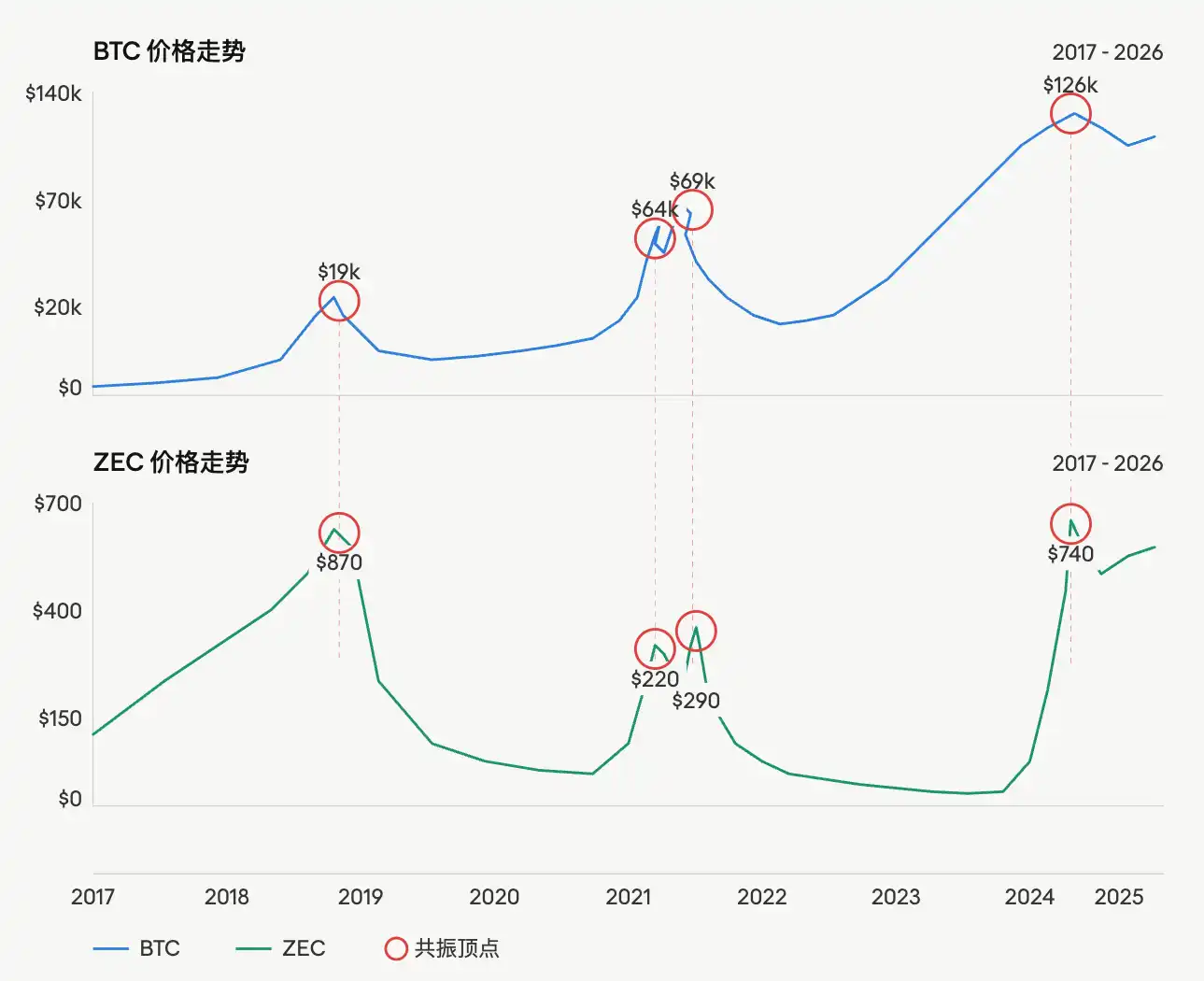
At the end of 2017, ZEC surged from $200 to $870. In the same month, BTC hit a peak of $19,000. Both almost topped out at the end of December, then entered a year-long bear market together.
From the end of 2020 to the beginning of 2021, ZEC surged from $50 to $220. During the same period, BTC experienced its first mid-term top at $64,000. BTC retraced to $30,000, and ZEC retreated to $100.
In the fourth quarter of 2021, ZEC surged again from $100 to $290. BTC eventually peaked at $69,000. Afterward, both entered a three-year bear market together.
In this round, ZEC went from 53 to 600+, while BTC is repeatedly testing the resistance around 125,000 to 127,000.
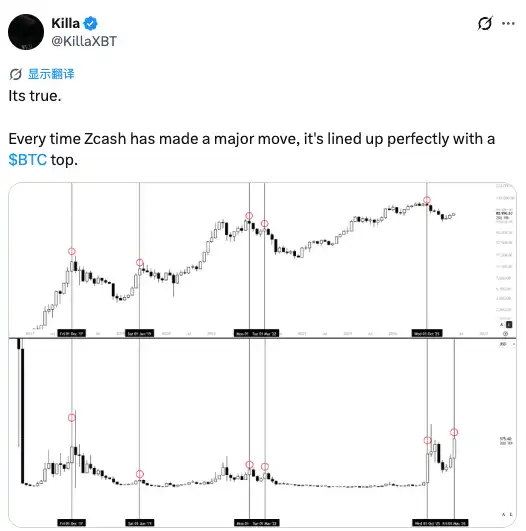
Technical analysis trader Killa (@KillaXBT) also noted and pointed out this view.
More notably, this pattern doesn't hold true for other mainstream coins. The synchronicity between ETH's peak and BTC isn't as precise. For newcomers like SOL and AVAX, this is even more evident. The ability to "pinpoint" the top of the BTC cycle like this is almost unique to ZEC.
ZEC's price surge seems to be following BTC's rhythm. As BTC approaches its peak, ZEC takes off. After BTC hits the top, ZEC also synchronously enters a pullback.
Back to the present.
ZEC's daily uptrend line has been broken. BTC is fluctuating around $75,000. If BTC falls below $75,000, the market generally believes that the mid-term peak of this bull market cycle is essentially confirmed.
If the historical pattern continues to hold, now is the time window for the fourth ZEC-BTC resonance peak.
So, the question becomes, why does this pattern exist? Why ZEC, and not another coin?
The answer may lie in the mining pool rankings.
ZEC Mining Pools, Another Game BTC OGs Play
Open the ZEC block explorer and look at the hashrate distribution over the past 7 days: ViaBTC 34.2%. Foundry 27.74%. F2Pool 12.82%. 2Miners 7.58%. Antpool 6.8%.
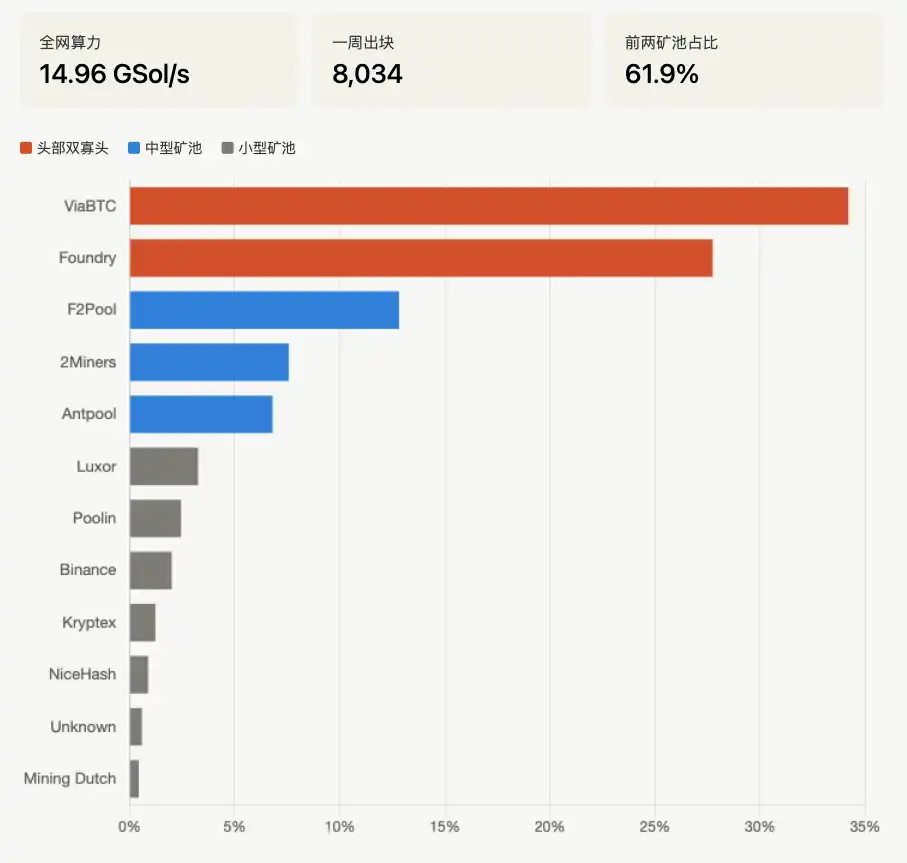
The top 5 mining pools hold 89.14%. Among them, the hashrate of 4 pools—ViaBTC, Foundry, F2Pool, Antpool—accounts for 81.6%.
These 4 pools all share a common identity: they are veteran pools in the top 10 of the BTC network hashrate ranking. Let's introduce each one.
Controlling 34.2% of ZEC's hashrate, ViaBTC was founded by Yang Haipo, an early Bitmain employee, in May 2016 in Shenzhen.
After leaving Bitmain, Yang Haipo started his own venture. During the 2017 BCH fork, he was one of the most ardent supporters. ViaBTC mined the first BCH block. Following this battle, Yang Haipo, together with Roger Ver, was seen as a key figure in the BCH camp. ViaBTC has consistently been in the top 5 global mining pools for BTC. In addition to the mining pool business, in 2017 Yang Haipo also founded the CoinEx exchange platform, followed by the ViaWallet wallet, ViaBTC Capital fund, and CoinEx Smart Chain public blockchain, creating a complete crypto ecosystem.
Occupying 27.74% of Foundry, Foundry is the mining arm of the DCG empire and may be the most crucial player in the whole story.
Foundry Digital is a wholly-owned subsidiary of Digital Currency Group (DCG). DCG is a crypto conglomerate founded by Barry Silbert, which also owns Grayscale, Genesis Trading, and CoinDesk.
The Foundry USA Pool is the world's largest Bitcoin mining pool, holding a long-term 28% to 32% of the BTC network's hashrate. Its clients are nearly all publicly traded mining companies in North America: Marathon, Riot, CleanSpark, Hut 8, Core Scientific. These companies cannot use Chinese mining pools due to compliance requirements, making Foundry their only option. It can be said that Foundry is not selling hashrate. It is selling "compliance." SOC 1 Type 2 certification, institutional-grade reports, SLA support. These are mining infrastructure services that publicly traded mining companies can purchase.
Next, let's look at Foundry's layout on ZEC. On March 11, 2026, Foundry announced its intention to launch a ZEC mining pool. It was officially launched on April 13.
In just one month, its hashrate share went from 0 to 27.74%. This can be considered the fastest hashrate migration in ZEC mining history.
Prior to Foundry's entry, ViaBTC alone held 68% of the hashrate. After Foundry entered, ViaBTC's share dropped to 34%. The additional 28% was almost entirely taken by Foundry. This North American institutional capital firm has officially taken over a large portion of the ZEC mining infrastructure. The entire process took only one month.
Another major player is F2Pool, representing 12.82% of the total hash rate. Formerly known as "Discus Fish," F2Pool was China's first Bitcoin mining pool. Founded by Wang Chun and Shenyu in April 2013, it is the world's oldest operating mining pool.
Even today, F2Pool remains in the top 5 mining pools for BTC. F2Pool was also one of the earliest pools to support mining when the ZEC mainnet launched in October 2016. Looking back at ZEC's mining history, F2Pool has been a key player throughout.
Another significant player is Antpool, representing 6.8% of the hash rate and operated by Bitmain.
Antpool was launched by Bitmain in 2014 as a self-operated mining pool, showcasing vertical integration between a mining hardware manufacturer and a mining pool operator. Antpool is the second to third largest mining pool globally for BTC. While its 6.8% share in ZEC may not be the highest, it represents the direct interests of a major mining equipment supplier.
This brings us to a often-overlooked fact about ZEC mining: the almost complete monopoly of ZEC mining equipment by Bitmain.
ZEC uses the Equihash algorithm. The primary ASIC miner supporting this algorithm is the Bitmain Antminer Z15 Pro, with a hash rate of around 860 kSol/s per unit. This means that other manufacturers like MicroBT and Canaan Avalon have almost no products for ZEC mining.
The entire supply of ASIC miners for the ZEC network is almost entirely controlled by Bitmain.
With the current network hash rate at 13 to 15 GSol/s, based on the Z15 Pro's hash rate per unit, it is estimated that there are about 15,000 to 17,000 Z15 Pro miners active on the network. The daily net profit per miner is approximately $55 to $56 (at $0.07 per kWh).
In a way, Bitmain holds the key to ZEC miner prices, used miner prices, and the pace of new miner supply.
If the mining pool ranking is indirect evidence of "who is mining," then the holdings ranking tells a more direct story. Interestingly, the largest ZEC miners are not necessarily the biggest ZEC holders.
One of the most prominent examples is Foundry and Grayscale.
According to on-chain data from Arkm, the Grayscale Zcash Trust holds approximately 390,298 ZEC, representing about 2.34% of the circulating supply. This trust is currently seeking SEC approval to convert to a spot ETF and plans to list on NYSE Arca under the ticker ZCSH.
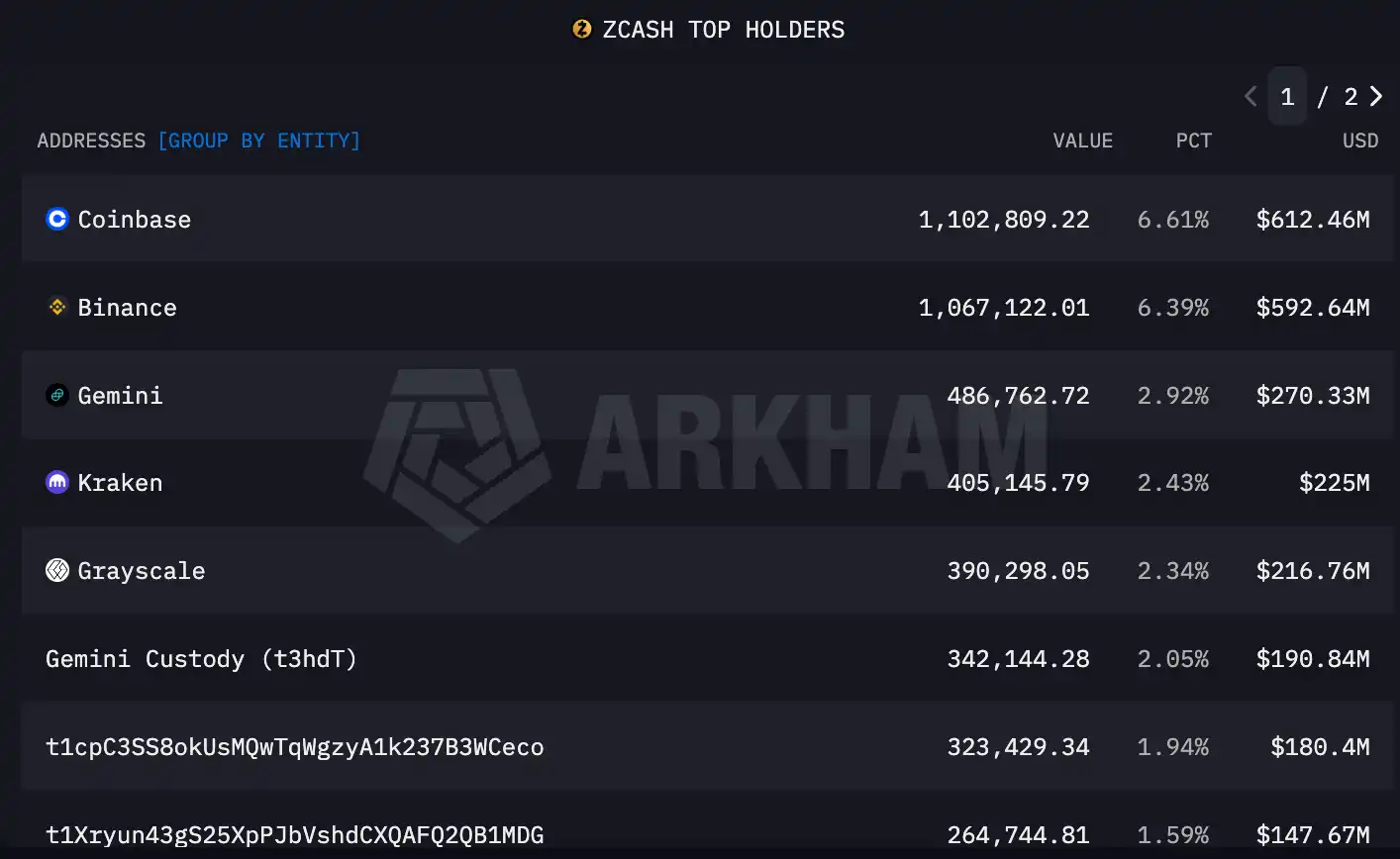
As mentioned earlier, Foundry Digital, which holds 27.74% of ZEC, is a wholly-owned subsidiary of DCG, as is Grayscale Investments. The parent company of both these entities is DCG.
Mine, Hold, Sell. DCG, as a single entity, has covered the entire chain of custody for ZEC from mining to institutional compliance.
Following DCG, the next largest holder of ZEC is Gemini, backed by the Winklevoss twins.
As a custody provider, Gemini holds most of its ZEC actually originating from Cypherpunk Technologies, traded on Nasdaq under the symbol CYPH. Originally, this company was a biotech firm named Leap Therapeutics, focused on cancer drug development. In 2025, it laid off 75% of its staff, effectively halting its main operations.
On November 12, 2025, the company announced its transformation and rebranding as Cypherpunk Technologies, positioning itself as a "Digital Asset Treasury" (DAT), dedicated to one thing: buying ZEC and hoarding ZEC.
On the day of its transformation, Cypherpunk raised $58.88 million in private funding, with the only institutional investor being Winklevoss Capital. This VC firm was founded by Tyler and Cameron Winklevoss in 2012, with "the majority of the funding" for the entire round coming from them.
Simultaneously, Winklevoss Capital appointed its principal, Will McEvoy, to Cypherpunk's board of directors and made him the company's CIO. The first purchase of 203,000 ZEC by Cypherpunk on the day of its transformation was also held in custody by Gemini.
The Winklevoss twins have a background in the Bitcoin space almost as deep as DCG's. Both entered Wall Street as early players in 2013 to 2014. Gemini and Grayscale are two key entities in the past decade's Wall Street-compliant crypto journey.
As the price of the coin rises, there is an increase in mining machine demand, leading to higher mining machine prices and new machine shortages. When the coin price drops, there is a reduction in mining production and a sell-off of older machines. The rhythm of the entire supply chain is coordinated by the mining pools in collaboration with the mining machine manufacturers.
It is indeed a very lucrative business.
After all, the most valuable aspect of a PoW coin has never been the technology; it is the distribution of industrial interests upstream and downstream of this chain.
The mining pool is the largest natural seller in the ZEC spot market. All ZEC mined daily (based on the current 1.25 ZEC × 1150 blocks = 1437 ZEC/day) is directly owned by the mining pool. This adds up to 520,000 ZEC per year. These coins are not taken by the miners immediately after mining; most of them are first received by the mining pool and then distributed to the miners. The mining pool has complete discretion over timing and can choose to sell in a high-liquidity market or hold back in a low market.
The mining pool has a complete "coin treasury." For example, ViaBTC owns the CoinEx exchange platform, enabling them to sell the mined coins directly on their own platform. F2Pool has Stakefish under its umbrella. Antpool is backed by Bitmain's financial business. Foundry is backed by DCG's full financial ecosystem (Grayscale + Genesis Trading + Foundry). They act as both the supply side at the mining end and the distribution side at the exchange platform, controlling the entire industry chain from mining to selling.
The mining pool has ten years of "coordinated experience." In BTC, there have been multiple instances of coordinated actions among mining pools at critical junctures (such as halting block production, supporting forks, and coordinating hashrate transfers), with the most notable being the 2017 BCH fork and the 2017 SegWit debate. For this group of people, engaging in coordinated behavior on ZEC is like muscle memory.
Combined, ViaBTC, Foundry, F2Pool, and Antpool, the companies that control 81.6% of ZEC's hashrate, along with their founders and parent companies, are all individuals most familiar with Bitcoin's cycles over the past decade.
Loong Wang also extracted the on-chain payout addresses of the top four mining pools, all of which are publicly marked by Zcashinfo (the official block explorer operated by Foundry) with no speculation involved.
Foundry's main receiving address is t1SqwRAAdSig6dE4EBPLonAait219VmkUjP. Since its launch in March 2026, this address has received a total of 22,696 ZEC — which represents Foundry's mining revenue for just over a month. On-chain data shows that almost all of these coins have been sent to the Orchard pool — ZEC's latest generation shielded pool that utilizes the Halo 2 zero-knowledge proof, making the funds completely untraceable once inside.
On the other hand, ViaBTC's main receiving address t1at7nVNsv6taLRrNRvnQdtfLNRDfsGc3Ak has received a total of 1.73 million ZEC, which currently amounts to over $1 billion. The funds are being directly sent to the Sapling shielded pool (Zcash's previous generation shielded pool). The address exhibits a very stable pattern, consolidating funds into the Sapling pool every 5 to 8 blocks mined, with minimal holdings.
F2Pool's three main receiving addresses have collectively received 5.87 million ZEC. Two of the addresses currently have a balance of 0. The distribution method is mixed, with some funds going to transparent addresses and some entering the Sapling shielded pool.
Antpool has the lowest distribution frequency, holding onto more coins and showing little distribution activity recently.
ZEC is a privacy-optional cryptocurrency, where users can choose whether each transaction utilizes the shielded pool. It is this "optional" feature that enables ZEC to comply with regulatory requirements. Among these four major mining pools, three conduct their core distribution activities within the shielded pool.
On Bitcoin, it is possible to track how much each mining pool sends to Coinbase or Binance daily, trace every large transfer, and determine each pool's inventory cycle, with dedicated analysts performing this work. However, on ZEC, on-chain data is largely opaque.
Once the coins enter the shielded pool, actions within it, the final recipient, which exchange platform, at what price they are sold — all of these details are essentially invisible. The level of concealment that mining pools enjoy with ZEC is an order of magnitude higher compared to the era of Bitcoin.
The ZEC token is inherently more suitable for market manipulation ("whale games") than BTC. How could Bitcoin's top miners pass up the opportunity to manipulate the market with ZEC, the "magic coin"?
Welcome to join the official BlockBeats community:
Telegram Subscription Group: https://t.me/theblockbeats
Telegram Discussion Group: https://t.me/BlockBeats_App
Official Twitter Account: https://twitter.com/BlockBeatsAsia