AI Apocalypse, is a massive short squeeze
Original Title: It's Too Obvious. What If AI Doesn't Actually End The World?
Original Source: The Kobeissi Letter
Original Translation: DeepTech TechFlow
DeepTech Summary: As AI tools like Anthropic demonstrate remarkable coding and workflow automation capabilities, the market has plunged into "AI Doomsday" panic, causing the evaporation of trillions of dollars in market value in an instant. However, this article presents an extremely insightful reverse perspective: the short-term impact triggered by AI is not a harbinger of economic collapse but rather an inevitable process of a sharp decline in "cognitive cost." By comparing the PC revolution of the 1980s and productivity historical data, the author points out that the true "Productivity GDP" era will only begin when technology makes knowledge acquisition cheap and abundant. This is not just a labor force restructuring but also a crucial path to geopolitical easing and a global productivity boom.
Full Text Below:
The stock market just wiped out $800 billion in market value because "AI taking over the world" is becoming a consensus viewpoint. This viewpoint is too obvious. And transactions that are "obvious" never truly win.
The reason this doomsday scenario can spread like wildfire is that it captures something primal. It portrays AI not as a productivity tool but as a macroeconomic destabilizer, capable of triggering a negative feedback loop: layoffs lead to weakened consumption, weakened consumption leads to more automation, and automation accelerates further layoffs.
The obvious fact is: AI is not just another software feature or efficiency tool. It is a universal capability shock that touches every white-collar workflow. Unlike any revolution in history, AI is becoming proficient at "everything."
But what if the doomsday scenario is wrong? It assumes demand is fixed, productivity gains do not expand the market, and the speed of system adaptation cannot surpass the speed of destruction.
We believe there is a second path, one that is being greatly underestimated. The Anthropic "takedowns" that seem like early signs of systemic collapse may ultimately be the beginning of the largest-scale productivity expansion in history.
Before we start, please bookmark this article and revisit it repeatedly over the next 12 months. While the analysis below is not a foregone conclusion, it is crucial to remember that humans always find a way to turn the tide, and free markets always find a way to self-heal.
Anthropic's "Unpacking" Is Real
First, we have to say, we cannot ignore the market. Anthropic is reshaping the world through Claude, causing Fortune 500 companies to lose hundreds of billions in market cap.
This is a story we've seen several times already in 2026: Anthropic releases a new AI tool, Claude makes substantial strides in programming and workflow automation, and within hours, the market of the target industry crumbles.
If you haven't been paying attention, here are some examples:
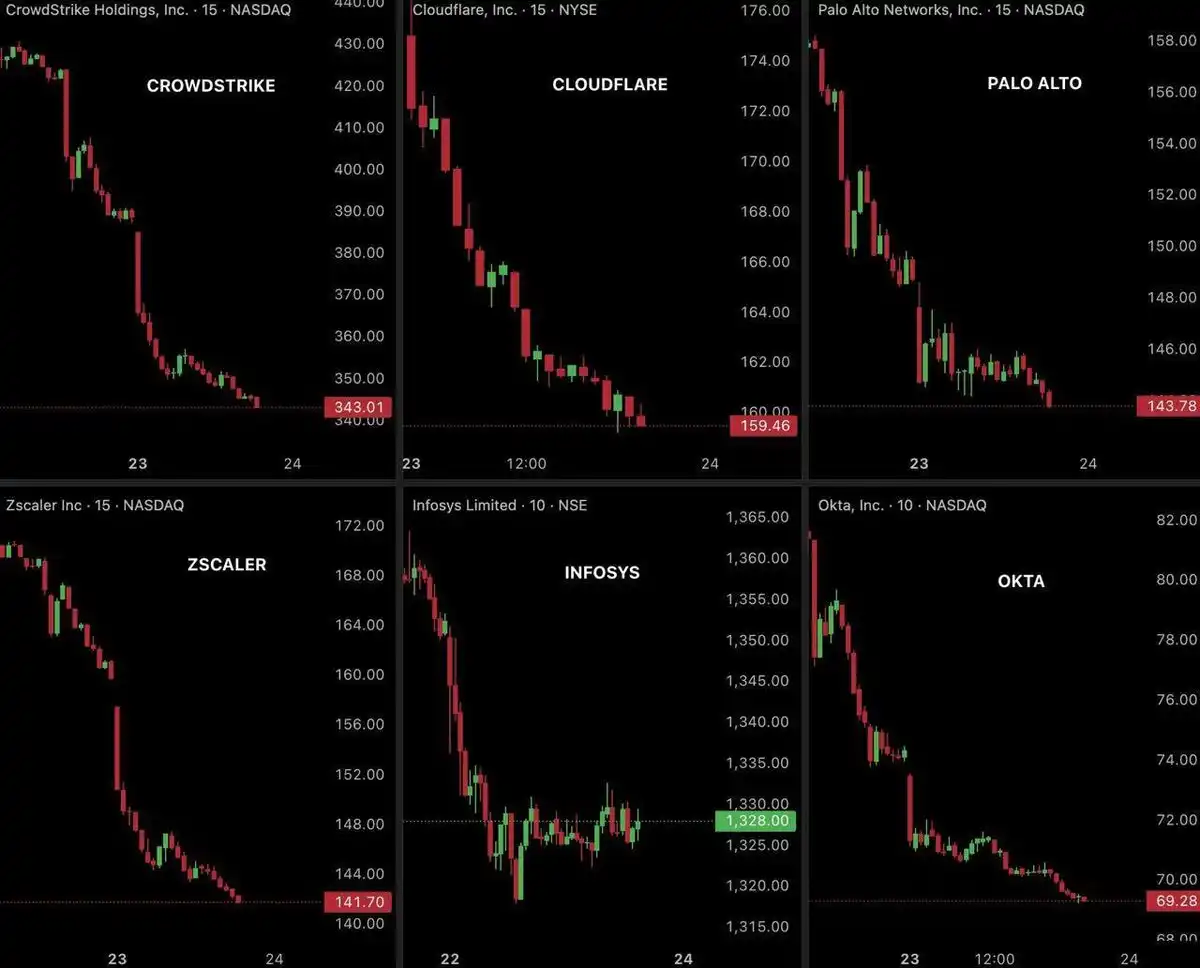
Stock Reactions to Claude's Announcements
IBM stock ($IBM) just had its worst day since October 2000 after Anthropic announced Claude could streamline COBOL code. Adobe ($ADBE) is down -30% year-to-date as generative capabilities compress creative workflows. The cybersecurity sector collapsed after the release of "Claude Code Security."
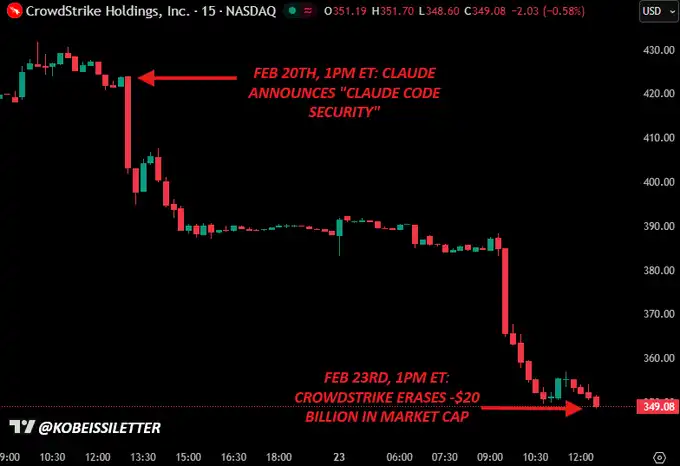
In the example above, CrowdStrike stock ($CRWD) plummeted almost instantaneously upon Claude's announcement of "Claude Code Security."
At 1:00 PM EST on February 20th, Claude announced "Claude Code Security." This is an automated AI tool that can scan vulnerabilities in a codebase.
Just two trading days later, CrowdStrike stock ($CRWD) evaporated - $20 billion in market cap in the wake of this news.
These reactions are not irrational. The market is attempting to price in real-time profit compression. When AI replicates the work of laborers, pricing power shifts to the buyer. This is the first-order effect, and it is very real.
Commoditization does not mean collapse. Instead, it is a way to lower costs and broaden access to technology. Personal computing commoditized computation, the internet commoditized distribution, the cloud commoditized infrastructure, and AI is commoditizing cognition.
Undoubtedly, some traditional workflows will experience profit margin compression. The question is, will the lower cognitive cost lead to economic collapse, or will it be allowed to expand dramatically?
The "Doom Loop" Assumes Fixed Demand
The doomsayer's loop has created a simplified linear model: AI gets better, companies reduce layoffs and wages, then purchasing power declines, companies once again invest in AI to defend profits, and so the cycle continues. This assumes a completely stagnant economy.
History shows that this is not the case. When the cost of producing something collapses, demand rarely remains the same but expands. When the cost of computation decreases, we do not consume the same amount of computation at a cheaper price. We consume orders of magnitude more computation and build entirely new industries on this basis.
As shown in the graph below, today's personal computers are 99.9% cheaper than in 1980.
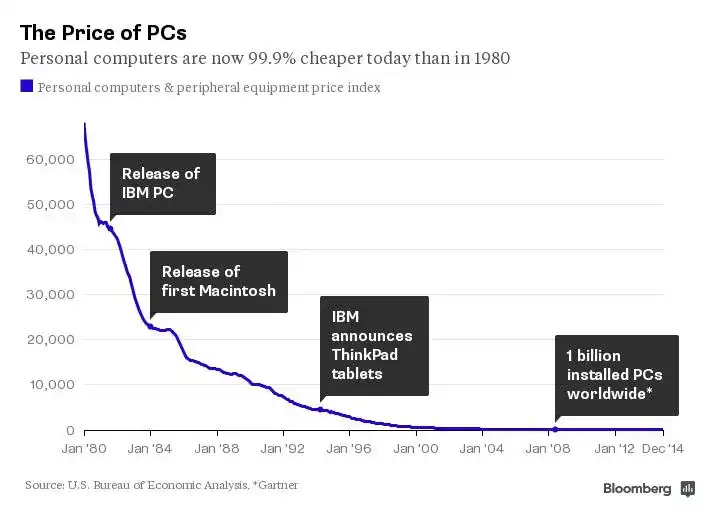
Graph Note: 1980-2015 Personal Computer Price Trend
AI reduces the cost of every industry, and when service costs decrease, purchasing power increases regardless of whether wages grow.
Only in the scenario where AI replaces labor without substantial demand expansion does the doomsday loop dominate. If cheap computation and productivity give rise to entirely new consumption categories and economic activities, then an optimistic scenario emerges.
The Real Impact is Price Collapse, Not Unemployment
Investors find it easier to sell the "obvious" layoff story, but the price compression the service industry is experiencing is the bigger news. The reason why knowledge work involving services is expensive is due to the scarcity of knowledge—this sounds simple but is indeed the case. An abundance of knowledge supply has led to a decline in the price of knowledge work.
Think of healthcare management, legal documentation, tax filing, compliance checks, marketing production, basic programming, customer service, and educational tutoring. These services consume a significant amount of economic resources largely because they require trained human attention. AI lowers the marginal cost of this attention.
Indeed, as shown in the graph below, the U.S. service sector contributes nearly 80% of the U.S. GDP.
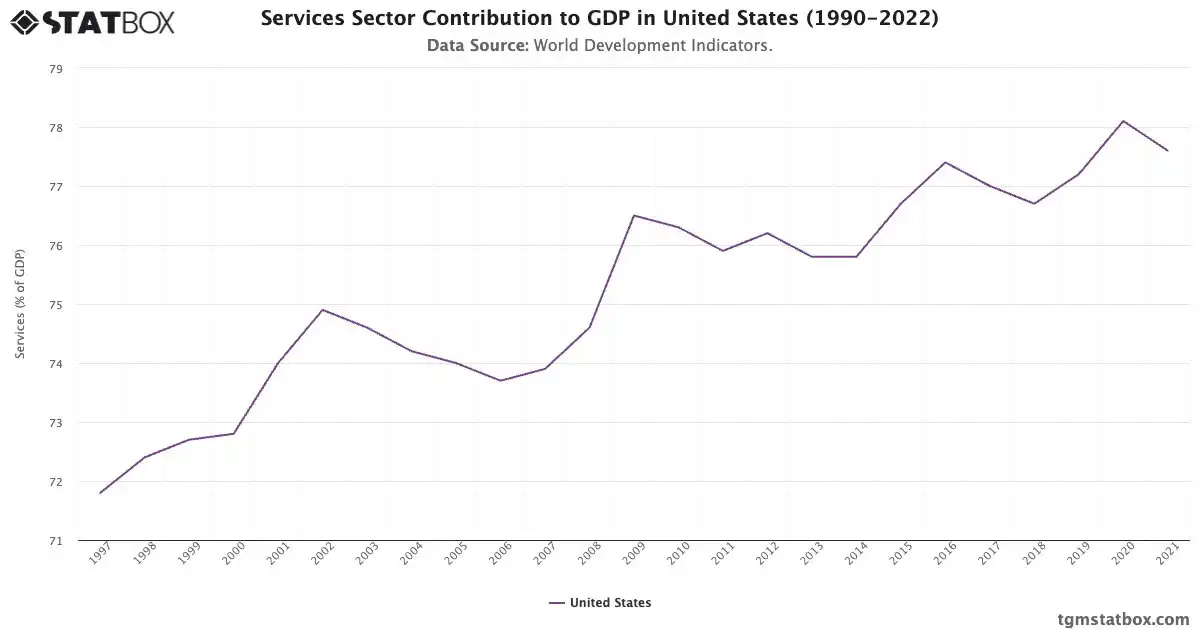
If operating costs for businesses decrease, small businesses become more accessible; if the cost of accessing services decreases, more households engage. To some extent, AI advancements can act as an "invisible" tax cut.
Companies whose profits rely on high-cost cognitive labor may suffer losses, but a broader economy will benefit from lower service inflation and higher real purchasing power.
Shifting from "Ghost GDP" to "Abundance GDP"
The bear case relies on "Ghost GDP," output that shows up in the data but doesn't benefit households. The optimistic counter is what we call "Abundance GDP," where output growth combines with falling living costs.
"Abundance GDP" doesn't require a surge in nominal income; it requires prices to fall faster than incomes. If AI lowers the cost of many essential services, then even if household wage growth slows, their real benefits increase. Therefore, the productivity gains don't evaporate but are passed through in lower prices.
This may explain why productivity has outstripped wage growth for over 70 years:
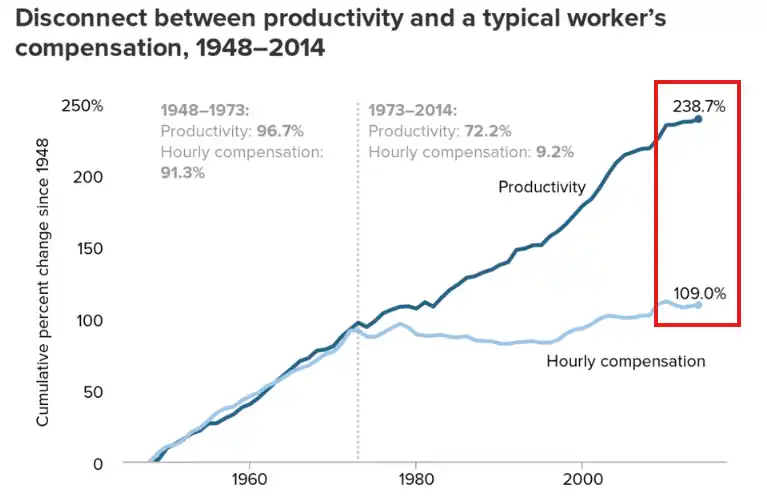
The internet, electricity, mass manufacturing, and antibiotics have all provided new ways to expand output and reduce costs, despite these processes being disruptive and volatile. However, in retrospect, these changes permanently raised living standards.
A society that reduces time wasted on navigating complex systems and redundant services in payments will functionally become wealthier.
Labor Markets Are Restructuring, Not Disappearing
A core concern is that AI will disproportionately affect white-collar employment, which drives non-essential consumption and housing demand. This is true and a valid concern, especially against the backdrop of such vast income inequality.
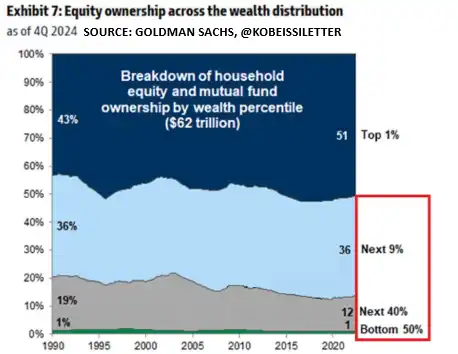
However, AI faces more challenges in the physical world's dexterity and human identity. Skilled trades, hands-on healthcare, advanced manufacturing, and experience-driven industries still have structural demand. In many cases, AI is a complement to these roles, not a replacement.
More importantly, AI lowers the barrier to entry for entrepreneurship. When one can automate accounting, marketing, support, and programming tasks, starting small businesses becomes easier. We are bullish on small enterprises.
In fact, by eliminating barriers to entry through AI, we may have a solution to the income inequality challenge we currently face.
The internet has killed off certain job categories but created entirely new ones. AI may follow a similar pattern, compressing some white-collar functions while expanding self-directed economic participation in other areas.
Received, to proceed with modularizing and compiling Part Three (final part). This section will explore the evolution of the SaaS business model, AI's reshaping of market structures, the real-world performance of productivity data, and an overlooked perspective: how AI-driven "abundance" can reduce global conflicts.
The "Demise" Story of SaaS
AI has evidently put pressure on the traditional Software as a Service (SaaS) business model. Procurement team negotiations have become more challenging, and some niche software products face structural resistance. But SaaS is merely a delivery mechanism, not the endpoint of value creation.
The next generation of software will be adaptive, agent-driven, outcome-based, and deeply integrated. The winners will not be providers of static tools but those most adaptable to change.
Each technological shift rearranges the stack, and companies pricing for static workflows will inevitably struggle. Companies with data, trust, computing power, energy, and validation, on the other hand, may thrive.
A profit squeeze in one layer does not mean the collapse of the entire digital economy; it signifies transformation.
AI Business Repositions the Market
Bears argue that agentic commerce will destroy intermediary links and eliminate fees. To some extent, this is true. Extracting fees becomes more challenging as friction decreases.
As shown in the chart below, even before AI became what it is today, stablecoin transaction volumes were already soaring. Why? Because markets always favor efficiency.
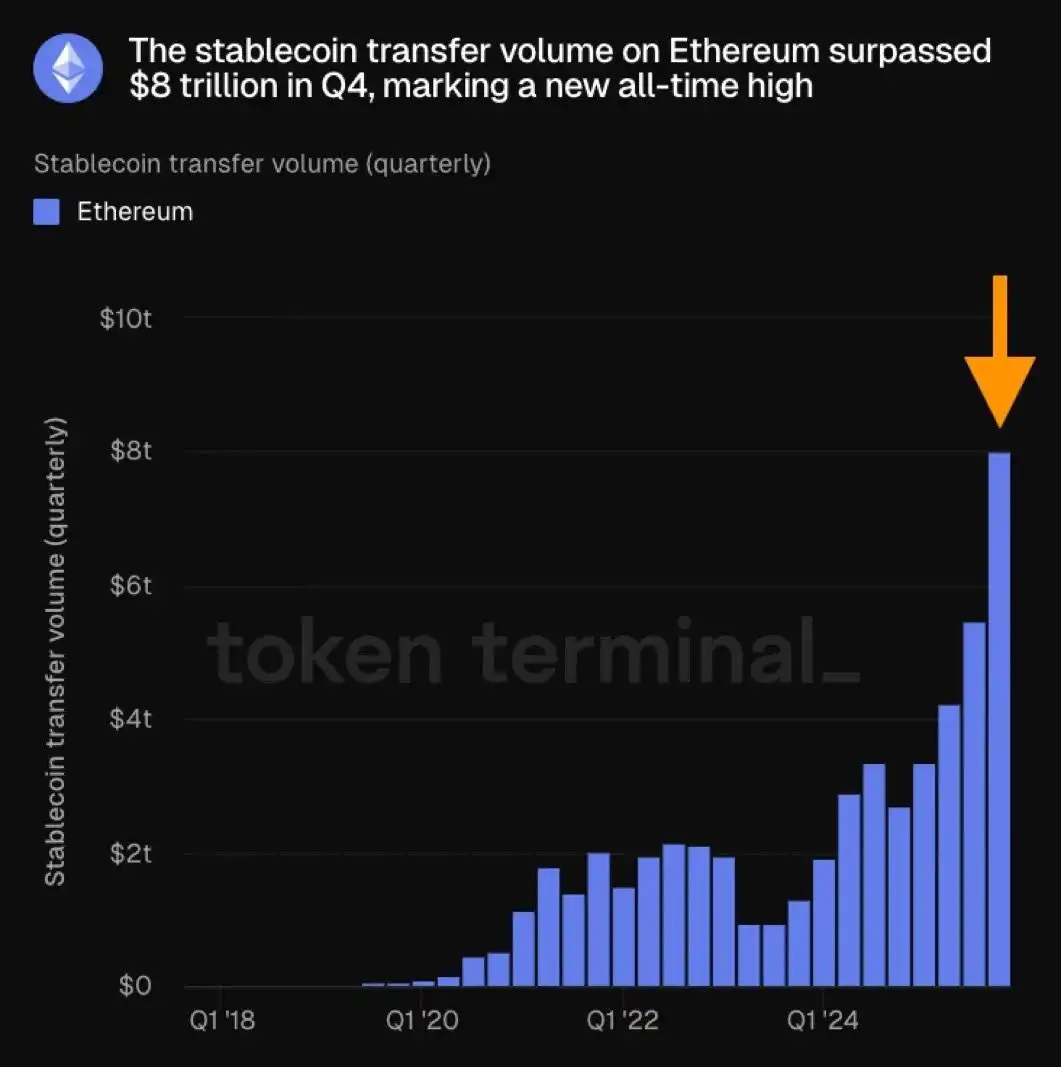
Lower systemic friction will also expand transaction volumes. As price discovery improves and transaction costs decrease, more economic activity occurs. This is a bullish trend.
Agentic entities representing consumer actions may compress platform profits built on "habit." However, they can simultaneously increase total demand by reducing search costs and improving efficiency.
Productivity Is the Core Variable
The ultimate determinant of optimistic outcomes is productivity. If AI can deliver sustained productivity gains in healthcare, government management, logistics, manufacturing, and energy optimization, then the outcome is abundance for all humanity and a reduction in barriers to entry.
Even a sustained 1–2% productivity growth would lead to significant compounding effects over a decade.
The macroeconomic shift triggered by AI has already spawned some of the best investment opportunities in history. This is an area we have spent countless hours researching and consistently staying ahead in.
As shown in the chart below, productivity has already started to increase rapidly due to AI. Labor productivity in the United States accelerated in Q3 2025, marking the strongest growth rate in two years:
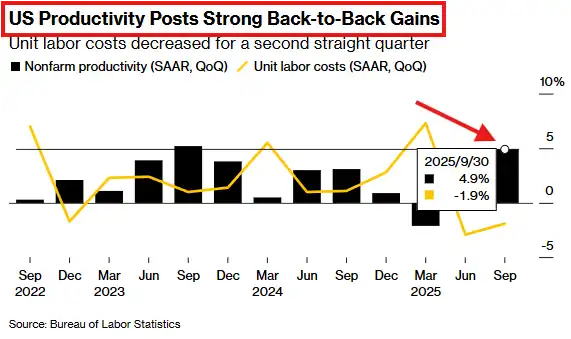
The pessimistic view assumes that productivity gains will flow entirely to AI model builders without translating into broader benefits. The optimistic view, however, believes that price compression and the formation of new markets will more widely distribute the gains.
Abundance Reduces Conflict, Not Just Costs
One of the least discussed impacts of AI-driven "abundance" is geopolitical. For much of modern history, wars have been fought over scarce resources: energy, food, trade routes, industrial capacity, labor, and technology. When resources are scarce and growth feels like a zero-sum game, competition arises between nations. But abundance changes everything.
If AI significantly reduces the production costs of energy, manufacturing design, logistics, and services, the global economic pie expands. When productivity rises and marginal costs fall, economic growth becomes less reliant on advantages gained through others' losses. This will end wars and could lead to the most peaceful era in human history.
Economic warfare is no different, as seen in the prolonged trade war we are currently in.
Tariffs are tools in a resource-scarce world to shield domestic industries from cost competition. But if AI causes production costs to collapse everywhere, why do we still need tariffs? In a high-abundance environment, protectionism becomes economically inefficient.
History has shown that technological acceleration periods often lead to reduced global conflicts in the long term. The post-WWII industrial expansion reduced the incentive for direct confrontations between major powers.
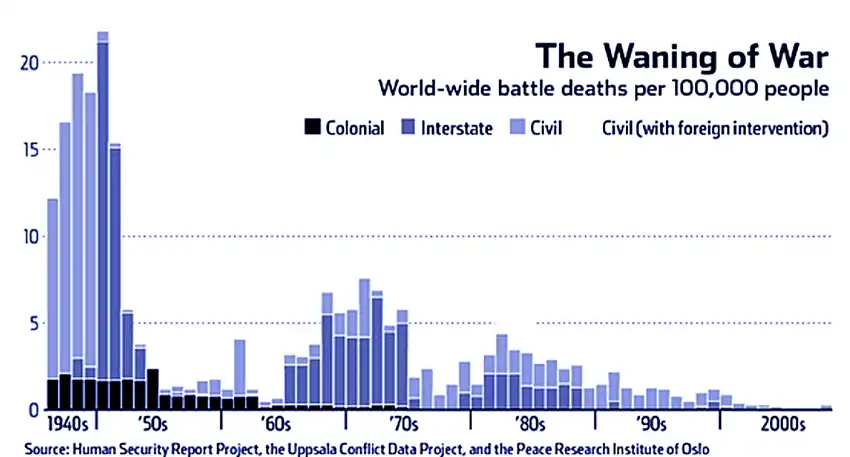
AI-driven abundance could accelerate this dynamic. If energy is managed more efficiently, supply chains are more resilient, and production is more localized through automation, nations become less fragile. As economic security rises, geopolitical aggression becomes less rational.
The most optimistic AI outcome is not just higher productivity or a higher stock index but a world where economic growth is no longer a zero-sum game.
Conclusion: What If the World Doesn't End?
AI amplifies outcomes. If institutions can't adapt, it can amplify fragility; if productivity outpaces the speed of destruction, it can also amplify prosperity.
Anthropic's "unbundling" is a signal of workflow repricing and cognitive work getting cheaper, marking a clear transition.
But transition does not mean collapse, just as every major technological revolution has always looked destabilizing at the outset.
The most underestimated potential of today is not utopia, but abundance. AI might compress rents, reduce friction, and reorganize the labor market, but it might also usher in the greatest real productivity expansion in modern history.
The difference between a "global intelligence crisis" and "global intelligence prosperity" lies not in capability, but in adaptability.
And this world always finds ways to adapt.
Finally, those who can remain objective and process-driven in the current turbulent times are experiencing the best trading environment in history.
Deep Dive Synopsis: As AI tools like Anthropic showcase incredible code and workflow automation capabilities, the market plunges into fears of "AI doom," evaporating market values worth billions in an instant. However, this article presents an extremely inspiring reverse perspective: the short-term impact caused by AI is not a harbinger of economic collapse but a necessary process of a sharp drop in "cognitive costs." By contrasting the PC revolution of the 1980s with historical productivity data, the author points out that the true era of "abundant GDP" will only begin when technology makes knowledge acquisition cheap and abundant. This is not just a labor restructuring but a necessary path to geopolitical easing and a global productivity surge.
Welcome to join the official BlockBeats community:
Telegram Subscription Group: https://t.me/theblockbeats
Telegram Discussion Group: https://t.me/BlockBeats_App
Official Twitter Account: https://twitter.com/BlockBeatsAsia