The group has started tipping CA! What does the surge of new and old Meme coins prove?

In the first week of 2026, the meme sector's surge and on-chain revival seemed to snap the crypto market out of its year-end sluggishness as if by magic. It's easy to start wondering if things will only get better from here. Looking back on the past year, from the era of "test coins" to the "broccoli wars," and then to the phenomenon of "Binance life," all of which made BSC the biggest winner in this round of the Meme battlefield. It also indicated that in the rubble of the VC coin valuation system collapse, Meme has become the asset class with the lowest consensus cost and the highest penetration.
This viewpoint may sound somewhat cliché, and many industry practitioners may be too lazy to discuss it again. However, we cannot ignore the New Year's market trend led by Meme. Meme trading has contributed a significant portion of the market's gains, directly driving up the gas consumption of public chains and shoring up DEX trading depth.
So, a more pressing question arises: with such a large amount of liquidity, where is the main matching taking place? And where is it settling into a stable trading habit and infrastructure?
Although there have been many whispers in the community recently about the development environment of the BSC ecosystem Meme, the current situation has evolved to the point where BSC is making Meme more and more like an assembly line: faster issuance, denser trading, stronger distribution, coupled with the platform and community's joint efforts to keep the momentum going. The rise of Four.Meme doesn't seem so much like an isolated blockbuster moment but more like a typical sample of the industrialization stage of the Meme economy.
According to records from Phemex and on-chain data terminals, Four.Meme's single-day protocol revenue reached $1.4 million in October last year, surpassing Pump.fun from the Solana ecosystem for the first time in history. This signifies that Meme coins are no longer just a frenzy for retail investors but have become the core battlefield where public chains compete for liquidity, user attention, and on-chain settlement rights.
Victory of Infrastructure
The success of Four.Meme is by no means a stroke of luck but rather the inevitable result built on top of the BNB Chain's 2025 underlying technological upgrades.
Meme transactions feature high frequency, low average transaction value, and extreme sensitivity to gas fees, placing stringent demands on the underlying blockchain's performance. In 2025, the BNB Chain completed consecutive hard fork upgrades codenamed Pascal and Lorentz. These two upgrades introduced the core BEP-7928 parallel execution mechanism, significantly boosting node throughput capacity and compressing block confirmation times to sub-second levels.
For Meme players, this means sniping the presale is no longer bottlenecked by congested networks, high-frequency arbitrage is back, and average Gas fees are stabilized at an ultra-low level of around $0.01. This physical infrastructure advantage has provided the perfect incubator for Four.Meme.
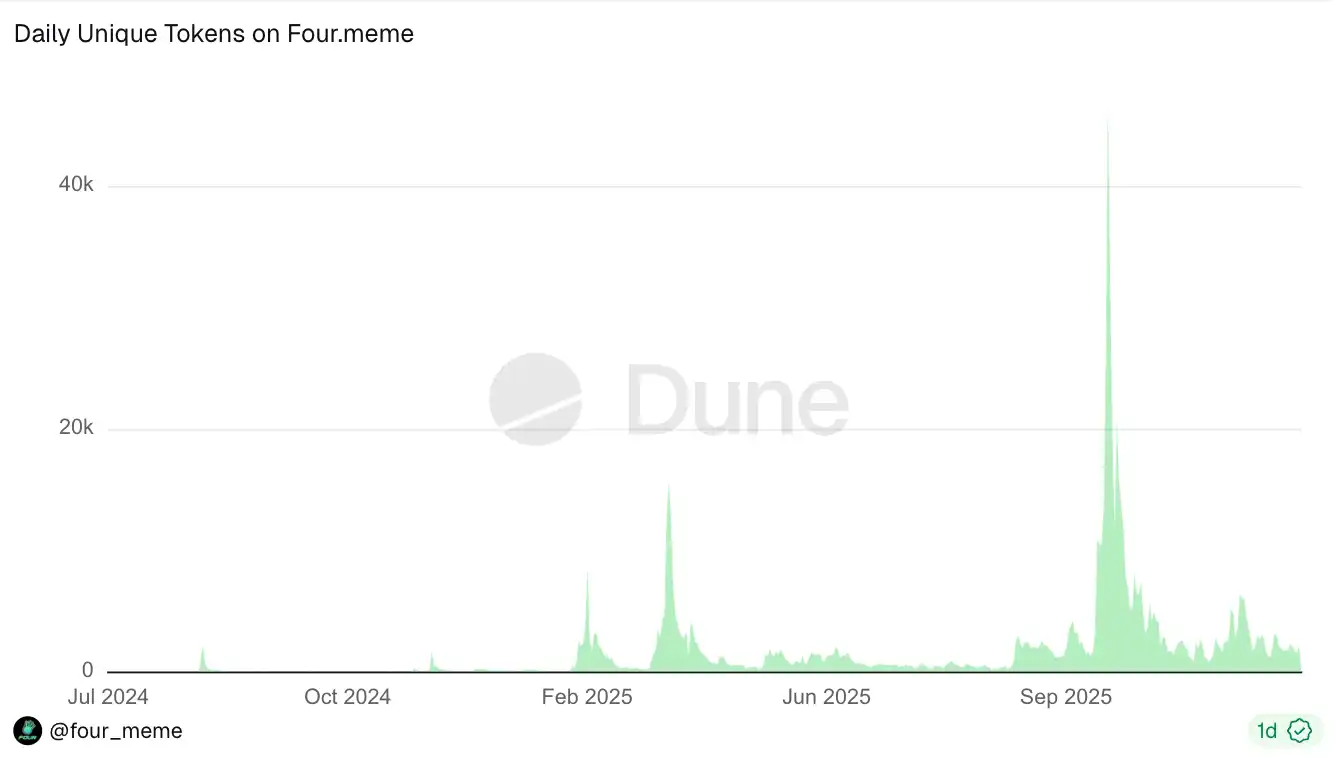
Four.Meme astutely seized this technological window, with platform weekly trading volume surging from $5 million to $400 million during last October's "Binance Life" craze, an 80-fold increase.
According to Bubblemaps data, about 70% of early participants reaped profits from this windfall. This significant wealth effect, far superior to the industry average, created a huge network effect within the community, leading to over 100,000 new traders flooding in within a week, significantly diverting traffic from competitor ecosystems.
From Launcher to Asset Incubator
If the 2024 Meme market was an era of chaotic gaming, then Four.Meme in 2025 seeks to transform it into a standardized asset incubator through mechanism innovation.
Four.Meme's core success lies in a micro-innovation of the fair launch mechanism, retaining the Bonding Curve pricing model but introducing a more stringent liquidity migration mechanism:
1. Intra-board Phase: Users trade on the curve, with prices automatically adjusting based on supply and demand.
2. Graduation Mechanism: When the token raises about 18 BNB, the launch ends.
3. Liquidity Locking: The smart contract automatically packages the raised BNB with the remaining tokens, creates a liquidity pool on PancakeSwap V3, and permanently locks the liquidity.
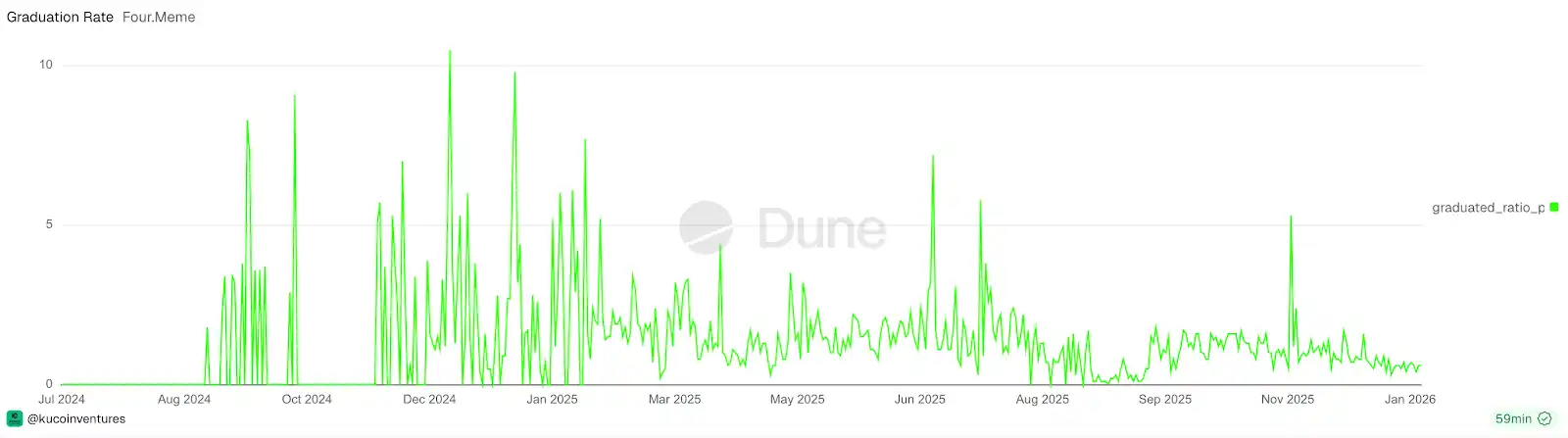
This mechanism restricts developers' withdrawal privileges, addressing the biggest trust issue in the Meme market. Statistics show that throughout 2025, Four.Meme has funneled over 5,150 graduating projects to the BSC ecosystem DEX PancakeSwap, directly contributing over $1 billion in trading depth to the DEX.
Four.Meme is responsible for primary market asset issuance, screening, and early pricing, while PancakeSwap handles secondary market price discovery and large capital absorption. This "Launchpad blood generation, DEX absorption" model constitutes a classic case of the BNB Chain ecosystem's internal circulation, significantly increasing asset survival rates.
Thanks to continuous asset inflows, PancakeSwap set new trading volume records for four consecutive quarters in 2025, with a total annual trading volume of $23.6 trillion. Through its "Meme2Million" event, fees generated by Meme trades were used to buy back and burn CAKE tokens, burning tokens worth hundreds of thousands of dollars in just this one event. The market bubble was cleverly transformed into deflationary pressure on DeFi protocol tokens, achieving a perfect closed-loop ecosystem value.
The biggest challenge of Web3 has always been Mass Adoption, with complex DeFi protocols causing newcomers to hesitate, but Four.Meme, with its simple and direct narrative of getting rich quickly, has become the most effective user onboarding tool.
A key step in Four.Meme's rapid growth is its deep integration with the Binance Web3 Wallet, introducing the Wallet Exclusive mode. This integration allows Binance exchange's hundreds of millions of users to participate in on-chain primary markets directly through their exchange accounts without having to manage complex mnemonic phrases.
This breaks down the long-standing financial barrier between CEX and DEX. For many users in Southeast Asia and Latin America, their first on-chain asset purchase may no longer be Bitcoin or Ethereum but rather a Meme coin on BSC bought through the Binance app into the wallet.
As its volume grows, Four.Meme is gradually evolving into an ecosystem connector. At the data layer, the platform's data flow is instantly pushed to analysis terminals such as Bitquery and Dune Analytics through APIs, ensuring that new assets are captured by the entire network within milliseconds of their birth. At the resource layer, the platform occasionally holds liquidity reward events, precisely directing flow to top projects. It can be said that Four.meme is one of the few "human touch" projects in the current crypto market.
Behind the Prosperity, What Else Can Four.Meme Bring to the Market?
Santiment data shows that in the first week of the year, the overall market value of Meme coins surged over 20.8%, with the sector's total market value surpassing $453 billion. Despite the impressive data, we must address the structural challenges facing Four.Meme and the entire Meme track.
The cruelty of the market lies in its eternal reward for innovation while ruthlessly punishing stagnation. The essence of the Meme market is the attention economy. With issuance costs reduced to negligible levels and a severe oversupply of assets, only 1.34% of projects can successfully graduate and maintain market value, meaning that 98% of projects die in the curve phase.
The lifecycle of the vast majority of Meme coins has been compressed to 1-3 days, causing the market to engage in a zero-sum game, where early scientists harvest retail investors and external incremental funding is lacking. To compete for traffic, malicious code and rug pull scams have frequently emerged. In October 2025, Four.Meme was forced to introduce a mandatory creation fee of 0.01 BNB to fend off spam attacks.
While in the current crypto market, which has been taken over by Wall Street and regulation, Meme has become the last haven for ordinary retail investors. But we can't help but ask, apart from providing a more equitable trading platform, what else can Four.Meme bring to the market?
Related Reading: "Can we still call what we're currently trading meme coins?"
From a longer-term perspective, Meme itself is not the ultimate business endpoint; it is more like an efficient container that carries cultural symbols and user traffic. For Launchpad platforms and even the entire BNB Chain ecosystem, the long-term value does not depend on how many short-lived get-rich-quick myths have been created but on whether they can establish a more robust creator incentive and evaluation mechanism after the wild growth and whether they can grow new narrative logics on the massive traffic dividend brought by Meme.
We look forward to seeing that, as the most influential presence in the industry, platform operators can transition from mere traffic aggregators to meticulous ecosystem nurturers, supporting creators with true cultural resilience and a willingness to operate long-term, rather than mere speculators in short-term hype.
Meme coins can go a long way, becoming part of young people's lifestyles, or they can quickly die and become a wasteland. If this industry truly brings profit and change to participants, then starting today, market participants and infrastructure builders need to look beyond mere PvP games and think about how to improve this market. Only when Meme evolves from a casino to a community can it truly become the most solid gateway into the Web3 world.
Welcome to join the official BlockBeats community:
Telegram Subscription Group: https://t.me/theblockbeats
Telegram Discussion Group: https://t.me/BlockBeats_App
Official Twitter Account: https://twitter.com/BlockBeatsAsia