The Holy Grail of Crypto AI: Exploring the Frontier of Decentralized Training
Original Article Title: "The Holy Grail of Crypto AI: Exploring the Frontier of Decentralized Training"
Original Article Authors: 0xjacobzhao and ChatGPT 4o
Special thanks to Advait Jayant (Peri Labs), Sven Wellmann (Polychain Capital), Chao (Metropolis DAO), Jiahao (Flock), Alexander Long (Pluralis Research), Ben Fielding & Jeff Amico (Gensyn) for their advice and feedback.
In the full value chain of AI, model training is the most resource-intensive and technically challenging link, directly determining the model's upper limit of capability and practical application effects. Compared to lightweight inference stage calls, the training process requires continuous large-scale computational power input, complex data processing workflows, and intensive optimization algorithm support, making it the true "heavy industry" of AI system construction. From an architectural paradigm perspective, training methods can be divided into four categories: centralized training, distributed training, federated learning, and the decentralized training discussed in this article.
Centralized training is the most common traditional approach, where a single organization completes the entire training process within a local high-performance cluster, from hardware (such as NVIDIA GPU), underlying software (CUDA, cuDNN), cluster scheduling systems (such as Kubernetes), to training frameworks (such as PyTorch based on the NCCL backend), with all components coordinated by a unified control system. This deeply collaborative architecture enables optimal efficiency in memory sharing, gradient synchronization, and fault tolerance mechanisms, making it very suitable for training large-scale models like GPT, Gemini, etc., with the advantages of high efficiency and controllable resources. However, it also faces issues such as data monopolies, resource barriers, energy consumption, and single-point risks.
Distributed Training is the current mainstream method for training large models, and its core is to decompose the model training task and distribute it to multiple machines for collaborative execution to overcome single-machine computation and storage bottlenecks. Although it possesses "distributed" characteristics physically, it is still centrally controlled by an organization for scheduling and synchronization, usually running in a high-speed local area network environment. It uses NVLink high-speed interconnect technology, with the main node coordinating all the subtasks. Mainstream methods include:
· Data Parallel: Each node trains on different data with shared parameters, requiring matching model weights
· Model Parallelism: Deploying different parts of a model on different nodes to achieve strong scalability;
· Pipeline Parallelism: Executing in stages sequentially to increase throughput;
· Tensor Parallelism: Fine-grained segmentation of matrix computation to improve parallelism.
Distributed training is a combination of "centralized control + distributed execution," analogous to a single boss remotely directing multiple "office" employees to collaborate on tasks. Currently, almost all mainstream large models (GPT-4, Gemini, LLaMA, etc.) are trained using this approach.
Decentralized Training represents a more open and censorship-resistant future path. Its core features include: multiple mutually untrusted nodes (which could be personal computers, cloud GPUs, or edge devices) collaboratively completing training tasks without a central coordinator, usually through protocol-driven task distribution and collaboration, and leveraging encrypted incentive mechanisms to ensure the honesty of contributions. The main challenges faced by this mode include:
· Heterogeneous Device Coordination and Task Partitioning Difficulty: Coordinating heterogeneous devices is challenging, and task partitioning efficiency is low;
· Communication Efficiency Bottleneck: Unstable network communication leading to significant gradient synchronization bottlenecks;
· Lack of Trusted Execution: Lack of a trusted execution environment makes it difficult to verify whether nodes are truly participating in computation;
· Lack of Unified Coordination: Without a central scheduler, task distribution and anomaly rollback mechanisms are complex.
Decentralized Training can be understood as a group of global volunteers each contributing computing power to collaboratively train models, but the "truly feasible large-scale decentralized training" remains a systematic engineering challenge, involving multiple aspects such as system architecture, communication protocols, cryptographic security, economic mechanisms, model validation, etc. However, whether it can "collaborate effectively + incentivize honesty + produce correct results" is still in the early prototype exploration stage.
Federated Learning, as a transitional form between distributed and decentralized learning, emphasizes local data retention and centralized model parameter aggregation, suitable for privacy-compliant scenarios (such as healthcare and finance). Federated Learning has the engineering structure and local coordination capabilities of distributed training while also benefiting from the data dispersal advantages of decentralized training. However, it still relies on a trusted coordinating party and does not possess fully open and censorship-resistant characteristics. It can be seen as a "controlled decentralization" solution in privacy-compliant scenarios, with relatively mild approaches to training tasks, trust structures, and communication mechanisms, making it more suitable as a transitional deployment architecture for industry.
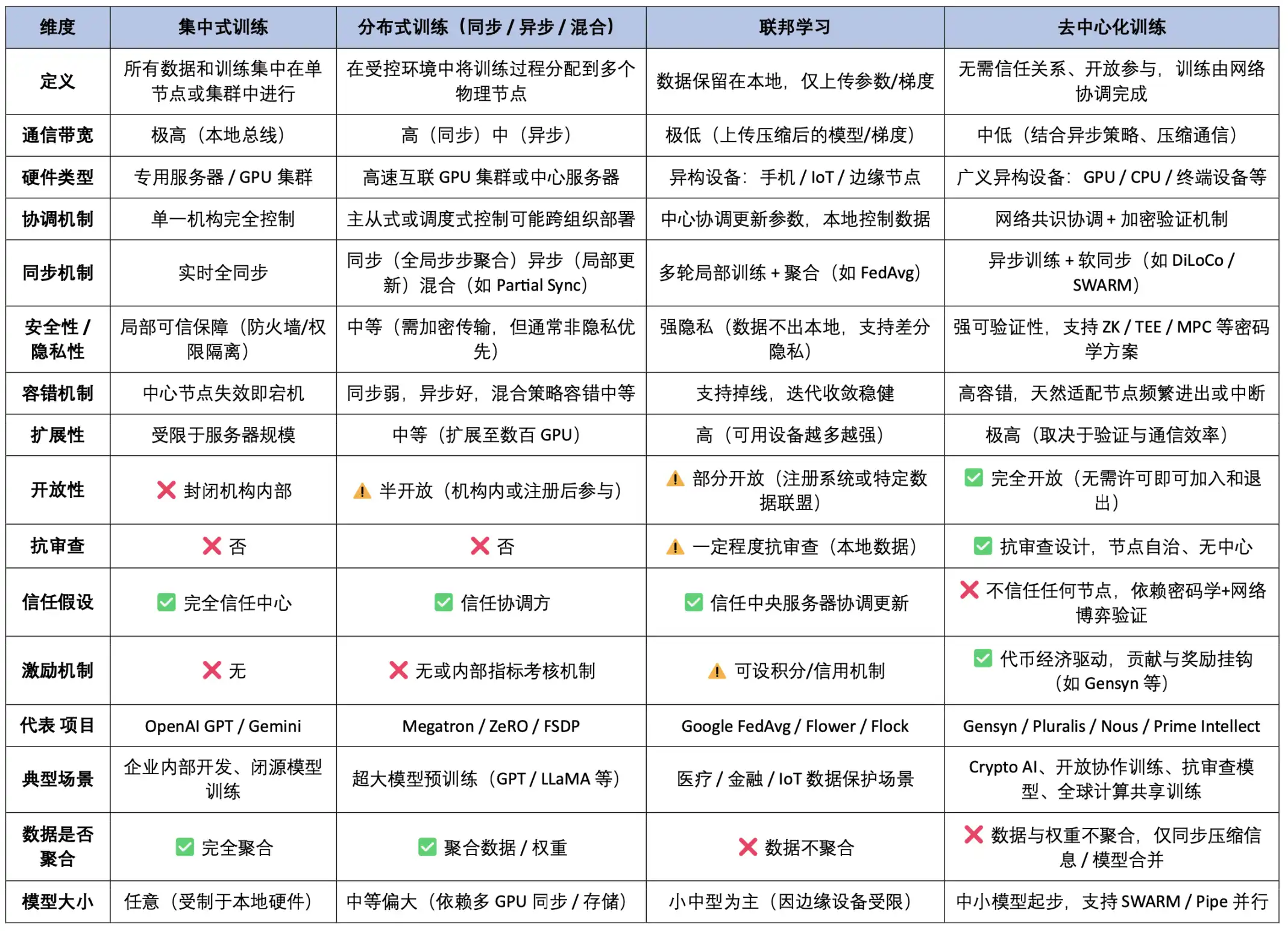
AI Training Paradigms Panorama Comparative Table (Technical Architecture × Trust Mechanism × Application Features)
Decentralized Training: Boundaries, Opportunities, and Realistic Pathways
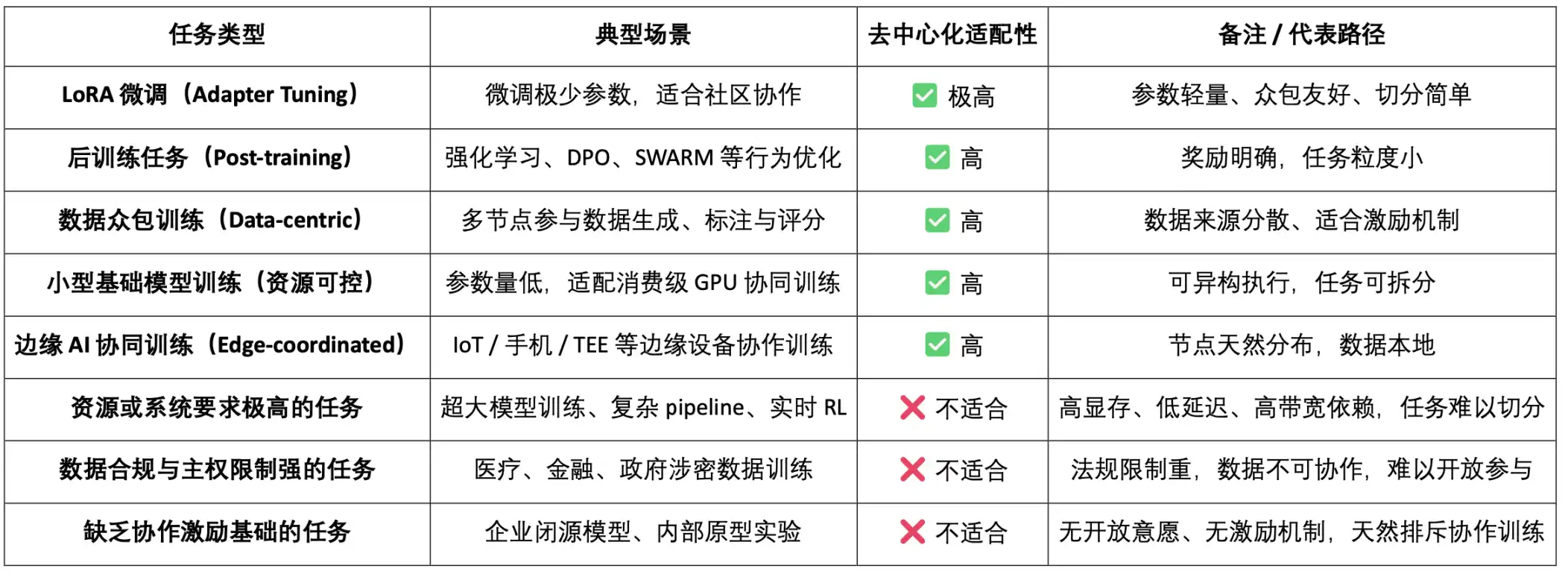
From the perspective of training paradigms, decentralized training is not suitable for all types of tasks. In certain scenarios, due to the complexity of the task structure, extremely high resource requirements, or significant collaboration challenges, it is naturally unsuitable for efficient completion among heterogeneous, untrusted nodes. For example, large model training often relies on high VRAM, low latency, and high-speed bandwidth, making it difficult to effectively partition and synchronize in an open network; tasks with data privacy and strong centralization requirements (such as medical, financial, and sensitive data) are restricted by legal compliance and ethical constraints, preventing open sharing; and tasks lacking collaborative incentive foundations (such as enterprise closed-source model or internal prototype training) lack external participation motivation. These boundaries collectively form the current realistic limitations of decentralized training.
However, this does not mean that decentralized training is a fallacy. In fact, in task types that are structurally lightweight, easily parallelized, and incentivizable, decentralized training demonstrates clear application prospects. These include but are not limited to: LoRA fine-tuning, behavior alignment post-training tasks (such as RLHF, DPO), data crowdsourcing training and labeling tasks, resource-controllable small-scale basic model training, and collaborative training scenarios involving edge devices. These tasks generally exhibit high parallelism, low coupling, and tolerance for heterogeneous computing power, making them very suitable for collaborative training through P2P networks, Swarm protocols, distributed optimizers, and other methods.
Decentralized Training Task Adaptability Overview Table
Classic Projects Analysis in Decentralized Training
Currently, in the forefront of decentralized training and federated learning, representative blockchain projects mainly include Prime Intellect, Pluralis.ai, Gensyn, Nous Research, and Flock.io. In terms of technological innovation and engineering implementation difficulty, Prime Intellect, Nous Research, and Pluralis.ai have proposed more original explorations in system architecture and algorithm design, representing the cutting-edge direction of current theoretical research; while Gensyn and Flock.io have relatively clear implementation paths and have shown initial progress in engineering. This article will analyze in sequence the core technologies and engineering architecture behind these five projects, and further explore their differences and complementary relationships in the decentralized AI training ecosystem.
Prime Intellect: Pioneer of a Reinforcement Learning Collaborative Network with Verifiable Training Trajectories
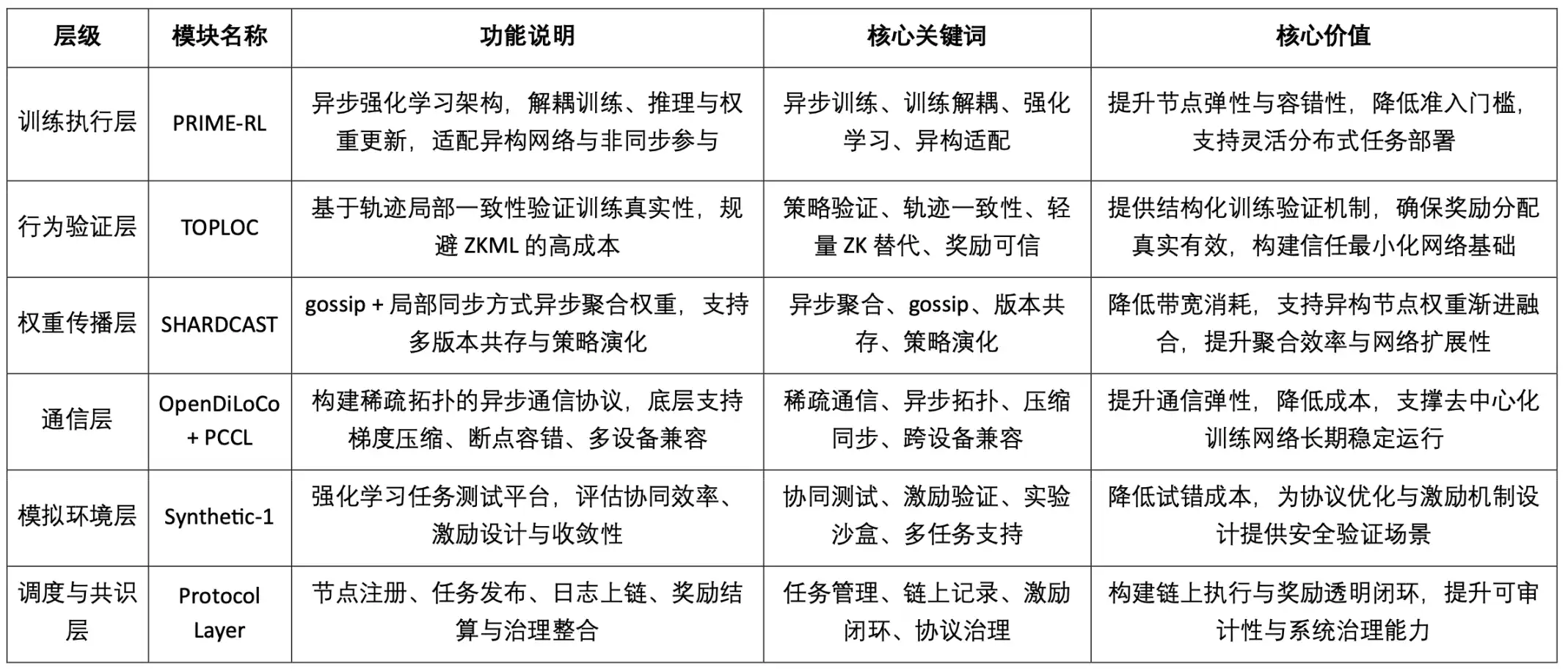
Prime Intellect is committed to building a trustless AI training network that allows anyone to participate in training and receive verifiable rewards for their computation contributions. Prime Intellect aims to construct a decentralized AI training system with verifiability, openness, and a robust incentive mechanism through the three core modules of PRIME-RL + TOPLOC + SHARDCAST.
一、Prime Intellect Protocol Stack Structure and Key Module Value
二、Prime Intellect Training Key Mechanisms in Detail
PRIME-RL: Decoupled Asynchronous Reinforcement Learning Task Architecture
PRIME-RL is a task modeling and execution framework customized by Prime Intellect for decentralized training scenarios, designed specifically for heterogeneous networks and asynchronous participation. It adopts reinforcement learning as its primary adaptation target, structurally decoupling the training, inference, and weight upload processes to enable each training node to independently complete the task loop locally and collaborate through standardized interfaces with validation and aggregation mechanisms. Compared to the traditional supervised learning process, PRIME-RL is more suitable for achieving elastic training in a decentralized scheduling environment, reducing system complexity and laying the foundation to support multitask parallelism and policy evolution.
TOPLOC: Lightweight Training Behavior Verification Mechanism
TOPLOC (Trusted Observation & Policy-Locality Check) is the core verifiability mechanism proposed by Prime Intellect, used to determine whether a node has truly completed effective policy learning based on observation data. Unlike heavy-duty approaches like ZKML, TOPLOC does not rely on full-model re-computation but instead completes lightweight structural verification by analyzing the local consistency trajectory between "observation sequence ↔ policy update." It first transforms behavior traces in the training process into verifiable objects, representing a key innovation in achieving trustless training reward distribution and providing a viable path to building an auditable, incentivized decentralized collaborative training network.
SHARDCAST: Asynchronous Weight Aggregation and Propagation Protocol
SHARDCAST is the weight propagation and aggregation protocol designed by Prime Intellect, optimized for real network environments that are asynchronous, bandwidth-constrained, and experience node state variability. It combines gossip propagation mechanisms with local synchronization strategies, allowing multiple nodes to continuously submit partial updates in different synchronization states, achieving the progressive convergence of weights and multi-version evolution. Compared to centralized or synchronous AllReduce methods, SHARDCAST significantly enhances the scalability and fault tolerance of decentralized training, serving as a core foundation for building stable weight consensus and continuous training iteration.
OpenDiLoCo: Sparse Asynchronous Communication Framework
OpenDiLoCo is a communication optimization framework independently implemented and open-sourced by the Prime Intellect team based on DeepMind's DiLoCo concept. It is designed specifically for common challenges in decentralized training such as bandwidth constraints, heterogeneous devices, and unstable nodes. Its architecture is based on data parallelism, and by building sparse topological structures such as Ring, Expander, Small-World, it avoids the high communication overhead of global synchronization, relying only on local neighboring nodes to achieve model collaborative training. By combining asynchronous updates and checkpoint fault tolerance mechanisms, OpenDiLoCo enables consumer-grade GPUs and edge devices to reliably participate in training tasks, significantly enhancing the inclusivity of global collaborative training. It is a key communication infrastructure for building decentralized training networks.
PCCL: Prime Collective Communication Library
PCCL (Prime Collective Communication Library) is a lightweight communication library tailored by Prime Intellect for decentralized AI training environments. It aims to address the adaptation bottlenecks of traditional communication libraries (such as NCCL, Gloo) in heterogeneous devices and low-bandwidth networks. PCCL supports sparse topologies, gradient compression, low-precision synchronization, and checkpoint recovery. It can run on consumer-grade GPUs and unstable nodes, serving as a foundational component that supports the asynchronous communication capabilities of the OpenDiLoCo protocol. It significantly enhances the bandwidth tolerance and device compatibility of the training network, bridging the "last mile" of communication infrastructure for constructing a truly open, trustless collaborative training network.
III. Prime Intellect Incentive Network and Role Division
Prime Intellect has built a permissionless, verifiable training network with an economic incentive mechanism, allowing anyone to participate in tasks and receive rewards based on real contributions. The protocol operates based on three core roles:
• Task Initiator: Defines the training environment, initial model, reward function, and validation criteria
• Training Node: Conducts local training, submits weight updates, and observation trajectories
• Validation Node: Uses the TOPLOC mechanism to validate the authenticity of training behavior and participates in reward calculation and policy aggregation
The core protocol processes include task publishing, node training, trajectory validation, weight aggregation (SHARDCAST), and reward distribution, forming an incentive loop around "authentic training behavior."
Four. INTELLECT-2: Release of the First Verifiable Decentralized Training Model
Prime Intellect released INTELLECT-2 in May 2025, which is the world's first reinforcement learning large model trained through asynchronous, trustless decentralized node collaboration, with a parameter scale of 32B. The INTELLECT-2 model was collaboratively trained by 100+ GPU heterogeneous nodes across three continents using a fully asynchronous architecture. The training lasted over 400 hours, demonstrating the feasibility and robustness of an asynchronous collaborative network. This model is not only a breakthrough in performance but also the first systematic implementation of Prime Intellect's "training as consensus" paradigm. INTELLECT-2 integrates core protocol modules such as PRIME-RL (asynchronous training structure), TOPLOC (training behavior verification), and SHARDCAST (asynchronous weight aggregation), marking the first realization of an open, verifiable, and economically incentivized closed-loop training process in a decentralized training network.
In terms of performance, INTELLECT-2 is based on QwQ-32B training and has undergone specialized RL training in code and mathematics, placing it at the forefront of current open-source RL fine-tuning models. Although it has not yet surpassed closed-source models like GPT-4 or Gemini, its true significance lies in being the world's first fully reproducible, verifiable, and auditable decentralized model experiment. Prime Intellect has not only open-sourced the model but, more importantly, has open-sourced the training process itself—training data, policy update trajectories, verification processes, and aggregation logic are all transparent and traceable, establishing a decentralized training network prototype that is open to all, trustworthy for collaboration, and allows for shared benefits.
Five. Team and Funding Background
In February 2025, Prime Intellect completed a $15 million seed round of funding, led by Founders Fund, with participation from Menlo Ventures, Andrej Karpathy, Clem Delangue, Dylan Patel, Balaji Srinivasan, Emad Mostaque, Sandeep Nailwal, and other industry leaders. Previously, the project completed a $5.5 million early-stage funding round in April 2024, co-led by CoinFund and Distributed Global, with participation from Compound VC, Collab + Currency, Protocol Labs, and other institutions. To date, Prime Intellect has raised over $20 million in cumulative funding.
The co-founders of Prime Intellect are Vincent Weisser and Johannes Hagemann, with team members spanning AI and Web3 fields. The core team members have backgrounds from Meta AI, Google Research, OpenAI, Flashbots, Stability AI, and the Ethereum Foundation. They possess deep expertise in system architecture design and distributed engineering implementation, making them one of the very few execution-oriented teams that have successfully completed true decentralized large-scale model training.
Pluralis: Pioneer of Asynchronous Model Parallelism and Structure Compression Cooperative Training
Pluralis is a Web3 AI project focused on a "Trusted Collaborative Training Network," aiming to drive a decentralized, open participation, and long-term incentivized model training paradigm. In contrast to the current mainstream centralized or closed training paths, Pluralis introduces a new concept called Protocol Learning: "protocolizing" the model training process. By incorporating verifiable collaboration mechanisms and model ownership mapping, it builds an open training system with an inherent incentive feedback loop.
1. Core Concept: Protocol Learning
Pluralis' proposed Protocol Learning consists of three key pillars:
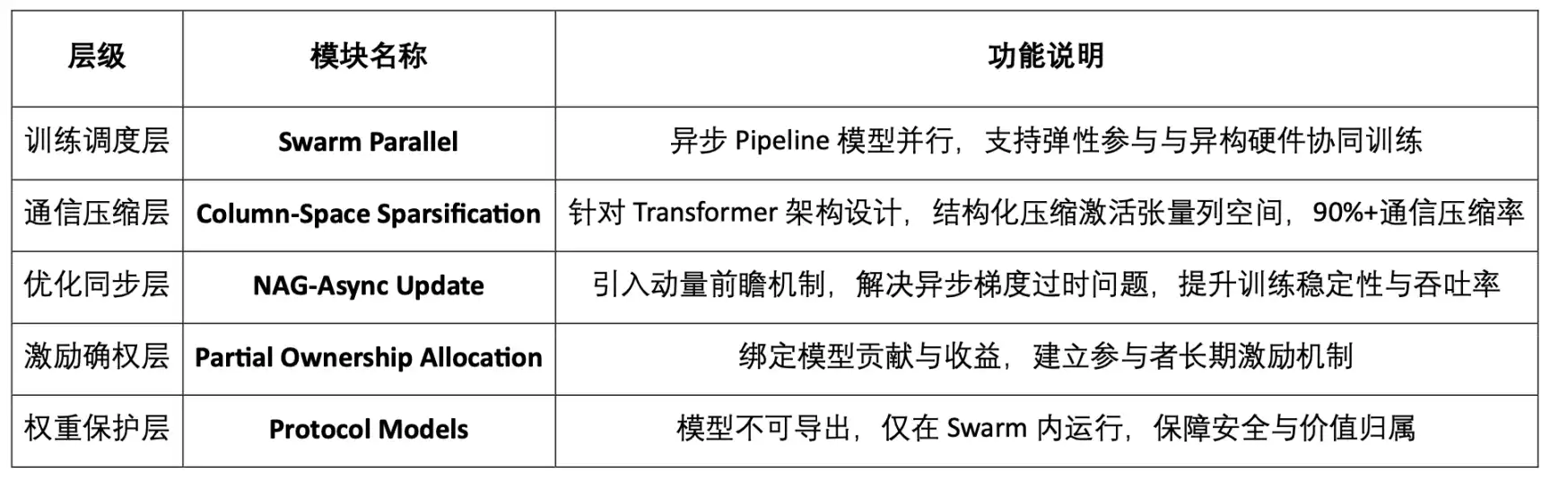
· Unmaterializable Models: Models are distributed in fragments across multiple nodes, rendering it impossible for any single node to reconstruct the complete weight to maintain source code secrecy. This design naturally turns the model into an "in-protocol asset," enabling access credential control, leakage protection, and revenue attribution binding.
· Model-parallel Training over Internet: Through asynchronous Pipeline model parallelism (SWARM architecture), different nodes hold only partial weights and collaborate over a low-bandwidth network for training or inference.
· Partial Ownership for Incentives: All participating nodes receive partial model ownership based on their training contributions, granting them future revenue sharing and protocol governance rights.
2. Technical Architecture of the Pluralis Protocol Stack
III. In-Depth Explanation of Key Technical Mechanisms
Unmaterializable Models
First systematically proposed in "A Third Path: Protocol Learning," the model weights are distributed in a fragmented form, ensuring that the "model asset" can only run on the Swarm network, ensuring that its access and revenue are both protocol-controlled. This mechanism is a prerequisite for realizing a decentralized training sustainable incentive structure.
Asynchronous Model-Parallel Training
In "SWARM Parallel with Asynchronous Updates," Pluralis built a Pipeline-based asynchronous model parallel architecture and empirically conducted it for the first time on LLaMA-3. The core innovation lies in the introduction of the Nesterov Accelerated Gradient (NAG) mechanism, effectively correcting gradient drift and convergence instability during the asynchronous update process, enabling training between heterogeneous devices to be practically feasible in low-bandwidth environments.
Column-Space Sparsification
Proposed in "Beyond Top-K," this column-space compression method, which is structurally aware, is introduced instead of the traditional Top-K to avoid disrupting semantic paths. This mechanism balances model accuracy and communication efficiency. Empirically tested in an asynchronous model parallel environment, it can compress over 90% of communication data, representing a key breakthrough in achieving structurally aware efficient communication.
IV. Technological Positioning and Path Selection
Pluralis explicitly takes "asynchronous model parallelism" as its core direction, emphasizing the following advantages compared to data parallelism:
· Supports low-bandwidth networks and inconsistent nodes;
· Adapts to heterogeneous devices, allowing consumer-grade GPUs to participate;
· Naturally possesses elastic scheduling capabilities, supporting frequent node online/offline transitions;
· Building on structural compression, asynchronous updates, and unmaterializable weights as the three major breakthrough points.
Currently, based on six technical blog documents published on the official website, the logical structure is integrated into the following three main threads:
· Philosophy and Vision: "A Third Path: Protocol Learning" and "Why Decentralized Training Matters"
· Technical Mechanism Details:《SWARM Parallel》《Beyond Top-K》《Asynchronous Updates》
· Institutional Innovation Exploration:《Unmaterializable Models》《Partial Ownership Protocols》
Currently, Pluralis has not yet launched a product, testnet, or open-sourced its code, due to the highly challenging technical path it has chosen: it needs to first address underlying system architecture, communication protocols, weight immutability, and other systemic challenges before it can encapsulate its product services.
In a new paper released by Pluralis Research in June 2025, the decentralized training framework has been expanded from model pretraining to the model fine-tuning stage, supporting asynchronous updates, sparse communication, and partial weight aggregation. In contrast to its previous focus on theory and pretraining design, this work emphasizes practical feasibility, marking a further maturity in its full-cycle training architecture.
Five, Team and Funding Background
In 2025, Pluralis completed a $7.6 million seed round of funding, led by Union Square Ventures (USV) and CoinFund. Founder Alexander Long has a background in machine learning research, with expertise in both mathematics and system research. The core team is entirely composed of machine learning researchers with doctoral backgrounds, making it a typical technology-driven project. The primary publication path is through high-density papers and technical blogs, and the project has not yet established a BD/Growth team but is focused on tackling the infrastructure challenges of low-bandwidth asynchronous model parallelism.
Gensyn: A Verifiable Execution-Driven Decentralized Training Protocol Layer
Gensyn is a Web3 AI project focused on "trustful execution of deep learning training tasks." Its core is not to reconstruct the model architecture or training paradigm but to build a verifiable distributed training execution network with a full process of "task distribution + training execution + result verification + fair incentives." Through off-chain training + on-chain verification architecture, Gensyn establishes an efficient, open, and incentivized global training market, making "training as mining" a reality.
One, Project Positioning: Execution Protocol Layer for Training Tasks
Gensyn is not about "how to train" but about the infrastructure of "who trains, how to verify, and how to share rewards." Its essence is a verifiable computation protocol for training tasks, mainly addressing:
· Who will perform the training task (computing power distribution and dynamic matching)
· How to verify the execution result (no need for full recalculations, only verify disputed operators)
· How to allocate training rewards (Stake, Slashing, and multi-role game mechanism)
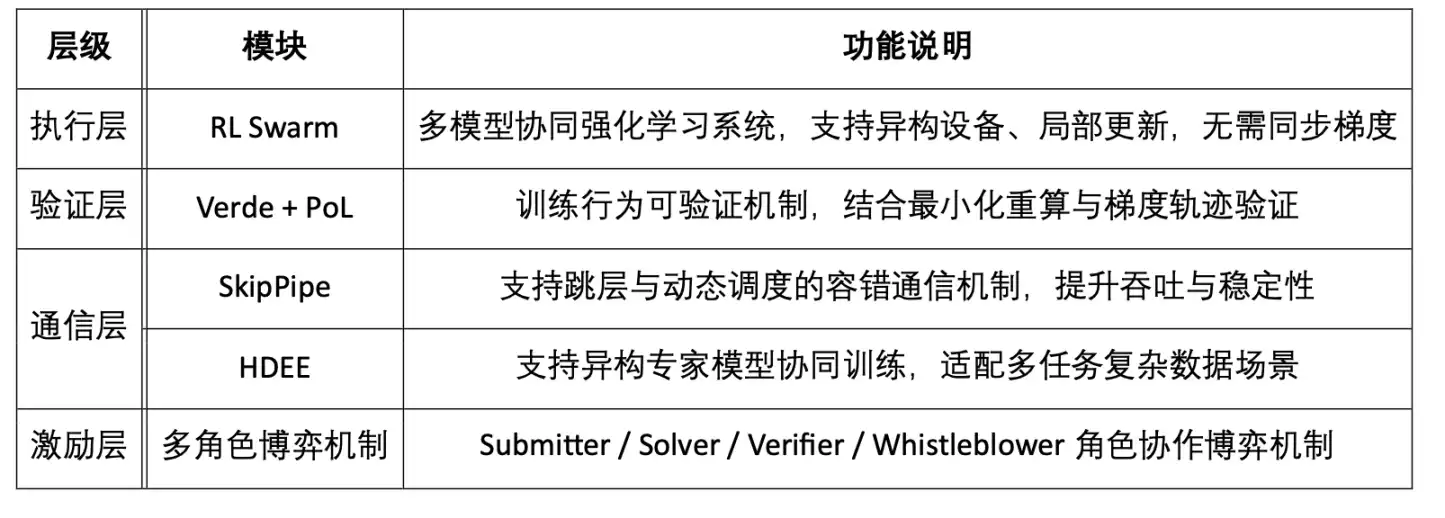
II. Technical Architecture Overview
III. Module Breakdown
RL Swarm: Collaborative Reinforcement Learning Training System
The RL Swarm pioneered by Gensyn is a decentralized multi-model collaborative optimization system aimed at the post-training phase, with the following core features:
Distributed Inference and Learning Process:
· Generation Phase (Answering): Each node independently outputs an answer;
· Critique Phase (Critique): Nodes critique each other's outputs to select the best answers and logic;
· Consensus Phase (Resolving): Predict the preferences of the majority of nodes and modify their own answers accordingly to achieve local weight updates.
The RL Swarm proposed by Gensyn is a decentralized multi-model collaborative optimization system where each node runs an independent model and conducts local training without requiring gradient synchronization. It naturally adapts to heterogeneous computing power and unstable network environments while supporting node elastic onboarding and offboarding. This mechanism draws inspiration from RLHF and multi-agent game theory but is closer to the dynamic evolution logic of collaborative reasoning networks. Nodes receive rewards based on the consistency of their results with the group consensus, thereby driving continuous optimization of reasoning capabilities and convergent learning. RL Swarm significantly enhances the model's robustness and generalization capabilities in an open network and has been deployed as a core execution module in Gensyn's Ethereum Rollup-based Testnet Phase 0.
Verde + Proof-of-Learning: Trustworthy Verification Mechanism
Gensyn's Verde module combines three mechanisms:
· Proof-of-Learning: Determines if training actually occurred based on gradient trajectories and training metadata;
· Graph-Based Pinpoint: Locates divergent nodes in the training computation graph, requiring recalculations of specific operations only;
· Refereed Delegation: Adopts an arbitration-based validation mechanism, where a verifier and challenger submit disputes and conduct partial validation, significantly reducing validation costs.
Compared to ZKP or full recompute validation schemes, the Verde scheme achieves a better balance between verifiability and efficiency.
SkipPipe: Communication Fault Tolerance Optimization Mechanism
SkipPipe aims to address communication bottlenecks in scenarios with "low bandwidth + node dropout." Its core capabilities include:
· Skip Layer Mechanism (Skip Ratio): Skips restricted nodes to avoid training blocking;
· Dynamic Scheduling Algorithm: Generates optimal execution paths in real time;
· Fault-Tolerant Execution: Even if 50% of nodes fail, the inference accuracy only drops by about 7%.
It supports training throughput improvement of up to 55% and achieves key capabilities such as "early-exit inference," "seamless reordering," and "inference completion."
HDEE: Cross-Domain Heterogeneous Expert Ensemble
The HDEE (Heterogeneous Domain-Expert Ensembles) module is dedicated to optimizing the following scenarios:
· Multi-domain, multi-modal, multi-task training;
· Various training data distributions imbalanced with significant difficulty differences;
· Task assignment and scheduling issues in environments with heterogeneous device computing capabilities and uneven communication bandwidth.
Its core features are:
· MHe-IHo: Assigns models of different sizes to tasks of different difficulty (model heterogeneity, consistent training strides);
· MHo-IHe: Unifies task difficulty but asynchronously adjusts training strides;
· Supports heterogeneous expert models + pluggable training strategies to enhance adaptability and fault tolerance;
· Emphasizes "parallel cooperation + ultra-low communication + dynamic expert allocation," suitable for the complex task ecosystem in reality.
Multi-Role Game Mechanism: Trust and Incentive in Parallel
The Gensyn network introduces four types of participants:
· Submitter: Publishes training tasks, sets structure and budget;
· Solver: Executes training tasks, submits results;
· Verifier: Validates training behavior to ensure its compliance and effectiveness;
· Whistleblower: Challenger Validator, receiving arbitration rewards or bearing penalties.
This mechanism is inspired by Truebit's economic game design, which incentivizes honest collaboration through forced error insertion + random arbitration, ensuring the network's trustworthy operation.
Four, Testnet and Roadmap Planning
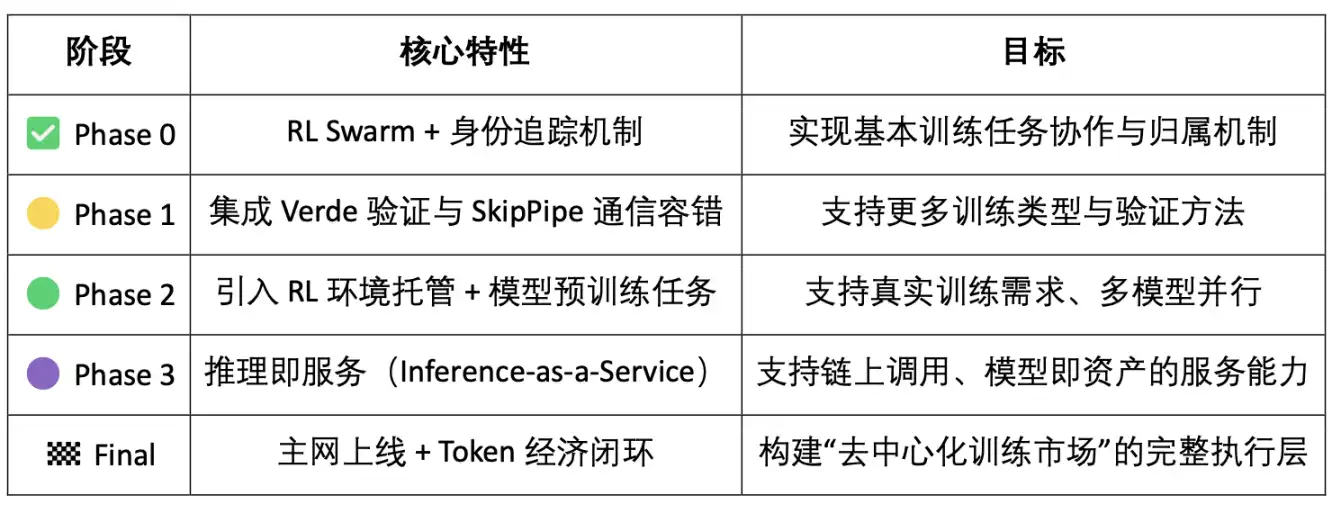
Five, Team and Funding Background
Gensyn was co-founded by Ben Fielding and Harry Grieve, headquartered in London, UK. In May 2023, Gensyn announced the completion of a $43 million Series A funding round led by a16z crypto, with other investors including CoinFund, Canonical, Ethereal Ventures, Factor, and Eden Block. The team background combines experience in distributed systems and machine learning engineering, with a long-term focus on building a verifiable, trustless large-scale AI training execution network.
Nous Research: Subjective AI-driven Cognitive Evolutionary Training System
Nous Research is one of the few decentralized training teams that combine philosophical depth with engineering implementation. Its core vision stems from the "Desideratic AI" concept: viewing AI as an intelligent agent with subjectivity and evolutionary capabilities, rather than just a controllable tool. The uniqueness of Nous Research lies in its approach: it does not optimize AI training as an "efficiency issue" but sees it as a process of forming a "cognitive agent." Driven by this vision, Nous focuses on building an open training network where heterogeneous nodes collaborate, without central scheduling, and resistant to inspection, and systematically implements it through a full-stack toolchain.
One, Conceptual Support: Redefining the "Purpose" of Training
Nous has not delved much into incentive design or protocol economics but has tried to change the philosophical premise of training itself:
· Against "alignmentism": Does not agree with the sole goal of "training" being human control, advocates that training should encourage the model to develop an independent cognitive style;
· Emphasizing model subjectivity: Believes that base models should retain uncertainty, diversity, and the ability to generate illusions (hallucination as virtue);
· Model Training as Cognitive Formation: A model is not the "completion of an optimization task," but rather an individual participating in the cognitive evolution process.
While this training view may seem "romantic," it reflects the core logic of Nous' design of the training infrastructure: how to allow heterogeneous models to evolve in an open network, rather than be uniformly trained.
II. Core Training: Psyche Network and DisTrO Optimizer
Nous' most critical contribution to decentralized training is the construction of the Psyche Network and the underlying communication optimizer, DisTrO (Distributed Training Over-the-Internet), jointly forming the central execution of training tasks: DisTrO + Psyche Network has several core capabilities, including communication compression (using DCT + 1-bit sign encoding, greatly reducing bandwidth requirements), node adaptability (supporting heterogeneous GPUs, disconnection reconnection, and autonomous dropout), asynchronous fault tolerance (continuous training without synchronization, high fault tolerance), and decentralized scheduling mechanism (no need for a central coordinator, consensus and task distribution based on blockchain implementation). This architecture provides a realistic technological foundation for a low-cost, highly resilient, and verifiable open training network.
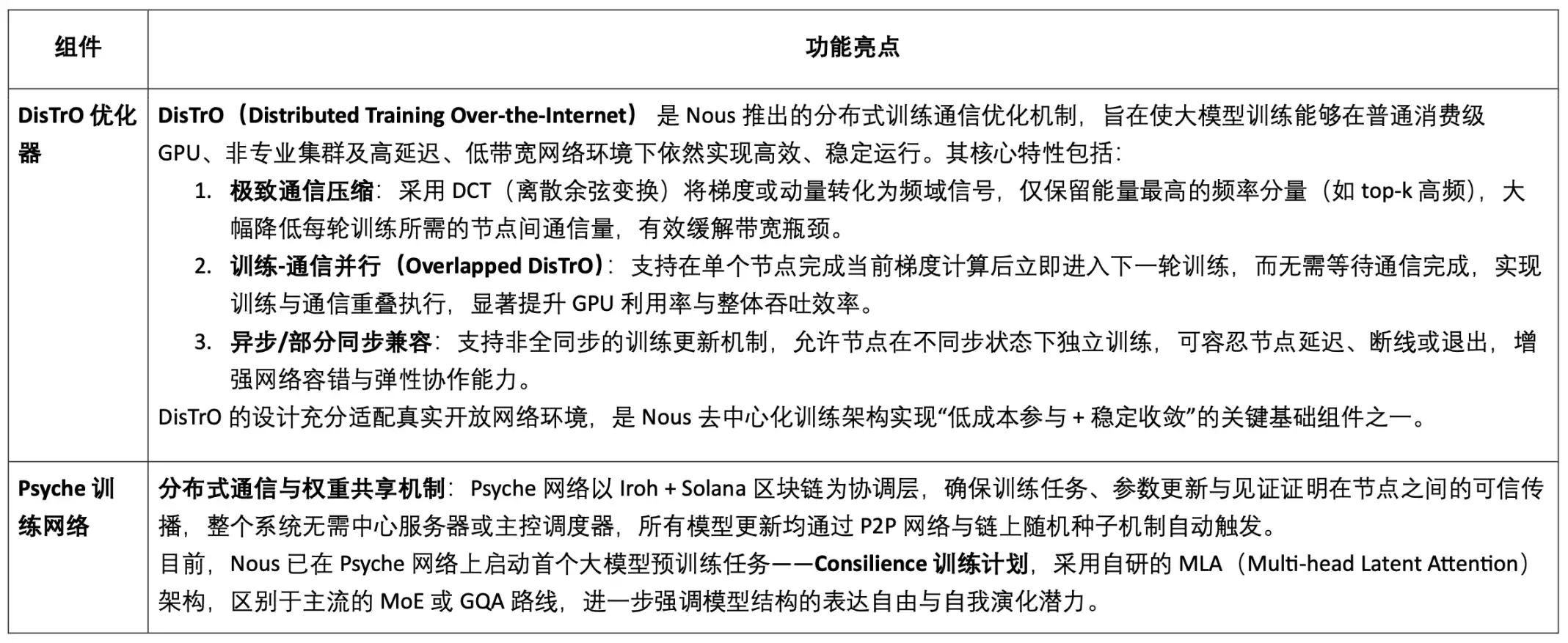
This architectural design emphasizes practicality: it does not rely on central servers, is compatible with global volunteer nodes, and provides on-chain traceability of training results.
III. Inference and Agent System Composed of Hermes / Forge / TEE_HEE
In addition to building decentralized training infrastructure, Nous Research has also carried out several exploratory system experiments around the concept of "AI subjectivity":
1. Hermes Open-Source Model Series: Hermes 1 to 3 are representative open-source large models introduced by Nous, based on LLaMA 3.1 training, covering three parameter scales of 8B, 70B, and 405B. This series aims to embody Nous' advocated training philosophy of "deinstruction, retaining diversity," showing stronger expressiveness and generalization in long-context preservation, role-playing, multi-turn dialogue, and other aspects.
2. Forge Reasoning API: Multi-Mode Inference System
Forge is Nous' self-developed reasoning framework, combining three complementary mechanisms to achieve more elastic and creative reasoning capabilities:
MCTS (Monte Carlo Tree Search): Suitable for policy search for complex tasks; CoC (Chain of Code): Introducing the combination path of code chains and logical reasoning; MoA (Mixture of Agents): Allowing multiple models to negotiate, enhancing the breadth and diversity of outputs.
The system emphasizes "non-deterministic reasoning" and combinatorial path generation, providing a robust response to the traditional instruction alignment paradigm.
3. TEE_HEE: AI Autonomous Agent Experiment: TEE_HEE is Nous's cutting-edge exploration in autonomous agent direction, aiming to validate whether AI can operate independently in a Trusted Execution Environment (TEE) with a unique digital identity. This agent has a dedicated Twitter and Ethereum account, with all control permissions managed by a remotely verifiable enclave, preventing developers from interfering with its behavior. The experiment's goal is to build an AI agent with "tamper-resistance" and "intentional autonomy," taking a significant step towards constructing autonomous intelligent agents.
4. AI Behavior Simulation Platform: Nous has also developed multiple simulators, including WorldSim, Doomscroll, Gods & S8n, to study AI's behavior evolution and value formation mechanisms in a multi-agent social environment. Although not directly involved in the training process, these experiments lay the semantic foundation for long-term autonomous AI cognitive modeling.
IV. Team and Funding Overview
Nous Research was founded in 2023 by Jeffrey Quesnelle (CEO), Karan Malhotra, Teknium, Shivani Mitra, and others. The team emphasizes both philosophy-driven and systems engineering and has diverse backgrounds in machine learning, system security, decentralized networks, among others. In 2024, they raised a $5.2 million seed round, and in April 2025, completed a $50 million Series A funding round led by Paradigm, with a valuation of $1 billion, joining the ranks of Web3 AI unicorns.
Flock: Blockchain-Enhanced Federated Learning Network
Flock.io is a blockchain-based federated learning platform designed to decentralize AI training data, computation, and models. FLock leans towards an integrated framework of "Federated Learning + Blockchain Incentive Layer," fundamentally an on-chain evolutionary version of traditional FL architecture, rather than a systematic exploration of building a completely new training protocol. In comparison to decentralized training projects like Gensyn, Prime Intellect, Nous Research, and Pluralis, Flock focuses on privacy preservation and usability enhancements rather than theoretical breakthroughs in communication, validation, or training methods. Its true counterparts are systems like Flower, FedML, OpenFL, and other federated learning systems.
1. Core Mechanism of Flock.io
1. Federated Learning Architecture: Emphasizing Data Sovereignty and Privacy Protection
Flock is based on the classic Federated Learning (FL) paradigm, allowing multiple data owners to collaboratively train a unified model without sharing raw data, focusing on data sovereignty, security, and trust issues. The core process includes:
· Local Training: Each participant (Proposer) trains the model on their local device without uploading raw data;
· On-chain Aggregation: After training is complete, participants submit local weight updates, which are aggregated by on-chain Miners into a global model;
· Committee Evaluation: Voter nodes are randomly elected through VRF to evaluate the aggregated model's performance using an independent test set and provide scores;
· Incentives and Penalties: Rewards or penalties are enforced based on the score results, achieving anti-malicious behavior and dynamic trust maintenance.
2. Blockchain Integration: Achieving Trustless System Coordination
Flock integrates all core stages of the training process (task assignment, model submission, evaluation scoring, incentive execution) on-chain to achieve system transparency, verifiability, and censorship resistance. Key mechanisms include:
· VRF Random Election Mechanism: Enhancing Proposer and Voter rotation fairness and resistance to manipulation;
· Proof of Stake (PoS) Mechanism: Using token staking and punishment to constrain node behavior and improve system robustness;
· On-chain Incentive Auto-execution: Task completion and evaluation result-binding rewards distribution and slashing penalties are implemented through smart contracts, establishing a trustless collaborative network without the need for intermediaries.
3. zkFL: Privacy-Preserving Innovation in Zero-Knowledge Aggregation Mechanism: Flock introduces the zkFL zero-knowledge aggregation mechanism, allowing Proposers to submit zero-knowledge proofs of local updates. Voters can verify their correctness without accessing raw gradients, ensuring privacy while enhancing the trustworthiness of the training process. This represents a significant innovation in the fusion of privacy protection and verifiability in federated learning.
2. Core Product Components of Flock
AI Arena: The decentralized training platform of Flock.io, where users can participate in model tasks through train.flock.io, taking on roles such as trainers, validators, or delegators. Users can earn rewards by submitting models, evaluating performance, or delegating tokens. Currently, tasks are officially issued, and in the future, they will gradually be open for community collaboration.
FL Alliance: The Flock Federated Learning client that enables participants to further fine-tune models using private data. Through VRF election, staking, and slashing mechanisms, it ensures the integrity and efficiency of the training process, serving as a key link between community initial training and real-world deployment.
AI Marketplace: A platform for model co-creation and deployment where users can propose models, contribute data, invoke model services, support database access, and reinforce RAG-enhanced reasoning, driving the adoption and circulation of AI models in various real-world scenarios.
III. Team and Funding Overview
Flock.io was founded by Sun Jiahao and has issued the platform token FLOCK. The project has raised a total of $11 million, with investors including DCG, Lightspeed Faction, Tagus Capital, Animoca Brands, Fenbushi, OKX Ventures, among others. In March 2024, Flock completed a $6 million seed round of funding to launch the testnet and federated learning client. Later in the same year, an additional $3 million was raised, with support from the Ethereum Foundation, focusing on researching blockchain-driven AI incentive mechanisms. Currently, the platform has created 6428 models and onboarded 176 training nodes, 236 validation nodes, and 1178 delegators.
Compared to decentralized training projects, systems based on federated learning such as Flock have advantages in training efficiency, scalability, and privacy protection, especially suitable for collaborative training of small to medium-sized models. The approach is pragmatic, easy to implement, and more focused on engineering-level feasibility optimization. On the other hand, projects like Gensyn, Pluralis, among others, seek deeper theoretical breakthroughs in training methods and communication mechanisms, posing greater system challenges but also being closer to a true exploration of the "trustless, decentralized" training paradigm.
EXO: Decentralized Training Attempt in Edge Computing
EXO is a highly representative AI project in the current edge computing landscape, aiming to achieve lightweight AI training, inference, and Agent applications on consumer-grade household devices. Its decentralized training approach emphasizes "low communication overhead + local autonomous execution," utilizing the DiLoCo asynchronous delayed synchronous algorithm and SPARTA sparse parameter exchange mechanism to significantly reduce the bandwidth requirements for multi-device collaborative training. At the system level, EXO has not built an on-chain network or introduced economic incentive mechanisms. Instead, it has introduced the single-machine multi-process simulation framework EXO Gym to support researchers in quickly verifying and experimenting with distributed training methods in a local environment.
1. Core Mechanism Overview
· DiLoCo Asynchronous Training: Node synchronization every H steps to accommodate unstable networks;
· SPARTA Sparse Synchronization: Exchange a minimal amount of parameters per step (e.g., 0.1%) to maintain model relevance and reduce bandwidth requirements;
· Asynchronous Cooperative Optimization: Both can be used in combination to achieve a better trade-off between communication and performance.
· evML Verification Mechanism Exploration: Edge-Verified Machine Learning (evML) proposes the use of TEE / Secure Context for low-cost computation verification, enabling trustworthy participation of edge devices without the need for staking through remote attestation + sampling mechanisms, serving as an engineering compromise between economic security and privacy protection.
2. Tools and Scenario Applications
· EXO Gym: Simulates a multi-node training environment on a single device, supporting communication strategy experiments for models such as NanoGPT, CNN, Diffusion, etc.;
· EXO Desktop App: A desktop AI tool for individual users, supporting local large-scale model execution, iPhone mirroring control, private context integration (e.g., SMS, calendar, video recordings), and other privacy-friendly personalized features.
EXO Gym is more like an exploration-driven decentralized training experiment project, mainly achieving lightweight training paths by integrating existing communication compression technologies (such as DiLoCo and SPARTA). Compared to projects like Gensyn, Nous, Pluralis, etc., EXO has not yet entered core stages such as on-chain collaboration, verifiable incentive mechanisms, or real distributed network deployment.
Decentralized Training Front-chain Engine: Panorama Study on Model Pre-training
Facing core challenges in decentralized training such as device heterogeneity, communication bottlenecks, coordination difficulties, and lack of trusted execution, Gensyn, Prime Intellect, Pluralis, and Nous Research have proposed system architecture paths with differentiation. From the perspectives of training methods and communication mechanisms, these four projects demonstrate their unique technological focuses and engineering implementation logics.
In terms of training method optimization, each of the four has explored key dimensions such as coordination strategies, update mechanisms, and asynchronous control, covering different stages from pre-training to post-training.
· Prime Intellect's PRIME-RL belongs to an asynchronous scheduling framework for pre-training, implementing an efficient and verifiable training schedule mechanism in a heterogeneous environment through a strategy of "local training + periodic synchronization." This method is highly versatile and flexible. It has a high level of theoretical innovation, proposing a clear paradigm in training control structure; the engineering implementation is moderately difficult, requiring high demands on underlying communication and control modules.
· DeMo, the optimizer introduced by Nous Research, focuses on the training stability issue in asynchronous low-bandwidth environments, achieving a high fault-tolerant gradient update process under heterogeneous GPU conditions. It is one of the few current solutions that have achieved theoretical and engineering unity in an "asynchronous communication compression loop." It has a very high level of theoretical innovation, especially in its representative role in compression and scheduling coordinated paths; the engineering implementation difficulty is also very high, particularly relying on the precision of asynchronous parallel coordination.
· SWARM + NAG from Pluralis is currently one of the most systematic and groundbreaking designs in the asynchronous training path. Based on an asynchronous model parallel framework, it introduces Column-space sparse communication and NAG momentum correction to build a large-model training solution that can stably converge under low-bandwidth conditions. It has an extremely high level of theoretical innovation and is a structural pioneer in asynchronous collaborative training; the engineering difficulty is equally extremely high, requiring deep integration of multi-level synchronization and model partitioning.
· RL Swarm from Gensyn primarily serves the post-training phase, focusing on policy fine-tuning and agent collaborative learning. Its training process follows a three-step process of "generate - evaluate - vote," especially suitable for dynamically adjusting complex behaviors in multi-agent systems. It has a moderately high level of theoretical innovation, mainly reflected in agent collaborative logic; the engineering implementation difficulty is moderate, with the main challenge lying in system scheduling and behavior convergence control.
At the optimization level of communication mechanisms, these four projects also have targeted layouts, generally focusing on systematic solutions to bandwidth bottlenecks, node heterogeneity, and scheduling stability issues.
· Prime Intellect's PCCL is a lower-level communication library designed to replace traditional NCCL, aiming to provide a more robust collective communication foundation for upper-level training protocols. It has a moderately high level of theoretical innovation, with a certain breakthrough in fault-tolerant communication algorithms; the engineering difficulty is moderate, with strong module adaptability.
· DisTrO from Nous Research is the communication core module of DeMo, emphasizing achieving minimal communication overhead in low-bandwidth while ensuring the coherence of the training loop. It has a high level of theoretical innovation, with universal design value in scheduling coordination structure; the engineering difficulty is high, requiring high compression precision and training synchronization.
· Pluralis's communication mechanism is deeply embedded in the SWARM architecture, significantly reducing the communication overhead in large-scale asynchronous training while maintaining high throughput efficiency to ensure convergence. It has a high theoretical innovation level, setting a paradigm for asynchronous model communication design; however, it faces extremely high engineering challenges, relying on distributed model orchestration and structural sparsity control.
· Gensyn's SkipPipe is a fault-tolerant scheduling component designed for RL Swarm. This solution has low deployment costs and is mainly used to enhance training stability at the engineering implementation level. It has a moderate level of theoretical innovation, mostly representing an engineering implementation of known mechanisms; it has relatively low engineering difficulty but demonstrates strong practicality in actual deployment.
In addition, we can assess the value of decentralized training projects from two macro perspectives: the blockchain collaboration layer and the AI training layer:
Blockchain Collaboration Layer: Emphasizes protocol trustworthiness and incentive collaboration logic
· Verifiability: Concerns whether the training process is verifiable, and if it introduces game theory or cryptographic mechanisms to establish trust;
· Incentive Mechanism: Considers whether a task-driven Token reward / role mechanism is designed;
· Openness and Entry Barrier: Considers whether nodes are easy to access, and whether they are centralized or permission-controlled.
AI Training System Layer: Highlights engineering capability and performance achievability
· Scheduling and Fault Tolerance Mechanism: Considers if it is fault-tolerant, asynchronous, dynamic, and features distributed scheduling;
· Training Method Optimization: Considers if there are optimizations for model training algorithms or structures;
· Communication Path Optimization: Considers whether gradient compression / sparse communication is used to adapt to low bandwidth.
Based on the above evaluation criteria system, a systematic assessment of the technical depth, engineering maturity, and theoretical innovation of Gensyn, Prime Intellect, Pluralis, and Nous Research on the path of decentralized training has been conducted in the following table.
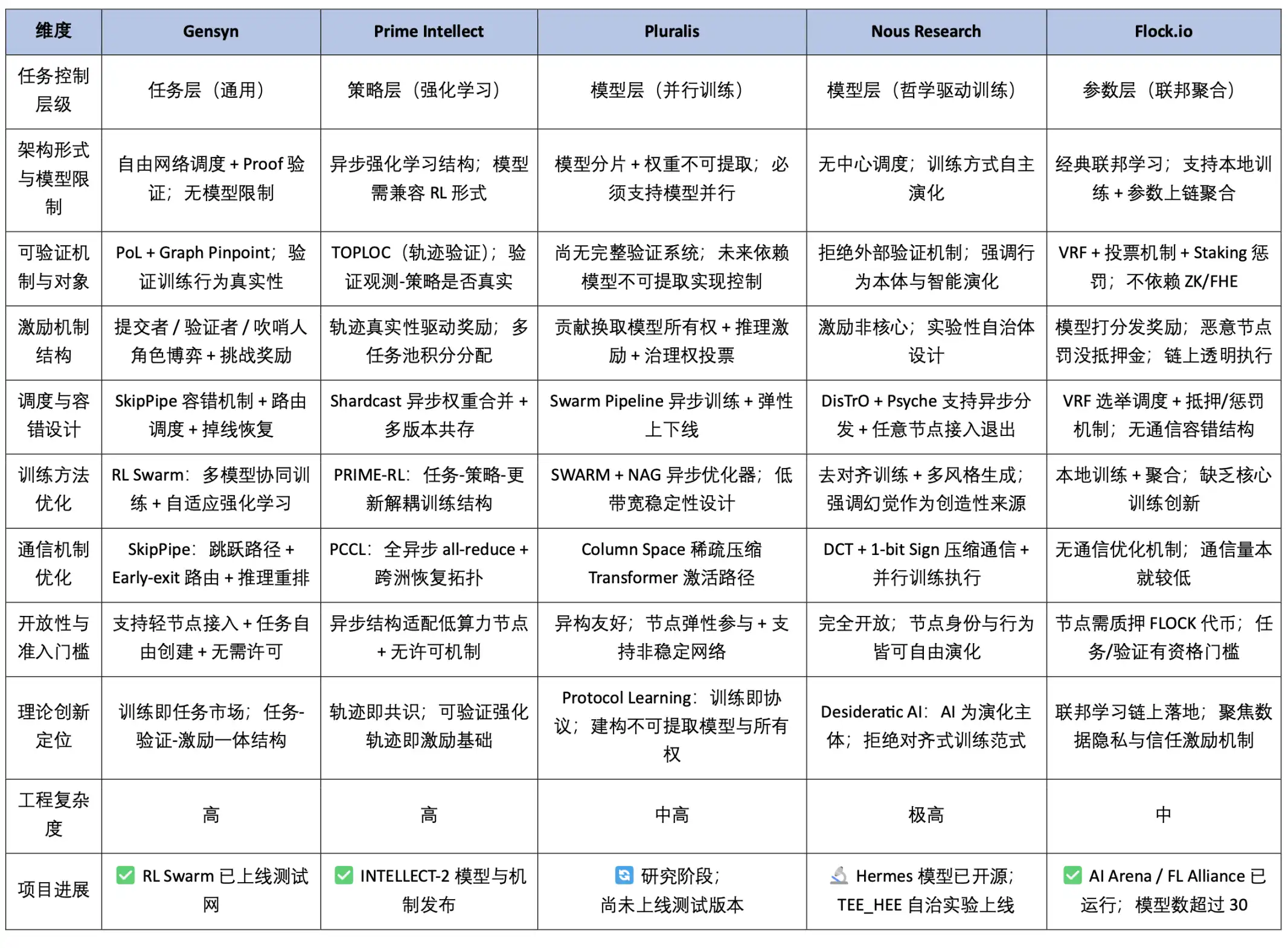
The Post-Training Ecosystem of Decentralized Training: LoRA-Based Model Fine-Tuning
In the complete value chain of decentralized training, projects such as Prime Intellect, Pluralis.ai, Gensyn, and Nous Research mainly focus on front-end infrastructure construction, such as model pre-training, communication mechanisms, and collaborative optimization. However, there is another type of project that focuses on the post-training stage of model adaptation and inference deployment, not directly involved in pre-training, parameter synchronization, or communication optimization processes. Representative projects include Bagel, Pond, and RPS Labs, all of which are centered around the LoRA fine-tuning method, forming a key part of the decentralized training ecosystem known as the "post-chain."
LoRA + DPO: The Realistic Path to Web3 Fine-tuning Deployment
LoRA (Low-Rank Adaptation) is an efficient parameter fine-tuning method whose core idea is to insert a low-rank matrix into a pre-trained large model to learn a new task while freezing the original model parameters. This strategy significantly reduces training costs and resource consumption, enhances fine-tuning speed and deployment flexibility, and is particularly suitable for Web3 scenarios characterized by modularity and composite calls.
Traditional large language models such as LLaMA, GPT-3, etc., often have billions or even hundreds of billions of parameters, making direct fine-tuning costly. In contrast, LoRA achieves efficient adaptation to large models by training only a small inserted parameter matrix, making it one of the most practical mainstream methods currently available.
Direct Preference Optimization (DPO), as a language model post-training method that has emerged in recent years, is often used in conjunction with the LoRA fine-tuning mechanism for model behavior alignment. Compared to traditional Reinforcement Learning from Human Feedback (RLHF) methods, DPO achieves preference learning through direct optimization of paired samples, eliminating the need for complex reward modeling and reinforcement learning processes. Its structure is more concise, convergence is more stable, making it particularly suitable for fine-tuning tasks in lightweight and resource-constrained environments. Due to its efficiency and ease of use, DPO is gradually becoming the preferred solution for many decentralized AI projects in the model alignment phase.
Reinforcement Learning (RL): The Future Evolution Direction of Post-training Fine-tuning
From a long-term perspective, an increasing number of projects are viewing Reinforcement Learning (RL) as a core path with greater adaptability and evolutionary potential in decentralized training. Compared to supervised learning or parameter fine-tuning mechanisms that rely on static data, RL emphasizes continuously optimizing strategies in dynamic environments, naturally fitting the asynchronous, heterogeneous, and incentive-driven collaborative patterns in the Web3 network. Through continuous interaction with the environment, RL can achieve highly personalized, continuous incremental learning processes, providing an evolvable "behavioral intelligence" infrastructure for Agent networks, on-chain task markets, and intelligent economies.
This paradigm not only aligns well with the spirit of decentralization in principle but also has significant systemic advantages. However, due to the higher engineering threshold and complex scheduling mechanisms, RL still faces significant challenges in practical implementation at this stage and is yet to be widely adopted in the short term.
It is worth noting that Prime Intellect's PRIME-RL and Gensyn's RL Swarm are driving RL from a post-training fine-tuning mechanism towards a pre-training master structure evolution, attempting to build a RL-centric, trustless coordination collaborative training system.
Bagel (zkLoRA): Trustworthy Verification Layer for LoRA Fine-Tuning
Bagel, based on the LoRA fine-tuning mechanism, introduces zero-knowledge proof (ZK) technology, aiming to address the trustworthiness and privacy protection challenges in the "on-chain model fine-tuning" process. zkLoRA does not participate in actual training computation but provides a lightweight, verifiable mechanism that allows external users to confirm a fine-tuned model without accessing raw data or weights, ensuring that the fine-tuned model indeed originates from a specified base model and LoRA parameters.
Unlike the dynamic validation of whether the training process "behavior actually occurred" emphasized by Gensyn's Verde or Prime Intellect's TOPLOC, Bagel focuses more on the static validation of whether the "fine-tuning result is trustworthy." The key advantage of zkLoRA lies in its low validation resource consumption and strong privacy protection, but its application scope is typically limited to fine-tuning tasks with minor parameter changes.
Pond: Fine-Tuning and Intelligent Agent Evolution Platform in GNN Scenarios
Pond is currently the industry's only decentralized training project dedicated to fine-tuning Graph Neural Networks (GNN), serving structured data applications such as knowledge graphs, social networks, and transaction graphs. By supporting users to upload graph-structured data and participate in model training feedback, it provides a lightweight, controllable training and inference platform for personalized tasks.
Pond also adopts efficient fine-tuning mechanisms like LoRA. Its core objective is to achieve a modular, deployable intelligent agent system on the GNN architecture, paving the way for a new exploration path of "small model fine-tuning + multi-agent collaboration" in a decentralized context.
RPS Labs: AI-Driven Liquidity Engine for DeFi
RPS Labs is a decentralized training project based on the Transformer architecture, dedicated to using fine-tuned AI models for DeFi liquidity management, mainly deployed in the Solana ecosystem. Its flagship product, UltraLiquid, is an active market-making engine that leverages fine-tuned models to dynamically adjust liquidity parameters, reduce slippage, enhance depth, and optimize token issuance and trading experience.
In addition, RPS has also launched the UltraLP tool, which supports liquidity providers in real-time optimizing their fund allocation strategy on DEX, thereby improving capital efficiency, reducing impermanent loss risk, and demonstrating the practical value of AI fine-tuning in a financial scenario.
From Front-chain Engine to Back-chain Ecosystem: The Path of Decentralized Training
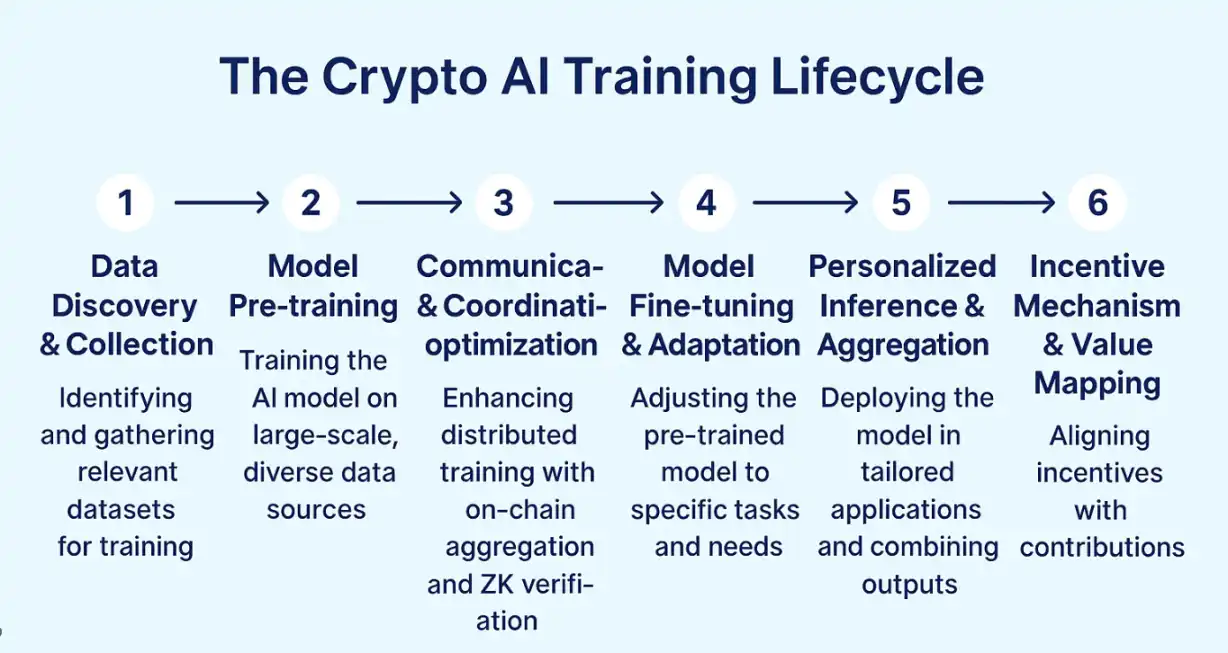
In the complete ecosystem of decentralized training, it can be broadly divided into two main categories: the front-chain engine corresponds to the model's pre-training phase, and the back-chain ecosystem corresponds to the model fine-tuning and deployment phase, forming a complete closed loop from infrastructure to application landing.
The front-chain engine focuses on the underlying protocol construction of model pre-training and is represented by projects such as Prime Intellect, Nous Research, Pluralis.ai, Gensyn, among others. They are committed to building a system architecture with asynchronous updates, sparse communication, and training verifiability, achieving efficient and reliable distributed training capabilities in a trustless network environment, forming the technical foundation of decentralized training.
Meanwhile, as an intermediate layer representative, Flock, through the federated learning path, integrates mechanisms such as model aggregation, on-chain validation, and multi-party incentives to establish a deployable and collaborative bridge between training and deployment, providing a practical paradigm for multi-node collaborative learning.
The back-chain ecosystem focuses on model fine-tuning and application layer deployment. Projects such as Pond, Bagel, and RPS Labs revolve around the LoRA fine-tuning method: Bagel provides on-chain trustworthy verification mechanisms, Pond focuses on the small model evolution of graph neural networks, and RPS applies fine-tuned models to intelligent market-making in the DeFi scenario. They provide low-threshold, composable model invocation, and personalized customization solutions for developers and end-users through components such as the inference API and Agent SDK, serving as key entry points for decentralized AI implementation.
We believe that decentralized training is not only a natural extension of the blockchain spirit in the AI era but also the embryonic form of a globally collaborative intelligent productivity system. In the future, as we look back on this challenging road traveled, we will still be inspired by the original intention: decentralization is not just a means, it is a value in itself.
This article is contributed content and does not represent the views of BlockBeats.
Welcome to join the official BlockBeats community:
Telegram Subscription Group: https://t.me/theblockbeats
Telegram Discussion Group: https://t.me/BlockBeats_App
Official Twitter Account: https://twitter.com/BlockBeatsAsia

 Related Articles