Who is buying cards on behalf of China's big tech companies?

Original title: "Who Is Buying Cards for China's Big Tech"
Original author: Dongcha Beating
Several data center financings in Southeast Asia have run into trouble.
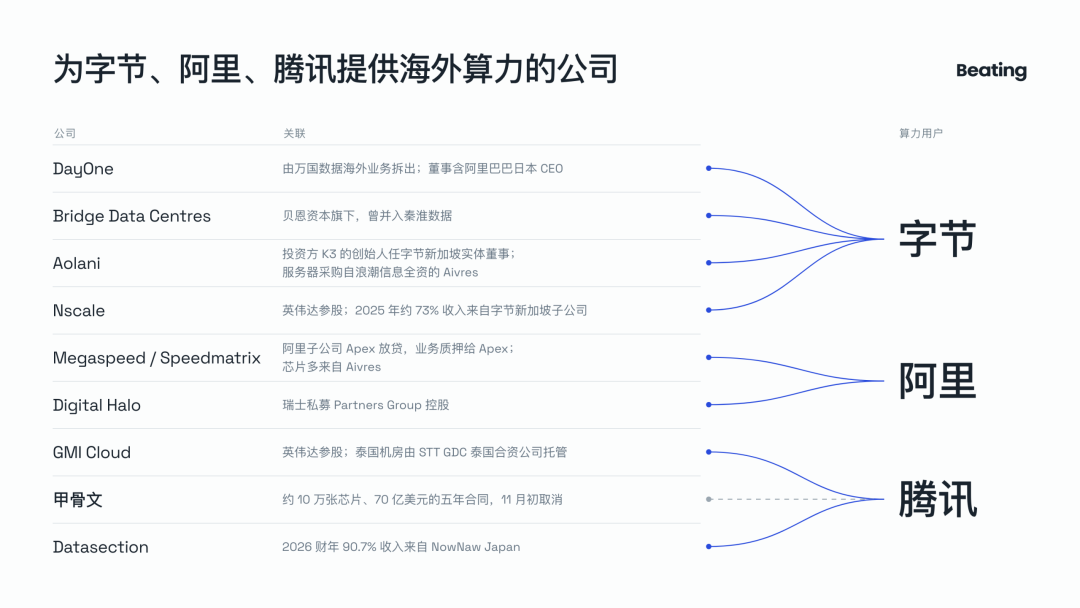
Bridge Data Centres is expanding its Malaysia loan to $6.6 billion, and some lenders are requiring due diligence to be completed first. Bridge is a Bain Capital company, and its MY06 campus in Johor has ByteDance as its anchor tenant.
Digital Halo has a $372 million loan that has been fully underwritten, yet one bank still exited. Its controlling shareholder is Swiss private equity firm Partners Group, and its Malaysian data center clients include Alibaba.
GMI Cloud wants to borrow $300 million to buy chips for a Thailand data center, with the chips to be used by Tencent. Nvidia invested in GMI just in October, and at least one fund still chose not to participate in this round.
A week earlier, a $480 million loan led by DBS Bank had already been frozen. The borrower is Singapore-based Aolani, and the money is to be used to buy GB300 servers for 97 racks in Kuala Lumpur, with ByteDance as the remote user.
None of the four borrowers is a Chinese company. The data centers belong to U.S. and Swiss private equity firms, the chips are booked on the accounts of Singapore and Taiwan companies, and the money comes from Wall Street and Singapore banks. It is just that the final users of these chips are ByteDance, Alibaba and Tencent.
This has been the standard practice for China's big tech companies using Nvidia chips overseas over the past three years. The big companies do not buy cards themselves. A non-Chinese company steps forward to borrow money, buy chips and build data centers, with the chips recorded under that company's name. The big companies sign multi-year long-term contracts with it, pay rent by the hour, and remotely use these chips over the network to train models and run services.
This is first and foremost to circumvent U.S. export controls. Companies headquartered in China need U.S. approval to buy advanced chips themselves, while renting computing power from a non-Chinese company had no clear restrictions under previous rules. The companies stepping forward are not Chinese companies, which is why Western banks dare to lend to them.
We reviewed loan terms, prospectuses and regulatory filings from the past three years. These companies are not Chinese companies in name, but their ties to China's big tech companies through shareholders, directors and funding are far closer than expected.
No one used to scrutinize this relationship, because the rules only looked at who the chips were sold to. On November 16, the U.S. Commerce Department issued new rules that instead look at where the headquarters of the company using the chips is located, and who steps forward no longer matters. The companies buying cards and the banks lending to them are beginning to withdraw one after another, and the risk of buying cards has returned to ByteDance, Alibaba and Tencent themselves.
The Companies Buying Cards on the Front Lines
Chinese tech giants go overseas to use cards because they can't get them domestically.
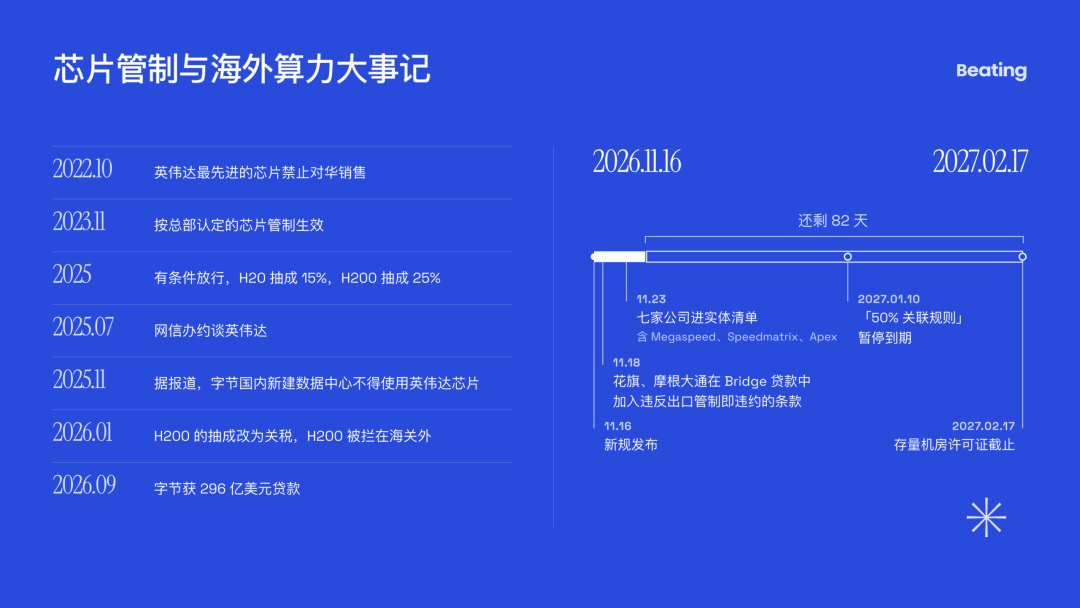
Since October 2022, Nvidia's best chips cannot be sold to China. In 2025, the Trump administration shifted to conditional approval, with a 15% cut on H20 and a 25% cut on H200, and in January this year the 25% cut was changed to a tariff.
Even after approval, each card still requires review and payment, and very few are actually approved. Licensing records published by the House Foreign Affairs Committee on November 19 show that as of May this year, Chinese companies applied for about 3.44 million H200 and MI325X chips, with about 880,000 approved, all with the status "approved, not shipped."
ByteDance applied for about 1.015 million, and 150,000 were approved; Alibaba applied for 949,000, and 75,000 were approved. The two companies also applied through subsidiaries in Malaysia, Indonesia, and Thailand for 1,118,500 chips, all of which were returned.
Even approved cards cannot get in, as Beijing is also blocking them. In July 2025, the Cyberspace Administration of China summoned Nvidia, saying the H20 had "vulnerability backdoor security risks." In November of the same year, according to The Information, regulators did not allow ByteDance to use Nvidia chips in newly built data centers in China. In January this year, H200s were blocked at customs, and about 600,000 are still piled up in Hong Kong.
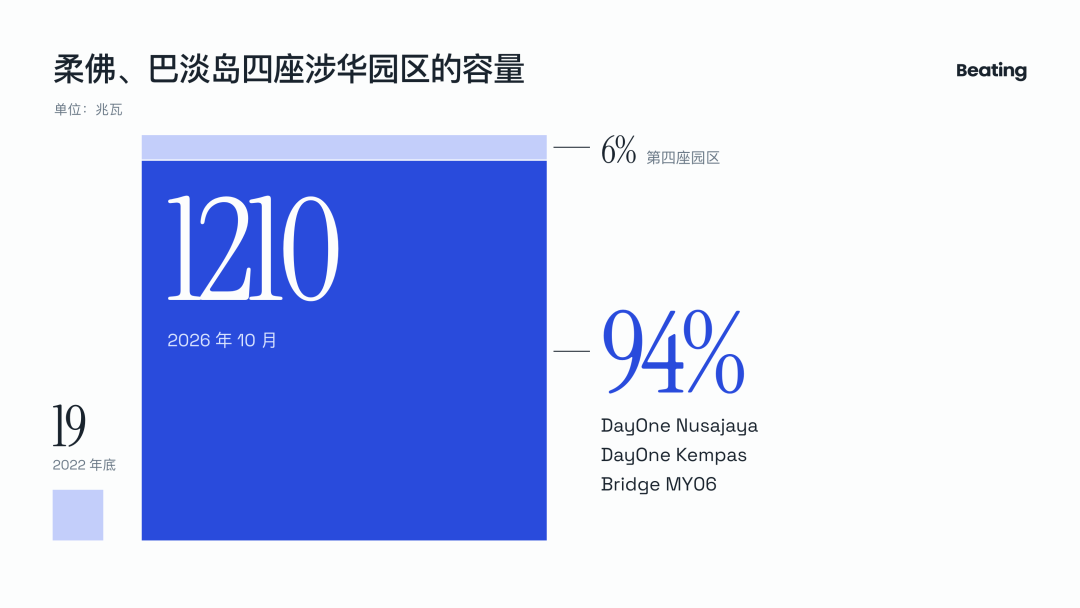
Most of the computing power that tech giants rent remotely overseas is in Johor state, Malaysia. Four China-related campuses in Johor and Batam Island, Indonesia, totaled 19 megawatts at the end of 2022 and rose to 1,210 megawatts by October this year, with about 94% concentrated in three campuses: DayOne's Nusajaya and Kempas, and Bridge's MY06.
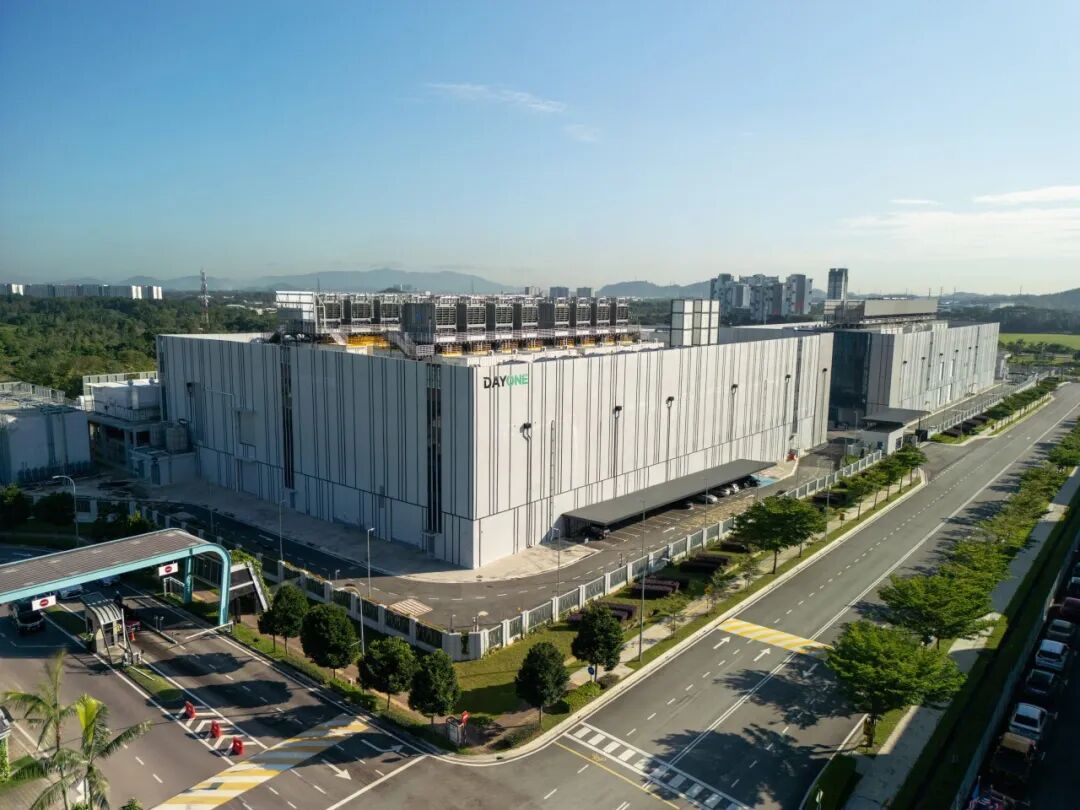
DayOne's Nusajaya data center campus in Johor state, Malaysia
Image source: DayOne
The companies on the front lines fall into two categories.
DayOne and Bridge are data center operators, responsible for building facilities, bringing in power, and leasing racks.
Bridge is backed by Bain, and its China ties come from Chindata. Bain merged Bridge into Chindata in 2019, took Chindata private in 2023, and then sold the China business to a consortium led by Dongyangguang for about $4 billion, keeping only the overseas portion. Drew Chen, who became Bridge's co-CEO starting in November this year, is a founding member of Bain's Asia private equity team.
Bridge's tenants are also changing. In February of this year, Bridge told lenders that the 68.4 megawatts originally reserved for Megaspeed had been fully reassigned to Zenlayer. Zenlayer is headquartered in Los Angeles and counts as a U.S. company under the new rules, but its founder Joe Zhu was a senior vice president at ChinaCache, the company has teams in Shanghai, Hangzhou and Beijing, and its Series B was led by Lightspeed China Partners. Lightspeed China Partners, which spun out of state-owned China Everbright, also appears among DayOne's Series C investors.
DayOne is the overseas business carved out of GDS. According to the prospectus, GDS gradually retreated to a minority shareholder position, loans made to DayOne were converted into shares, it ceased consolidation at the end of 2024, and it terminated trademark licensing and customer referrals at the end of 2025. In January of this year, DayOne spent $385 million to buy back a portion of GDS's shares, reducing GDS's stake to 19.4%.
After GDS stepped back, three other shareholders hold stakes comparable to its own. At the time the prospectus was filed, the top four shareholders were Coatue and Hillhouse at 19.5% each, GDS at 19.4%, and Zhongfang Capital at 15.6%.
Hillhouse has been involved since the Series A. When GDS announced the Series A in March 2024, the listed investors included Hillhouse and its real assets platform Rava Partners, as well as Boyu Capital and other institutions. Hillhouse's current shares are pledged to a group of lenders, and DayOne's CFO worked at Hillhouse between 2023 and 2026.
Zhongfang Capital is one of the heaviest backers. According to the prospectus, its four holding entities subscribed for a total of about $1.16 billion, of which the $210 million in the Series A was the largest single investment in that round.
This shareholder's office is in Taipei, and its controlling person is Chen Chu-wang. He is the eldest maternal grandson of Wang Yung-ching and a nephew of Cher Wang, joined VIA in 1996, and served as CEO of VIA China.
On the board, both GDS and Alibaba people are present. GDS founder Huang Wei remains a director and holds options on about 3.5%. Andy Okada is president of the SoftBank and Alibaba joint venture and also CEO of Alibaba Japan.
The chairman and CEO come from the Temasek system. Chairman Lim Ah Doo served as a director of ST Telemedia and its subsidiary STT GDC for more than ten years, and CEO Jamie Khoo was a senior finance executive at ST Telemedia before later moving to GDS. ST Telemedia belongs to Temasek and as of the end of March this year still held about 29% of GDS's Class A shares. Alejandro Aguzín, who joined the board this year, was CEO of HKEX from 2021 to 2024 and before that was CEO of JPMorgan Asia Pacific.
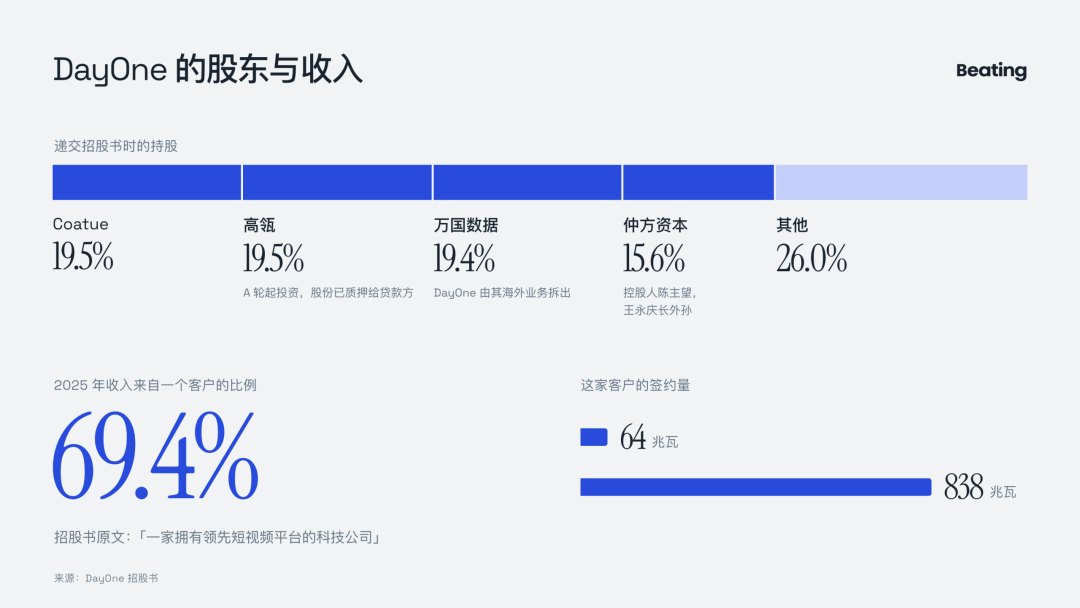
Revenue mainly comes from a single customer. The prospectus states that 69.4% of revenue in 2025 came from "a technology company with a leading short-video platform," and this customer's contracted capacity surged from 64 megawatts to 838 megawatts. The prospectus also notes that two existing customers are on the Pentagon's "Chinese Military Companies" list. Tencent was added to the list in January 2025, and Alibaba in June of this year.
Another type of company stepping forward is the neocloud—buying chips, building clusters, and renting out computing power to major companies by the hour. The frozen loan mentioned at the outset was borrowed by Aolani, one such company.
Since February 2025, Aolani has been renting H100 servers to ByteDance in Malaysia, and this year it has prepared approximately 36,000 B200 GPUs for ByteDance. Its holding company is registered in the Cayman Islands, with early investor K3 Ventures based in Singapore. K3's founder, Kuok Meng Xiong, is a grandson of Robert Kuok, and according to his disclosed biography at companies such as TVS Motor, he himself also serves as a director of ByteDance's Singapore entity.
Aolani's servers are procured from Aivres. Aivres was formerly Inspur Systems, the U.S. subsidiary of Inspur, and changed its name in 2023. Inspur Information's financial reports and U.S. court documents show that it is indirectly wholly owned by Inspur Information through KAYTUS Holdings in Hong Kong and KAYTUS Group in the British Virgin Islands. According to The New York Times, from April 2024 to February of this year, Aivres shipped at least $5.6 billion worth of servers to Southeast Asia.
Inspur Group was added to the Entity List in March 2023, and Inspur Information was added in March of last year; Aivres itself is not on the list. The U.S. "50% affiliation rule" is currently suspended until January 10 of next year. Once the rule is restored, subsidiaries majority-owned by listed companies will also be subject to controls, and Aivres, 100% owned by Inspur Information, would be among them.
GMI Cloud is also a neocloud. Founder Yeh Wei-Yen is the son of Yeh Chia-Wen, co-founder of Realtek Semiconductor. The company initially focused on Bitcoin computing power, and its Series A investors include Thai energy group Banpu. The Thai data center where it purchased chips for Tencent is hosted by STT GDC's Thai joint venture.
STT GDC originally also belonged to ST Telemedia, and in September of this year it was acquired by KKR and Singtel from Temasek. The 51% stake in the Thai joint venture is held by Frasers Property, under the TCC Group of the Suksawat family.
The Megaspeed that Bridge replaced is backed by Alibaba. Alibaba was Megaspeed's founding anchor client. In June 2024, Alibaba's Singapore subsidiary Apex lent money to Megaspeed's Malaysia-affiliated company Speedmatrix, which pledged its entire business to Apex.
According to The New York Times, most of Speedmatrix's chips also come from Aivres and are run for Alibaba in YTL's Johor data center. YTL called this claim "speculative and unfounded."
The named YTL is Nvidia's earliest partner in Malaysia. In December 2023, Jensen Huang traveled to Kuala Lumpur with YTL to announce an AI infrastructure partnership. YTL now says its GPU business consists of only a 10-megawatt Nvidia DGX Cloud project, fully underwritten by Nvidia, with everything else being colocation, and that it does not provide GPU services to Chinese customers.
There is another data center in Johor that did not appear in this report. Bitdeer, founded by Bitmain founder Jihan Wu, has a facility there called A201, having purchased more than 100 racks of GB300s, with power-on scheduled for early next year. Bitdeer says over 70% of capacity has been committed by customers, with five-year contract value exceeding $1.7 billion, and that the money for buying cards mainly comes from customer prepayments. According to The New York Times, the compute capacity of this data center is planned to be sold to a Chinese tech giant. After the new rules came out, brokerage StoneX estimated that A201 has a 25% chance of falling through.
The People Lending to Them
The companies fronting the purchases borrow most of the money. Banks lend to operators to buy chips, chips serve as collateral, and long-term leases from major companies are the repayment source. Aolani's $480 million was calculated at a 1.15x debt service coverage ratio. According to Natixis, syndicated loans for ASEAN data centers have totaled approximately $48 billion since 2023.
From major companies to operators, Citigroup and JPMorgan appear at almost every stage.
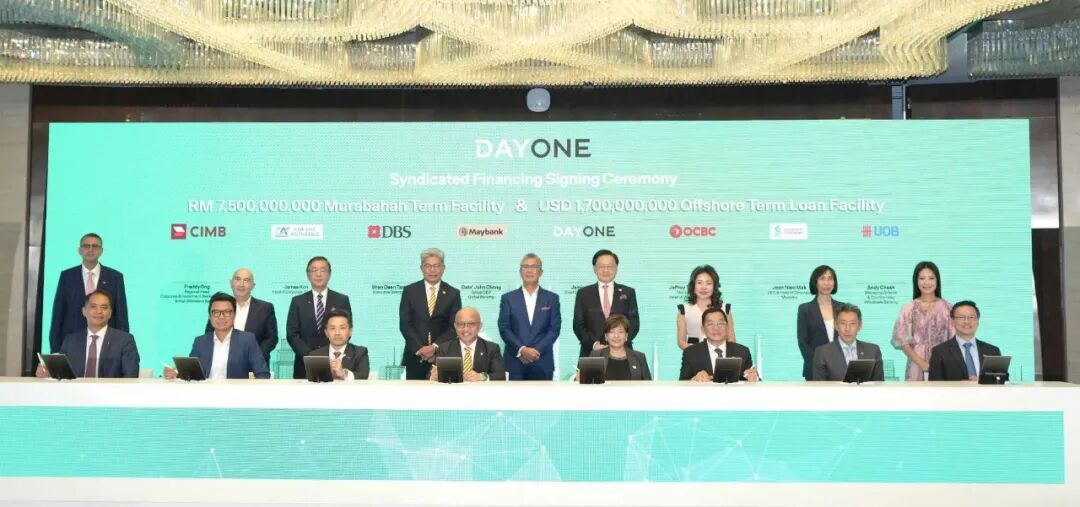
In 2025, DayOne held a signing ceremony with multiple banks
for a RM15 billion syndicated financing facility
Image source: UOB
In September of this year, they led a $29.6 billion loan to ByteDance, unsecured, at SOFR plus 68 basis points. For Bridge's $2.8 billion loan last year, they each contributed approximately $120 million. This data center serves ByteDance and has also signed a service contract with Megaspeed. In April of this year, Bain sold at least 40% of Bridge's equity, and they were also responsible for that sale. DayOne's IPO underwriting syndicate is led by Morgan Stanley and JPMorgan, with Citi also included, and JPMorgan is also the depositary bank for its American Depositary Shares.
Singaporean banks are responsible for leading and distributing. The lead bank for Aolani's loan was DBS, and for the approximately $3.7 billion loan DayOne secured in Johor in October of this year, all three local Singaporean banks were involved.
Chinese banks have always been present — the closer to ByteDance, the more money they put in. Of ByteDance's $29.6 billion, 15 Chinese banks contributed $18.9 billion, accounting for 64%.
Further down to the operator level, Chinese banks are also present. Bridge's $2.8 billion loan list includes Bank of China and China Minsheng Bank, and Industrial Bank also stated in a press release that it was the lead bank for an overseas syndicated loan to Bridge. For Epoch Digital's data center in Johor, the $488 million loan was led by Bank of China and AIIB. AIIB's project page states that the entire first phase of 60 megawatts was signed to BytePlus, a subsidiary of ByteDance. For a data center in Rayong, Thailand where ByteDance is the anchor tenant, the first-phase loan was led by China Merchants Bank.
Nvidia is also helping these companies borrow money, through backstopping. For GMI Cloud's GPU loan in Taiwan, China, Nvidia committed to leasing idle computing power at agreed prices within six years, while taking half of GMI's revenue from other customers. For Zankore's $3.1 billion loan in Indonesia, Nvidia provided revenue sharing and credit support. Such backstops, as far as can be verified, have all been given to projects whose customers are not Chinese companies.
Nvidia's equity investments are not so clearly delineated. It is a shareholder of GMI and also a shareholder of UK neocloud Nscale, having participated in several rounds of Nscale's financing since September 2025, and in Nscale's listing documents this year, it also committed to subscribing to $2 billion in convertible bonds. Of Nscale's $33 million in revenue in 2025, approximately 73% came from Spring, ByteDance's Singapore subsidiary. In the first half of this year, that proportion dropped to 52%, and Nscale expects it to fall below 20% for the full year.
What the New Rules Changed
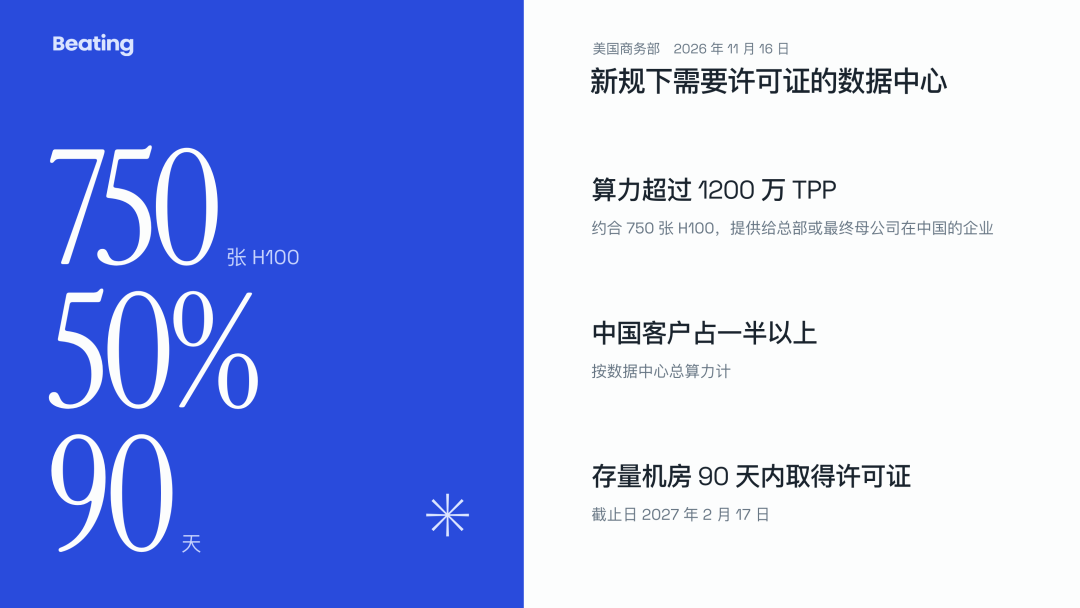
The new rules issued on November 16 draw the line based on where the customer's headquarters is located. Regardless of which country a data center is built in, if it provides more than 12 million TPP of computing power (roughly 750 H100s) to companies headquartered in China or whose ultimate parent company is in China, or if Chinese customers account for more than half of its total computing power, supplying chips to it requires a license. Existing facilities must obtain a license within 90 days, with a deadline of February 17, 2027.
This rule could have been much looser. According to reports, Commerce Secretary Lutnick originally pushed a version that only covered future shipments, required only notification for Chinese customers training models, and had a higher threshold. That version would have let Bitdeer's A201 through, and Lutnick family's Cantor Fitzgerald was the sales agent for Bitdeer's up to $1 billion capital increase.
Between Cantor and Bitdeer stands stablecoin giant Tether. Cantor acquired approximately 5% of Tether in 2024. In May of the same year, Tether took a $100 million stake in Bitdeer, and the placement agent for that deal was also Cantor. By June of this year, Tether held approximately 19.7% of Bitdeer's Class A shares. After Lutnick transferred Cantor's shares to a trust for his children, Tether extended a loan to that trust, with collateral including more than half of Cantor's equity.
What was ultimately released was the stricter version. According to Politico, Treasury Secretary Bessent pushed for it, with Rubio on his side. Bessent has said that the Treasury Department had been advocating for months to add Megaspeed to the Entity List, but "the pen is in the Commerce Department's hands." A week after the new rules were released, on November 23, seven companies including Megaspeed, Speedmatrix, and Alibaba's Apex were added to the Entity List.
There are three details in the rules specifically targeting the practice of buying chips through proxies.
The first is "indirect buyer." The rules state that the 2023 control determination based on headquarters "never only" applied to the direct recipient. If a Chinese company is a direct or indirect buyer in a transaction, or is the exclusive or primary user of a data center, it also falls under jurisdiction. Major companies prepaying rent or lending money to operators could all lead to being classified as indirect buyers.
The second area is retroactivity. Law firm Paul Weiss interprets that BIS believes this control has been in effect since November 2023, and transactions over the past three years may already constitute violations, so BIS is encouraging companies to voluntarily disclose.
The third area is the recommendation system exemption. Computing power used only for recommendation systems may not require a license, provided that the data center reports to BIS the names of Chinese customers, computing power usage, and what due diligence has been conducted. This information will be forwarded to the End-User Review Committee, which is the committee that sets the Entity List.
Banks Retreat First
The rules gave 90 days, but banks began acting within a week.
Banks moved so quickly because financing itself may also constitute a violation. General Prohibition Ten of the U.S. Export Administration Regulations lists "financing" as a prohibited act; regardless of whether one is a U.S. person, knowingly providing financing for a violation may lead to liability. In October 2024, BIS specifically issued compliance guidance to financial institutions, with civil penalties of up to twice the transaction amount. Applied Materials was fined $252.5 million in February this year under this standard.
We have not found a precedent of BIS penalizing banks under this prohibition. But once the rules are applied retroactively, banks must re-examine not only new loans but also money already lent on their books. Bloomberg also noted that some old loans may be deemed to have violated loan covenants.
DBS logo outside the DBS building in Singapore
Image source: DBS
On November 18, Citigroup and JPMorgan added a clause to Bridge's loans: violation of U.S. export controls constitutes default. The decision came from the two banks' New York headquarters.
Regional banks like DBS earn lead fees and distribution fees, provided the loans can be sold and the risk transferred out. The market for taking on such risk was already very tight this year: HSBC and Deutsche Bank are both doing risk transfers for data center loans, Barclays is seeking insurance for over $10 billion in AI infrastructure credit, and insurers' underwriting capacity is already "nearly exhausted." After the new rules, a roughly $1 billion risk transfer by UOB also slowed down. A Singapore syndicated loan banker interviewed by IFR said that before the rules are clear, no one is willing to commit even $100 million.
Interest rates also vary widely. ByteDance's own borrowing is at SOFR plus 68 basis points; AirTrunk's ordinary data center loan in Malaysia is at plus 225 basis points; Zankore's GPU loan client is a U.S. fintech company, with Nvidia backstop, at plus 330 basis points.
The same GMI loan borrowed in Taiwan, China is backed by Nvidia, with an interest rate of about 3.43%. For the loan to buy chips for Tencent in Thailand, the expected yield is in the teens, and the draft term sheet states that once Tencent enters the U.S. restricted list, the loan must be repaid in full ahead of schedule. For those small neoclouds in the U.S. without credit ratings, borrowing costs are roughly SOFR plus 800 to 900 basis points.
Tencent's own ratings are Moody's A1 and S&P A+, yet GPU loans using Tencent as tenant are priced similarly to those of small unrated U.S. companies.
The situations of the three companies
The three major tech companies acquire overseas computing power in different ways and face different impacts.
ByteDance has the largest footprint. According to SemiAnalysis estimates, about one-fifth of the computing power already delivered in China is used by ByteDance alone. According to The Straits Times, citing industry and government sources, ByteDance has rented about 90% of Johor's computing capacity, most of which is CPU running businesses like TikTok, largely eligible for the recommendation system exemption. What cannot qualify for the exemption is the AI portion: the 60 megawatts signed to BytePlus is for enterprise AI cloud, and Aolani's 36,000 B200s are at training scale.
With this portion of computing power blocked, ByteDance has no chips of its own to fall back on. It is the only one among China's major platforms without a commercial AI accelerator chip. According to LatePost, ByteDance's AI chip was taped out this year but failed to meet performance targets, and Shi Yunfeng, who was in charge of AI chips, has submitted his resignation.
ByteDance's strength is money. Of that $29.6 billion loan, nearly two-thirds comes from Chinese banks, giving it the greatest capacity among the three to bear the risk itself.
Besides acting as tenant, Alibaba also lends directly to operators through Apex, using the operators' entire business as collateral. Under the "indirect buyer" language in the new rules, this is precisely the practice most easily traced. Apex has also become the first subsidiary among the three major tech companies to enter the entity list.
But Alibaba has not pulled back overseas. The day after the new rules were issued, Alibaba Cloud announced in Hong Kong, China that it would build new data centers in nine locations within a year, including Malaysia and Brazil, both of which are among the five countries named in the new rules where shipments themselves require licenses. Alibaba is also betting on T-Head. Wu Yongming said on an earnings call that T-Head chips can support hyperscale training, with the new-generation Zhenwu V900 to enter mass production in the first quarter of next year; Morgan Stanley estimates that Alibaba wants to raise the share of self-developed chips in its own computing power from just over 10% to 40-50%.
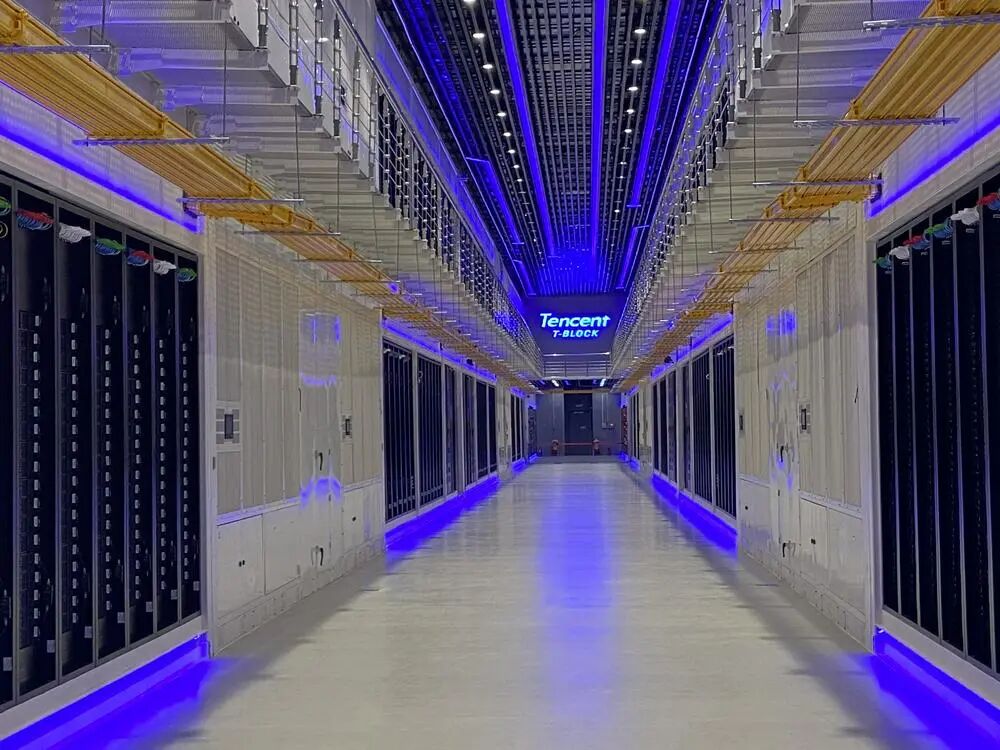
Inside Tencent's Gui'an Qixing Data Center in Guizhou
Image source: Cailian Press
Tencent's pressure is on cash. It operates on a prepayment model. In the third quarter, Tencent's free cash flow was negative RMB 69.1 billion. The company said that excluding computing power prepayments, it was positive RMB 16.9 billion — roughly RMB 86 billion prepaid in a single quarter. At the end of June, Tencent still had net cash of RMB 58.2 billion; by the end of September, that had turned into net debt of RMB 13.7 billion.
The largest prepayment went to Oracle. Five years, roughly 100,000 Nvidia chips, housed in Oracle's Southeast Asian data centers, with a contract value of approximately $7 billion, of which Tencent prepaid about 30%. According to the Financial Times, after U.S. officials "expressed concerns," Oracle canceled the agreement in early November.
One of Oracle's Southeast Asian data centers is leased from DayOne. According to Bloomberg, in 2025 Oracle became the sole tenant of DayOne's Nongsa campus on Batam Island, Indonesia. Oracle also holds a 15% stake in TikTok's U.S. joint venture and serves as its security partner.
Tencent has another line in Japan and Australia that has also run into trouble. Tokyo-listed Datasection derived 90.7% of its revenue in fiscal 2026 from a company called NowNaw Japan.
According to a Financial Times report last December, the ultimate client behind NowNaw was Tencent, involving contracts worth more than $1.2 billion across Tokyo and Sydney. Tencent responded at the time that its use of cloud services complied with applicable laws. In August this year, an additional order worth ¥79.86 billion was canceled. On November 16, Datasection cut its revenue forecast for the fiscal year from ¥162.2 billion to ¥17.3 billion, and the landlord of the Sydney data center terminated the lease after months of negotiations over swapping B200s for B300s dragged on.
The Middlemen
Trace the companies buying chips up the chain, and most of the names you find are familiar faces. Ethnic Chinese family capital from Taiwan and Southeast Asia, plus Singapore's state capital, have for decades served as middlemen between China and the West — in manufacturing, real estate, ports — with money and goods from both sides passing through their hands. AI computing power is the latest category in this business.
Chinese tech giants have demand; the West has chips and dollar loans. The middlemen provide a corporate identity acceptable to both sides, and a piece of land where they can pull in electricity.
This business has to pick a side every once in a while.
In November 1989, Wang Yung-ching made his first trip to the mainland, and subsequently proposed building an integrated upstream-to-downstream petrochemical zone in Haicang, Xiamen, abbreviated as the "901 Project." The news caused considerable controversy in Taiwan, China. Taipei stepped in to retain him, offering tax breaks and a $1.5 billion water supply facility, while also pushing down land and water prices. In August 1991, Wang Yung-ching accepted the Mailiao, Yunlin plan—what later became the Sixth Naphtha Cracker Complex. In November 1992, he held a press conference and announced the Haicang project was suspended. More than thirty years later, Zhongfang Capital, controlled by his eldest grandson, became the fourth-largest shareholder of DayOne.

2024, Microsoft and G42 investment cooperation signing ceremony
Image source: G42, published via The National
The most recent side-picking happened in the Middle East. In 2023, U.S. intelligence raised concerns about Abu Dhabi AI company G42's ties to China. In December, G42 CEO Peng Xiao told the Financial Times: "We can't do both sides." G42 subsequently stopped using Huawei equipment and sold off its investments in China, including its stake in ByteDance. In April 2024, Microsoft invested $1.5 billion in G42, and exiting China was a condition G42 privately negotiated with the U.S. government before the investment.
What the middlemen do has always been a business of exploiting regulatory loopholes. The remote access loophole was visible to all parties over the past three years. BIS expressed concerns in its rule guidance as early as 2023; Nvidia conducted compliance reviews of each cloud partner; bank loan documents stated who the tenants were. Nvidia said in March of this year that export rules "by design" allowed building cloud outside regulated countries. The new rules of November 16 closed this loophole.
A new round of side-picking has already begun. Aolani's CEO said that about half of its signed contract value now comes from Western clients. According to The Straits Times, four of DayOne's five largest customers are not Asian companies. B300 chips originally leased to Chinese customers are being relisted and sold to buyers in the U.S. and Western Europe. Nvidia, standing on the other side, turned even earlier—two weeks before the new rules were released, it told partners that Chinese customers could account for at most 49%.
Of the investments approved by Malaysia in the first three quarters of this year, data centers and cloud computing accounted for 35%. It has in fact already picked a side once. In May 2025, a deputy minister announced the use of Huawei Ascend chips to build national AI infrastructure—one week after the U.S. Commerce Department had just said that using Ascend anywhere in the world could violate U.S. export controls. The next day, the deputy minister's office retracted the speech, and Anwar said the announcement was "premature." Two months later, Malaysia began requiring licenses for the export and transshipment of U.S. AI chips.
With the new rules out, Malaysia's Minister of International Trade and Industry Johari said: "If you want a seat at the table, you have to play by America's rules." Singapore Prime Minister Lawrence Wong put it this way: "We do not enforce US export controls, but we do not want Singapore to be exploited or abused as a conduit."
Middlemen can still pick sides; ByteDance, Alibaba and Tencent cannot.
There are 82 days left until the license deadline of February 17, 2027.
Original link
Welcome to join the official BlockBeats community:
Telegram Subscription Group: https://t.me/theblockbeats
Telegram Discussion Group: https://t.me/BlockBeats_App
Official Twitter Account: https://twitter.com/BlockBeatsAsia

 Related Articles