"Big Short" Burry goes almost all-in on long positions—does he think the bottom is in?

TL;DR
· On November 25, "The Big Short" Michael Burry disclosed that he had cleared out his remaining Nasdaq 100 index put options. Currently, apart from short positions in Palantir and MetLife, he is almost entirely long, and the long-term call options on Nvidia in his hands have doubled in value.
· This is not The Big Short judging that tech stocks have bottomed and completely turning bullish, but rather a swing risk control move to take profits on short positions amid the sharp decline and use out-of-the-money call options to guard against a rebound; he plans to short again when Nvidia returns to around $200 and the market becomes optimistic again.
· Related tickers: Nvidia (NVDA), Palantir (PLTR), MetLife (MET), Nasdaq 100 Index (NDX)
On November 25, investor Michael Burry, known for shorting subprime mortgages, disclosed in a paid column that he had sold half of his remaining Nasdaq 100 index put options amid the weakness in tech stocks. His portfolio's long allocation has now risen to its highest level in recent memory, with almost only two individual stock shorts remaining.
What surprised the market even more is that this "Big Short" who has long been bearish on the AI bubble also holds long-term deep out-of-the-money call options on Nvidia (cheap contracts with strike prices far above the current price), and their value has already doubled. After the news broke, many speculated whether he thought the decline had bottomed and was preparing to turn completely bullish.
But Burry himself quickly poured cold water on that. He explicitly emphasized that his current relatively long positioning is only "temporary," that Nvidia at around $149 is not yet the time to short, and that he is preparing to open shorts again when the stock price approaches $200 and the market becomes optimistic again.
A fourteen-day rhythm shift: how to buffer a short squeeze during Nvidia's surge?
By stringing together the violent market moves of the past two weeks, one can understand why Burry suddenly "changed face." What he relied on was not abandoning his bearish view, but gradually cashing out short profits during the sharp decline while using cheap call contracts to put anti-rebound insurance on his shorts.
In mid-November, Nvidia suffered a selloff due to executive turmoil and accounting review rumors, and Jensen Huang briefly departed. Burry had already doubled his Nasdaq 100 put options (contracts betting on declines for profit) on November 12 and reopened shorts in semiconductor ETFs; when Nvidia fell another 14% on November 20, he decisively first closed half of his chip and index shorts to lock in profits.
Immediately afterward, on November 23, Nvidia's board unexpectedly announced the reinstatement of Jensen Huang as chief executive officer, and the stock price soared 31.5% in a single day. Reducing positions by half in advance greatly buffered the short-squeeze impact brought by the surge, and the Nvidia call options he used to guard against a rebound also doubled accordingly.
Two days later, on November 25, tech stocks pulled back again in early trading, with the Nasdaq 100 plunging more than 4% at one point, and Nvidia closing down 3.91% at $149.30. Burry promptly cleared out the last half of his Nasdaq short position, leaving about 25% of his portfolio assets in cash.

Strategic bearishness and tactical bullishness: calculating the odds
Ordinary investors tend to imagine the "Big Short" as a permanent bear who holds on to the end, but in recent years Burry has long been a swing trader who switches positions at high frequency. Nvidia has already fallen from its intra-year high near $243 to $149, with its price-to-earnings ratio back to about 16 times; at this point, chasing the short has unfavorable odds.
Options come with expiration dates and time decay. Once market sentiment turns pessimistic after a sharp decline, continuing to hold put options will quickly give back profits if there is a violent rebound. Therefore, his core approach is to harvest short profits during panic and then place bets again when sentiment warms up to around $200.
In August this year, he used exactly the same hedging tactic. At the time, while heavily shorting Nvidia, Palantir and Oracle, he bought Nvidia call options expiring in December with strike prices above $200, explicitly stating that this was merely insurance against a short squeeze.
Over the past year, such large swings have been commonplace. In the first quarter of 2025, he cleared out long positions and aggressively bought Nvidia put options; in the second quarter, he quickly closed shorts and reversed into large purchases of call options on tech and healthcare stocks; and in the third quarter, he once again increased AI short positions.
From calling "sell" and admitting the mistake to stopping out of Tesla: losses breed new risk controls
The reason Burry increasingly relies on the playbook of "out-of-the-money calls to guard against short squeezes + taking profits in batches and holding cash" stems largely from repeated losses in the past caused by entering too early. Being right on direction does not mean one can endure the violent swings of a bull market until the trade pays off.
The most famous lesson came in 2023. At the end of January that year, he posted just one word on social media: "Sell." As a result, the Nasdaq posted its best first-half performance in four decades, forcing him to publicly admit at the end of March that calling "sell" had been a wrong judgment.
Even earlier, in 2021, he disclosed holding more than 1 million Tesla put options, but ultimately exited early under sustained short-squeeze pressure, conceding that the market trend made it difficult to keep holding. Even by the end of 2025, after he publicly shorted Nvidia and Palantir, both stocks still extended gains for a time in the short term.
Even his long stock picks were not always spot-on. In November this year, when his column marked its one-year anniversary, several early long positions he publicly tracked, such as Lululemon, Shift4 and Fannie Mae, had fallen by more than 40% on average, which made him place even greater emphasis on position control and profit-taking discipline.
The $200 Second Short Line, and the Two Shorts Left Behind
Precisely because Burry has historically shown a rhythm gap between public statements and rapid short-term position switches multiple times, and this round of updates all comes from his paid-column self-account, not mandatory quarterly holdings reports, the specific new long targets have not been disclosed, and the risk for ordinary investors to copy him is extremely high.
The clues currently visible are hidden in "what he left behind." After clearing short positions in broad-based index and chip ETFs, Burry retained only put options on AI software stock Palantir and insurance giant MetLife, without giving up shorting selected individual stocks.
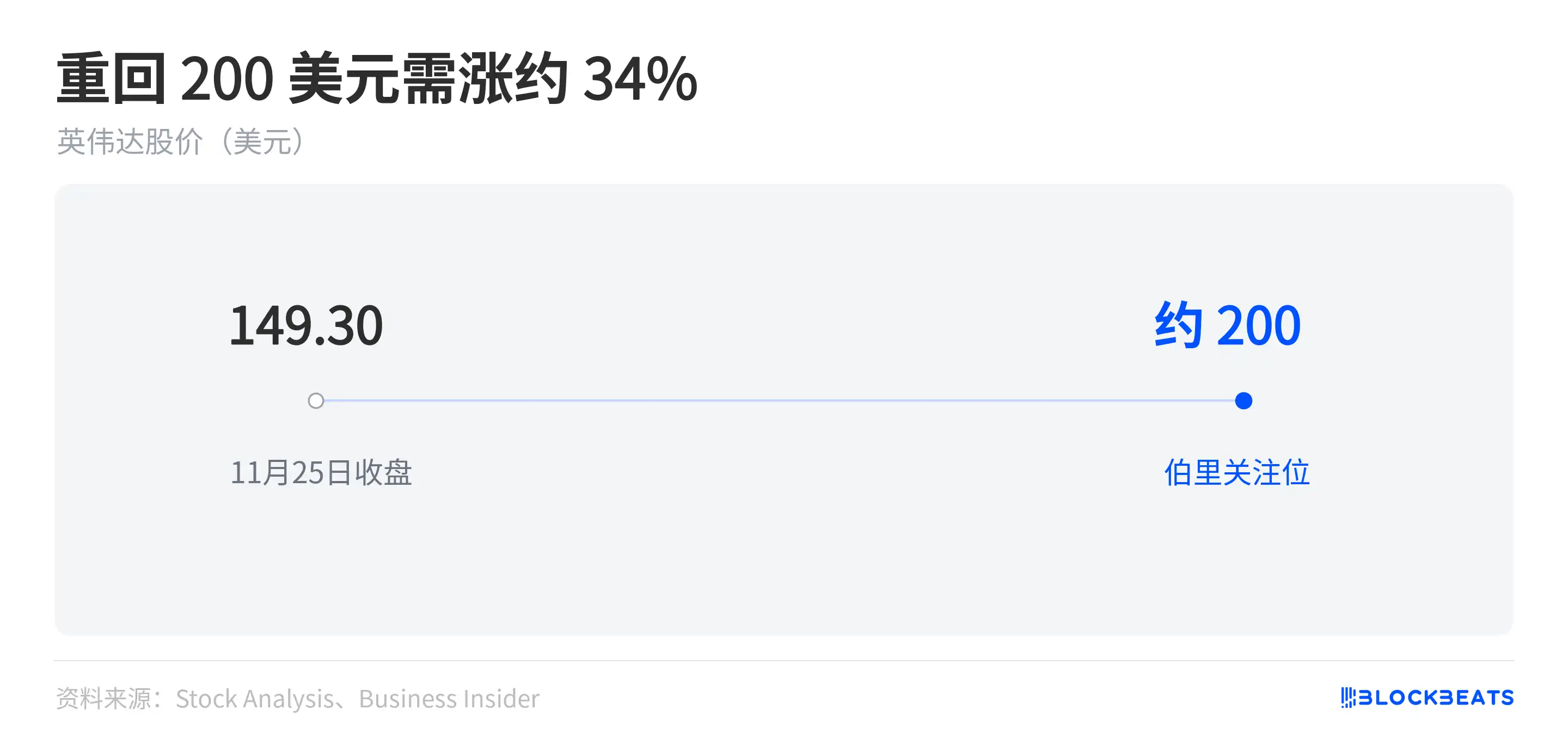
As Nvidia closed at $149.30 on November 25, the market's test of Burry's strategy has only just begun: whether Nvidia can rebound to around $200 to trigger his second short, and when this 25% cash position will strike again, will determine the success or failure of this round of the game.
Welcome to join the official BlockBeats community:
Telegram Subscription Group: https://t.me/theblockbeats
Telegram Discussion Group: https://t.me/BlockBeats_App
Official Twitter Account: https://twitter.com/BlockBeatsAsia

 Related Articles