Web3 Lawyer Analysis: How Will Hong Kong's Proposed "Stablecoin Bill" Impact the Chinese Crypto Community?
Original Title: "Web3 Lawyer's Interpretation: What Impact Will Hong Kong's Draft Stablecoin Ordinance Have on the Chinese Crypto Industry?"
Original Author: CryptoLawyer
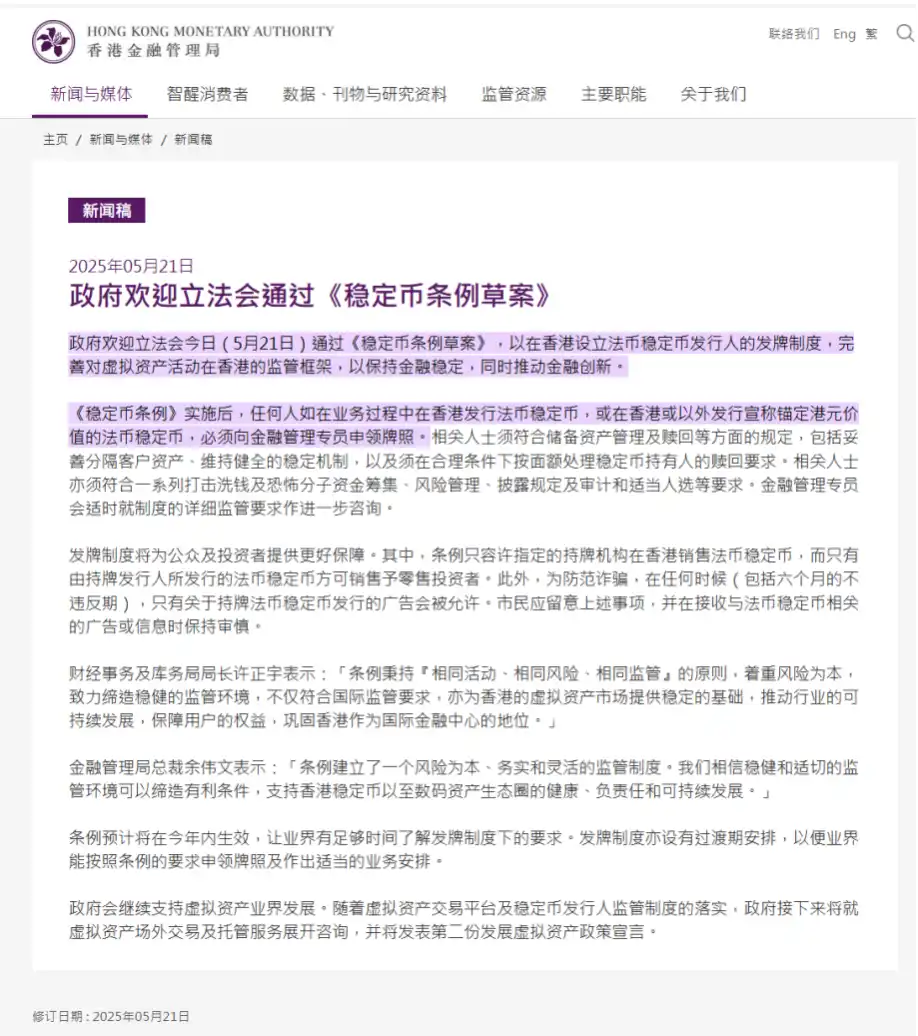
The Hong Kong Legislative Council passed the "Stablecoin Ordinance Bill" on May 21, 2025, marking Hong Kong as the world's first jurisdiction to establish a comprehensive regulatory framework for fiat-backed stablecoins. This legislative action not only provides a clear legal framework for Hong Kong's virtual asset industry but also, by balancing financial innovation and risk prevention, has had a profound positive impact on the development of the virtual currency industry in both Hong Kong and mainland China. Lawyer Liu (web3_lawyer) analyzes the positive significance of the passage of this bill from the perspectives of both Hong Kong and mainland China, combining policy background, industry impact, and future trends.
1. Positive Impact on Hong Kong
(a) Reinforcing Hong Kong's Position as a Global Digital Asset Hub
As an international financial center, Hong Kong has been actively engaged in the virtual asset space in recent years. The passing of the "Stablecoin Ordinance Bill" further solidifies Hong Kong's leading position in the global digital asset market. The bill outlines regulatory requirements for stablecoin issuers, including a HK$25 million minimum capital threshold, a 1:1 reserve asset peg to the issuance, and mandatory safeguards for unconditional redemption rights. These stringent yet clear regulatory standards provide a transparent and compliant environment for the stablecoin market, helping to attract global investors and enterprises to choose Hong Kong as the operating center for stablecoin businesses.
Furthermore, the Hong Kong Monetary Authority plans to swiftly issue regulatory guidelines post-bill passage and open license applications by the end of 2025. This will incentivize entities such as Standard Chartered Hong Kong, AN JI Group, and other institutions to actively participate, accelerating the development and application of the Hong Kong dollar-backed stablecoin. The introduction of the Hong Kong dollar stablecoin will not only enhance Hong Kong's competitiveness in cross-border payments but also drive the development of the Web3 ecosystem, injecting new vitality into Hong Kong's digital economy. For example, the Hong Kong dollar stablecoin can be used for efficient, low-cost cross-border trade settlement, further solidifying Hong Kong's position as an Asian financial hub.
(b) Promoting Financial Innovation and Technological Development
The passage of the "Stablecoin Ordinance Bill" indicates that the Hong Kong government views stablecoins as a vital part of digital financial infrastructure rather than a fringe technology. By providing a clear compliance path for stablecoin issuers, the bill encourages companies to engage in technological innovation within a regulatory framework. For instance, JD Group has entered the stablecoin "sandbox" testing phase in Hong Kong, demonstrating the company's confidence in the Hong Kong market. This "regulatory sandbox" mechanism allows companies to test innovative products in a controlled environment, reducing compliance costs for startups and providing space for technological iteration.
Stablecoins, as a core part of Decentralized Finance (DeFi), are expected to drive further development in Web3, NFTs, and the Metaverse. Since 2022, the Hong Kong government has been laying the groundwork for virtual asset regulation, conducting public consultations in 2023 and launching a regulatory sandbox in 2024, demonstrating long-term support for the Web3 ecosystem. The passage of the bill will further catalyze the application of blockchain technology in areas such as payments, settlements, and supply chain finance, fostering a vibrant digital asset ecosystem in Hong Kong.
(3) Enhancing Market Confidence and Investor Protection
The virtual asset industry has faced a trust crisis due to past events (such as the FTX scandal). Hong Kong, through the establishment of a comprehensive stablecoin regulatory framework, emphasizes reserve asset management, liquidity, and Anti-Money Laundering (AML) requirements, effectively reducing market risks. These measures ensure the sustainability of stablecoin issuers' business models while providing investors with higher security. For example, mandatory 1:1 reserve asset requirements and unconditional redemption rights can effectively prevent stablecoin uncoupling risks, enhancing market trust in stablecoins.
Furthermore, Hong Kong's regulatory framework seeks a balance between innovation and protection, demonstrating an open and compatible attitude. This balance has not only attracted the attention of global crypto companies but also provided safer investment channels for local retail investors. For instance, ZA Bank has pioneered virtual asset trading services, supporting Bitcoin and Ethereum transactions, and may expand to stablecoin transactions in the future. This pioneering effect will drive more financial institutions to enter the virtual asset market, expanding Hong Kong's investor base.
(4) Promoting Cross-Border Payments and Financial Connectivity
Stablecoins offer advantages of low cost and high efficiency in cross-border payments, and Hong Kong's stablecoin bill lays the foundation for widespread adoption of a Hong Kong dollar stablecoin. The introduction of a Hong Kong dollar stablecoin will optimize financial connectivity between Hong Kong and other regions in Asia, especially in the Belt and Road Initiative and the Greater Bay Area development. For example, the Hong Kong dollar stablecoin can be used in cross-border e-commerce, trade settlements, and supply chain finance, reducing transaction costs and improving settlement efficiency. This not only helps Hong Kong solidify its position as a global trade center but also provides local businesses with more digital financial tools.
2. Positive Impact on Mainland China
(1) Providing Regulatory Experience Reference for Mainland China
Mainland China has a relatively strict regulatory stance on virtual currencies, banning cryptocurrency business-type transactions and ICOs but maintaining an open attitude towards blockchain technology. The passage of the Hong Kong "Stablecoin Bill" provides a regulatory model that mainland China can reference. Hong Kong's regulatory framework emphasizes compliance, risk control, and the balance of financial innovation, aligning with mainland China's policy goals to promote the application of blockchain technology in the financial sector (such as the digital yuan).
For example, Hong Kong's "regulatory sandbox" mechanism has provided a testing environment for stablecoin issuance. This model may inspire the mainland to explore similar pilot mechanisms in specific areas (such as central bank digital currency CBDC or supply chain finance). Hong Kong, as a bridge between the mainland and the international market, its successful experience may propel the mainland to gradually relax regulatory restrictions on stablecoins and other virtual assets in the future, especially in the field of stablecoins pegged to the Hong Kong dollar or the renminbi.
(2)Promoting Renminbi Internationalization
Hong Kong's stablecoin bill has provided an experimental field for non-dollar stablecoins (such as stablecoins pegged to the Hong Kong dollar or renminbi). Although Hong Kong's stablecoin regulation currently mainly focuses on Hong Kong dollar stablecoins, its open regulatory attitude has provided possibilities for exploring renminbi stablecoins. As an offshore renminbi center, Hong Kong has a mature financial infrastructure and an international market environment, making it suitable as a testing ground for renminbi stablecoins. If renminbi stablecoins succeed in Hong Kong, it will further promote the use of the renminbi in global payments and settlements, contributing to the internationalization of the renminbi.
For example, Hong Kong's stablecoin regulatory framework may provide mainland enterprises with compliant channels to issue renminbi-pegged stablecoins through Hong Kong for cross-border trade and investment. This model can not only enhance the international acceptance of the renminbi but also provide new financing and payment tools for mainland enterprises, enhancing their competitiveness in the global market.
(3)Promoting the Coordinated Development of FinTech in the Guangdong-Hong Kong-Macao Greater Bay Area
The Guangdong-Hong Kong-Macao Greater Bay Area is an important region where the mainland of China promotes the application of financial technology and blockchain technology. Hong Kong's stablecoin bill has provided new opportunities for the coordinated development of FinTech in the Greater Bay Area. For example, the Hong Kong dollar stablecoin can complement the digital renminbi, jointly serving the cross-border payments, trade finance, and supply chain finance needs of the Greater Bay Area. Hong Kong's regulatory experience and mature financial market can provide compliance guidance for Greater Bay Area enterprises, attracting more mainland tech companies to enter the international market through Hong Kong.
In addition, Hong Kong's virtual asset trading platforms and stablecoin issuers may cooperate with mainland enterprises to develop blockchain-based financial products. For example, stablecoins can be used on the Greater Bay Area's supply chain finance platforms to address the financing difficulties of small and medium-sized enterprises. This cross-border cooperation will drive the integration and development of the Greater Bay Area's FinTech ecosystem.
(4)Indirectly Stimulating the Application of Blockchain Technology in the Mainland
Although the mainland adopts a cautious stance on cryptocurrency trading, blockchain technology has been widely applied in areas such as supply chain finance, cross-border payments, and digital identity authentication. Hong Kong's stablecoin bill has provided a successful case of commercializing blockchain technology, which may indirectly stimulate mainland enterprises to accelerate the research and application of blockchain technology within a compliance framework. For instance, Hong Kong's stablecoin "sandbox" testing experience can provide technical references for mainland enterprises, driving the implementation of blockchain technology in the FinTech sector.

III. Future Trends Outlook
The passing of the Hong Kong "Stablecoin Bill" marks a new stage in global stablecoin regulation. In the future, Hong Kong may become a global experimental field for non-US dollar stablecoins, attracting more international enterprises to enter its market. At the same time, Hong Kong's regulatory model may serve as a reference for other countries and regions, promoting the coordination and development of global stablecoin regulation.
For mainland China, the successful experience of Hong Kong may prompt regulatory agencies to gradually relax restrictions on virtual assets in the future, especially in areas related to the internationalization of the renminbi. Mainland enterprises can participate in the global digital asset market through Hong Kong's compliant channels, enhancing international competitiveness. In addition, financial technology cooperation between Hong Kong and the mainland will be further deepened within the Guangdong-Hong Kong-Macao Greater Bay Area framework, setting an example for regional coordinated development.
IV. Conclusion
The passing of the Hong Kong "Stablecoin Bill" has far-reaching positive implications for the virtual currency industry in Hong Kong and mainland China. For Hong Kong, the bill consolidates its position as a global digital asset hub, promoting financial innovation, investor protection, and cross-border payment development. For mainland China, Hong Kong's regulatory experience serves as a reference, driving indirect stimulation for the internationalization of the renminbi, the coordinated development of financial technology in the Greater Bay Area, and the application of blockchain technology. In the future, as the stablecoin market in Hong Kong matures and further cooperation with the mainland, both parties will occupy a more important position in the global digital finance field, injecting new momentum into regional economic development.
Disclaimer: The views expressed are solely those of the author and do not constitute legal advice or opinions on specific matters.
This article is a contribution and does not represent the views of BlockBeats.
Welcome to join the official BlockBeats community:
Telegram Subscription Group: https://t.me/theblockbeats
Telegram Discussion Group: https://t.me/BlockBeats_App
Official Twitter Account: https://twitter.com/BlockBeatsAsia

 Related Articles