Web3 Lawyer In-Depth Analysis: What Are the Key Points of Stablecoin Regulation? How Does the Stablecoin Regulatory Framework Differ Between the United States and Hong Kong?
Original Title: "Web3 Lawyer In-Depth Analysis: What are the Key Points of Stablecoin Regulation? How Does the Stablecoin Regulatory Framework Differ Between the U.S. and Hong Kong?"
Original Source: CryptoLaw
In the previous article, the CryptoLaw team delved into the core concept of stablecoins and systematically analyzed the operational mechanisms and use cases of mainstream stablecoins in the current market. Through the analysis, it is easy to see that the stablecoin track holds tremendous growth potential. However, stablecoin technological innovation is a double-edged sword. While it has broad development prospects, its potential risks should not be ignored. According to the "2024 Global Cryptocurrency Crime Report" released by on-chain analytics firm Chainalysis, the total amount of illegal transactions completed through stablecoins reached a staggering $400 billion in just the years 2022 to 2023. Among them, 70% of cryptocurrency fraud activities and over 80% of transactions evading sanctions used stablecoins.
Therefore, to balance innovation and risk, global regulatory agencies are accelerating the establishment of a comprehensive regulatory framework for stablecoins: the U.S. is actively advancing the "Stablecoin Tethering and Bank Licensing Enforcement (STABLE) Act" and other related legislative processes, while the Hong Kong Monetary Authority has passed the "Stablecoin Ordinance" and established a "Stablecoin Sandbox" regulatory mechanism. This dynamic balance between technological neutrality and risk control is shaping the next stage of stablecoin development, marking the transition of the stablecoin industry from unbridled growth to compliance.
· What are the risks associated with stablecoins and why is it necessary to regulate stablecoins?
· Which countries and regions currently have regulatory frameworks for stablecoins?
· What are the specifics of the regulatory framework? What are the entry barriers and compliance requirements for the stablecoin industry?
· In the long term, how will the continuous improvement of the regulatory framework affect the future development of the stablecoin industry?
The CryptoLaw team has deep roots in the cryptocurrency industry and years of experience in handling complex cross-border compliance issues in the cryptocurrency industry. In this article, they will combine relevant industry research and the CryptoLaw team's practical experience to provide a professional lawyer's perspective to outline and answer the above questions.
Ⅰ. What are the risks associated with stablecoins and why is it necessary to regulate stablecoins?
Why is the regulatory framework for stablecoins so important? Currently, the stablecoin industry faces two major risks:
One is the endogenous risk of stablecoins.
The value stability of stablecoins is not an absolute guarantee but is based on a balance of market consensus and trust mechanisms. The core logic is that the relative stability of stablecoins is not derived from the intrinsic value of the reserve assets but relies on the continuous trust of holders in the issuer's ability to fulfill their obligations. This trust is essentially a "consensus-driven value balance"—when the majority of market participants conduct transactions and transfers based on their expectations of stablecoin value stability, the risk of significant price fluctuations is suppressed by the consensus itself.
However, once the trust foundation is compromised, the stability of a stablecoin will quickly erode. For example, in cases of mismanagement such as insufficient reserve assets or fund misappropriation, when the market perceives such risks, the consensus mechanism of stablecoin holders may rapidly reverse or collapse. This is specifically manifested as follows: panic selling by stablecoin holders triggering a coin price deviation from its peg, and the market panic induced by the price deviation further stimulating the sell-off, ultimately forming a self-reinforcing negative feedback loop—known as a "death spiral." Moreover, a single stablecoin's collapse can ultimately trigger a series of chain reactions in the cryptocurrency market, becoming a black swan event for the overall market.
This systemic risk transmission mechanism was fully validated in the 2022 Luna-UST incident. As a representative of algorithmic stablecoins, UST relies on a complex algorithmic mechanism with the Luna token to maintain its peg to the dollar. However, when a market liquidity crisis erupted, the inherent flaws in the algorithm design were maliciously exploited and amplified. Simultaneously, the lack of transparency of UST further led to a rapid spread of a trust crisis, ultimately causing a collapse in its value. This event not only resulted in nearly $40 billion in market value evaporation but also triggered chain reactions in the crypto market, fully exposing the endogenous risks inherent in unregulated stablecoins.
The second type is the stablecoin's external risks.
While the anonymity and cross-border liquidity of stablecoins have brought significant convenience and advantages, these features also make them susceptible to being utilized by dark gray industries and illegal criminal activities. Without effective regulation, especially unclear anti-money laundering (AML) and counter-terrorist financing (CFT) compliance requirements for stablecoins, they are likely to become a clandestine channel for illegal fund flows, posing a threat to the security of the financial system.
II. Introduction to Stablecoin Regulatory Framework in the United States and Hong Kong, China
In recent years, the global stablecoin regulatory framework has shown a trend of rapid development. Countries and regions such as Hong Kong, China, the United States, Singapore, the European Union, and the United Arab Emirates are rapidly advancing and gradually implementing relevant laws and regulations.
Overall, the current stablecoin regulatory frameworks of various countries mainly revolve around the following three major directions:
1. Issuer's Admission Threshold: Clearly define the qualifications required for stablecoin issuers to ensure they have sufficient capital strength, risk management capabilities, and industry experience.
2. Coin Stability Mechanism and Maintenance of Reserve Assets: Require issuers to maintain an adequate reserve of stablecoin assets and ensure transparency and compliance through regular disclosure and independent audits.
3. Compliance in the Circulation Stage: Emphasize the enhancement of stablecoin's Anti-Money Laundering (AML) and Know Your Customer (KYC) mechanisms to prevent stablecoins from being used in illegal fund flows.
Next, this article will focus on Hong Kong, China, and the United States, delving into their latest stablecoin regulatory frameworks and exploring the following dimensions: regulatory process, regulatory documents, regulatory authorities, and core content of the regulatory framework.
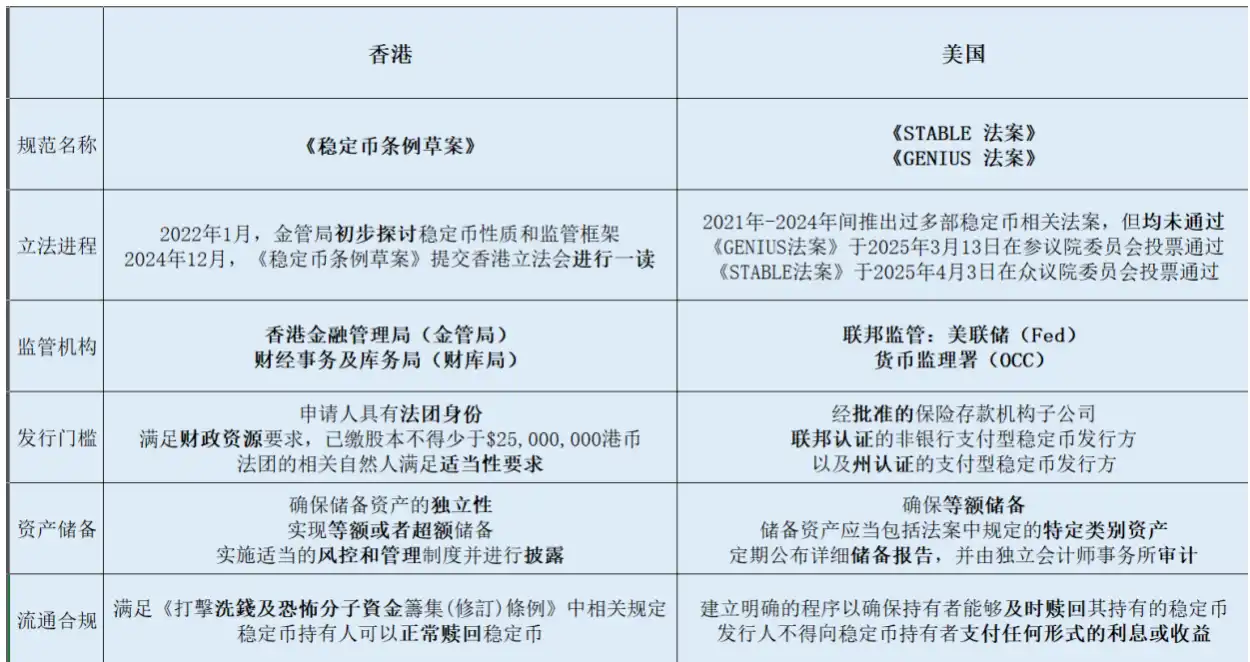
(The above diagram summarizes a comparison of the stablecoin regulatory frameworks in the United States and Hong Kong, China)
(I) Hong Kong, China
1. Regulatory Process
· January 2022: The Hong Kong Monetary Authority (referred to as the "HKMA" hereinafter) issued the "Discussion Paper on Cryptocurrency and Stablecoins," initiating the preliminary discussion on the nature of stablecoins and the related regulatory framework.
· December 2023: The HKMA and the Financial Services and the Treasury Bureau (referred to as the "FSTB" hereinafter) jointly issued the "Legislative Proposal Consultation Paper on Implementing a Regulatory Regime for Stablecoin Issuers in Hong Kong," proposing a specific draft regulatory framework for stablecoins. This paper focuses on regulating issuers and protecting holders.
· March-July 2024: The HKMA launched the "Stablecoin Sandbox" program, introducing a stablecoin issuer "sandbox," with companies like Circle Tech and JD CoinChain becoming the first batch of participants in this "sandbox."
· December 2024: On December 6, 2024, the Hong Kong government published the "Stablecoin Bill Draft" in the Gazette and submitted it to the Hong Kong Legislative Council for the first reading on December 18. According to Hong Kong's legislative procedures, a bill needs to go through three readings in the Legislative Council before becoming formal law, namely the first reading, second reading, and third reading. Essentially, this involves three stages of reading and deliberation on the bill. Therefore, before the "Stablecoin Bill" is formally signed into law, it must also complete this process, with an optimistic estimate of completion by 2025.
2. Legal Text and Corresponding Regulatory Authorities
The core regulatory document of the Hong Kong Stablecoin Regulatory Framework is the "Stablecoin Act" released in December 24, and the regulatory system for Hong Kong stablecoins is mainly overseen by the Hong Kong Monetary Authority and the Treasury Bureau as mentioned earlier.
3. Regulatory Framework and Key Contents
a. Definition of Stablecoin
Firstly, the "Stablecoin Act" clarifies the definition of "stablecoin" in a broad sense. Article 3 of the "Stablecoin Act" stipulates that a stablecoin should have the following characteristics:
· It is a form of storing value for a unit of account or economic value;
· It is a publicly accepted medium of exchange that can be used to purchase goods or services, settle debts, or make investments;
· It is deployed on a distributed ledger system and can be transferred, traded, and stored electronically;
· It is referenced to a single asset or a basket of assets to maintain a stable value.
It is important to note that the "Stablecoin Act" in Hong Kong does not regulate all stablecoins in a broad sense but specifically regulates "designated stablecoins" that meet certain conditions. Article 4 of the "Stablecoin Act" clearly states that a stablecoin that fully references the value of one or more official currencies is considered a "designated stablecoin" regulated by this Act.
b. Regulated Stablecoin-Related Activities
After defining stablecoin and designated stablecoin concepts, Article 5 of the "Stablecoin Act" specifies the activities related to stablecoins that fall under the regulation of this Act and require licensing, such as:
· Issuing designated stablecoins within Hong Kong;
· Issuing Hong Kong Dollar-pegged designated stablecoins outside Hong Kong;
· Actively promoting stablecoin-related activities to the public.
c. Issuer Admission Criteria
To engage in regulated stablecoin-related activities, one needs to obtain the corresponding stablecoin issuance license under the "Stablecoin Act" regulatory framework. The admission criteria for obtaining this license include but are not limited to the following:
· Firstly, the license applicant must have legal personality, either as a company established in Hong Kong or as a banking institution established outside Hong Kong.
· Secondly, if the license applicant intends to engage in stablecoin-related activities, they must meet basic financial resources requirements to fulfill their ongoing obligations. Specifically, the license applicant's paid-up capital must not be less than HK$25,000,000.
· Lastly, relevant natural persons such as the license applicant's shareholders, directors, ultimate beneficial owners, senior management, etc., must also meet the corresponding fitness and propriety requirements as outlined in the Stablecoin Regulations, which will not be discussed here.
d. Coin Value Stability Mechanism and Reserve Asset Maintenance
Regarding the designated stablecoin's reserve asset management, the Designated Stablecoin specifies the following:
· Firstly, the licensee must ensure that the designated stablecoin's reserve asset composition and any other assets are kept strictly separate to ensure the independence of the reserve asset.
· Secondly, at all times, the market value of the designated stablecoin's reserve asset composition must be greater than or equal to the stablecoin's circulating face value, thereby achieving full or over-collateralization.
· Lastly, the licensee must implement appropriate risk management policies and procedures concerning the reserve asset and ensure timely and complete disclosure to the public regarding the reserve asset's management policy, risk assessment, composition and market value, and the results of regular audits.
e. Compliance Requirements in the Circulation Phase
Firstly, the Stablecoin Regulations explicitly require the licensee to establish a dedicated risk management system that complies with the relevant provisions of the 2022 Anti-Money Laundering and Counter-Terrorist Financing (Amendment) Ordinance to prevent money laundering or terrorist financing activities associated with their designated stablecoin activities. Secondly, each holder of the designated stablecoin must have the right to redeem the stablecoin, and the issuance of the designated stablecoin must not be subject to any unduly restrictive conditions limiting the redemption of the stablecoin or impose unreasonable fees related to redemption.
f. Hong Kong Stablecoin Sandbox
Alongside the introduction of the Stablecoin Regulations, the Hong Kong Monetary Authority has also established the corresponding "Stablecoin Sandbox" mechanism to provide a testing environment and compliance support for relevant stablecoin issuers. Currently, several stablecoin issuers who have received initial approval from the HKMA are participating in this sandbox, including Roundcoin Technology, JD.com, and Standard Chartered Bank, among others. These issuers are expected to be among the first entities in Hong Kong, China to issue compliant stablecoins. Although the "Stablecoin Sandbox" mechanism was launched and tested last year, these entities have not yet formally completed the issuance of stablecoins. The Crypto Salad team understands that these stablecoin issuers in the sandbox may formally launch stablecoin products that comply with Hong Kong’s regulations by 2025.
(2) United States
1. Regulatory Process and Framework Documents
To understand the current stablecoin regulatory framework in the United States, the two core framework documents are the Guiding and Establishing National Innovation for U.S. Stablecoins Act (hereinafter referred to as the "GENIUS Act") and the Stablecoin Transparency and Accountability for a Better Ledger Economy Act (hereinafter referred to as the "STABLE Act").
The GENIUS Act was introduced by Senator Bill Hagerty and garnered support from multiple senators. The bill was passed in the Senate on March 13, 2025, with 18 votes in favor and 6 votes against. The STABLE Act was introduced by U.S. Representatives Bryan Steil and French Hill and was passed by the House Financial Services Committee on April 3, 2025, with 32 votes in favor and 17 votes against.
According to the U.S. legislative process, the STABLE Act, following approval by the House Financial Services Committee, will be submitted for full chamber debate in either the Senate or the House of Representatives. The bill must receive a majority vote in both the Senate and the House and undergo reconciliation to be signed into law by the President.
It is important to note that these two bills are not mutually exclusive or contradictory. Instead, the STABLE Act is positioned as an improvement and continuation of the GENIUS Act. Bryan Steil, Chair of the House Digital Assets Subcommittee, informed reporters that "following a round of revisions, the STABLE Act will align well with the Senate's GENIUS Act, a result of several rounds of draft amendments in the House and Senate with technical assistance from the SEC and CFTC. In fact, the bill has a 20% difference from the GENIUS Act, which is merely textual in nature and does not represent significant or substantive differences."
2. Relevant Regulatory Agencies
As of now, stablecoin regulation in the United States remains fragmented, without a unified federal framework to regulate stablecoin issuance and operations. This regulatory ambiguity has led to jurisdictional overlaps between federal agencies, and inconsistencies among state laws have further complicated regulatory oversight.
Currently, the United States Securities and Exchange Commission (SEC) and the Commodity Futures Trading Commission (CFTC) hold primary regulatory authority over the stablecoin market. The SEC considers many stablecoins to be structurally similar to money market mutual funds and therefore argues that they should be subject to securities regulations.
However, on June 28, 2024, the U.S. District Court for the District of Columbia ruled in favor of Binance, rejecting the SEC's claim that the BUSD stablecoin is a security. BUSD is issued through a collaboration between Paxos and Binance and is regulated by the New York State Department of Financial Services (NYDFS). This ruling aligns with previous judicial decisions regarding stablecoins, further emphasizing that stablecoins like BUSD and USDC—due to their 1:1 peg to a fiat currency—do not inherently fall within the SEC's jurisdictional definition of an investment contract.
On the other hand, the CFTC has designated some stablecoins as commodities and regulates them as such. CFTC Chairman Rostin Behnam previously stated to reporters in 2023, "Stablecoins are a commodity, so absent clear direction from Congress that they are some other type of asset, we must regulate this market." For example, the CFTC fined Tether $41 million for violating sanctions trading regulations related to its USDT stablecoin.
In conclusion, the lack of a unified legal framework not only complicates compliance efforts for stablecoin issuers but also poses financial stability risks to investors. Therefore, some suggest that bringing stablecoins under a regulatory framework similar to banks may help mitigate stablecoins' systemic risks and provide clearer compliance guidance to the market.
The "GENIUS Act" and "STABLE Act" have to some extent clarified the previously complex and ambiguous regulatory landscape. Specifically, for issuers of stablecoins exceeding $100 billion, federal-level oversight is implemented. The Federal Reserve (Fed) oversees deposit-taking issuers, while the Office of the Comptroller of the Currency (OCC) supervises non-bank issuers. Simultaneously, state regulators are permitted to oversee issuers with stablecoin market values below $100 billion. Therefore, these two acts establish a dual federal-state regulatory framework, aiming to provide a more comprehensive and systematic regulatory model for the U.S. stablecoin industry.
3. Regulatory Framework and Key Aspects
Next, we will delve into an analysis based on the recently enacted "STABLE Act."
a. Definition of Stablecoin
The bill stipulates that a Payment Stablecoin subject to this law shall have the following characteristics:
· A digital asset intended to be used as a means of payment or settlement;
· Denominated in national currency;
· Issuers are obliged to exchange, redeem, or repurchase it for a fixed amount of currency value;
· Not a national currency and not a security issued by an investment company.
b. Issuer Admission Criteria
Only "Permitted Payment Stablecoin Issuers" can issue stablecoins, including:
· Approved subsidiary of an insured depository institution;
· Federally chartered non-bank Payment Stablecoin issuer;
· State-chartered Payment Stablecoin issuer;
c. Currency Stability Mechanism and Reserve Asset Maintenance
The issuer must ensure that the reserve assets cover 100% of the outstanding supply of liquid stablecoins (i.e., 1:1 backing). The reserve assets should include the following categories:
· US dollars in cash;
· Federal Reserve Bank deposits;
· Demand deposits with a custodian;
· Short-term US Treasury securities maturing within 93 days;
· Overnight repurchase agreements meeting specific criteria;
· Money market funds invested in the above assets.
Additionally, the issuer must publicly disclose a detailed report of the reserve composition monthly, audited by an independent registered public accounting firm. Furthermore, the report must be accompanied by written attestations from the company's CEO and CFO to ensure the accuracy and integrity of the information.
Finally, the issuer must comply with capital adequacy, liquidity management, and risk management requirements established by the primary federal Payment Stablecoin regulatory agency. Risk management encompasses key areas such as operational risk, compliance risk, IT risk, and cybersecurity risk.
d. Compliance in the Circulation Phase
First, the issuer should publicly disclose the stablecoin's redemption policy and establish a clear procedure to ensure holders can redeem their stablecoin holdings promptly. Second, the issuer must not pay any form of interest or return to stablecoin holders to avoid potential conflicts of interest and market distortion.
III. Salad Interpretation
The Crypto Salad team's analysis believes that major global economies accelerating the construction of a stablecoin regulatory framework has, in fact, revealed the core value of stablecoins in different dimensions:
First, as an indispensable key infrastructure of the digital asset market, stablecoins are accelerating the breakthrough of the on-chain ecosystem's boundaries, deeply integrating with the traditional financial system and the real economy's operational aspects, thereby achieving a deep integration of on-chain and off-chain value systems.
Second, at a critical juncture of deep adjustments in the current global financial landscape and the accelerated trend of de-dollarization, stablecoins will play a more crucial role in the international monetary and financial system game, becoming an important strategic tool for countries to maintain currency sovereignty and financial security.
Finally, with the continuous optimization of stablecoin regulatory mechanisms in various countries, the stablecoin industry will surely enter a new stage of balanced development between standardization and innovation. This requires stablecoin issuers to further enhance compliance capabilities within the regulatory framework and also provides institutional space for exploring new business paradigms. The future development of the stablecoin industry will seek new growth momentum and value creation points in the global financial regulatory system through technological iterations and institutional adaptions.
Welcome to join the official BlockBeats community:
Telegram Subscription Group: https://t.me/theblockbeats
Telegram Discussion Group: https://t.me/BlockBeats_App
Official Twitter Account: https://twitter.com/BlockBeatsAsia