error
Original title: The Great Return of Options: A New Era for DeFi
Original source: Three Sigma, blockchain engineering and auditing firm
Original translation: Felix, PANews
The DeFi space continues to evolve, and the options market has made significant progress. New protocols, products, and strategies continue to emerge, reshaping decentralized options trading. It is important to revisit this changing landscape and evaluate the trends that shape the future of DeFi options. A year ago, protocols were divided into 4 main categories:
· Order Books
· AMM (Internal)
· AMM (External)
· Structured Products
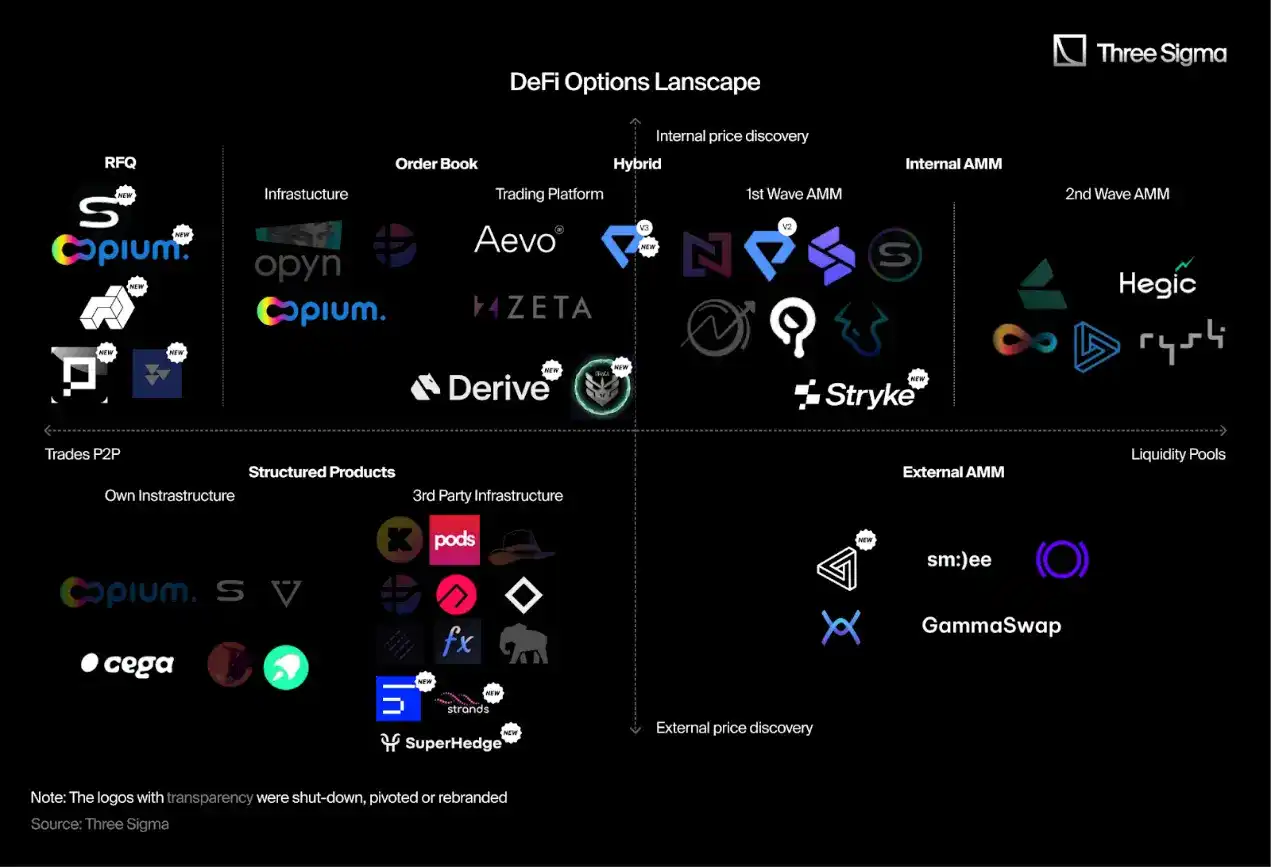
Since then, protocols in each category have undergone significant changes. Some protocols are expanding aggressively, while others are pivoting to new models or, unfortunately, shutting down. The outlook is both challenging and promising, and survival in this fast-paced environment is not guaranteed.
As @DanDeFiEd (founder of rysk finance) mentioned in his derivatives speech at the Federal Polytechnic of Milan last year, "Some of you are NGMI." (PANews Note: NGMI is the abbreviation of Not gonna make it, meaning unable to succeed). His words have proven to be prophetic. 50% of the protocols mentioned in the original report have either abandoned the options business or ceased operations. The DeFi ecosystem can be ruthless, and only the most adaptable will survive.
But why such a high elimination rate?
The past year has seen the dominance of point systems and MEME coins, raising questions about sustainability and value creation. The preference for perpetual contracts to gain leverage has been a key challenge for many options protocols struggling to find product-market fit (PMF).
In addition, the rise of points trading has diverted attention and liquidity from more complex structured products such as options.
Have the protocols that struggled last year successfully adapted, or has the increasing focus on perpetuals and short-term rewards sealed their fate? The answers are as varied as the projects themselves, but one thing is certain: the road ahead will only get harder.
Overall Trends
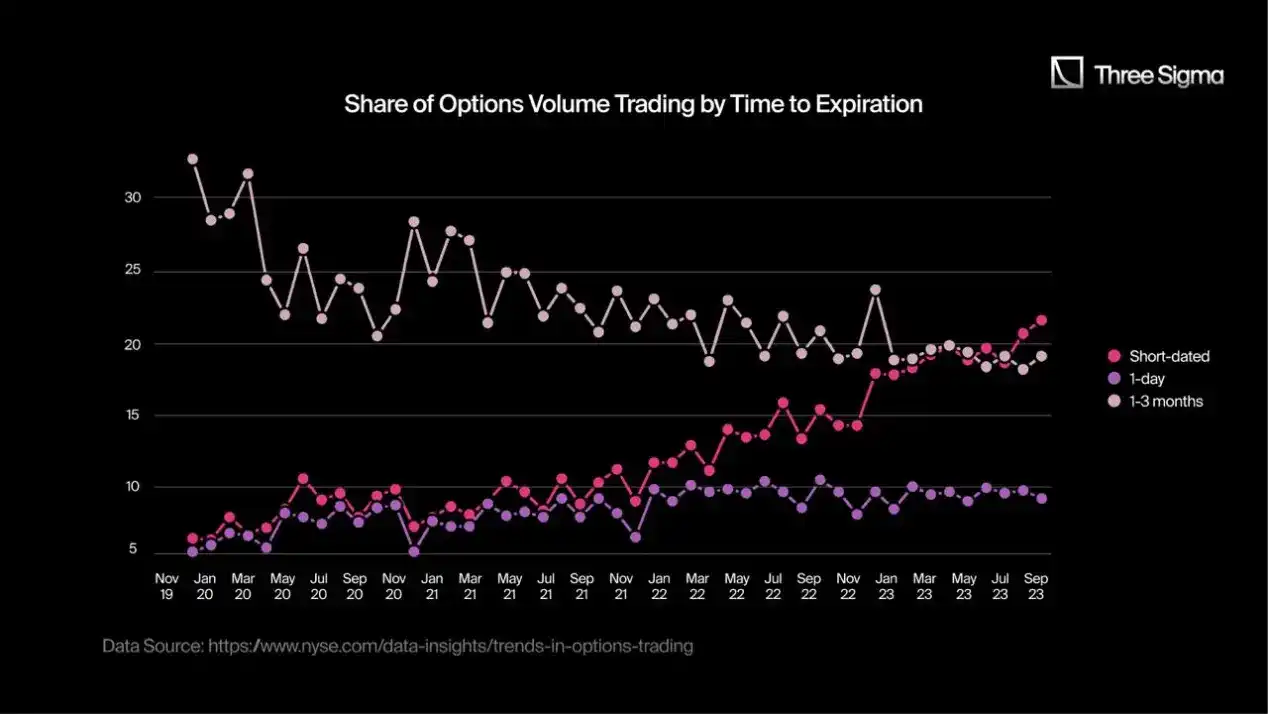
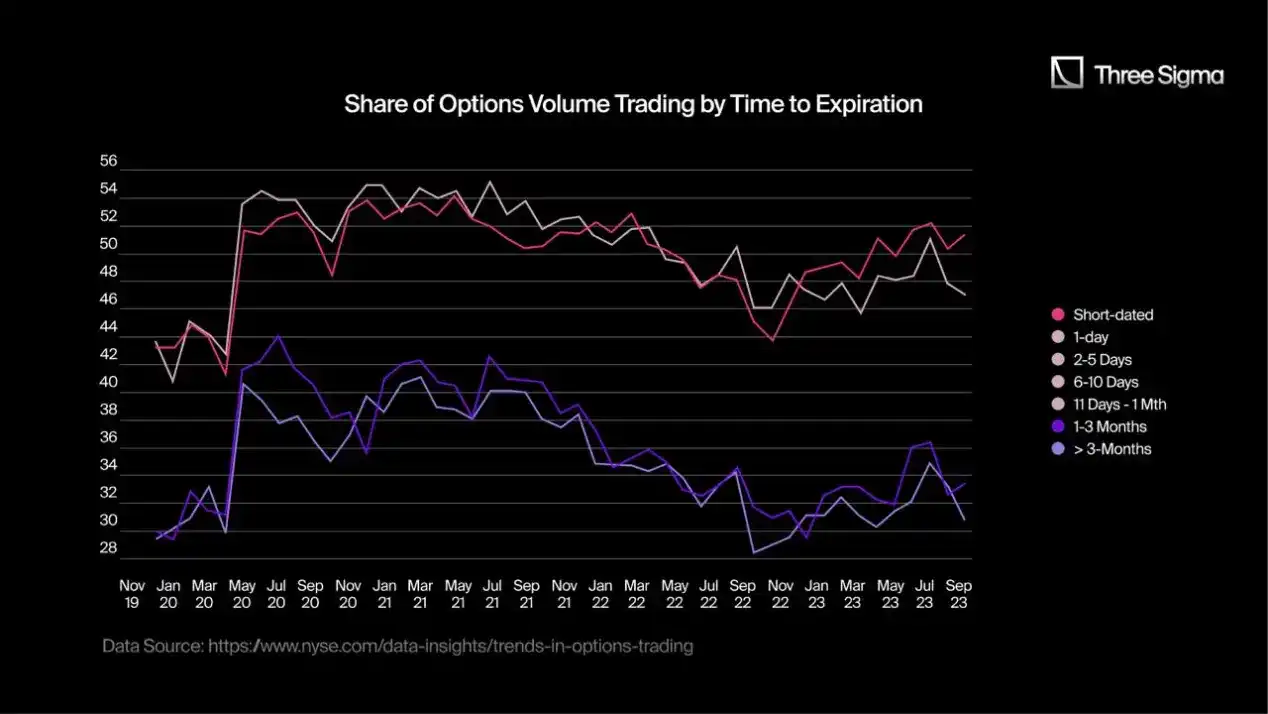
"[…] Retail share of options volume in the U.S. equity market is […] 45%, according to our estimates. Growth in retail options share was initially driven by the 2020 pandemic and has continued to grow as retail options traders seize short-term options to bet on market direction. Volume share for low-priced options is also increasing, further boosting overall options volume, especially retail volume. Neither of these trends appears to be in danger of reversing." NYSE
—Options Trading Trends, December 2023
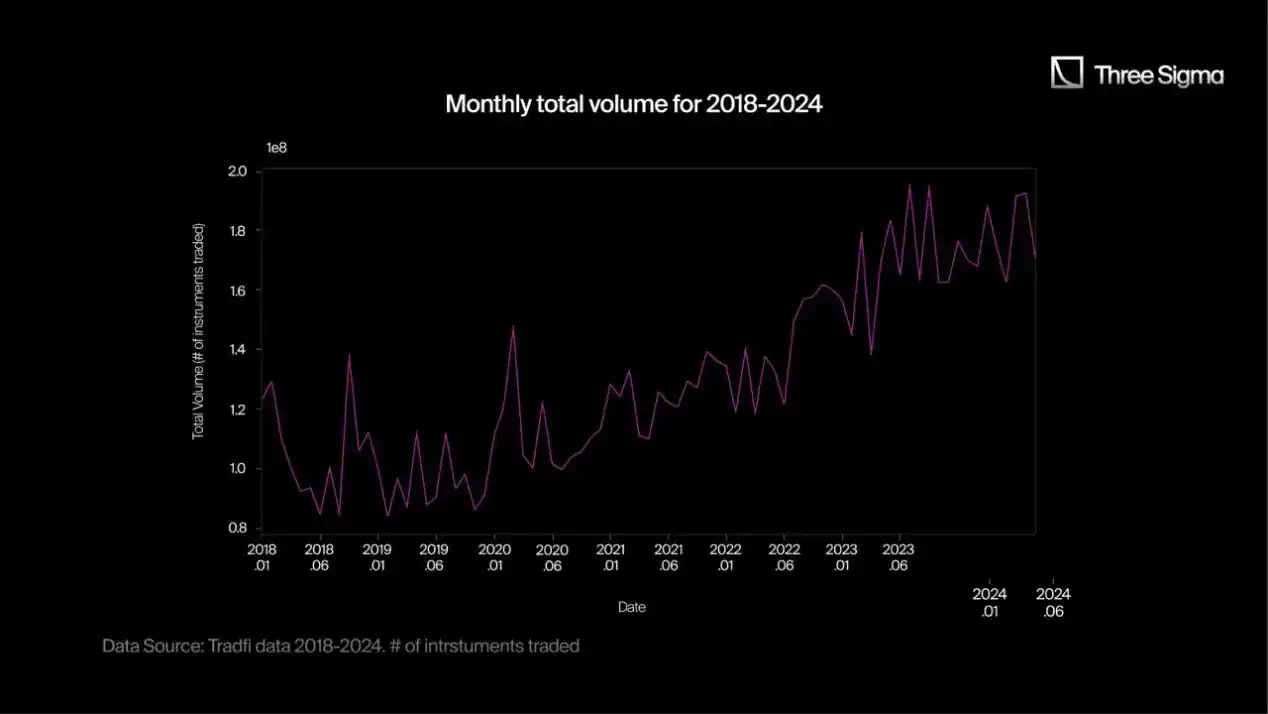
In traditional finance (TradFi), retail traders are increasingly interested in high-risk, short-term options. This shift is evident in the data: weekly options volume has doubled, climbing from about 100 million contracts per week in 2018 to 200 million contracts in 2024. This means that the number of positions opened and closed each week has increased significantly.
With retail traders outside of the crypto space leaning heavily toward short-term, highly leveraged opportunities, the question arises: Can DeFi options capitalize on the same momentum? Or will perpetual options continue to dominate the crypto leverage narrative?
DeFi Options Development
· “We found PMF” — founder to an unsuspecting VC
· “Huuugeee TAM” — same founder to the same unsuspecting VC
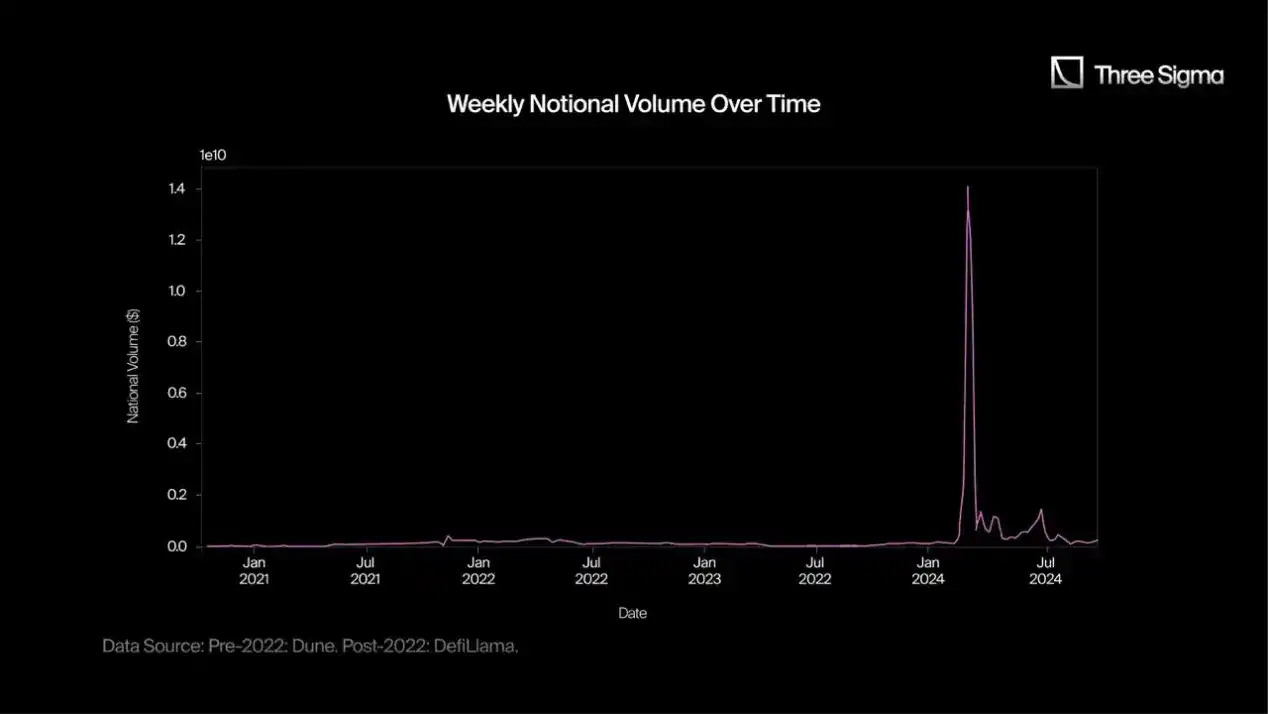
Throughout 2022, options libraries like Ribbon gained popularity and sparked interest in the DeFi community. However, as the initial excitement faded, notional volumes began to steadily decline from the end of 2022 to 2023. This downturn reflects the broader challenges facing DeFi options protocols in maintaining momentum.
However, by 2024, things began to change. The introduction of new exchanges and products such as AEVO, Derive (Lyra's application chain) and Stryke helped to rekindle interest in the space, gradually regaining market share. The following are notional volume data:
· September 2021: $392 million
· September 2022: $411 million (up 1.05x year-on-year)
· September 2023: $78 million (down 0.19x year-on-year, with a 81% drop in volume)
· September 2024: $866 million (up 10.99% year-on-year)
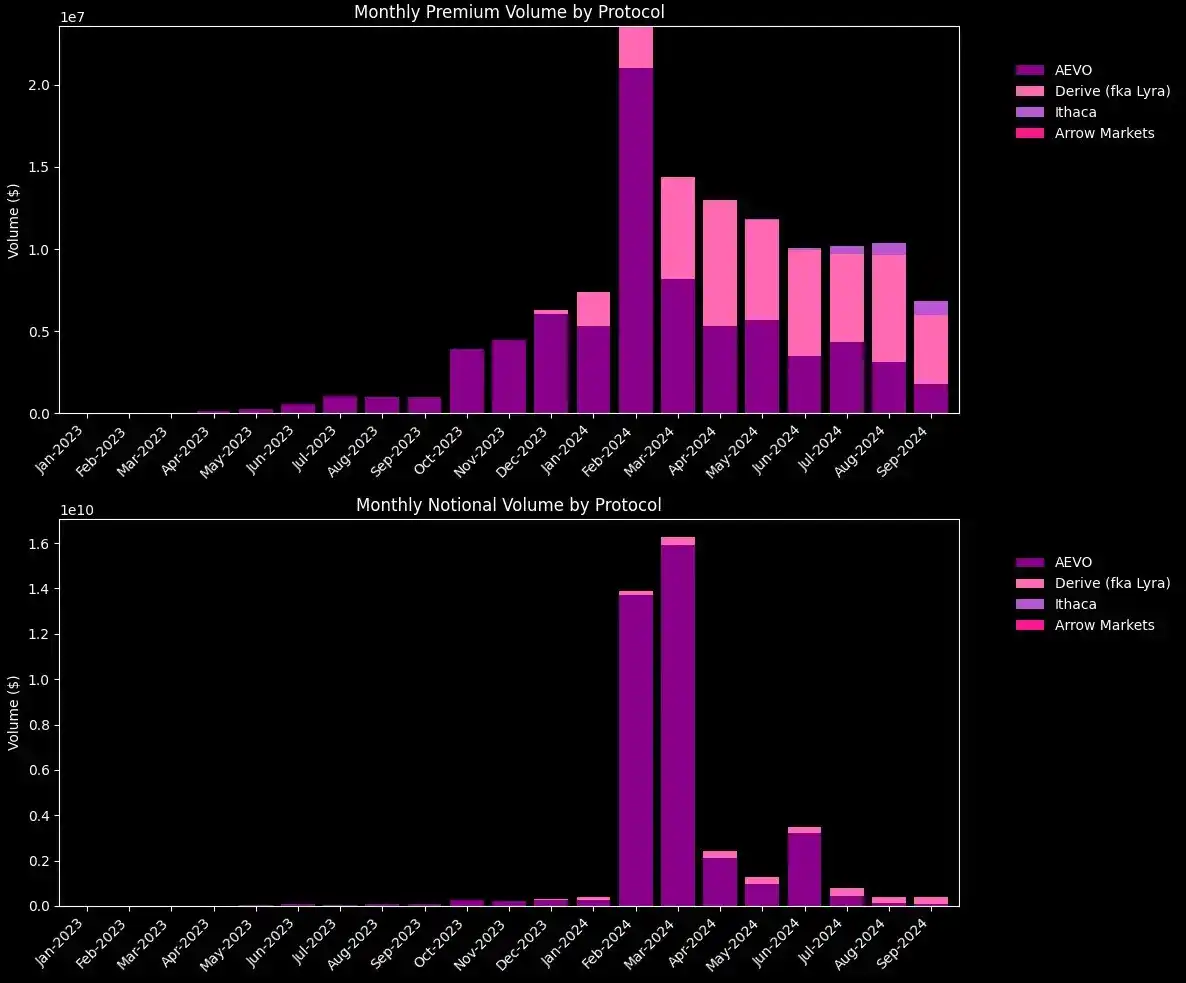
In addition to the surge in notional volume, another key indicator of market health is premium volume – the amount buyers pay sellers for options. Data evidence of a strong recovery from 2022 to 2024: · September 2022: $3.8 million · September 2023: $3.3 million (YoY change: 0.87x) · September 2024: $10.3 million (YoY change: 3.11x) The growth in premium trading volume highlights the new demand for DeFi options, as buyers are willing to pay much higher premiums in 2024 than in previous years. This reflects a shift in the market, where new products and more complex strategies are driving increased participation and confidence in the options space.
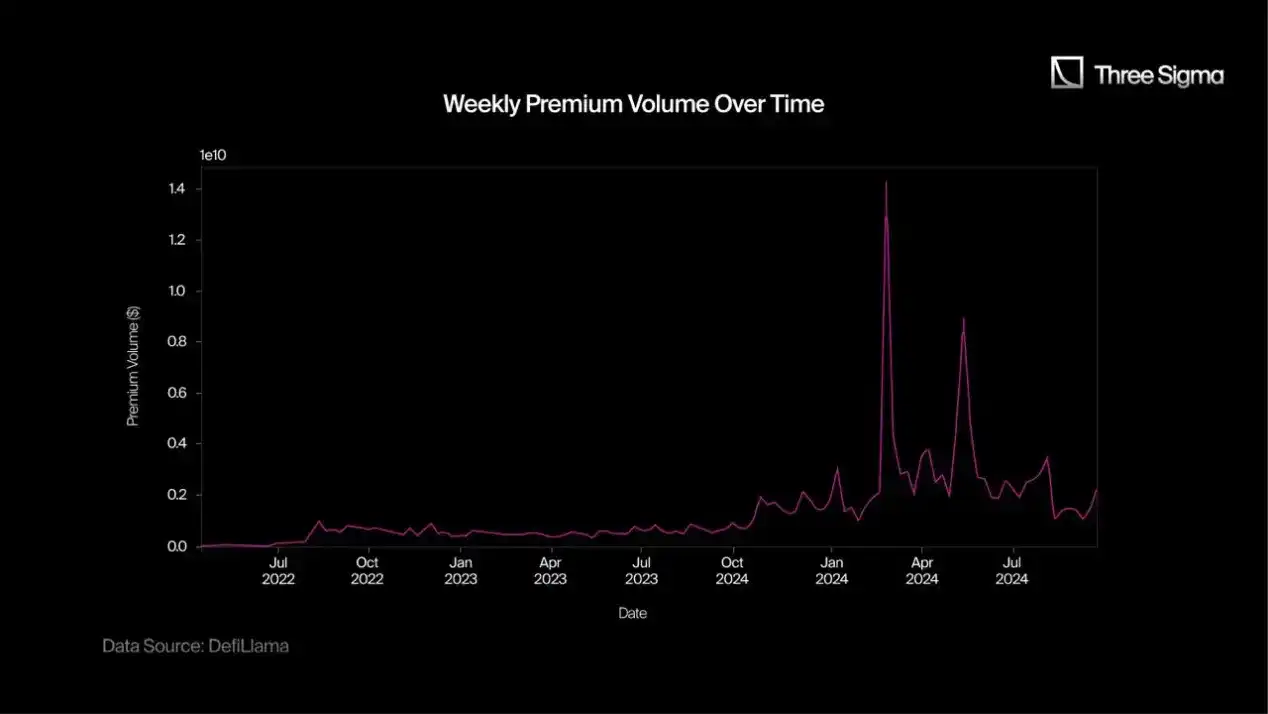
While notional volume surged 18x between 2023 and 2024, premiums to liquidity providers (LPs) grew only 3.7x. This discrepancy suggests that while trading activity has surged, much of it has been driven by cheap options, most likely out-of-the-money (OTM). High volumes may be impressive, but lower premium growth suggests the market is still dominated by low-cost, high-risk options.
Options vs. Perpetuals: The Battle for Dominance
Despite the rapid growth of DeFi options, perpetuals still dominate.
While the gap between the two is still large, it is gradually narrowing. In 2022 and 2023, perpetual swaps traded between $10 billion and $12 billion per week on-chain, growing to $41 billion in 2024. Meanwhile, options volume remains about 1/100 of perpetual swaps.
· September 2022: Perpetual swaps trade 85 times more than options
· September 2023: The gap widens to 400 times
· September 2024: 160x smaller
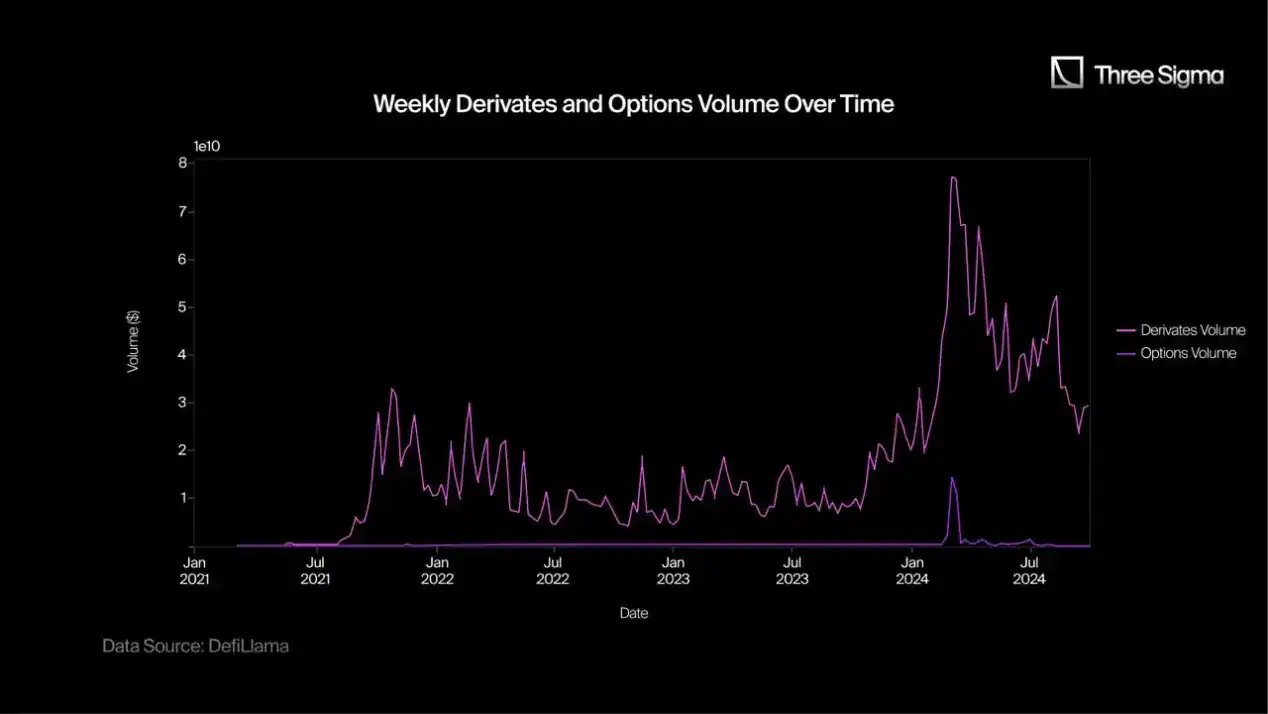
While the DeFi options space has struggled to match the scale of perpetuals, it is not without hope. When reviewing research from a year ago, it is clear that the industry is growing, albeit unevenly. Most users still prefer perpetuals due to ease of use and high liquidity, leaving options protocols in a more challenging position.
The options space is heavily obscured, with many projects continuing to struggle with PMFs in a market still dominated by perpetuals.
The key question remains: where will future demand for DeFi options come from? Can DeFi options carve out their own niche as traders seek more complex strategies, or will perpetuals continue to dominate the on-chain derivatives space?
New Faces
As DeFi options continue to grow, several new protocols have emerged. Here is a brief analysis of these new players:
Order Book/Request for Quote (RFQ)
· Arrow Markets — uses the RFQ system and launched on Avalanche
· Ithaca — has off-chain order books and on-chain settlement
· Predy V6 — is expected to launch intent-based options soon
· Valorem — is using an off-chain streaming RFQ system. Unfortunately, it is outdated.
External AMM
Limitless — An oracle-free and liquidation-free platform where Uniswap LPs can generate yield by lending it to traders/borrowers even when their liquidity positions are out of range.
Structured Products
· 3Jane — Ribbon fork where early depositors can earn more yield.
· Strands — A structured product based on Lyra and CME that allows traders to tokenize their covered call options.
· SuperHedge — Allows users to deploy assets on platforms like AAVE or Ethena, stake yield tokens on Pendle, and use part of the yield to buy options.
Other protocols
· ClearDAO — Provides options SDK.
· Jasper Vault — Provides 0DTE and 2-hour options with permissioned liquidity and internal pricing oracles.
· Sharwa (Dedelend) — Initially an aggregator of Ryks, Hegic, Premia, etc., the upcoming release will introduce 10x leverage, using WBTC, WETH and USDC as collateral, powered by Hegic.
· tealfinance — is an aggregator that compares prices across different platforms such as bitbit.
· Umoja — Creates synthetic options by adjusting positions in a portfolio of tokens and perpetual contracts based on market movements.
Order Books
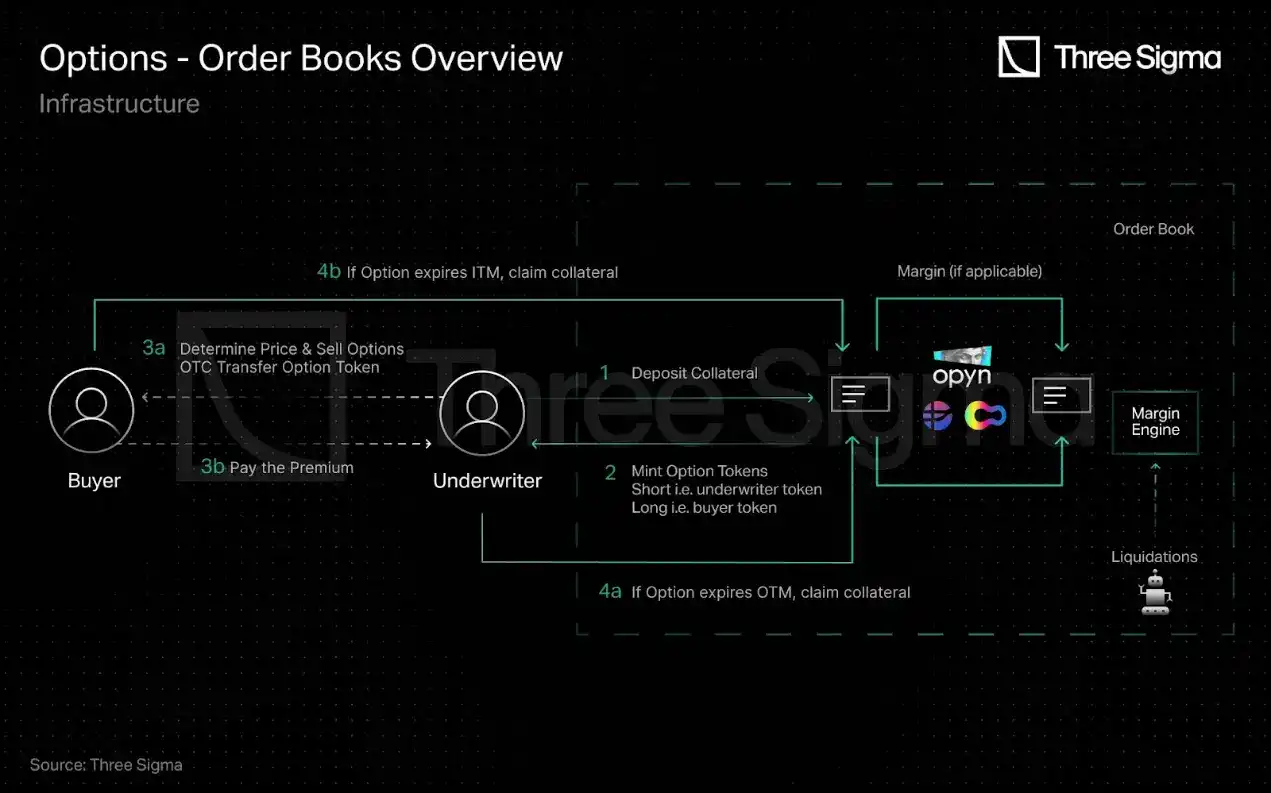
The order book landscape within the DeFi options space can be divided into two broad categories: protocols that provide order books as infrastructure for others to build on, and protocols that serve as trading platforms. The truth is brutal, 3 out of 6 are out. Here’s a deeper look at what happened:
Still Evolving:
1.AEVO — As a top competitor in the on-chain options market, its rise is simple: Points Mining. AEVO offers traders the ability to go 10x long on a single Bitcoin with the right collateral, or to buy ultra-cheap out-of-the-money (OTM) options. For example, an option with a notional value of $40,000 can be bought for just pennies if the seller is willing to underwrite it.
(PANews Note: Out-of-the-money options refer to options whose strike price makes them have no intrinsic value. For call options, the strike price is higher than the current market price; for put options, the strike price is lower than the market price)
This has brought AEVO's monthly trading volume to billions of dollars, setting a record high for the protocol and the entire on-chain options market.
While notional trading volume has surged, premiums remain low due to the large number of forward OTM options. Consider that trading volume was $16 billion in March and $2 billion in April - despite an 8-fold increase in trading volume, the premium was only 50% higher ($8.2 million vs. $5.3 million). Even if the point mining program is no longer implemented, AEVO is still one of the protocols with the highest notional trading volume.
2.Derive (fka Lyra) — After transitioning from the Synthetix ecosystem, Derive now runs its application chain Derive Chain on the Optimism (OP) Stack. By moving to an order book model, Derive provides a more efficient trading experience with a monthly settlement volume of between $200-300 million.
3.Opium — Once a base layer infrastructure provider, it has shifted to focus on zero-day expiration (0DTE) options, reflecting the retail market's growing interest in short- and medium-term tools in TradFi.
Stay away from the options business or fail
1.Opyn — Despite the early success of its options suite, Opyn never generated any revenue through it. The team has since moved to perpetual contracts.
2.Psyoptions — has ceased operations with no clear direction for development.
3.Zeta — has abandoned options and is now fully committed to perpetual contracts, which has proven to be more sustainable for them.
AMM (Internal)
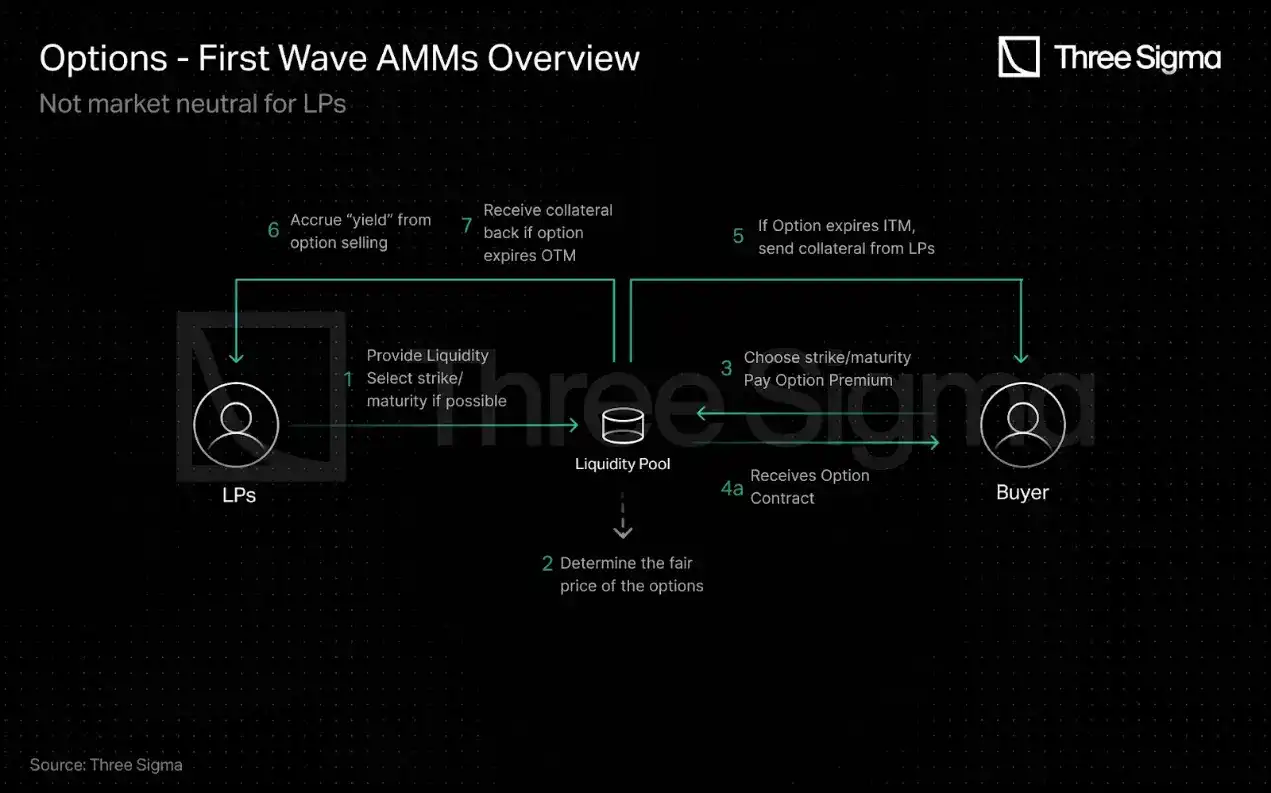
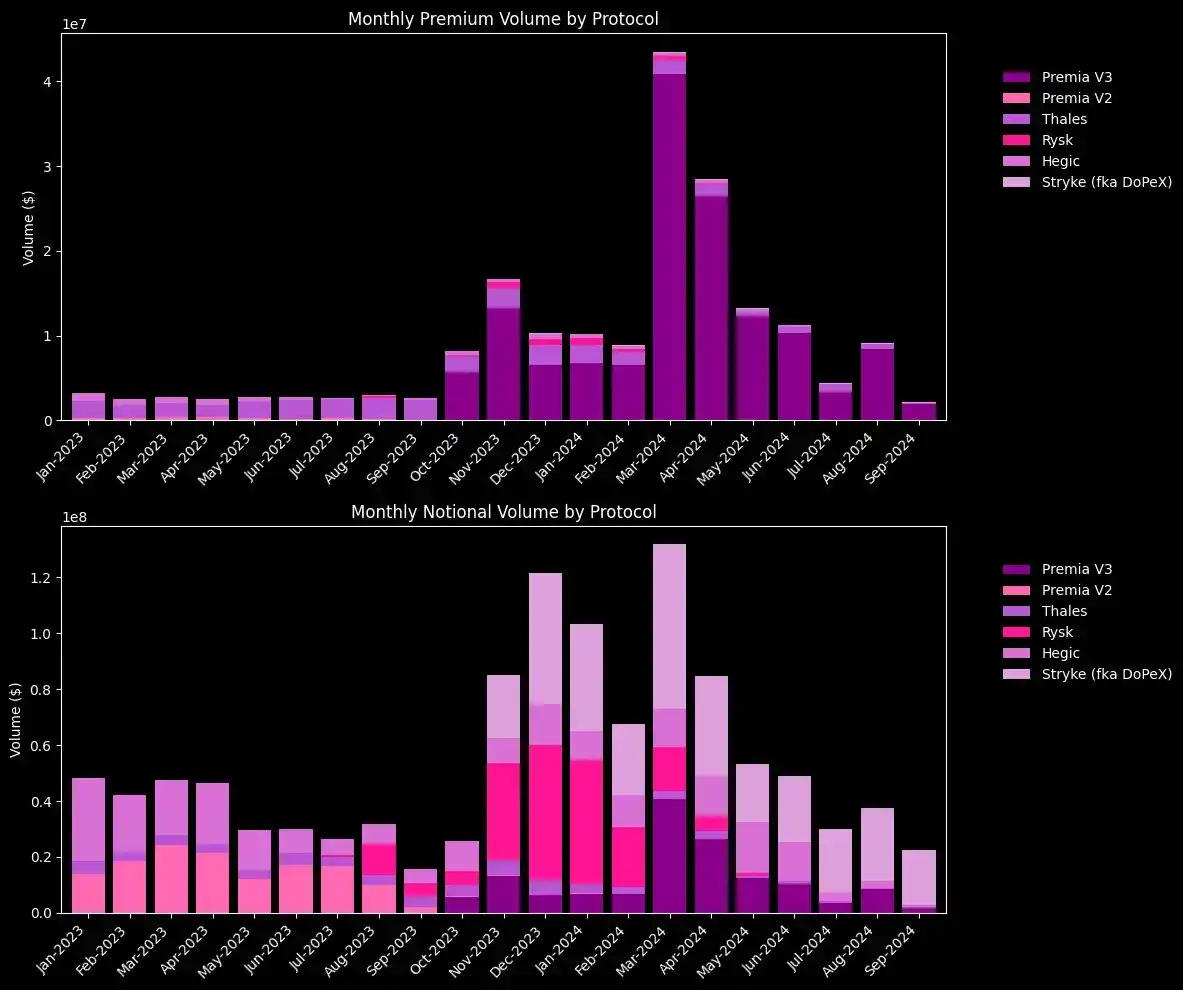
Protocols that use internal AMMs to price options. Some protocols have complex liquidity provision strategies, while others are simpler and rely more on the risk of their LPs. Today, 3 out of the 10 protocols have transitioned or closed.
Still evolving:
1.Deri — With the launch of the V4 protocol, Deri attracted a lot of capital on Linea and now offers perpetual contracts and perpetual derivatives, with its liquidity pool acting as the counterparty to all transactions.
2. Hegic — launched 0DTE options in the summer of 2024, but its core product, the one-click strategy, has remained unchanged for years.
3. IVX — offers 0DTE on Berachain.
4. Premia — V3 adopts a hybrid model that combines CLAMM on Arbitrum One and the on-chain order book on Arbitrum Nova. With monthly trading volumes between $6 million and $15 million, the team plans to launch premium V4, improve collateralization, and introduce perpetual contracts.
5.Rysk — After the success of V1, Rysk is now focused on building Rysk V2, which will create vaults for decentralized order book DEXs, allowing market makers to sign orders from these vaults.
6.Stryke (fka DoPeX) — Successfully transformed their AMM by introducing CLAMM and managed to turn things around. Over the past year, monthly trading volumes have reached $20 million to $50 million. During the rebranding process, Stryke also migrated from their dual-token model (DPX/rDPX) to SYK, deprecating the rDPX token. Now, xSYK represents the staking version of the SYK token.
7.Thales — Provides support for trading binary options and on-chain derivatives on the Ethereum network. Although the protocol is a niche market, monthly trading volumes have always remained around $5 million. However, as of the second half of 2024, trading volume has fallen to $1 million per month, down from higher levels earlier this year.
Stay out of the options business or fail:
1. Ntropika — They never seem to have successfully launched. Despite raising $3.2 million from Tier 1 VCs in August 2020 and another $12 million from NFT sales in 2022, there has been almost no movement since then. Rug pull? Development issues? The community is clueless.
2. Oddz — Originally an options-AMM protocol, Oddz later pivoted to become a perpetual options aggregator.
3. Siren — Once based on AMM, it has now moved to an oracle/RFQ system, with off-chain pricing managed by a select group of whitelisted providers (called Siren Guardians).
AMM (External)
What does external AMM mean? These protocols leverage third-party spot AMMs (such as Uniswap or Balancer) as a base layer to enable others to trade options seamlessly. Today, all 3 are in operation.
1. GammaSwap—Launched on Arbitrum, GammaSwap offers over 20 assets. A key development is that they now use an internal spot AMM (Delta Swap) to power the platform instead of Balancer or Uniswap. Since its launch in January 2024, the protocol has facilitated approximately $130 million in notional volume, an average of $13 million per month.
2. Panoptic — After several alpha tests on L2s and alt-L1s, it is preparing for its mainnet launch, which is expected to go live before the end of 2024.
3. Smilee — Launched on Arbitrum, Smilee offers wETH, wBTC, GMX, and ARB options. Since its launch in March 2024, the protocol has seen a notional volume of approximately $71 million, averaging $10 million per month.
Structured Products
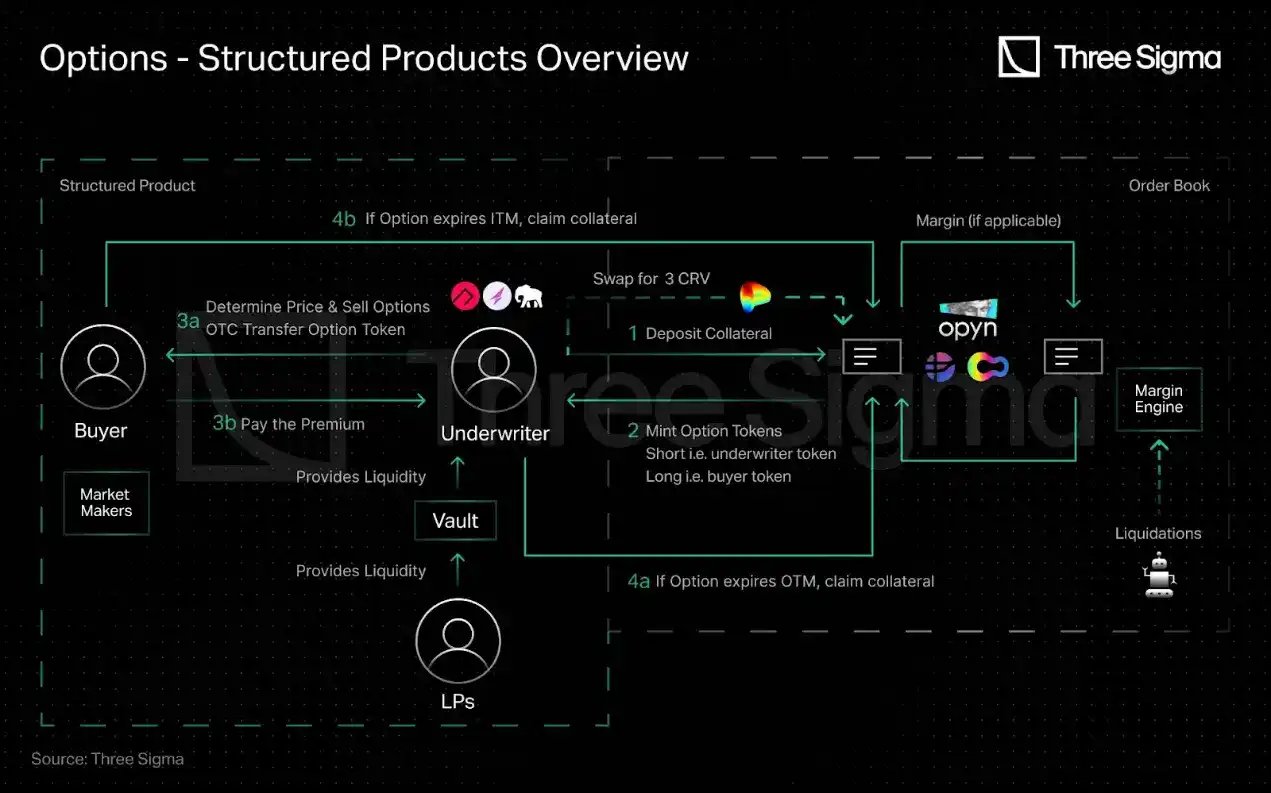
This space once accounted for the largest share of DeFi options TVL, but its luster has clearly faded - 9 of the 13 protocols have adjusted or discontinued their products.
Still Evolving:
1.Cega — Continues to offer knock-in and knock-out vaults, expanding beyond Solana and integrating Pendle YT tokens for additional yield.
2.PODS — Still active, using yield assets (stETH, aUSDC) to purchase options, offering a unique approach compared to other structured products.
3.Ribbon — Ribbon is still operational, although TVL has dropped and the team’s focus has shifted to AEVO.
4.Thetanuts — Continues to operate, with recent vaults focused on Pendle’s PT tokens.
Stay Out of the Options Business or Fail:
1.Cally and Putty Finance — Both protocols are struggling to find product-market fit as the NFT market cools.
2. JonesDAO - abandoned its options vault, marking their no longer involvement in the options space.
3. Katana - acquired by PsyFi in an M&A transaction on April 4, 2023.
4. Knox Vaults - integrated into Premia's V3 ecosystem as part of a broader strategic shift.
5. Polynomial - shifted to become a derivatives L2, now focusing on perpetual contracts.
6.Polysynth (now Olive) — Shut down options vault and pivoted to become a universal aggregated liquidity layer across L1 and L2.
7.Primitive — Did not gain significant traction. The team is currently focused on building Pluto (Pluto Labs)
8.PsyOptions — Despite the acquisition of Katana, PsyOptions shut down its vault and other products in June 2024.
9.StakeDAO — No longer offers options vault.
Will history repeat itself?
The resurgence of on-chain options volume, led by order books like AEVO and Derive, bodes well for the positive, but it raises important questions about decentralization. Like perpetual markets, being fully on-chain and decentralized may no longer be as attractive as it once was. Instead, protocols are moving to centralized L2s or application chains to gain greater control over the key parameters needed to build efficient order books.
New protocols like GammaSwap and Smilee offer hope for attracting new users to options trading, but the market remains brutally unforgiving. As the saying goes, history doesn’t repeat itself, but it often rhymes. It’s very likely that within a year, several of the protocols listed here will no longer be operational, a testament to the ruthless and fast-moving nature of the DeFi market.
However, despite the challenges, the increase in options trading activity is undeniable. With the perpetual contract market still about a hundred times larger than the options market, the challenge for options protocols is to make their products accessible to less experienced users.
Welcome to join the official BlockBeats community:
Telegram Subscription Group: https://t.me/theblockbeats
Telegram Discussion Group: https://t.me/BlockBeats_App
Official Twitter Account: https://twitter.com/BlockBeatsAsia

 Related Articles