Binance Research Report: Axelar (AXL) is the Core Infrastructure to Promote Institutional-level Crypto Adoption
Introduction: Blockchain Technology and Digital Ownership
Blockchain technology offers trustless, verifiable digital ownership and has the potential to revolutionize the way the internet works. To achieve mass adoption of blockchain technology worldwide, on-chain applications that people want to use need to be developed and ensure that these applications are easy to understand and access.
Institutional Adoption
Institutional investors have shown strong interest in blockchain technology but face challenges with custody solutions and cross-chain transactions. Institutions are beginning to recognize the potential and value of blockchain's ability to provide a trustless, global environment for custody and trading tokenized real-world value. There is also a growing institutional movement to recognize the value of digital native assets such as Bitcoin and Ethereum.
However, in order to achieve widespread institutional adoption, the cryptocurrency industry needs to ensure that institutions are provided with the necessary tools to conveniently and low-risk custody and management of digital assets and tokens. The usability of on-chain accounts must be improved to accommodate the convenience provided by banks. To achieve widespread institutional adoption, the cryptocurrency industry must address these two fundamental functions used on institutional-grade chains: institutional custody and on-chain transactions and chain abstraction.
Institutional-grade custody solutions such as Fireblocks’ MPC-CMP and Ceffu’s multi-signature wallets provide increased security and flexibility.
Cross-chain interoperability projects such as Axelar and Project Guardian facilitate institutional adoption by simplifying transactions and communications between different blockchains.
Given their size and volume, institutions require deep liquidity to execute transactions in an efficient and capital-efficient manner. The multi-chain world we currently live in has resulted in liquidity being fragmented across multiple isolated distributed ledgers and Layer2s. This reduces accessibility for institutions looking to adopt blockchain. The lack of blockchain interoperability also requires institutions to decide to adopt a specific blockchain ecosystem. This requires high setup costs. Institutions may not be willing to invest time and money to integrate with a specific blockchain.
For these reasons, chain abstraction has become an important development in the journey to bring institutions on-chain. Projects focused on chain abstraction are building the necessary infrastructure to unify multi-chain asset and account management. This will allow users to more easily and conveniently access decentralized applications and assets across the multitude of distributed ledgers that currently exist. Currently, users are required to set up and maintain a separate account and private key for accounts on different blockchains. Chain abstraction has the potential to allow users to control accounts and assets on multiple blockchains with a single private key. This creates a more attractive and more easily adopted on-chain environment for institutional integration.
Axelar
Developed by the team at Interop Labs using the Cosmos SDK, Axelar is a proof-of-stake network that acts as a communication layer for decentralized applications to interact in the EVM and Cosmos ecosystem. It enables the transmission of tokens, smart contract calls, and general messages, all of which are supervised by a network of validators. These validators operate nodes to monitor network status, verify transactions, and manage cross-chain communications. As of now, Axelar connects more than 50 blockchains through its secure, scalable network.
Axelar is positioned as the core infrastructure for financial institutions adopting blockchain technology to unify multi-chain asset and account management.
It is worth noting that Axelar has achieved some initial success in working with institutions to promote blockchain development:
◆ Axelar connects more than 50 public blockchains through a secure, scalable network.
◆ In May 2024, Deutsche Bank announced a partnership with Interop Labs, the team behind the Axelar Network project. Interop Labs will support Deutsche Bank in joining the "Guardian Project" to test asset tokenization in a regulatory environment led by the Monetary Authority of Singapore (MAS). Within the Project Guardian framework, Deutsche Bank aims to explore the capabilities of open architectures and interoperable blockchain platforms.
◆ In November 2023, the Axelar team also made headlines for its successful proof-of-concept collaboration with JPMorgan's blockchain platform Onyx. This collaboration is also part of the Guardian Program. As part of the proof-of-concept, Onyx leveraged Axelar's cross-chain technology to achieve interoperability with private and permissioned blockchains, introducing composability and programmability to cross-chain portfolio management.
◆ Deutsche Bank relies on Axelar to support its "Guardian Project" initiative in 2024 to "explore the capabilities of open architectures and interoperable blockchain platforms"
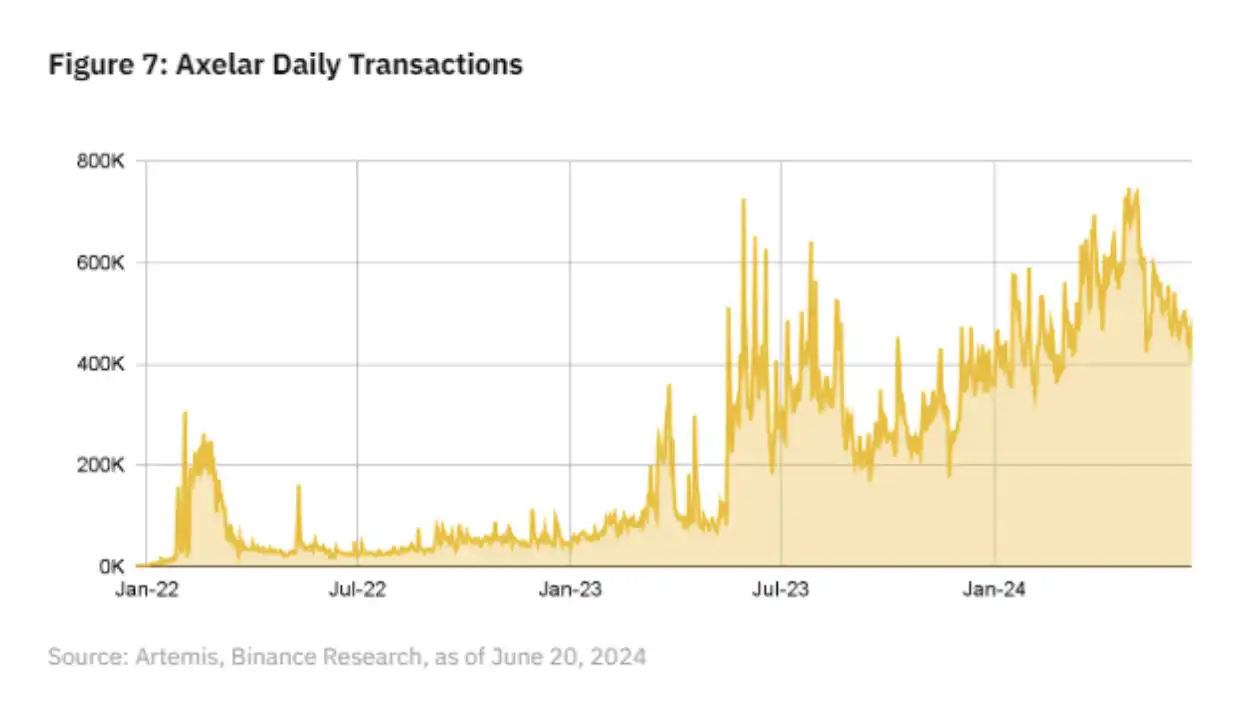
Since joining Project Guardian, the Axelar network has continued to grow in daily active addresses and daily transaction volume.
In addition, Binance Research published an article featuring Axelar following the publication of its white paper "Institutional Interoperability", which was contributed by global banks Citi, Deutsche Bank and Mastercard.
On July 1, Axelar will host an invitation-only event at the Zurich Interoperability Forum, hosting representatives from Citi, Deutsche Bank, and Mastercard:
Retail User Adoption
In general, retail users will benefit from the same improvements as institutions, namely greater convenience and greater security. The average retail user typically prioritizes convenience over institutions, but must ensure that user-friendly solutions do not compromise security.
Projects such as Binance Web3 Wallet and Moonpay have helped drive retail user adoption by simplifying the user experience.
Crypto Skeptics
Despite the growing acceptance of new crypto technologies and the industry, some skepticism remains, in part due to past incidents involving certain CEXs and projects that have attracted negative attention. However, the industry is making significant improvements in transparency, security, and reliability to build trust and confidence among users. The cryptocurrency industry has begun to leverage two important ways to combat some of the skepticism and distrust directed at the industry:
1. Improving Transparency
The cryptocurrency industry must continue to build systems and processes that promote fairness and transparency, allowing users to independently verify information without relying on or trusting third parties.
2. Education
Education and knowledge sharing are critical to the global adoption of blockchain technology. As more people begin to understand how the technology works and the benefits of decentralization, more demand and innovation will emerge.
Improving Transparency
Binance Proof of Reserves is a great example of how the cryptocurrency industry can improve transparency and create new practices after the FTX debacle. Proof of Reserves allows cryptocurrency users to verify the amount of assets owned by a CEX or other cryptocurrency custodian. Immediately after the FTX debacle, many cryptocurrency CEXs committed to implementing Proof of Reserves.
CEX’s move to implement Proof of Reserves is a great example of how cryptocurrency companies can improve, resulting in greater transparency and a better overall experience for users. In the long run, efforts to make the industry more transparent to users should go a long way toward building broad public goodwill toward blockchain technology and blockchain companies.
Education
Binance Academy
Binance Academy is a leading blockchain and cryptocurrency education platform with over 800 articles and glossary entries, as well as courses on blockchain, cryptocurrency, Web3, and more. Launched in 2018, it serves millions of learners around the world in more than 30 languages. Binance Academy's educational initiatives also include "Learn & Earn", university outreach programs, student ambassador programs, and partnerships with top online learning platforms, professional associations, and industry alliances.
Free courses are designed by the Binance Academy team and currently include:
◆ Beginner Track (consisting of 6 fixed courses);
◆ Intermediate Track (consisting of 6 fixed tracks); and
◆ Specialization Track (consisting of various professional courses).
While the free courses are comprehensive and cover a wide range of topics, users can also choose to enroll in paid courses to further develop their crypto knowledge. Paid courses are university courses curated and certified by leading educational institutions.
Binance Research
Binance Research is an initiative by Binance to enhance online educational resources for the public. As of today, Binance Research has published over 150 in-depth reports covering a wide range of topics across the cryptocurrency industry, from DeFi to infrastructure to gaming and NFTs.
Every article on Binance Research is designed to be useful and educational to any reader, whether they are institutional, retail, or crypto skeptic.
Conclusion
Blockchain builds on the internet, a borderless exchange of information, to enable borderless, permissionless, and verifiable digital ownership. In recent times, many have considered blockchain to be a niche technological development. In the past, types of digital assets stored on distributed ledgers were labeled non-serious and merely speculative. Today, BlackRock, the world’s largest asset manager, is tokenizing assets on Ethereum.
For blockchain technology to gain mass adoption and use around the world, two things are needed. First, there must be on-chain applications that people want to use. Second, people must be able to understand and easily access these applications. The summer of 2020 saw a Cambrian explosion of new on-chain applications, many of which achieved product-market fit and are still widely used today (e.g. Uniswap, Aave, MakerDAO). Now that the basic DeFi building blocks are in place,
Some momentum in the blockchain industry seems to have shifted towards making on-chain applications more accessible and usable by the general public. On the road to 1 billion on-chain users, the cryptocurrency industry must build the necessary infrastructure, tools, and public recognition to make the concept of "digital ownership" easy for the global human community to understand and comprehend.
This article comes from a contribution and does not represent the views of BlockBeats
Welcome to join the official BlockBeats community:
Telegram Subscription Group: https://t.me/theblockbeats
Telegram Discussion Group: https://t.me/BlockBeats_App
Official Twitter Account: https://twitter.com/BlockBeatsAsia
 Related Articles