Let’s talk about Restaking again. How many new airdrops and benefits can we unlock through EigenLayer?

Original Title: "Let's talk about restaking and all the different airdrops and yield options"
Original Author: Route 2 FI
Translated by: N/A
Editor's note:
The author of this article, a cryptography researcher named Route 2 FI, claims to be a writer and trader with extensive knowledge of defi. In this article, the author mainly discusses the reopening of EigenLayer and its impact on Ethereum restaking, as well as different airdrop and yield options.
The article also discusses in detail the specific operations of certain protocols, such as EtherFi, Swell, Mantle ETH, Kelp, and Puffer, analyzing their advantages, potential returns, and airdrop opportunities. The author proposes options that may interest different types of users, including airdrop hunters, those seeking the highest returns, and investors pursuing relative safety. BlockBeats has translated the original article as follows:
EigenLayer will reopen its limit on Monday, February 5th, so I want to share some thoughts on it and its risks. As you know, I am a long on Ethereum, and restaking is very attractive.
Approximately one quarter of the circulating ETH has been staked (a total of 120 million ETH, approximately 30 million of which has been staked).
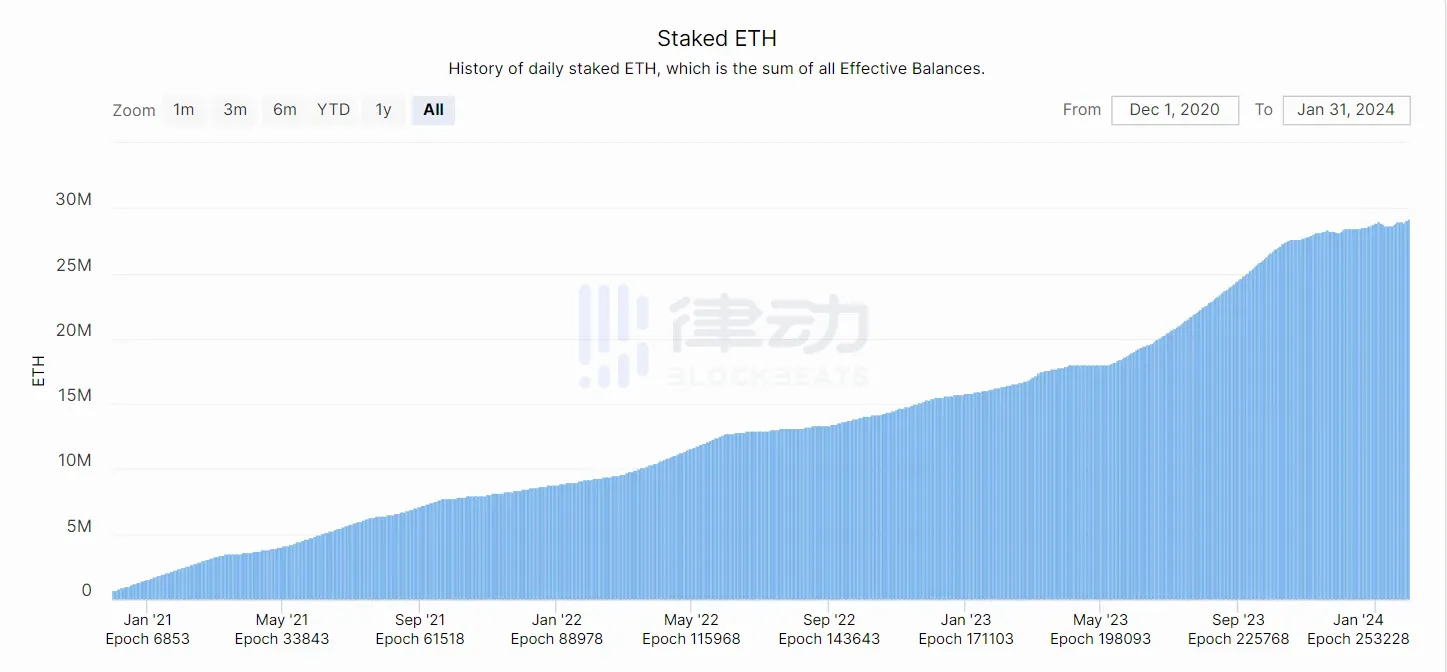
This provides great security for Ethereum and the smart contracts running on it, as attacks on the Ethereum consensus system would require a large amount of ETH.
With the introduction of EigenLayer re-staking, Ethereum validators can now use their 32 ETH stake (which is being reused) to protect other protocols. Validators do not need to unstake or add additional capital, and can also earn additional rewards. EigenLayer allows non-smart contract protocols to utilize Ethereum's security through re-staking, which was previously impossible.
EigenLayer is not a DeFi protocol, but a platform that guides a new Proof of Stake (PoS) system. Through the EigenLayer protocol, users cannot engage in any financial activities such as exchange and lending.
However, for decentralized services built on top of EigenLayer (which we refer to as AVS, or Active Verification Services), these services themselves can be DeFi applications or support key functionalities in other DeFi protocols. These AVS are outside of the EigenLayer contract.
In addition, another type of protocol built on top of EigenLayer is called the Liquidity Re-Staking Protocol (LRT). They can be built on EigenLayer without permission. These are of concern to degens: Swell Network, Ether.fi, Genesis, Puffer, Kelp, and so on.
Swell and EtherFi offer double points through native token airdrops. You can also earn Eigenlayer points and KelpDAO points by re-staking stETH or ETHx (ETHx has more points).
不同选项的情况:
Different options:
Firstly, we need to distinguish between liquid staking and liquid restaking.
Traditional staking involves locking your assets in a smart contract that supports blockchain operations and earning staking rewards. Liquid staking, on the other hand, allows you to stake your assets using a liquidity staking protocol and receive liquidity tokens that represent your staked assets. Liquid restaking is a method for Liquid staking token (LST) holders to re-stake their tokens by transferring them to the EigenLayer smart contract.
If you want to learn more, Inception has published a great blog post that introduces these differences: https://medium.com/@InceptionLRT/liquid-staking-tokens-and-liquid-restaking-tokens-what-are-the-differences-61669f4f4de2
In the screenshot below from DeFiLlama, you can see liquid staking liquidity staking protocols (Lido, RocketPool, Mantle, Frax, Swell, etc.).

In the second screenshot below, you can see the largest liquid restaking protocols such as ether.fi, Puffer, Kelp, Renzo, and more.

In the following section, I will outline what I personally believe to be the most interesting opportunities in the current LST/LRT industry.
Regarding EtherFi (eETH):
Deposit ETH -> Generate eETH + Earn EtherFi loyalty points + EigenLayer points. Use eETH to interact with different DeFi protocols and earn additional rewards (such as Pendle).
Regarding Swell (swETH/rswETH):
Deposit ETH into Swell to receive swETH LST -> then stake it in EigenLayer -> ultimately generating liquidity for rswETH LRT. Assuming the Pearls reward system continues to apply unless TGE occurs before LRT. Stake your ETH and Swell to earn "Pearls"/airdrop points + additional bonuses through referrals and re-depositing into EigenLayer and other DeFi partner strategies.
Regarding Mantle ETH (mETH):
Deposit ETH into Mantle LSP (Liquidity Staking Protocol) to earn an annualized yield of 7.2% (they promise this yield for the next 2 months, which may be extended). The mETH you receive can be stored in your wallet. EigenLayer opens on Monday, and you can deposit mETH to earn additional EigenLayer rewards. The downside of this method is that there is no airdrop because Mantle tokens already exist. However, the returns are very good. So if you enter the pool on Monday, you will receive double rewards + EigenLayer points.
Regarding Kelp (ETHx):
On Kelp, you can choose between stETH, ETHx, and sfrxETH. For all assets, you will receive Eigenlayer points + Kelp points (for airdrops). ETHx offers more EigenLayer points than any other LST because Stader (the team behind Kelp) re-stakes their ETH from their treasury in EigenLayer and gives away those extra EL points.
Regarding Renzo:
Pledge ETH and receive ezETH. You will also receive EigenLayer points, Renzo ezPoints (airdrop), and normal ETH pledge returns.
Regarding EigenPie:
For every deposit of LST worth 1 ETH, users will receive 1 Eigenpie point per hour. During the first 15 days, depositors will receive double the point rewards to incentivize early supporters. These Eigenpie points are crucial as they are shared through an airdrop of 10% of the total EGP supply and a 60% share in the EGP token IDO at 3 million FDV.
Regarding Puffer:
Welcome to join the official BlockBeats community:
Telegram Subscription Group: https://t.me/theblockbeats
Telegram Discussion Group: https://t.me/BlockBeats_App
Official Twitter Account: https://twitter.com/BlockBeatsAsia

 Related Articles