The programmable token brought by Smart Layer may be the next generation of new mainstream assets

Original Title: "Programmable Tokens brought by Smart Layer, or the Next Generation of Mainstream Assets"
Original Author: Ri Yue Xiao Chu
1. New Paradigm of Digital Assets
Smart Tokens is a new digital asset paradigm brought by Smart Layer Network. It is a programmable Token that adopts TokenScrip technology on the ERC-5169 standard token.
Every innovation in assets brings about a wave of change and a representation of enormous opportunities. In the ICO era of 2017, smart contracts brought about a new way of token distribution; in 2020, DeFi obtained tokens through contributing TVL; in 2021, NFTs, essentially a new asset, created numerous myths of sudden wealth; and in 2023, a new asset called Inscription once again demonstrated exponential growth.
People who missed out on the fortune of inscriptions should empathize and pay extra attention to new assets. Even if you cannot imagine its value now, the market will naturally discover it. As the bull market approaches, what kind of story will this new asset, programmable assets, unfold? It is truly something to look forward to.
We can see the value of new assets like Smart Tokens.
1) Smart Tokens carry complete information, making them more valuable. In the future, we will see NFTs like Fat Penguin that come with information about friends and family, past adventure experiences, or the previous owner who may have been a celebrity.
2) The composability of Smart Tokens is stronger, making it more convenient for other systems to call. In the future, we may see GameFi selling perfectly matched heroes and equipment.
translate 功能的智能代币,这些代币可以自动翻译不同语言的文本,使得跨语言交流变得更加便捷。
3) Smart Tokens' programmable objects add on-chain and off-chain functionality, making them more functional. In the future, we can expect to see smart tokens with Google Translate-like capabilities, automatically translating text in different languages, making cross-language communication more convenient.
Decentralized identities like ID, with complete privacy protection for data.
2.Smart Tokens will lead the industry to further iteration and evolution
The world of blockchain is centered around tokens, and currently there are only two main attributes of tokens: 1) ownership, which refers to the wallet address that the token belongs to, and 2) transaction history, which refers to the record of transactions on the blockchain. This world has undergone tremendous changes in the past decade, with explosive growth in demand and use cases. Clearly, this thin token attribute is now inadequate and inefficient in many scenarios. Therefore, a new digital asset paradigm called Smart Tokens has emerged, which endows assets with many more attributes and brings greater possibilities.
Take gamefi as an example, we know that real games are very complex, including various props, equipment, game mechanisms, and so on. For example, a hero NFT often comes with weapons, helmets, shoulder pads, shoes, and these equipment also need to be synthesized and upgraded. Not only that, various experiences of characters will also be involved in the game. Obviously, the existing NFTs cannot meet the demand, and game developers have to put a lot of content on centralized servers. However, if tokens' programmability is used, NFTs can have a large number of attributes and links, and many problems can be solved easily.
In Desocial, the core of social interaction is the users and their interconnected relationships. Currently, strategies like cyberconnect and lens use NFTs as character accounts and establish social relationships through smart contracts. However, Smart Layer may be more perfect, as it only requires NFTs as user accounts and can naturally incorporate features such as accounts, friends, blocking, articles, likes, and favorites.
Perhaps Defi can also undergo significant changes. We don't need to stake tokens in Dapps, we just need to define the earning attribute in the token and then stake it for mining. This way, even if the Dapp is hacked, users won't suffer any losses.
3. The cornerstone of realizing Web3 on a large scale
The large-scale application of Web3 is an important topic today. Efforts are currently focused on two aspects. On the one hand, developing public chains with low GAS and high concurrency to meet the needs of a large number of users. On the other hand, reducing barriers to entry for users, such as AA wallets, etc. However, I believe that Smart Tokens are also essential because only programmable tokens can meet the needs of the complex real world.
Take a real-life example. Nowadays, when we log in to many websites, we use Google ID for convenience. As a result, users' behavioral data is controlled by Google, a centralized authority. Let's assume that it won't pose any malicious risks, but the potential risk of data theft is real. Keep in mind that Google ID has billions of users worldwide and has connected to hundreds of billions of authorized websites.
As a blockchain practitioner, we hope to create an identity system like Google ID that can protect privacy and ensure data ownership. However, the existing NFT as an identity seems a bit awkward because it is far from sufficient in terms of functionality. This is where Smart Tokens can come into play. They can be programmed to authorize website access, revoke access when necessary, and record various website authorization data in the NFT. What's more valuable is that programmable objects can be linked off-chain, providing more functionality and gameplay, such as linking to offline physical stores' membership programs and so on.
4.Smart Layer Introduction
The Smart Layer Network project aims to create a new type of asset - Executable Token/NFT (Non-Fungible Token) - by utilizing the ERC-5169 standard and TokenScript technology. These tokens not only exist as assets, but also have the feature of built-in executable code, providing high practicality and strong scalability. By transforming tokens into multi-functional assets, they can be linked with external scripts, greatly improving the circulation and integration capabilities of the tokens.
TokenScript is a JavaScript/WebAssembly/XML framework designed to enhance the functionality, security, and usability of blockchain tokens in various ways. It allows token issuers and other trusted entities to enhance specific tokens by combining extensive information, rules, and features. By using TokenScript, wallets and network services can easily, securely, and privately integrate a token and all of its functions (whether on-chain or off-chain) without the need to deeply understand its underlying smart contract.
Smart Layer Network is not a public chain, but a decentralized network service, similar to The Graph. This network consists of three key components:
1. Blockchain infrastructure: At this layer, smart contracts play a critical role. They not only ensure that token transactions follow established rules, but also record a historical snapshot of token operations for future verification.
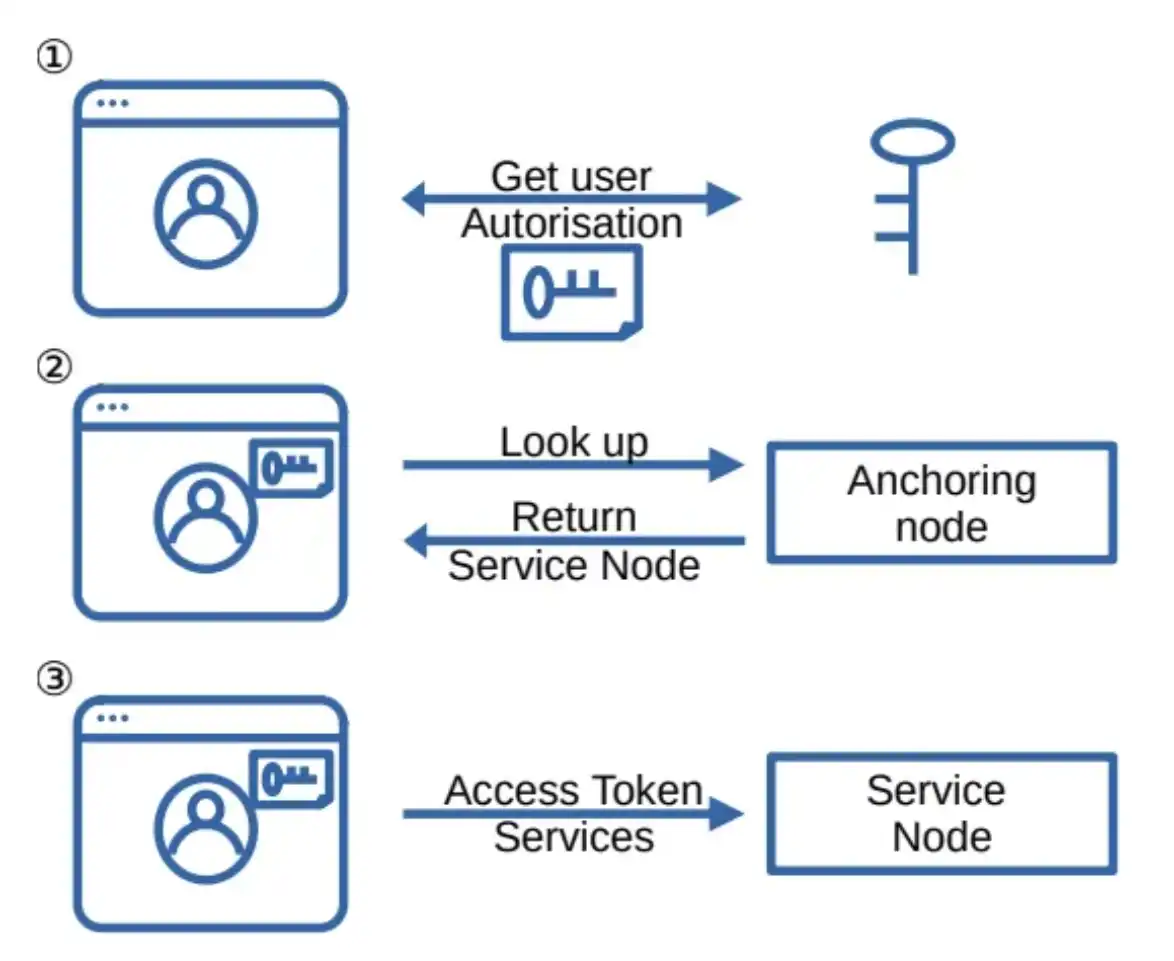
2. Anchor Nodes: Well-known organizations selected by DAO operate these nodes, which are the backbone of the network, ensuring the stability, security, and service objectives of the network are achieved.
3. Service nodes: They are the backbone of the industry, providing fundamental services that enable the network to operate effectively and efficiently. These nodes form a wider network, which distributes service tasks through a distributed hash table and provides TokenAPIs for various integrations.
The service nodes are an important component of Smart Layer Network, providing basic services that enable the network to operate effectively and efficiently. They form a large node network. The incentive mechanism for service nodes is implemented through Smart Layer Tokens. These tokens can be paid by users who use their services or websites that need token integration. This payment method is implemented through API calls and takes the form of gradually redeemable promises, which service nodes can redeem at the end of the session. Smart contracts play a critical role in this process, not only handling payments but also destroying a portion of Smart Layer Tokens to ensure the system operates effectively.
Anchoring nodes are responsible for monitoring the entire system to ensure that everything is proceeding according to plan. As semi-trusted nodes in the network, anchoring nodes need to have extremely high availability. They regularly check whether service nodes have met the service level specified in the contract. At the same time, they are also responsible for recording critical token operations and generating commitment summaries. These commitments are generated through information exchange between anchoring nodes, and at each time interval, an anchoring node will write the commitments into the blockchain through randomly assigned roles. Anchoring nodes are also responsible for maintaining the rules of the distributed hash table to ensure network redundancy and performance.
6.Smart Cat
Welcome to join the official BlockBeats community:
Telegram Subscription Group: https://t.me/theblockbeats
Telegram Discussion Group: https://t.me/BlockBeats_App
Official Twitter Account: https://twitter.com/BlockBeatsAsia