Understanding Kiln: Focusing on “Staking as a Service”, what’s so special about Ethereum’s largest node operator?


"Nowadays, pledging is considered one of the safest sources of returns in the cryptocurrency market. In this complex era, investors view companies specializing in this activity as a veritable cash machine," revealed an investor.
As an enterprise-level Ethereum staking platform, Kiln enables institutional clients to stake assets and provide white-label solutions for their own clients. Although it supports multiple PoS blockchains, most of Kiln's staked assets are on Ethereum, valued at over $3.1 billion according to its Dune Analytics dashboard.
The new pool launched by Kiln achieves organic growth in a different way. In addition, as time passes, Ethereum staking becomes more centralized due to dilution. Kiln pool provides a diverse and powerful staking pool selection to reduce centralization risks and encourages users to diversify their staked assets across different pools operated by different node operators, promoting network decentralization.
The top-ranked node operator on Ethereum
Although staking is considered one of the safest sources of returns in the cryptocurrency market, the number of Ethereum withdrawals has exceeded the number of deposits since the Shanghai upgrade.
According to a report released by Glassnode at the end of last year, more and more validators in the Ethereum staking pool have chosen to exit since October last year, reaching an average of 1018 validators per day. The increase in validator exits has led to a decrease in the daily issuance of Ethereum, which is related to the active amount of Ethereum in the staking pool.
Related reading: "Glassnode: Dynamic Changes in Ethereum Staking Pools and Market Activity".
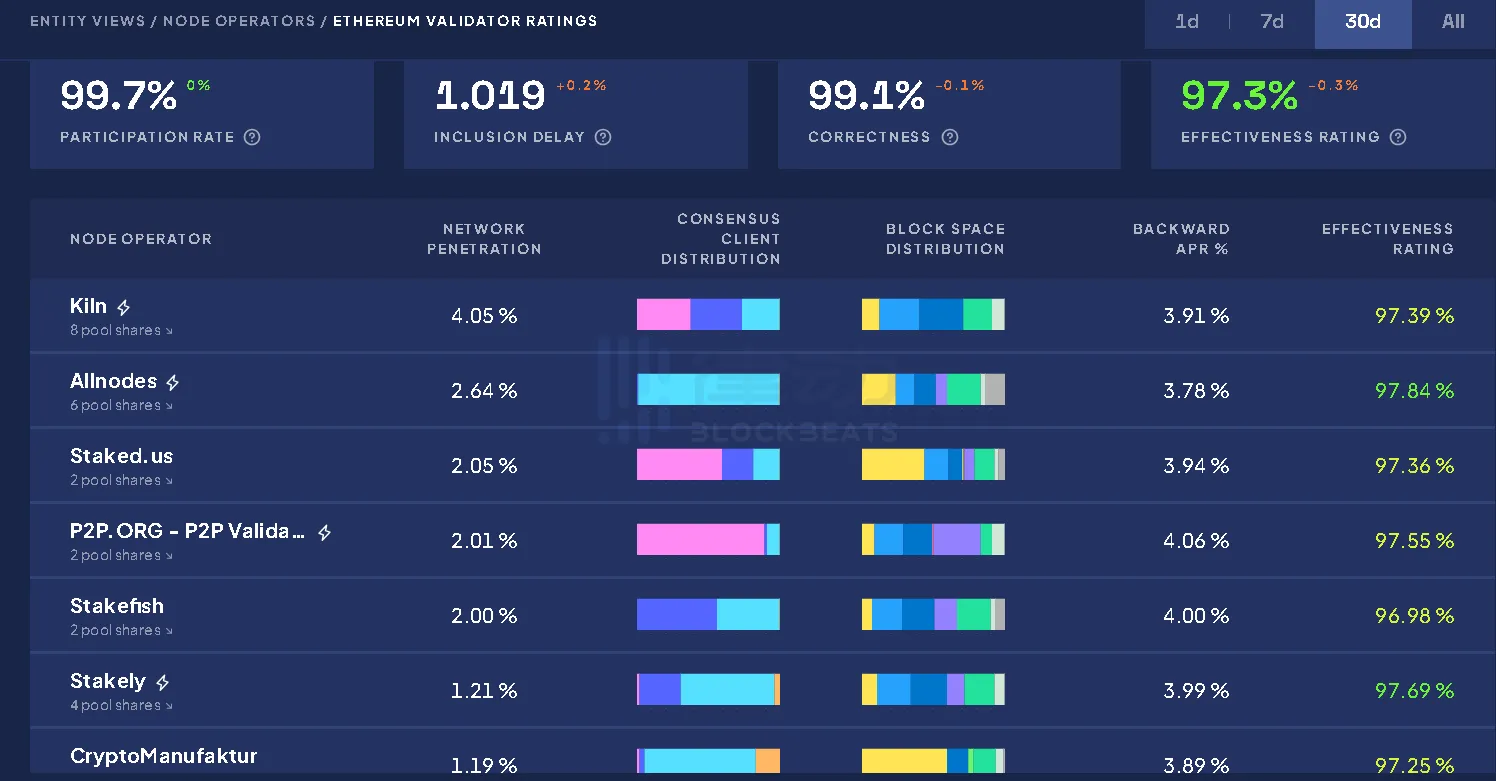
Recently, with the rise of the narrative of re-staking and the FOMO sentiment caused by the airdrop expectations, LSDFi has once again become a hot topic. Riding this wave, Kiln has now become the top-ranked node operator on Ethereum. According to the Ethereum staking dashboard rated.network, Kiln's infrastructure manages approximately 4% of staked Ethereum, equivalent to managing approximately $4 billion in assets.
Kiln's Technical Features
As we all know, the minimum amount of tokens required to run an Ethereum 2.0 staking node is 32 ETH.
Currently, there are four main types of Ethereum staking solutions, including centralized platform staking (CEX Staking), such as Binance and Coinbase; large pool staking (Large Pool Staking), such as Lido and Rocket Pool; solo staking; and staking as a service staking (Staking as a Service Staking).
Simply put, it can be divided into two main categories: reserving 32 Ethereum for self-staking or relying on liquidity staking platforms, which allow staking with less funds and usually have no minimum Ethereum requirement. Therefore, for users who hold less than 32 ETH, staking services are the only solution.
On the LSD track, for general cryptocurrency players, participating in LSD is enough, but for the underlying logic and security implementation of participating in staking, there will not be a deep understanding. The large number of users choosing LSD has caused a centralization risk in Ethereum, which is actually a significant threat to the entire Ethereum ecosystem. Lido is a typical example.
Pledge as a Service
Decentralization should be a rational choice made by each user based on their own interests. In order to ensure the security of staking, there are only two ways: Solo Staking and Staking as a Service. However, for most ordinary people, they do not have enough technical knowledge or energy to run their own nodes. Therefore, although Solo Staking is the most decentralized and has relatively no middleman fees or deductions, it is too difficult.
Therefore, Kiln has established a full-stack staking-as-a-service platform. Simply put, SaaS means you provide funds (32 ETH), and node operators provide technology (software and hardware), and both parties collaborate to participate in staking.
This type of collateralization is suitable for users with medium to large capital, and compared to LSD, the biggest advantage of SaaS is higher security, lower trust in third parties, lower costs, and potentially higher returns. However, because SaaS is not a familiar concept to most Ethereum users, even experienced defi degens, a large number of users who could have participated in SaaS have been lost.
The specific advantages of SaaS over LSD in terms of security, returns, costs, and operability can refer to "Staking as a service: a rational choice between security and income for Ethereum staking".
Kiln's SaaS platform allows capital pools to participate in PoS. Through this platform, investors and builders can manage validators and read-write nodes on multi-cloud infrastructure in a simple, fast, and secure way. Kiln allows customers to securely deploy, manage, and monitor blockchain validators across multiple networks in a single space, while users retain control of their private keys.
Kiln runs validators on all major PoS blockchains through Kiln Dashboard, managing over $360 million in stake (a 4.4x YoY increase) across multi-cloud, multi-region infrastructure. Kiln also offers a validator-agnostic suite of products for fully automated deployment, reporting, and commission management, enabling custodians, wallets, and exchanges to simplify cross-provider staking operations.
Its Ethereum validator monitoring program Kiln Dashboard was developed by the team's senior engineer @aimxhaisse and is a Python tool that can connect to execution nodes and beacon nodes.
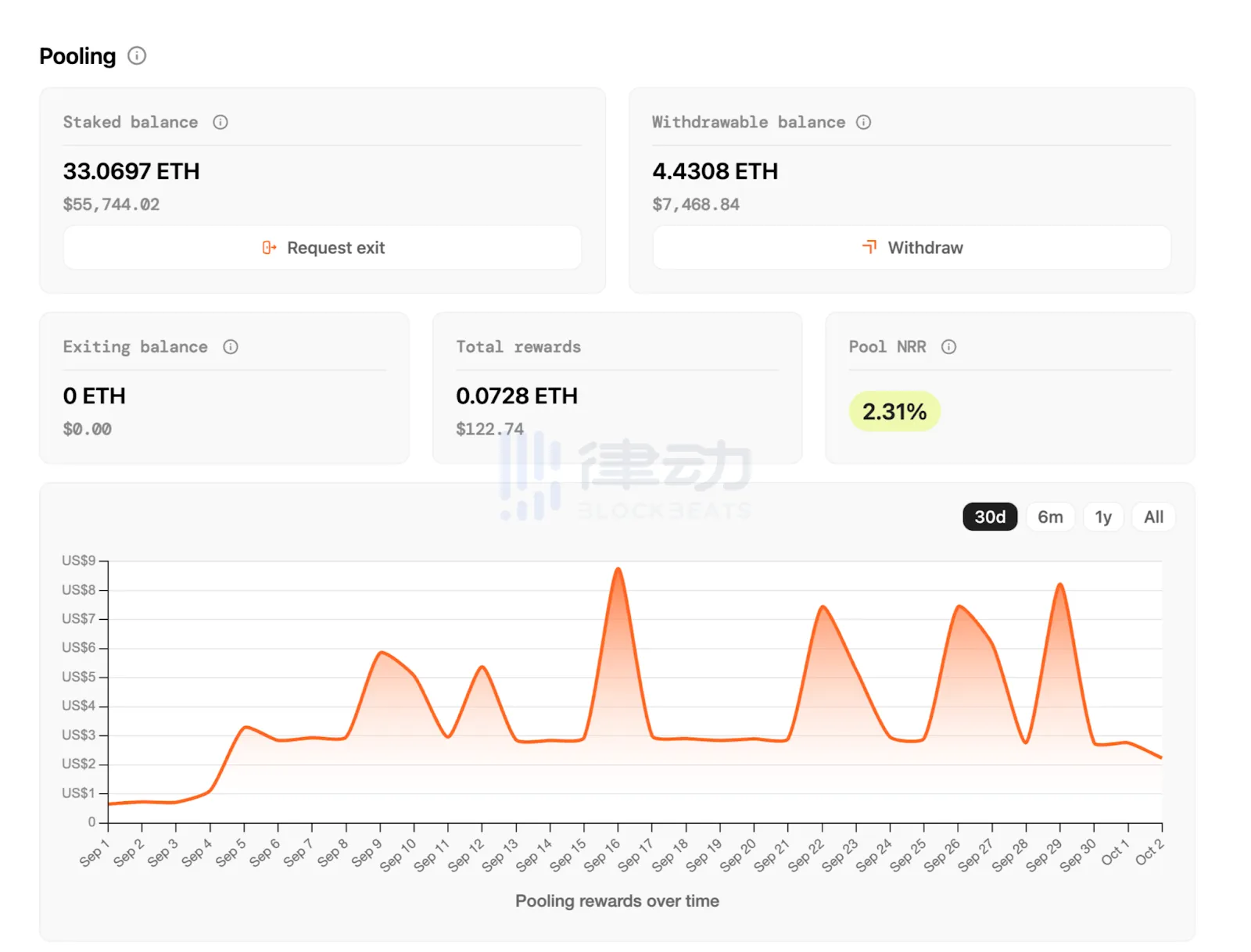
In the Kiln organization, users can create multiple accounts that act as folders for their equity, which can be organized by clients, regions, and other organizational needs. Users can view an overview of AUS and total rewards for each account, as well as view AUS and total rewards for each protocol and detailed information for each equity in the account.

Kiln runs a SaaS model for its services, dashboard, and API. Kiln partners with Ledger Live, Crypto.com, and Coinbase to provide a collection of staking services, allowing any Ethereum holder to stake any amount of Ethereum to create value in the digital asset ecosystem. In addition, Coinbase Cloud has integrated Kiln's on-chain platform into its product, enabling Coinbase Cloud to bring on-chain Ethereum staking functionality to its customers with limited engineering effort required for integration.
Kiln On-Chain
Kiln announced that its Kiln On-Chain platform is the first 100% on-chain white-label staking platform in the Ethereum ecosystem. The platform's latest Ethereum staking pool allows for staking any amount of Ethereum and receiving daily rewards. It also allows integrators to seamlessly integrate access to the staking pool into their workflows, improving accessibility.
Integrators have complete autonomy to set fees, customize liquidity tokens, choose operators, and provide tailored user experiences. Users and assets remain on their platform, while commission based on smart contracts eliminates external referrals and off-chain invoices. The entire system operates in a transparent and auditable manner through smart contracts.
In addition, the introduction of the new Kiln pool with limited liquidity for Ethereum staking presents unique challenges.
Due to dilution encountered by early participants in the pool expansion and in the face of a long queue of validators entering, the reward for new validators took longer to realize during the initial growth phase as staked assets accumulated. This led to a suppression of the Gross Reward Rate (GRR) due to dilution caused by the distribution of rewards and pool value among a larger user base.
GRR represents the annualized ratio of rewards obtained from the pool relative to the total staked amount in the pool. Choosing organic growth instead of pre-financing, a significant feature of the pool's initial launch is the initial dilution and fluctuation of GRR. Specifically, GRR will be close to or at 0% for at least about 20 days after the first deposit, as the initial validators are waiting for activation.
Therefore, the growth of Kiln's staking pool largely depends on the support and participation of integrators and early adopters. As the pool grows and more deposits accumulate, the GRR will steadily increase, tending towards a stable rate that is typically consistent with the average reward rate within the network.

Welcome to join the official BlockBeats community:
Telegram Subscription Group: https://t.me/theblockbeats
Telegram Discussion Group: https://t.me/BlockBeats_App
Official Twitter Account: https://twitter.com/BlockBeatsAsia

 Related Articles