Take the actual operation of 1,000 US dollars as an example to quickly understand the impact of spot ETFs on Bitcoin prices.
Original Title: "Understanding the Impact of Spot ETF on Bitcoin Prices - Using $1000 as an Example"
Original Author: Atlascap Invest
On January 10th, the US SEC approved applications for 11 Bitcoin spot contracts, officially marking the entry of crypto assets into the core asset allocation pool of global mainstream institutions. However, on the first day of ETF trading, the price of Bitcoin went in the opposite direction of the previously bullish market sentiment, dropping from a low of $49,000 to $41,500, wiping out almost all gains from the past month. What happened during this time? What caused this major drop, and why did a large amount of capital flow out of the BTC market through ETFs after their approval instead of flowing in? After practical experience, this article takes the example of the entire process of $1,000 circulating in the ETF to help investors better grasp investment opportunities in crypto assets in the era of ETFs.
Part1: Revealing the Fund Flow Process Behind ETF with a $1000 Investment
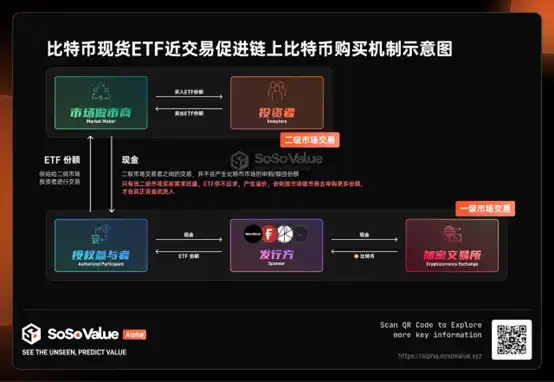
First, it is necessary to understand the four important participants in the Bitcoin spot ETF system:
· Sponsor: Responsible for designing and managing ETF products, calculating the daily net asset value (NAV) of ETF products, and collecting management fees. Currently, there are 11 approved sponsors, such as Blackrock, Fidelity, Ark, Grayscale, etc.
· Authorized Participant (AP): The only institution authorized to directly purchase and redeem with the issuer, usually a fund management company or securities firm.
· Market Maker: Provides liquidity in the secondary market, buying and selling ETF shares, and requesting the creation/redemption of ETF shares from authorized participants (APs) when liquidity is insufficient/excessive.
· Investors: Individuals or institutional investors who buy and sell ETF shares through the secondary market.
After understanding the above participants, let's follow a $1000 ETF investment and reveal the flow of funds behind it.
Please note that due to the fact that the US SEC has only approved Bitcoin ETFs based on cash purchases and redemptions, all currently issued Bitcoin ETFs cannot be redeemed or purchased in physical form. Therefore, the flow of funds can only be carried out through the following methods:
· When you decide to purchase a Bitcoin spot ETF with $1000, you usually choose an online trading platform such as Robinhood or Interactive Brokers (IBKR); place an order at the current market price, and after a successful transaction, your $1000 will flow to the market maker.
· At the same time, market makers may receive a large number of $1000 buy orders, and the ETF shares they hold are not enough to meet the demand. As a result, the ETF price rises and the market value is relatively detached from the total Bitcoin assets held by the issuer, resulting in a premium. Market makers will then apply to authorized participants (APs) for assistance in purchasing ETF shares. A portion of your $1000, for example $200, will be transferred to the authorized trading partner (AP).
· And the authorized participant (AP) will apply for the purchase of ETF shares from the sponsor after receiving the subscription request and $200, and transfer the $200 to the sponsor.
The sponsor will use the $200 to purchase Bitcoin through platforms such as Coinbase. According to the agreements of different funds, the time for purchasing Bitcoin with the funds can be from the day of subscription to 1-2 days after the subscription, and the funds will eventually flow into the cryptocurrency market.
Part 2: ETF Secondary Market Trading Volume ≠ Net Inflow and Outflow of Funds in Bitcoin Market
Through the study and operation of the circulation process, we can conclude that: the trading volume of ETF secondary market buy and sell transactions is not equal to the net inflow and outflow of funds in the Bitcoin market, and these two values cannot be directly equated but have mutual influence.
When we discuss the impact of Bitcoin spot ETF on the price of Bitcoin, the most important question in essence is to focus on how many USD flow into the Bitcoin market to purchase Bitcoin spot from the traditional financial market through ETF, that is, the Total Net Inflow.
So how is net inflow calculated? By adding up the overall subscription and redemption data of these 11 ETFs, the corresponding values will be disclosed on the official website of each sponsor, and can also be queried daily through professional data tracking tools such as Bloomberg or the ETF section of Sosovalue. Taking the ETF dashboard of SoSo Value as an example.
We can see that Grayscale GBTC, a Bitcoin ETF, had a net outflow of $594 million on January 16th, the third trading day after approval. The ETF also had redemptions on the following two trading days (January 11th and 12th), with net outflows of $95 million and $480 million, respectively, for a total outflow of $580 million. Therefore, despite the fact that the trading volume of the entire ETF market on January 11th and 12th was as high as $4.67 billion and $3.19 billion, respectively, and other ETFs such as ARK, BlackRock, and Fidelity had a net inflow of $1.4 billion, the large net outflow of Grayscale ETF resulted in a significantly lower net inflow of funds into the overall Bitcoin market than expected, leading to the Bitcoin correction that began on January 12th.
(See Figure for cross-sectional data as of January 12th)
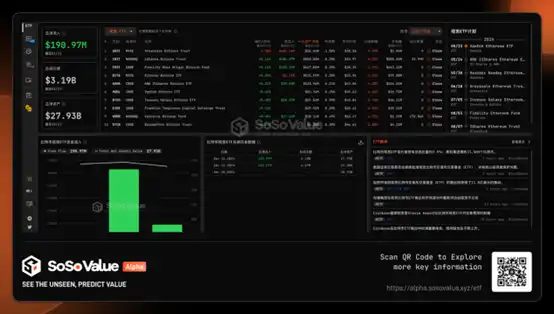
Source: SoSo Value cross-sectional data as of January 12, 2024
Part 3: Why is there a large outflow of funds from grayscale Bitcoin ETF? How long will this outflow of funds continue?
Gray Bitcoin ETF has seen three consecutive days of redemption, bringing about selling pressure of approximately 26,000-28,000 bitcoins and increasing market caution. According to SoSo Value data, Gray GBTC saw redemptions on January 11th, 12th, and 16th, with a total net outflow of $1.174 billion.
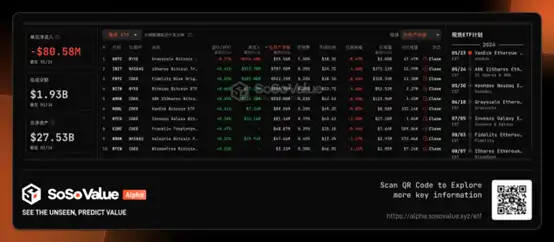
Source: SoSo Value cross-sectional data as of January 16, 2024
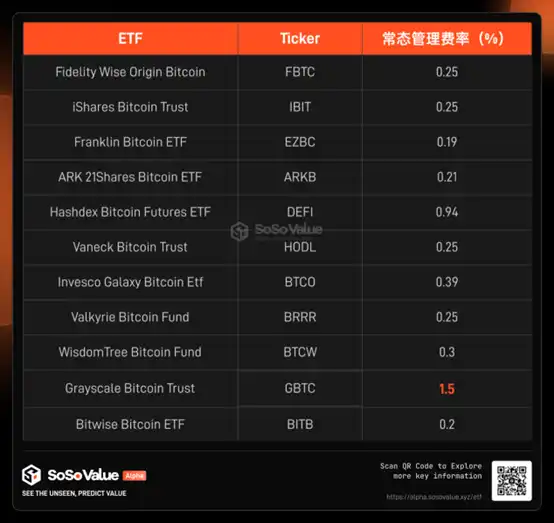
6 times higher management fee than competitors and the closing of the pre-discounted trust arbitrage position are the two core reasons for the net outflow of Grayscale Bitcoin ETF.
Gray Bitcoin Spot ETF (stock code GBTC), formerly known as Bitcoin Trust, can only be subscribed and traded on the secondary market, and cannot be redeemed. From the perspective of the Bitcoin market, the Bitcoin Trust subscribed through Grayscale is like a mythical beast that only allows funds to flow into Bitcoin but not out. Since its launch 8 years ago, GBTC has accumulated about 620,000 Bitcoins. On January 10th, it was approved by the SEC to upgrade to an ETF, allowing investors to redeem their ETF shares for US dollars through authorized dealers (AP), thus opening up the flow of funds from the grayscale part of the cryptocurrency market. Based on the different attributes of investors, there are two types of redemption transactions. By analyzing the intentions and behaviors of these two types of investors, we can more clearly analyze and predict the net outflow of Grayscale ETF and how it will affect the price of Bitcoin over a certain period of time:
First Category of Investors:
Long-term bullish on Bitcoin assets, but due to the high management fee of Grayscale, we have shifted to other ETFs. Among 11 comparable ETFs, Grayscale GBTC's management fee is 5-6 times that of its competitors, with a management fee rate of 1.5%, while others are generally below 0.3%, and early investors are given management fee discounts. For investors with large amounts of funds, there is a strong motivation to sell Grayscale ETFs and switch to other ETFs. For example, Ark was once one of the top ten investors in GBTC, and is expected to shift its position to its own ETF (ARKB) in the future. Whether BlackRock and Fidelity previously held corresponding positions in Grayscale and need to shift their positions is unknown. The redemption process of such position shifting will bring about a time difference between the outflow and inflow of funds in the cryptocurrency market, and the time difference will lead to a drop in BTC prices, which will increase the wait-and-see sentiment of new market inflows.
Second Type of Investor:
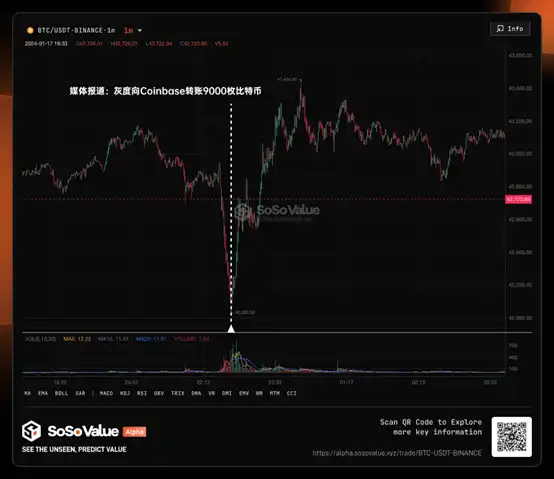
Arbitrage Gray GBTC Discount Rate, Off-Exchange Short BTC Hedge. Due to the chain reaction in the cryptocurrency asset market caused by the FTX explosion, the GBTC trust shares of Grayscale cannot be redeemed, resulting in a maximum discount rate of up to 49% for GBTC, and it has been maintained at around 20% for a long time. Six months ago, the market began to expect that the SEC would approve the Bitcoin spot ETF, and GBTC could be converted from trust to ETF shares redeemable based on NAV, and the discount would disappear. Arbitrage funds began to intervene, arbitraging the discount rate by buying discounted GBTC and shorting BTC off-exchange. After the Bitcoin spot ETF on January 10th, the discount rate of GBTC on January 12th was only -1.18%. Therefore, for some investors who hope to profit from the disappearance of the discount, there is a strong motivation to take profits. Since most of the funds for arbitrage discount rates should have corresponding hedging mechanisms off-exchange, after taking profits, the off-exchange hedging short positions will also correspondingly close, so the overall arbitrage discount rate funds will not have too much impact on the price of BTC logically.
·Fidelity Wise Origin BitcoinFBTChttps://www.sec.gov/Archives/edgar/data/1852317/000119312523306021/d375081ds1a.htmhttps://digital.fidelity.com/prgw/digital/research/quote/dashboard/summary?symbol=FBTC
·iShares Bitcoin TrustIBIThttps://www.sec.gov/Archives/edgar/data/1980994/000143774924000785/bit20240106_s1a.htmhttps://www.ishares.com/us/products/333011/ishares-bitcoin-trust#/
·Franklin Bitcoin ETFEZBChttps://www.sec.gov/Archives/edgar/data/1992870/000113743923001486/ftdhts1a122023.htmhttps://www.franklintempleton.com/investments/options/exchange-traded-funds/products/39639/SINGLCLASS/franklin-bitcoin-etf/EZBC
·ARK 21Shares Bitcoin ETFARKBhttps://www.sec.gov/Archives/edgar/data/1869699/000119312524003823/d549524ds1a.htmhttps://ark-funds.com/funds/arkb/
·Hashdex Bitcoin Futures ETFDEFIhttps://www.sec.gov/Archives/edgar/data/1985840/000199937124000009/tct_424b3-010224.htmhttps://hashdex-etfs.com/defi
·Vaneck Bitcoin TrustHODLhttps://www.sec.gov/Archives/edgar/data/1838028/000093041324000044/c106800_s1a.htmhttps://www.vaneck.com/us/en/investments/bitcoin-trust-hodl/overview/
·Invesco Galaxy Bitcoin EtfBTCOhttps://www.sec.gov/Archives/edgar/data/1855781/000119312524003812/d507893ds1a.htmhttps://www.invesco.com/us/financial-products/etfs/product-detail?audienceType=Advisor&ticker=BTCO
·Valkyrie Bitcoin FundBRRRhttps://www.sec.gov/Archives/edgar/data/1841175/000183988224000518/bitcoin-s1a_010824.htmhttps://valkyrieinvest.com/brrr/
·WisdomTree Bitcoin FundBTCWhttps://www.sec.gov/Archives/edgar/data/1850391/000121465924000371/wtbs1a6.htmhttps://www.wisdomtree.com/investments/etfs/crypto/btcw
·Grayscale Bitcoin Trust ETFGBTChttps://www.sec.gov/Archives/edgar/data/1588489/000119312524004895/d264170ds3a.htm#rom264170_7https://etfs.grayscale.com/gbtc
·Bitwise Bitcoin ETFBITBhttps://www.sec.gov/Archives/edgar/data/1763415/000199937123001336/bitwise-s1a_122923.htmhttps://bitbetf.com/
Welcome to join the official BlockBeats community:
Telegram Subscription Group: https://t.me/theblockbeats
Telegram Discussion Group: https://t.me/BlockBeats_App
Official Twitter Account: https://twitter.com/BlockBeatsAsia
 Related Articles