Bitcoin Spot ETF First Week Recap: Net Inflows Exceed $1.2 Billion in 6 Days, Grayscale Still Holds Over 550,000 BTC

Original Article Title: "A Week One Report Card for BTC Spot ETF: Net Inflows Exceeded $1.2 Billion in 6 Days, with an Average Price Drop of 14.8%"
Original Article Author: Carol, PANews
On January 11, after a decade-long tug-of-war, the Bitcoin spot ETF finally settled, with the U.S. Securities and Exchange Commission (SEC) formally approving 11 Bitcoin spot ETFs, including iShares Bitcoin Trust, Fidelity Wise Origin Bitcoin Fund, Bitwise Bitcoin ETF, etc.
The mainstream view is that the listing of Bitcoin spot ETFs is expected to open the institutional channel, attract more funds, and promote the rapid expansion of the crypto economy. In simple terms, Bitcoin spot ETFs are hoped to drive up the price of Bitcoin and herald the return of a full bull market. However, in the first week after the Bitcoin spot ETF opened for trading (as of January 19), these ideal scenarios have not yet materialized, and the price of Bitcoin has fallen back to around $41,000.
What is the basic situation of Bitcoin spot ETFs? How did they perform in the first week of trading? What impact did they have on Bitcoin? Through an analysis of the basic situation and trading of each ETF, PAData, a data column under PANews, found:
· As of January 19, the total assets under management (AUM) of the 11 Bitcoin spot ETFs were approximately $26.975 billion. The top three in terms of AUM are Grayscale with $23.537 billion, iShares Bitcoin Trust with $1.199 billion, and Fidelity Wise Origin Bitcoin Fund with $1.017 billion. Between the 11th and the 19th, the AUM of the 11 Bitcoin spot ETFs decreased by 8.41%.
· As of January 19, 8 ETFs that disclosed their holdings collectively held 635,700 BTC, with Grayscale holding around 567,000 BTC. Following that, iShares Bitcoin Trust, Fidelity Wise Origin Bitcoin Fund, and Bitwise Bitcoin ETF also had relatively high holdings, with around 28,600 BTC, 24,900 BTC, and 10,200 BTC, respectively.
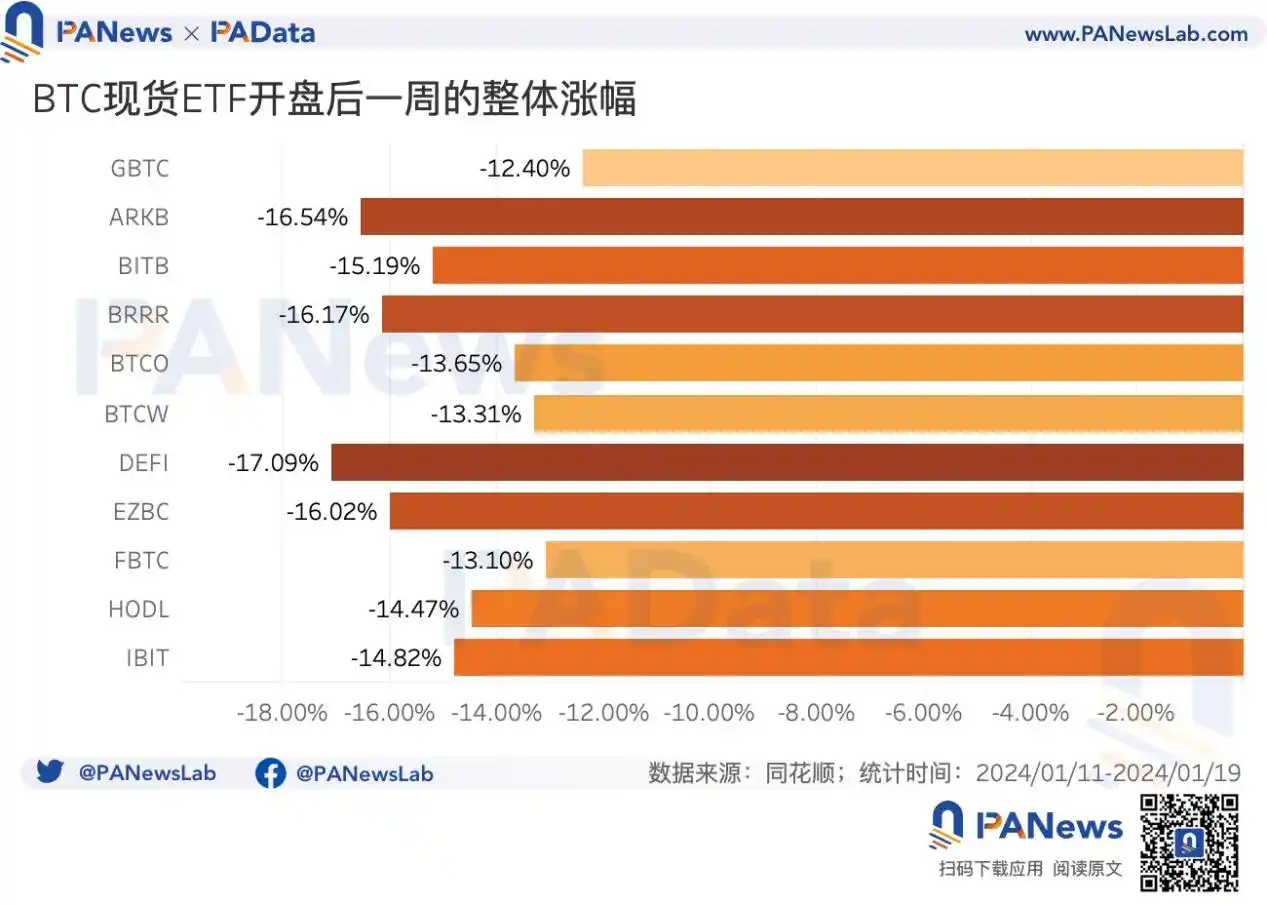
· Since the opening of Bitcoin Spot ETFs, there has been a general decline in prices. Calculated based on the difference between the closing price on the 19th and the opening price on the 11th, the market price of the 11 ETFs has dropped by an average of 14.80%.
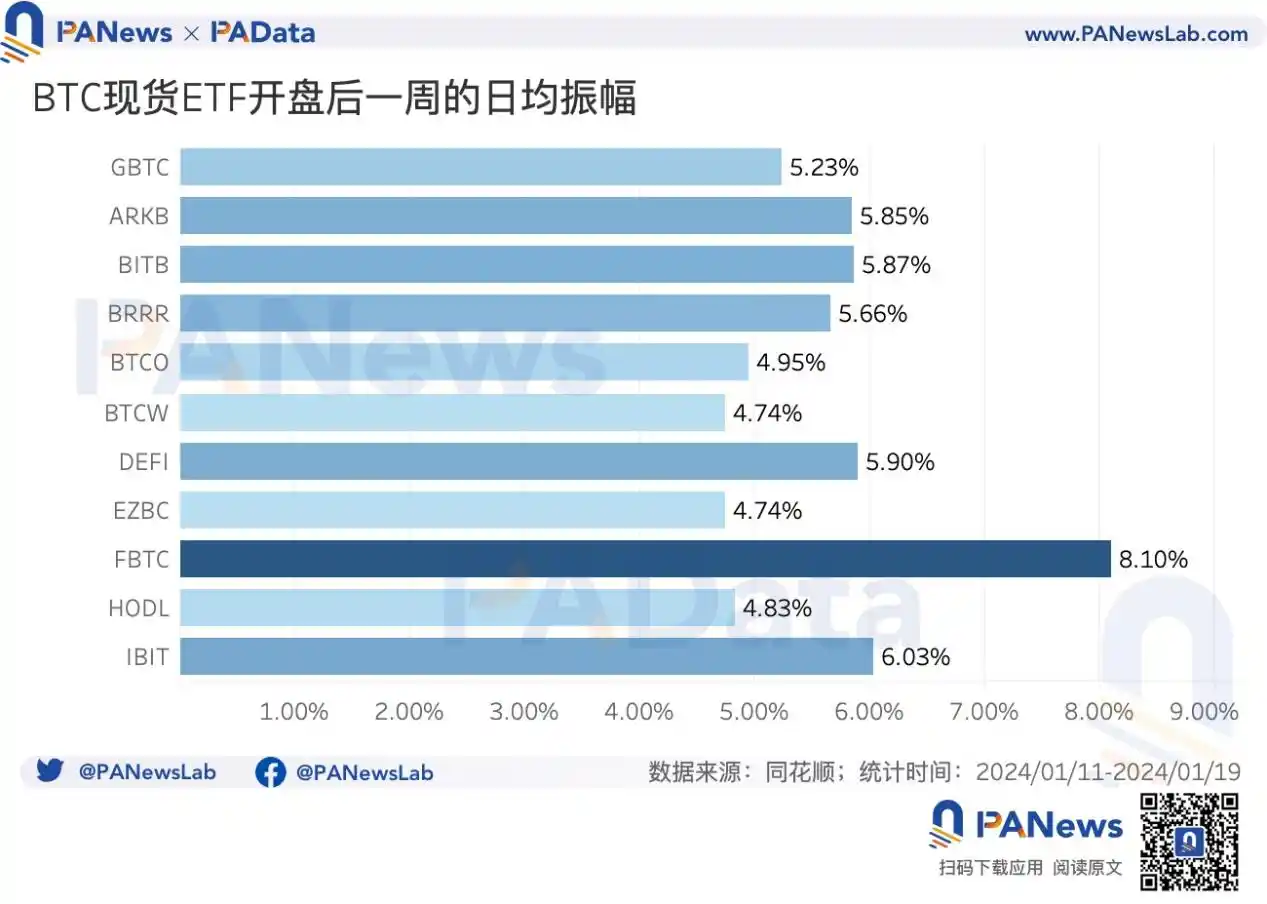
· Bitcoin Spot ETFs have shown significant price volatility. The mean daily price fluctuation of the 11 ETFs is approximately 5.63%, higher than Bitcoin's 4.78% during the same period.
· Among the 11 Bitcoin Spot ETFs, 5 are trading at a discount. The ETF with the highest discount is BRRR, with a discount rate of 0.51%; the lowest is GBTC, with a discount rate of around 0.27%. The arbitrage space based on GBTC's discount rate has further decreased, and it is expected that these arbitrage activities will have a limited impact on market selling pressure in the future.
· The total trading volume in the first 6 days after the listing of Bitcoin Spot ETFs was approximately $16.91 billion. Among them, GBTC had the largest trading volume, with a total of $9.12 billion in 6 days, followed by IBIT and FBTC, with $3.94 billion and $2.49 billion, respectively.
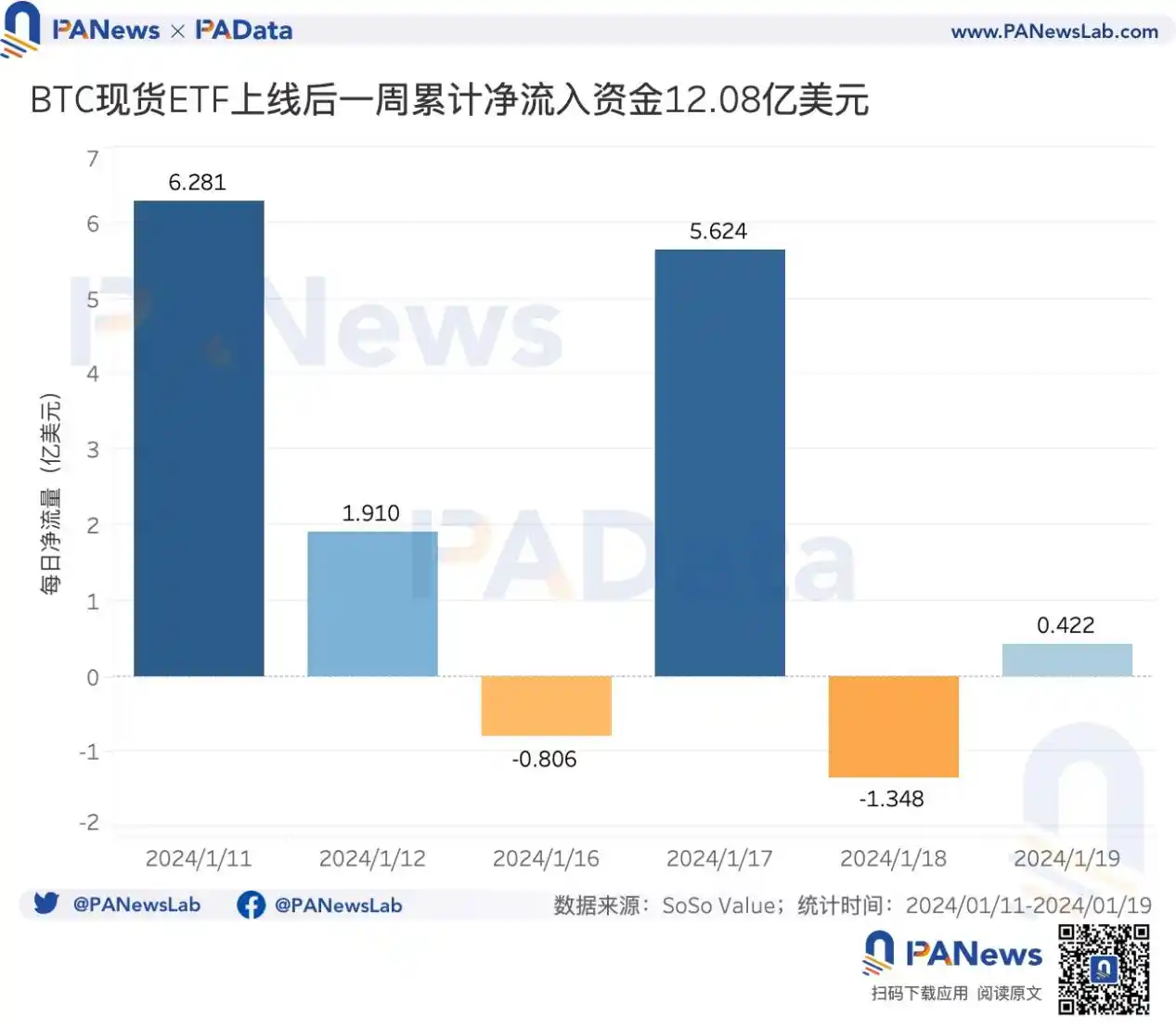
· The cumulative net inflow of funds into Bitcoin Spot ETFs in the first 6 days after listing was approximately $1.08 billion. On the first day, there was a net inflow of $6.28 billion. Although Spot ETFs have injected new capital into the crypto market, they are still far from driving a new round of "institutional bull run."
· Investors in the United States are very optimistic about the approval and listing of Bitcoin Spot ETFs, but in contrast, investors in Asia are not.
· The Bitcoin market has shown some positive features recently. Firstly, there is increased buying power in the market; secondly, Bitcoin on-chain transaction activity has increased; thirdly, more Bitcoin is being accumulated.
01. Total AUM exceeds $26.9 billion, with 8 ETFs disclosing holding a total of 635,700 BTC
According to data from the official websites of the 11 issuers, combined with cross-validation with third-party data from Trading View and Robinhood, as of January 19th, the total Assets Under Management (AUM) of the 11 Bitcoin Spot ETFs was approximately $26.75 billion. Among them, only Grayscale's AUM reached $23.37 billion, accounting for 87.25% of the total. Next, the AUM exceeded $1 billion for iShares Bitcoin Trust and Fidelity Wise Origin Bitcoin Fund, while the AUM of other spot ETFs is currently relatively small, all less than $5 billion, some even less than $1 billion.
According to the AUM data calculated by SoSo Value, the AUM on January 11th was approximately $293.80 billion. By January 19th, it had decreased to $269.10 billion, representing an overall decline of about 8.41%.
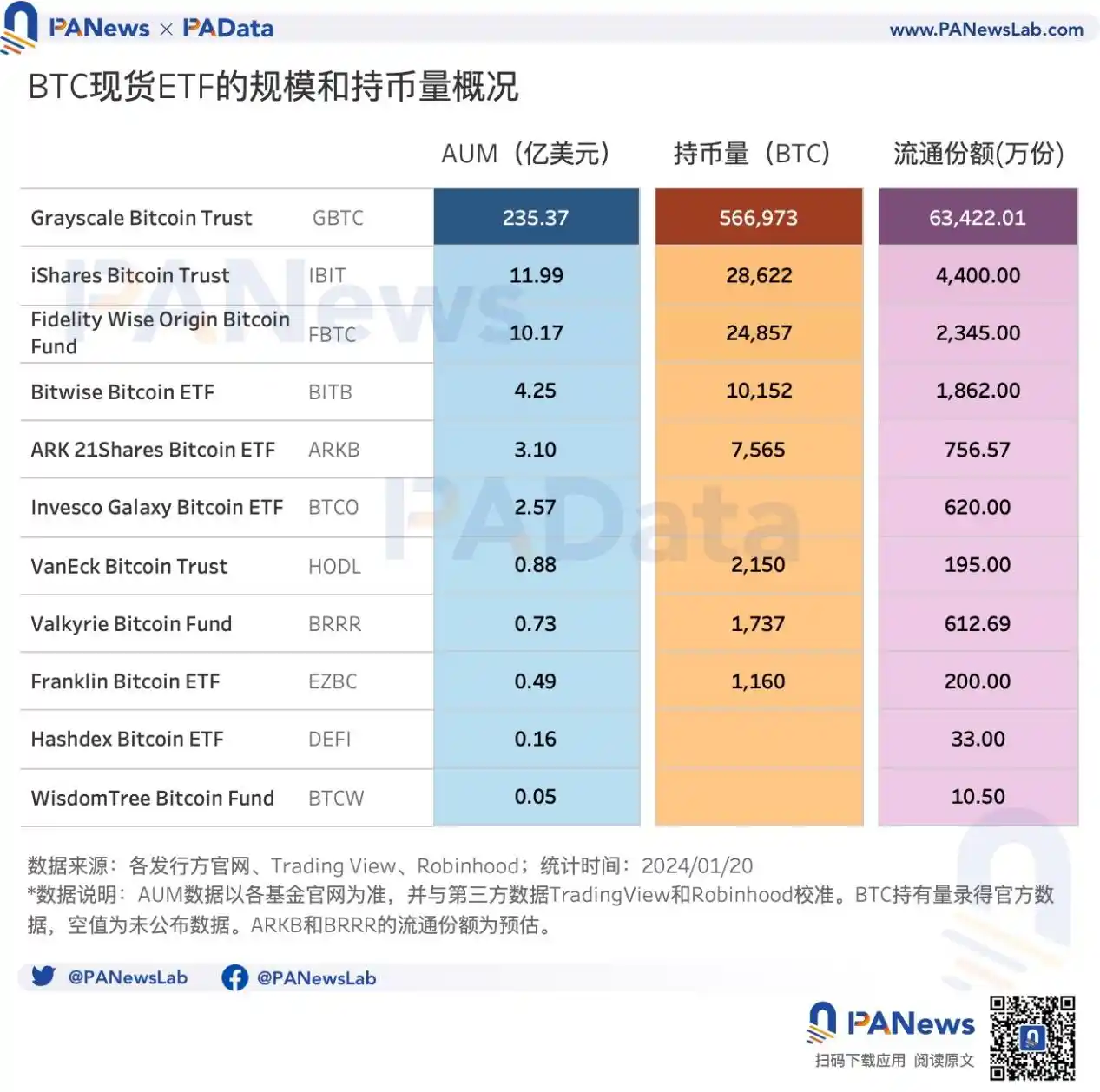
Among the issuers of the 11 Bitcoin spot ETFs, 8 have disclosed the amount of Bitcoin held. As of January 19th, these 8 ETFs collectively held 635,000 BTC, with Grayscale holding around 567,000 BTC, accounting for about 89.20% of the total. Following Grayscale, iShares Bitcoin Trust, Fidelity Wise Origin Bitcoin Fund, and Bitwise Bitcoin ETF also held significant amounts, approximately 28,600 BTC, 24,900 BTC, and 10,200 BTC, respectively.
Facing the fierce competition of 11 Bitcoin spot ETFs launching simultaneously, various institutions have adopted a strategy of reducing the Total Expense Ratio (TER) to attract market funds. Currently, 6 Bitcoin spot ETFs, including FBTC, BITB, and BTCO, have a 0% management fee rate. However, after the promotional period, the management fees of these ETFs will generally increase to around 0.2%-0.3%, which is below the industry average. In contrast, the largest fund, Grayscale, still maintains a very high 1.5% management fee, while the Hashdex Bitcoin ETF also has a relatively high fee of 0.9%.
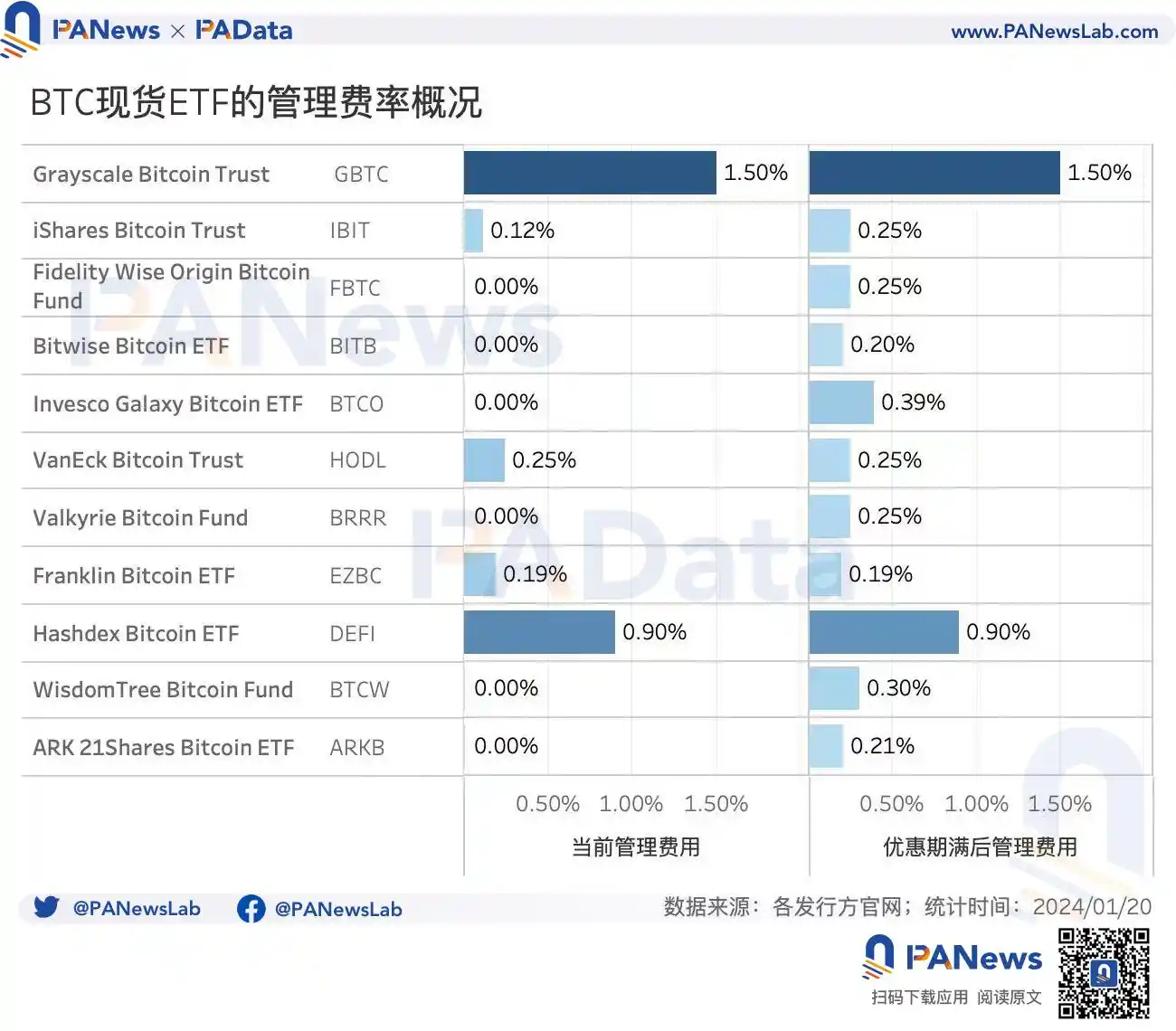
Public reports indicate that VanEck and Bitwise intend to donate 5% and 10% of the ETF profits to Bitcoin Core developers, respectively. Based on the estimated management fees of the two ETFs after the promotional period and the current AUM, the total donation amount is approximately $96,100. If the Bitcoin spot ETFs develop successfully, the AUM of these two ETFs will increase significantly, leading to a rise in the donation amount.
02. Six-Day Total Trading Volume Exceeding $16.6 Billion and Cumulative Net Inflows Exceeding $1.2 Billion Since Opening
Since the opening of the Bitcoin spot ETFs, there has been a general downward trend. As of the 19th, based on the percentage increase from the 11th opening price to the 19th closing price, the average market price of the 11 ETFs has fallen by 14.80%. Among them, DEFI experienced the largest price decline, exceeding 17%, while GBTC saw the smallest decline at around 12%.
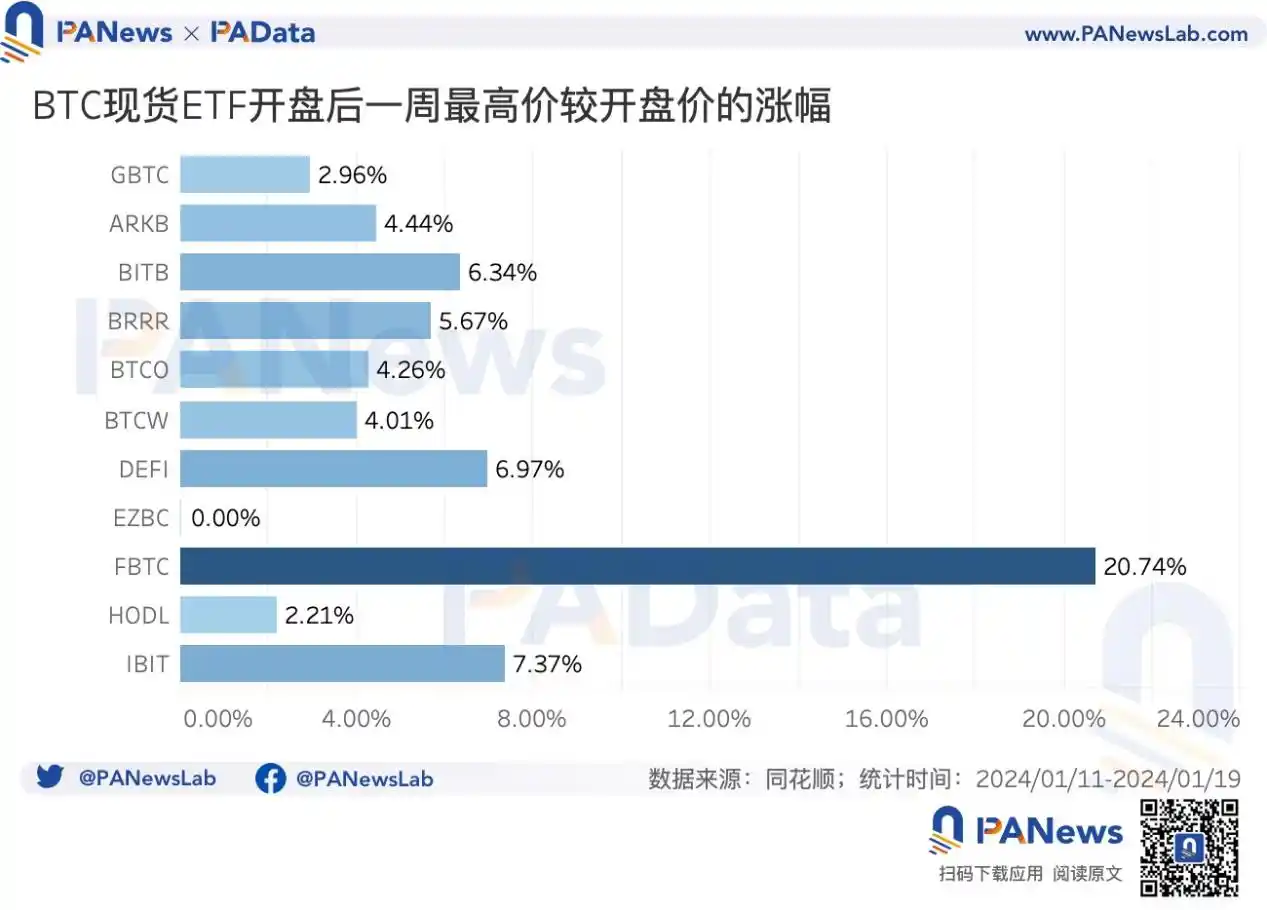
Aside from Franklin's EZBC plummeting all the way down, with the opening price being the highest price, investors still had the opportunity to profit from buying after the Bitcoin spot ETF opened. Based on the theoretical maximum price increase from the opening price on the 11th, the average maximum price increase of the 11 ETFs was about 5.91%. Among them, Fidelity's FBTC saw a price surge of over 20%, far higher than other ETFs. Following closely was BlackRock's IBIT, with a price surge of over 7%.
The newly listed Bitcoin spot ETFs still exhibit significant price volatility. Calculating the daily price fluctuation from the highest to the lowest price, the average daily price fluctuation of the 11 ETFs is around 5.63%. According to data from CoinMarketCap, Bitcoin's average daily price fluctuation during the same period was around 4.78%, lower than the ETFs' price volatility level.
Among these ETFs, Fidelity's FBTC had the highest daily price fluctuation, reaching 8.10%. For most other ETFs, including GBTC, BITB, and IBIT, the daily price fluctuation ranged mainly between 5% and 6%. Only BTCW and EZBC had daily price fluctuations lower than Bitcoin's during the same period.
Comparing the ETFs' NAV (Net Asset Value) on January 19th with the closing price of the day, it can be observed that 5 out of the 11 Bitcoin spot ETFs are trading at a discount, meaning the current market price is below the NAV. Among them, BRRR had the highest discount level, with a discount rate of 0.51%. FBTC, EZBC, and BTCW had similar discount rates, all exceeding 0.3%. GBTC had the lowest discount rate, at around 0.27%.
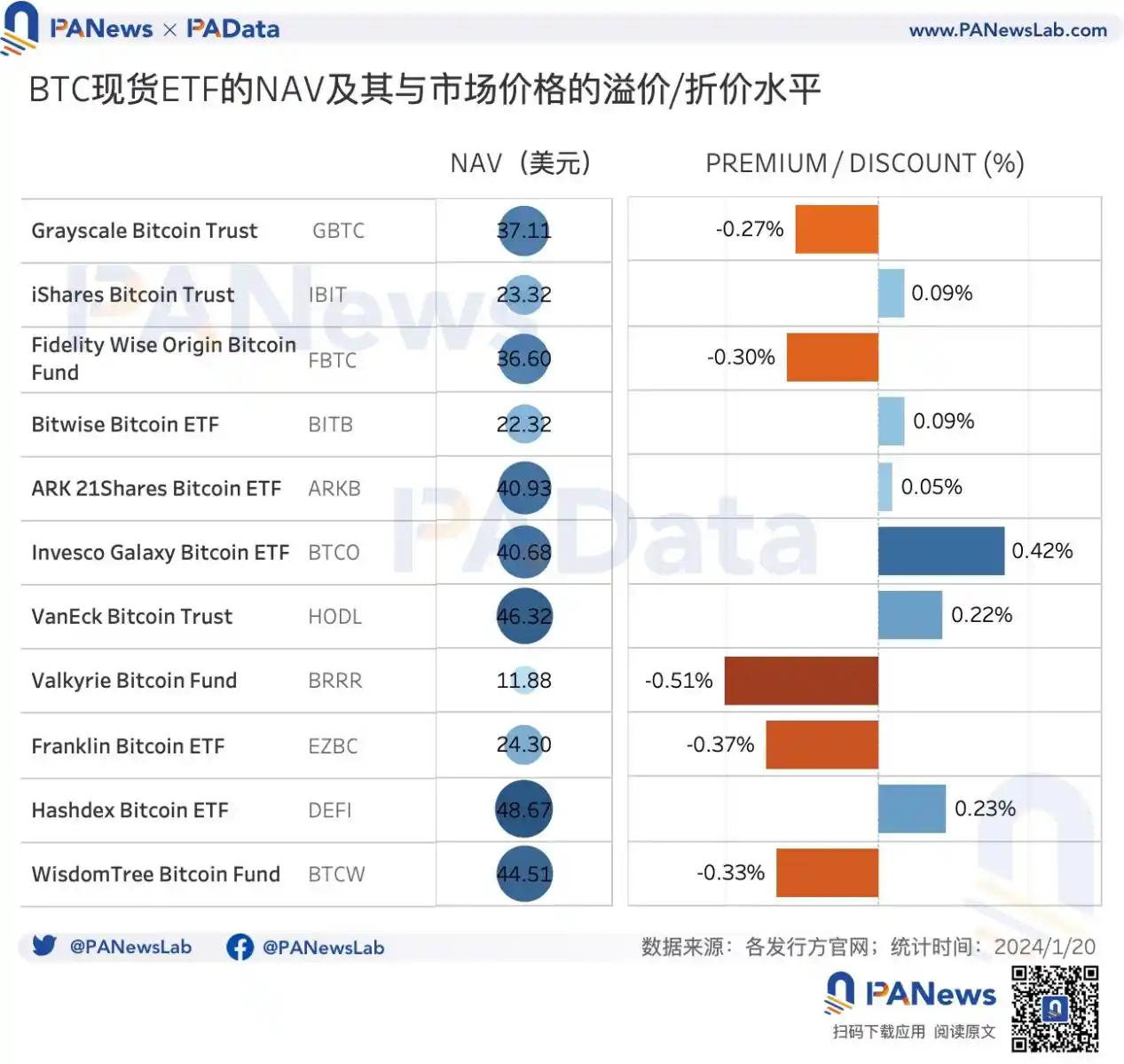
Some argue that part of the reason for the high selling pressure on GBTC is arbitrage activity where investors buy GBTC at a discount and simultaneously engage in off-exchange BTC short selling. Based on the current discount rate, the opportunity for this arbitrage activity has further diminished, and it is expected that its impact on market selling pressure will be limited in the future.
Additionally, 6 ETFs are currently trading at a premium, with BTCO having the highest premium rate, reaching 0.42%. HODL and DEFI have premium rates around 0.2%, while IBIT, BITB, and ARKB have premium rates of less than 0.1%.
In terms of trading volume, the total trading volume of Bitcoin spot ETF in the first 6 days after listing was approximately $16.91 billion, with a daily average trading volume of around $2.82 billion. Among them, GBTC is the ETF with the largest trading volume, with a total trading volume of $9.12 billion in 6 days, followed by IBIT and FBTC, reaching $3.94 billion and $2.49 billion, respectively. Additionally, there are 4 ETFs with trading volumes of less than $1 billion, including BRRR, BTCW, DEFI, and HODL.
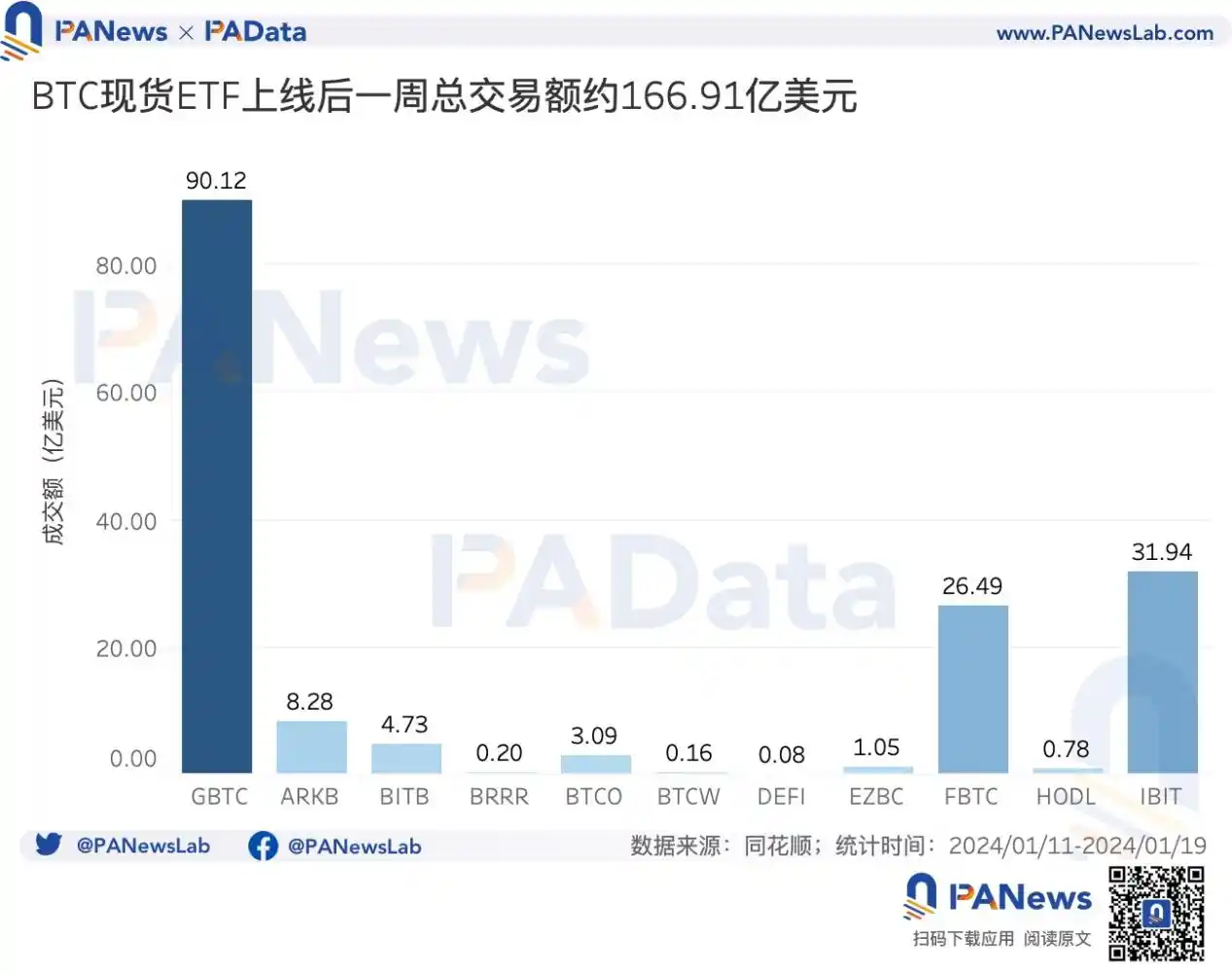
It is important to emphasize that the trading volume of Bitcoin spot ETF does not equate to the capital flow in the Bitcoin trading market; only funds truly entering the Bitcoin trading market will have a direct impact on the crypto market.
According to SoSo Value's data, based on the product of the daily change in each ETF's circulating shares and the current NAV (Today's Shares - Yesterday's shares) x Current NAV), the cumulative net inflow of funds into the Bitcoin spot ETF in the first 6 days after listing is approximately $1.08 billion. Of this, there was a net inflow of $6.28 billion on the first day and $5.62 billion on the 17th day. Overall, the issuance of the Bitcoin spot ETF has injected new funds into the crypto market, but it is still a distance away from driving a new round of "institutional bull run."
03. BTC Price Falls Back to Around $41,000, On-Chain Transaction Speed Accelerates, Accumulation Trend Strengthens
What reactions have occurred in the Bitcoin trading market and on-chain performance after the listing of the Bitcoin spot ETF? What do these reactions imply for future trends?
From the most intuitive price performance perspective, after the Bitcoin spot ETF listing, Bitcoin reached a recent peak of $46,936 on the first two days (January 9), and then began to experience a pullback. By the end of January 11 with a price of $46,632, and by January 19, after the bullish sentiments faded, Bitcoin's price had fallen to $41,261, a notable 12.09% decline from the recent peak.
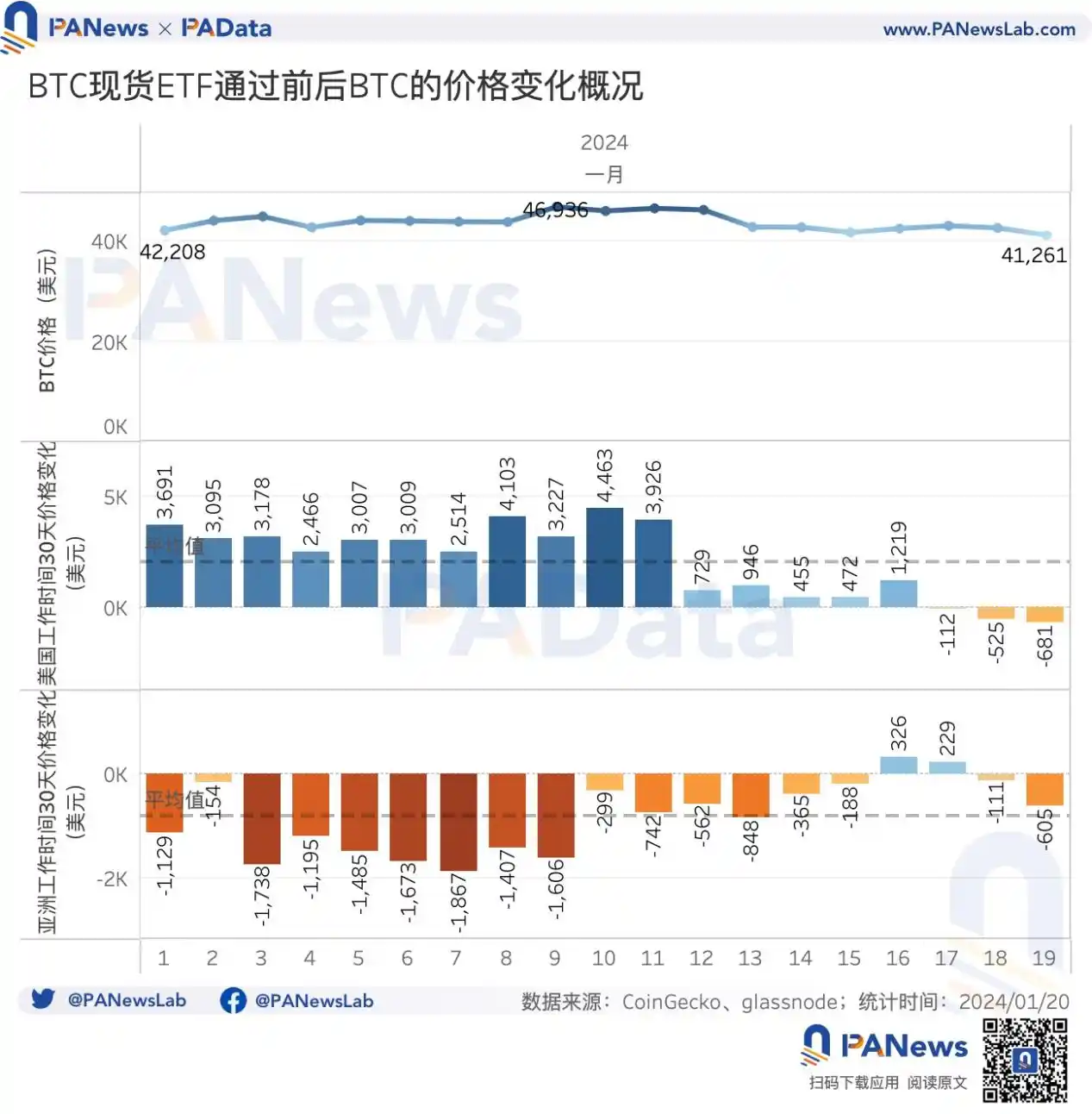
If we specifically analyze the changes in Bitcoin's price based on different regions' working hours, we can observe significant differences in Bitcoin's price performance during U.S. and Asian (predominantly China) working hours.
During U.S. working hours (from 8 a.m. to 8 p.m. Eastern Time), before the Bitcoin spot ETF listing (including the day of the 11th), Bitcoin's daily prices were showing substantial increases ranging from $3,000 to $4,500 compared to 30 days prior. Even within the first 5 days after the ETF listing (before the 16th), Bitcoin's daily prices compared to 30 days prior were still in an upward trend, although the gains had reduced to around $1,000.
Overall, investors in the United States are very optimistic about the approval and listing of a Bitcoin spot ETF, while conversely, investors in Asia are not.
During the Asian working hours (8 a.m. to 8 p.m. China Standard Time), the daily price of Bitcoin has mostly declined compared to 30 days ago before and after the listing of the Bitcoin spot ETF. Before the ETF listing (including the listing day), the daily Bitcoin price has dropped by almost $1,000 or more compared to 30 days ago, and after listing, this decline has significantly narrowed to within $1,000.
Looking at other market indicators, the Bitcoin market has shown some positive features recently.
First, there is increased market buying power. The Stablecoin Supply Ratio (SSR) is the ratio of the Bitcoin market cap to the stablecoin market cap. When the SSR decreases, it means that the current stablecoin supply has more "buying power" to purchase BTC. After the listing of the Bitcoin spot ETF, the SSR has decreased from 13.022 to 11.662, a decrease of about 10.44%. The market's "buying power" has increased, which helps absorb the selling pressure from GBTC.
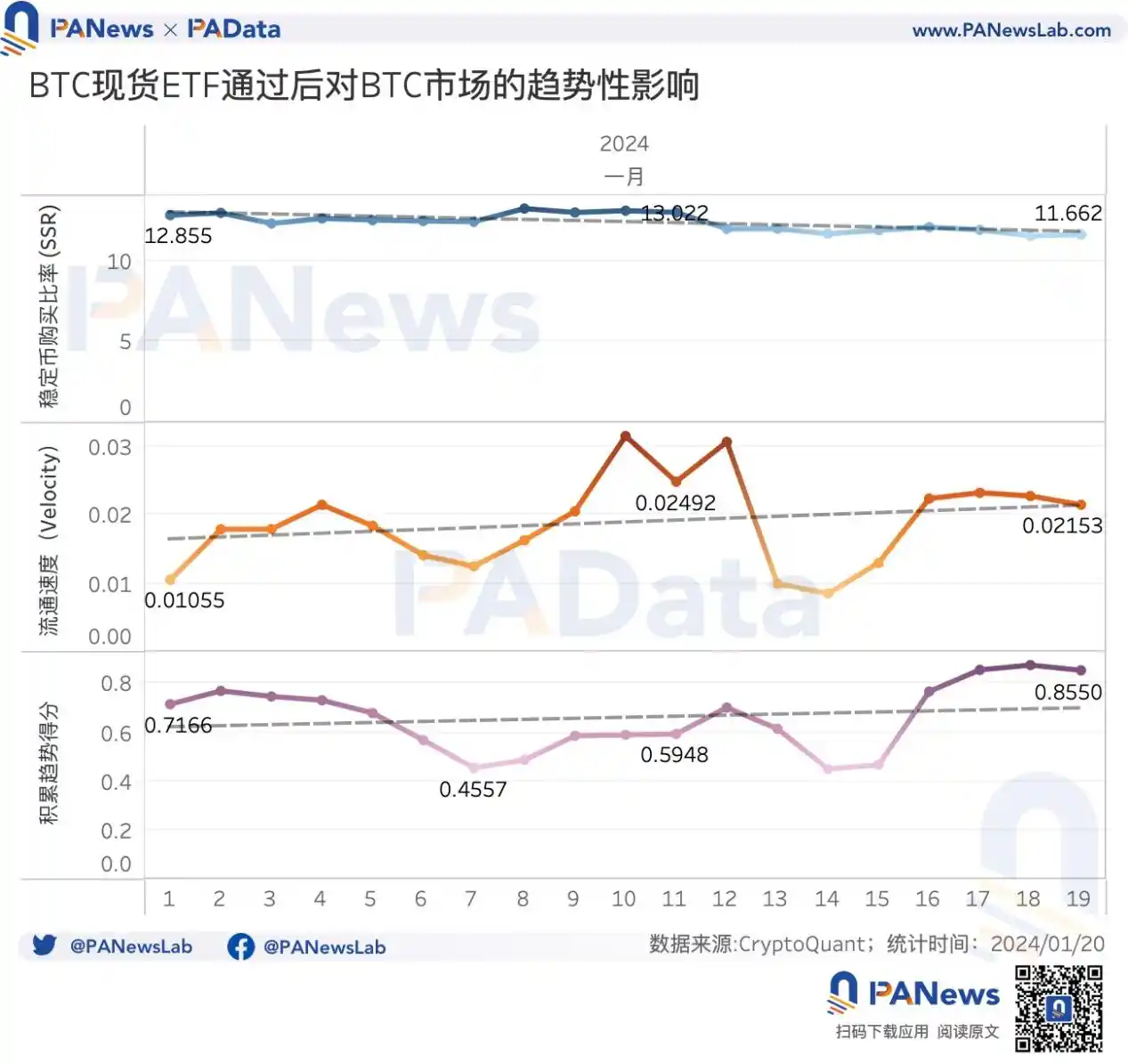
Second, there is an increase in Bitcoin on-chain transaction activity. Velocity is an indicator that measures the speed of unit circulation in the network. A higher value indicates a faster circulation speed on the Bitcoin chain and higher transaction activity. So far this year, Velocity has risen from 0.011 to 0.022, reaching a recent peak of 0.032 on the day before the Bitcoin spot ETF listing (January 10). The overall trend of increased activity is quite evident.
Third, more Bitcoin is being accumulated. The Accumulation Trend Score closer to 1 indicates that overall more market participants are accumulating tokens. Since the beginning of this year, Bitcoin's accumulation trend has risen from 0.72 to 0.86, showing a clear tendency for participants to accumulate tokens. Although this trend briefly dropped below 0.5 before the listing of the Bitcoin spot ETF, possibly due to profit-taking by participants at higher levels, it has recently resumed its upward trend.
Overall, the positive signals from Bitcoin trading markets and on-chain data demonstrate the market's confidence in future price trends. Additionally, Bitcoin is expected to undergo its fourth halving on April 22 this year. Following the price trends after the previous three halvings, the market has high expectations for a price increase after this halving. It is worth further observation to see if a positive feedback loop between Bitcoin price and the Bitcoin spot ETF will develop at that time.
Original Article Link
Welcome to join the official BlockBeats community:
Telegram Subscription Group: https://t.me/theblockbeats
Telegram Discussion Group: https://t.me/BlockBeats_App
Official Twitter Account: https://twitter.com/BlockBeatsAsia