Blast L2 operation tutorial: Airdrop split in half, I want both TVL and developers.
Original Title: "Blast L2 Operation Tutorial: Airdrop Half, TVL and Developers I Want All"
Original Source: DeepTech TechFlow
Editor's note: On January 17th, Blast, a Layer 2 network founded by Pacman, the founder of Blur, announced the official launch of its testnet. At the same time, Blast announced the "Blast BIG BANG" activity aimed at attracting Dapps to join. The operational strategy of Blast's incentive activity provides us with a more direct and profit-oriented template. TechFlow has analyzed this in detail, and the full text is as follows:
Blast has once again appeared in everyone's sight recently.
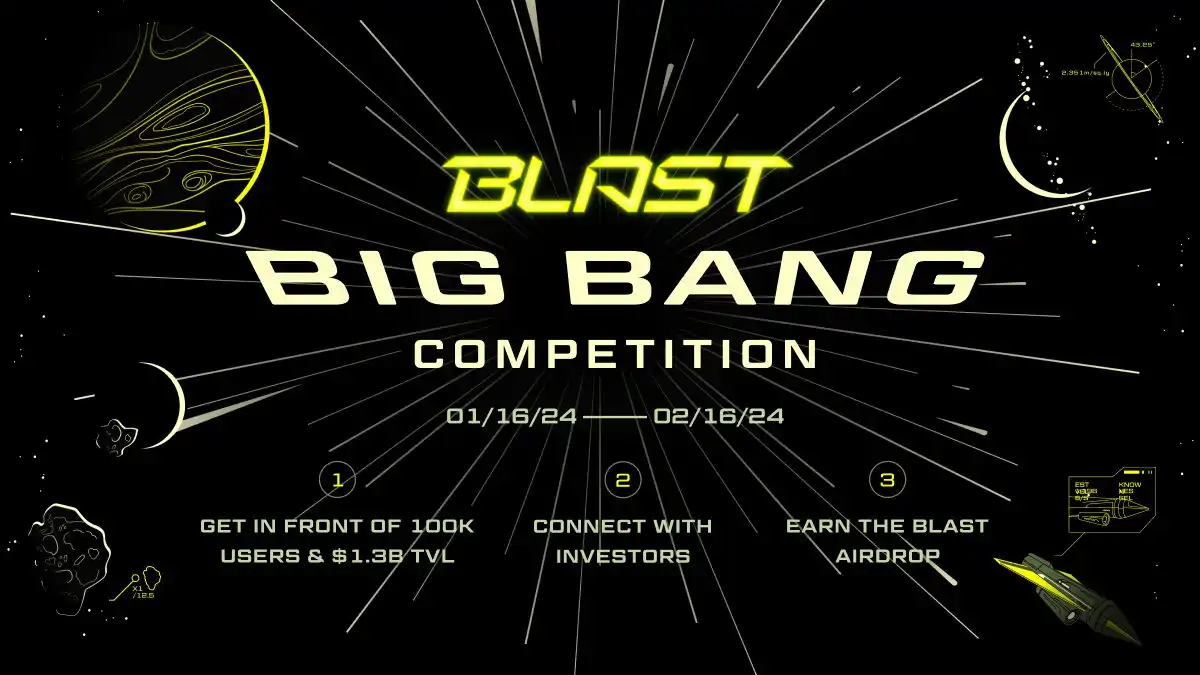
On January 17th, Blast officially announced the launch of its testnet and a one-month incentive plan called "Big Bang" to encourage developers to actively build applications within its ecosystem. Through certain rules and competitions, winning projects can receive Blast's token airdrops and have the opportunity to connect and communicate with top investors.
More importantly, this incentive activity is more like an audition and rehearsal, with the ultimate stage being the Blast mainnet. The audience below is filled with users attracted by Blast in the past few months, waiting for the launch of new projects and eager for the next liquidity feast.
This L2, launched by Pacman, founder of Blur, has attracted widespread attention since its announcement in November last year: its built-in revenue, Paradgim investment, and Blur's successful experience make it highly topical and controversial.
The last time Blast caused widespread discussion in the industry was because of its ability to quickly attract users and liquidity.
Last November, just a few days after its launch, Blast's TVL quickly surpassed $500 million, making many L2 competitors feel the pressure. At the time, the CEO of Arbitrum's parent company also tweeted, "We created this monster."
And now, this monster has become even bigger.
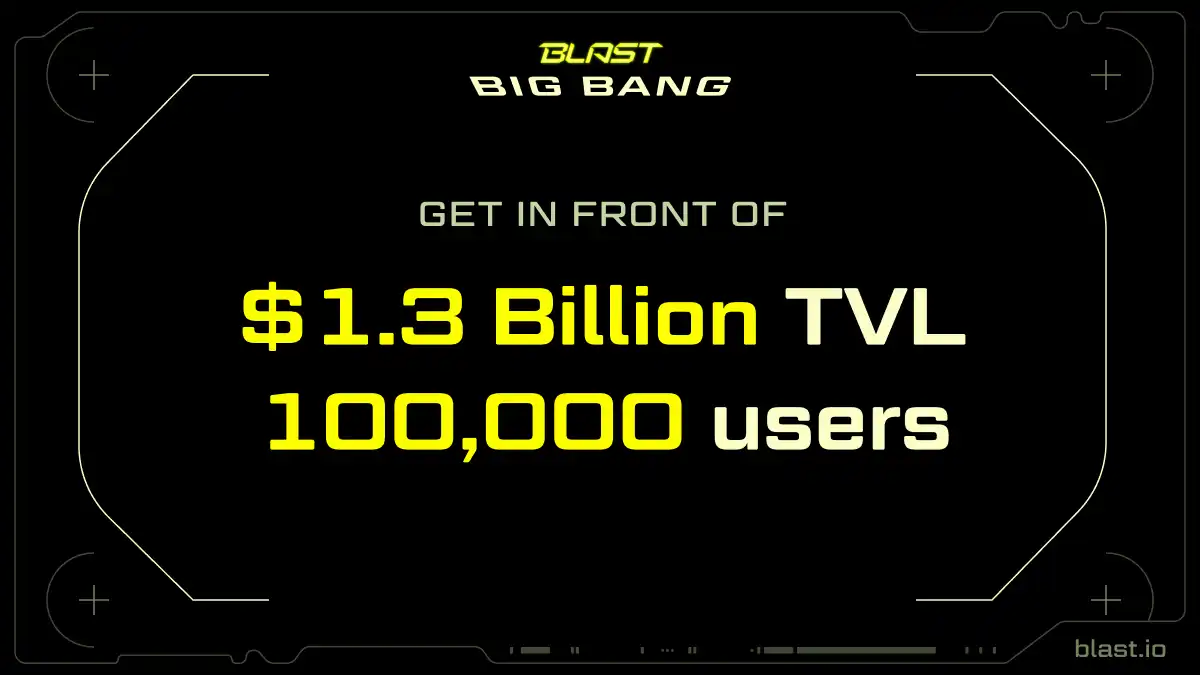
Blast has successfully absorbed a total of 1.3 billion US dollars in TVL and over 100,000 users in about 2 months. Considering that Blast has not yet officially launched and has a short operating time, for comparison, the TVL of Arbitrum, which has been in operation for a long time, is 2.6 billion US dollars, only twice as much as Blast.

Not only attracting users, now Blast has also extended an olive branch to developers.
Big Bang This testnet plan helps you find users, funds, and connections, and this price tag may make it difficult for new projects to refuse.
Incentives in the world of encryption are truly what helped Blast understand it.
一张测试网,空投对半分
translates to
A testnet with a 50% airdrop
We can take a closer look at the details of the Big Bang Test Incentive Program.
Consider L2 as a stage, where users are the audience and projects are the performers.
For the stage organizer Blast, there are at least two troublesome issues that affect each other:
Promise to the audience that there will be someone singing, and promise to the singer that there will be someone watching.
At the same time, this is also a common dilemma faced by any platform project, that is, how to attract resources when there are no resources on both ends, or even when both ends are on the side of competitors.
Blast's method is rough, primitive, and effective --- profit, profit, and more profit.
The L2 mainnet has not yet been launched, but we are announcing to users that depositing assets can earn corresponding ETH staking rewards and stablecoin interest. This alone is enough to attract a large number of cryptocurrency users who are solely focused on making money, not to mention the expected airdrops for point redemption in the future.
On the other hand, Blast can confidently attract projects to build with solid TVL and also directly indicate that developers will be rewarded with airdrops.
One testnet, profits split in half.
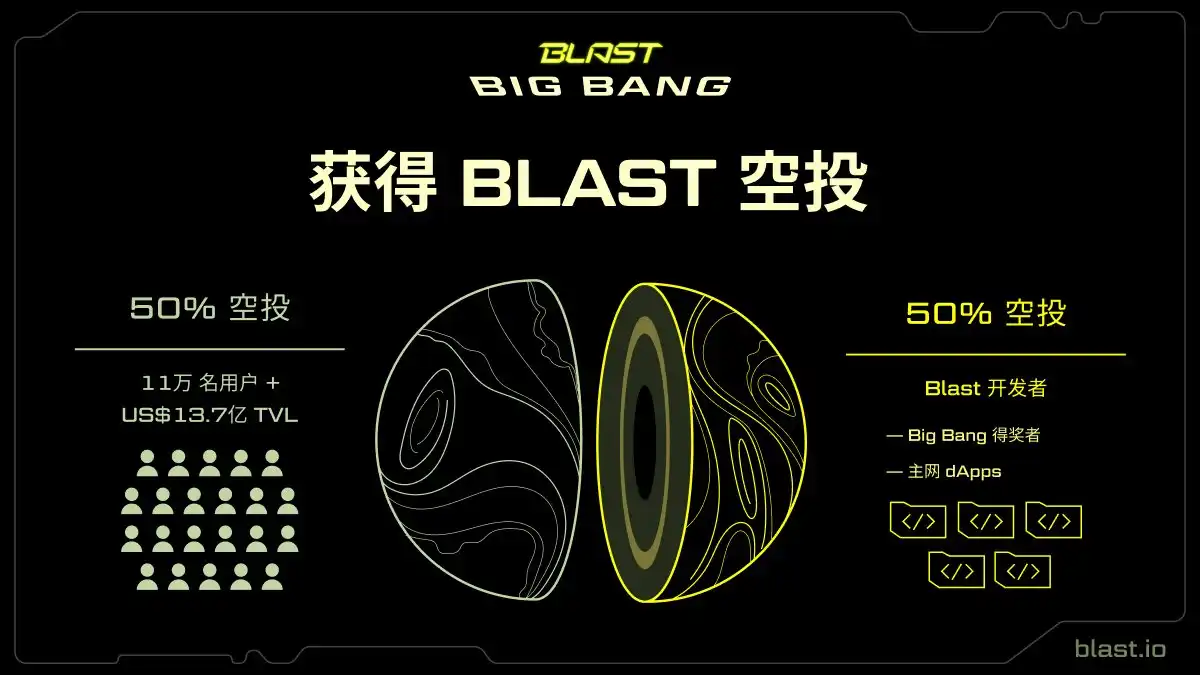
All Blast airdrops are split in half, with one half going to the winning projects and mainnet application developers, and the other half going to users who deposit liquidity on Blast.
Generally speaking, airdrops are more oriented towards retail investors, and it is not common to directly airdrop to developers. However, as the saying goes, "there are always brave men under heavy rewards", especially in the case of the solidification of other L2 ecosystems and the obvious effect of head projects. Going to Blast to do a project, with airdrops, users, and virgin land, why not?
From the information provided by Blast official, it appears that they currently encourage projects in 8 major categories, including DeFi/NFT/social media/gaming/infrastructure, which basically covers the areas that are most popular in the cryptocurrency market. With strong incentives, it may only be a matter of time before excellent projects emerge.

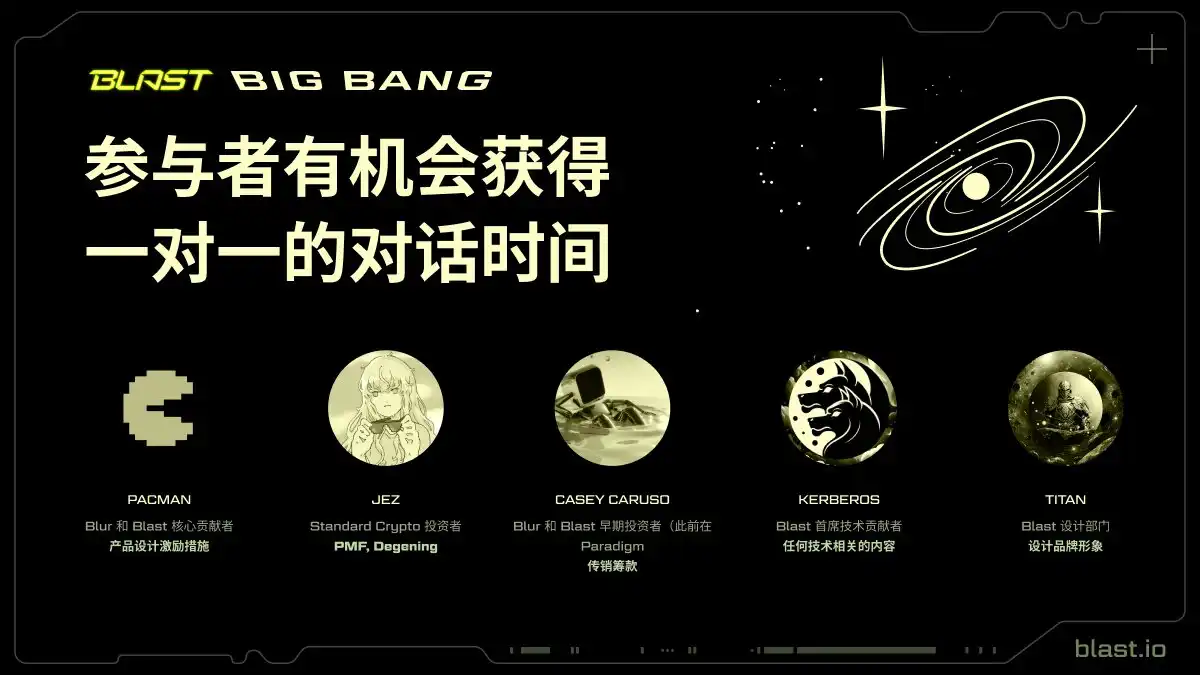
We can see that Blast is very eager to recruit talents, and at the same time, it maximizes the value of its team and IP in terms of gameplay. Those projects that will win awards in the future will also have the opportunity to have conversations with core members of the Blur project team. Although a single conversation may not solve any practical problems, the networking and circle effects it brings are beneficial for project development, business development, and information gathering without any harm.
The airdrop and resource benefits are at their maximum, and Blast seems to understand the developers and users in the encryption market very well. How can they be effectively mobilized?
Technical homogenization, operational explosion
Blast's testnet incentive program, named "Big Bang," but the author believes that the real "Big Bang" is the operational strategy.
Leaving aside Blast, how did the previous L2s attract users and developers?
There are airdrops, but the rules are unclear and the cards are not revealed at the beginning; there are incentives for developers, but it seems that they do not directly engage with retail investors at first, but later become equivalent token emissions to attract user participation.
More importantly, previous L2 solutions were mostly focused on technical narratives, such as what my OP/ZK technology can achieve, how low gas fees can be, and how fast performance can be.
This is important, but not critical.
When there are dozens of underlying L2 technologies with homogenization in the entire encryption market, users and developers have long been considering:
I don't really care how good your technology is, I care more about how much benefit you can provide.
From the perspective of the operating strategy of Blast, it seems to have set a different tone for us: we don't expect you to be a technical genius before you come, we just want you to come for the sake of profit.
明牌,效率且实际。
明牌, efficient and practical.First attract users and liquidity with predictable returns (ETH staking and stablecoin interest), then use liquidity as a price tag to attract developers.
No user will refuse the temptation of real benefits, and no developer will refuse the temptation of having a large number of users.
Both ends use profits as leverage to manipulate the behavior of both parties, at least to quickly accumulate popularity and complete a cold start of the latecomer L2.
Of course, there is always a doubt in the market that users acquired through profits and incentives are not sustainable, not legitimate, and not technical. However, in the world of encryption, it's a matter of winner takes all. If the business is successful and users receive rewards, the project gains users, L2 itself receives transaction fees, then everyone naturally stops questioning.
Those who continue to question in the future will undoubtedly be competitors and those who have not made money. This logic is particularly similar to the previous Blur challenge to Opensea.
Blur once staged a classic case of a post-emptive strike on an NFT platform, and Blast seems to be using the same operational formula to nibble away at the market share of L2:
Incentivize matchmaking and promise benefits to both parties.
Meanwhile, the Blast testnet event had an even greater impact by turning itself into an L2 with built-in Launchpad properties.
Want liquidity? I have it here. Want incentives? I have them here too. Want users? I have even more here.
For a new project, what reason is there not to go to Blast? Looking at it the other way around, when the idea of "going to Blast for a new launch" becomes a consensus, Blast becomes a Launchpad and is more likely to attract subsequent projects to try their luck.
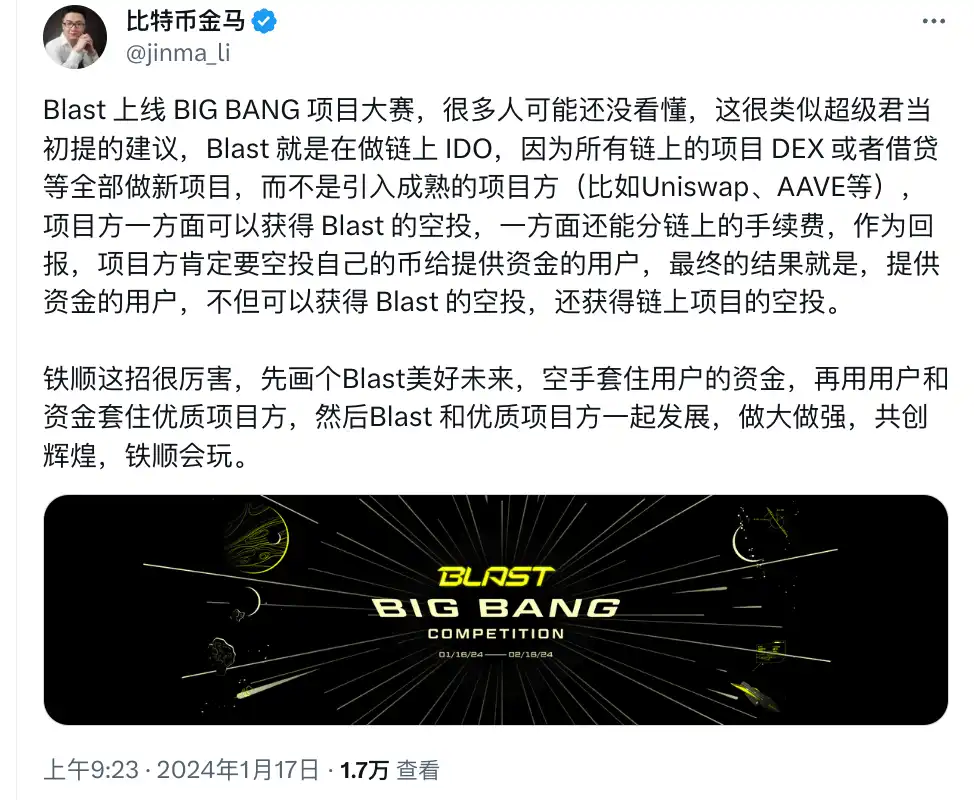
In the new cycle, those high-end technologies seem to be losing their effectiveness, and users prefer projects that are less routine, easy to understand, and directly motivating. So we see the rise of inscriptions, the anxiety of VC, and more projects that cannot compete joining the inscription feast or the practical choice of the Bitcoin ecosystem.
Is the L2 track also undergoing a "down-to-earth" transformation in terms of concepts and operations? Blast has at least started the trend.
It's interesting to note that you can always feel the narrative, teams, and gameplay changing in the world of encryption.
But behind it all, the insight into human nature remains unchanged.
Original article link
Welcome to join the official BlockBeats community:
Telegram Subscription Group: https://t.me/theblockbeats
Telegram Discussion Group: https://t.me/BlockBeats_App
Official Twitter Account: https://twitter.com/BlockBeatsAsia

 Related Articles