



TVL exceeded 600 million in 9 days, the rational thinking about Blast behind the madness
Original author: YBBCapital Researcher Ac-Core
Foreword:
With the recent launch of Layer2 network Blast by the founder of Blur, the market with strong expectations for airdrop returns has also experienced mixed emotions. According to official announcements, the Blast mainnet will go live in February next year, and airdrops will be conducted based on points, similar to the previous model of Blur. Within a few days of the news, Blast's TVL growth rate has skyrocketed, but Blur's sudden attack on the Layer2 narrative undoubtedly leads to three possible outcomes: sparking a new round of hotspots, planting a huge landmine, and "copying homework" of related projects in the same field. From a marketing perspective, this event is undoubtedly a market battle between strong technology Layer2 and strong consensus Layer2.
Review of the basic structure of Ethereum Layer2
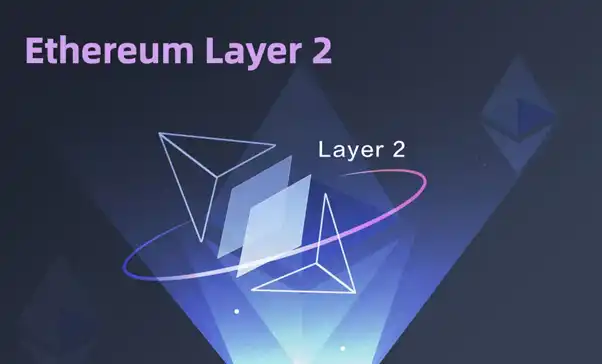
Source: Top Ethereum Layer 2 Networks
After Blur proposed its "Stake Layer2" narrative, let's first understand the basic structure types of Ethereum Layer2 currently, and then make a judgment. It is an scalability solution aimed at improving transaction throughput and reducing transaction costs by introducing second-layer protocols or protocol stacks on the Ethereum blockchain. It can be roughly summarized as the following types:
State Channels
Definition: State channels are a solution that allows for direct exchange of signatures between parties without the need to write every transaction to the blockchain. The basic principle is to create an off-chain environment between participants, allowing transactions to occur off-chain and only broadcasting to the network when the final state needs to be submitted to the blockchain. This method greatly improves transaction efficiency and throughput.
Working principle: In a state channel, participants can open a channel, execute multiple transactions, and then submit the final state of the channel to the blockchain. This way, only the opening and closing of the channel require on-chain transactions, while transactions within the channel can be conducted off-chain, avoiding the cost and time delay of conducting every transaction on the blockchain.
Example: The Lightning Network is a state channel solution for Bitcoin. Users can conduct fast and low-cost micropayments off-chain, and only write the final state to the blockchain when the channel needs to be closed. On Ethereum, Raiden Network is a similar state channel solution that achieves highly scalable transactions by creating a multi-party channel network.
Sidechains
Definition: A sidechain is a chain that is detached from the main blockchain but is compatible with it. It can have its own consensus mechanism and block generation rules. Users can lock assets on the main chain and then trade on the sidechain, and ultimately submit the transaction results to the main chain. This approach improves overall network performance by achieving higher throughput on the sidechain. Here are several common ways to bridge sidechain contracts:
Pegged Bridge: It is a mechanism for cross-chain interaction that anchors or maps assets between two chains. In this bridging method, users lock assets on one chain, and an equivalent amount of assets is generated on another chain. This usually involves some trusted intermediaries responsible for supervising the locking and releasing of assets.
Lock-and-Mint Bridge: A Lock-and-Mint Bridge is a way of bridging assets by locking them on one chain and creating a corresponding amount of assets on another chain. Users lock their assets on the original chain, and the bridging protocol issues the corresponding amount of tokens or assets on the target chain. This method usually requires a trusted intermediary or a multi-signature contract to ensure the security of the locking and releasing process.
Cross-Chain Atomic Swap: A decentralized method that allows users to perform atomic-level exchanges on two chains, either completing all or none of the transaction. This method typically uses smart contracts and hash locking to ensure transaction reliability. Atomic swap methods do not involve trusted intermediaries, but involve more complex smart contract design.
Proxy Bridge: A method of cross-chain interaction using an intermediary proxy. Users send assets to the bridging proxy, which performs the corresponding operation on another chain and then sends the corresponding assets to the target address. An example of this method is executing transactions between two chains using a multi-signature contract.
Light Client Bridge: The Light Client Bridge uses lightweight clients to track the state on the source chain and then generates the corresponding state on the target chain. This approach does not require locking and unlocking of assets, but instead ensures the reliability of the interaction by verifying the state on both chains. This is a common feature in some Layer2 solutions on Ethereum.
Plasma
Definition: Plasma is a Layer2 framework, originally proposed by Vitalik Buterin, one of the founders of Ethereum. Its design inspiration comes from a tree structure, which includes multiple independently running sub-chains. Each sub-chain can process transactions and only submits the final state to the main chain when there is a dispute. This structure allows each sub-chain to be viewed as an independent sidechain, which can run at lower costs and higher throughput.
Working principle: The key idea of Plasma is to reduce the burden on the main chain by distributing transaction processing to multiple sub-chains. This layered structure helps to improve the scalability of the entire system while maintaining the security requirements of the main chain. However, Plasma also faces some challenges, such as designing the exit process and dispute resolution mechanism for sub-chains.
Hybrid Solutions:
Definition: This is a hybrid approach used by some Layer2 solutions, which combines the advantages of state channels and sidechains, aiming to provide more flexible solutions in different usage scenarios.
Working principle: In the system, state channels can be used to process certain high-frequency transactions, while sidechains can be used to process larger or less frequent transactions. This hybrid approach allows for the selection of the optimal solution based on actual needs, thereby improving the flexibility of the entire network system.
Rollups
This is currently the mainstream and widely known expansion plan, which mainly adopts the method of migrating computation and storage off-chain. According to a report【1】from Chainstack, a recent blockchain infrastructure department, without Layer2 Rollup networks such as Optimism and Arbitrum, Ethereum transaction fees would be four times the current price. The plan is currently divided into two main categories: Optimistic Rollup and ZK Rollup.
● Optimistic Rollup: It adopts the "optimistic execution" approach, which assumes that transactions are valid and only rolls back in case of disputes. This reduces the burden on the main chain and improves overall throughput. However, an effective dispute resolution mechanism is needed to ensure the security of the system.
● ZK Rollup: Uses zero-knowledge proofs to verify transactions on the sidechain, ensuring their validity and security. This method leverages the power of zero-knowledge proofs by executing transactions on the sidechain and then submitting verification data to the main chain, providing high levels of privacy and security.
Validium Chains
Validium Chains combines the characteristics of sidechains and state channels to ensure the validity of transactions by executing them off-chain while using zero-knowledge proofs. This approach avoids the cost of executing every transaction on the main chain, while ensuring the security and verifiability of transactions. It provides a novel combination for high performance and privacy protection.
State Rent
First of all, it should be noted that State Rent is not a Layer2 solution, but rather an improvement mechanism on the main chain. It encourages users to release unused states by introducing rent, thereby reducing the storage pressure on the chain. Although it does not directly increase transaction throughput, State Rent helps optimize the use of on-chain resources and improve overall network efficiency.
Return to Blast itself

Source: Season 3 Rewards & Loyalty
The above-mentioned different types of Layer2 solutions are committed to solving the scalability problem of blockchain, and each solution has its unique advantages and applicable scenarios. Choosing the appropriate method usually depends on the specific application's needs, security requirements, and user experience considerations. Blast itself has been proven to control the recharge address by relying on 3/5 multisignature, and most Layer2 solutions also rely on multisignature for management (see Extended Reading [2]). Even though the problem of centralized sequencer in Rollup has not been solved yet, Blast has still achieved great success in the short term from the perspective of community consensus.
Lido Possible Risks and Hazards:
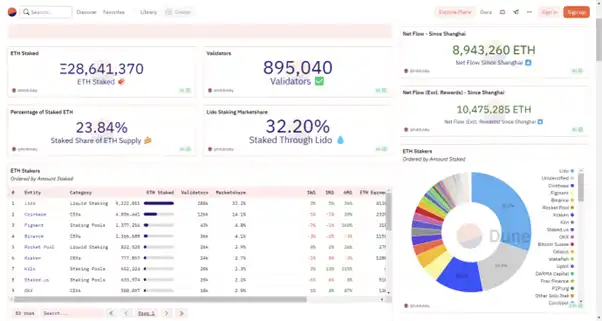
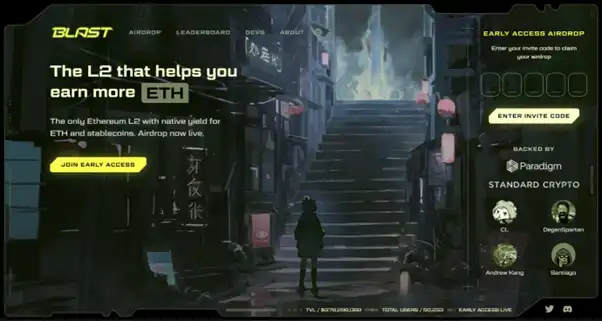
● If Blast is viewed as a novel "Stake Layer2", while users lock a large amount of ETH assets to earn profits, they also lock a large amount of liquidity. It is worth considering how Dapp applications in the Blast ecosystem can obtain liquidity and how to communicate new coin issuance expectations.
2. Technology and Consensus, which direction of Layer2 is more likely to be accepted by the market?
First of all, the main goal of blockchain is to solve trust and security issues in transactions. Once information is confirmed and added to the blockchain, it will be permanently stored. Unless someone has control over more than 51% of the nodes in the system, a single node cannot modify the data. The development of the industry relies on technological progress. From a technical perspective, Blast is not innovative, but rather a new approach. Strictly speaking, Blast does not belong to Layer2.
But the strongest essence of blockchain currently is still finance, with technology relying more on mathematics and code, while finance is mixed with more psychological expectations. Blast's greatest success lies in leveraging its own and Paradigm's strong traffic, and directly hitting users' expectations for project airdrops in a straightforward manner. Compared with other strong technical Rollups, Blast undoubtedly distributed them to users through Stake as a result of earning price differences through Gas, and liquidity is the soul of all public chain systems. Blast's expected airdrop has achieved a strong consensus in the short term. In the short term, strong consensus will still be bought by the market, but long-term maintenance requires more opportunities.
3. Investment firm Paradigm's research director Dan Robinson's implication?
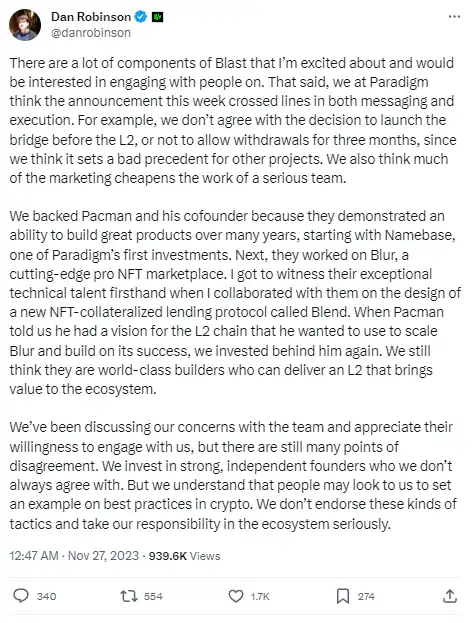
Source: X (Twitter) @danrobinson
Blast project decision disagreement:
● Order of bridging and L2: Paradigm mentioned that they do not agree with the decision to start bridging before L2. This may indicate that they believe that launching bridging before the L2 (Layer 2) solution is ready may pose risks that could affect the stability and security of the project.
● Three-month withdrawal restriction: Similarly, for the decision to not allow withdrawals within three months, Paradigm may consider this to set a precedent unfavorable to users, which may cause concern and dissatisfaction among users.
Worries about marketing methods:
The article mentions dissatisfaction with the marketing methods used for the Blast project, pointing out that these methods may lower the image of a serious team. Specifically, this may refer to problems with the promotion of the project or technology, which may be presented in an exaggerated or inaccurate manner.
Support for Pacman and the team in the past:
Paradigm reviewed their support for Pacman and their past work with partners, from Namebase to Blur and now Blend. This indicates that Paradigm has a certain level of trust in this team, based on their demonstrated technical abilities and track record of building excellent products over the past few years.
Support for L2 vision:
Paradigm emphasizes that they have had discussions with the Blast team, expressing their concerns, and the team has also shown willingness to communicate with them. This indicates that when difficulties or disagreements arise, both parties are willing to resolve them through dialogue.
Paradigm emphasizes their sense of responsibility in the encryption industry, stating that they are aware that people may value their approach in this field. They explicitly state that they do not support certain strategies and emphasize their serious approach to responsibility within the ecosystem.
Overall, this paragraph reflects some specific objections from Paradigm regarding the decision-making process of the Blast project, but also expresses their support for the past work of the Blast team and emphasizes their sense of responsibility in the crypto ecosystem. According to Wu's blockchain news, Pacman also tweeted to make some necessary clarifications:
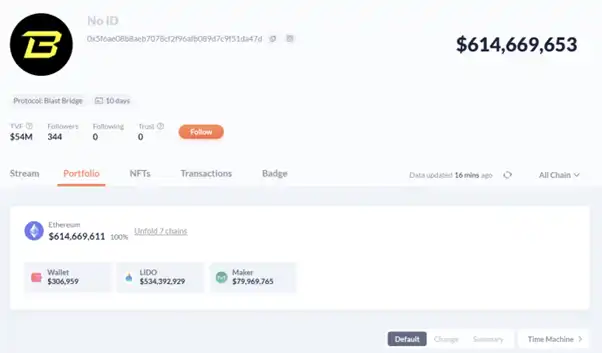
● Blast's high returns are not a Ponzi scheme. Its returns come from Lido and MakerDAO, which are based on Ethereum's staking returns and on-chain T-Bills. These returns are a core component of the on-chain and off-chain economy and are sustainable.
● The market strategy (GTM) is not related to Paradigm, although Paradigm provides consultation on technical L2 design, GTM is completely decided internally by Blast;
● The invitation system of Blast is not a new mechanism. The invitation system has existed for a long time. This mechanism aims to reward users who contribute to the L2 ecosystem and is a feedback to the community support. This is the reason why the invitation reward exists.
Note: This paragraph analysis only represents the author's personal opinion and does not involve guidance. If there are any objections, they can be ignored.
Data source: DeBank
5. New Task from ApeCoin
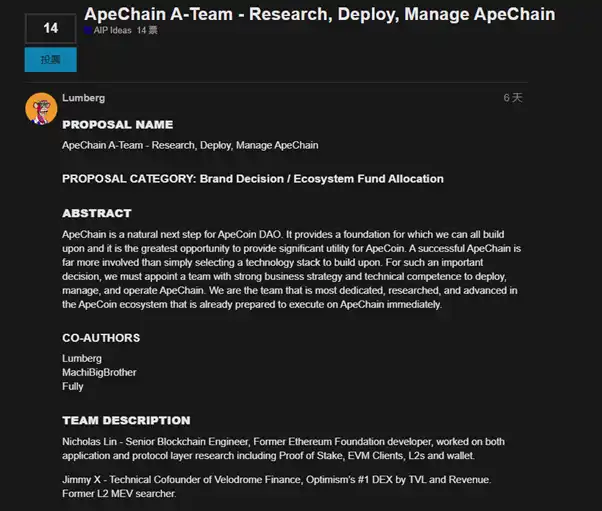
The original article mentioned a proposal called "ApeChain", which aims to promote research, deployment, and management of ApeChain in the ApeCoin DAO ecosystem (see original link [3]). The article stated that the team met with multiple technical solution partners and discussed the advantages and weaknesses of each solution to seek their support. After careful consideration by the project team, they chose to support Layer2 Rollups in order to better attract developers to build on ApeChain.
Its future development will be compatible with the Optimism Superchain ecosystem, and promises to provide basic token grants to help ApeCoin DAO participate in Superchain governance. Does this remind us of how Ape quickly caught up with a wave of hotspots by leveraging Blast's TVL siphon effect? The specific costs of the DAO include: infrastructure, business operations, developer relations, and ecosystem development.
The infrastructure includes:
● Blockchain browsers such as Blockscout, Etherscan, or open source alternatives like Otterscan;
● Oracle: Chainlink, Pyth or Redstone;
● The publishing fee for Layer 1 data in ETH.
● Directly launching ApeChain (AC) tokens without any cost for DAO;
【1】https://blockworks.co/news/ethereum-rollups-save-gas-fees
【2】https://twitter.com/eternal1997L/status/1729128004239216863
【3】https://forum.apecoin.com/t/apechain-a-team-research-deploy-manage-apechain/20163
Welcome to join the official BlockBeats community:
Telegram Subscription Group: https://t.me/theblockbeats
Telegram Discussion Group: https://t.me/BlockBeats_App
Official Twitter Account: https://twitter.com/BlockBeatsAsia



