Detailed explanation of native Bitcoin Layer 2 network LumiBit
15 years ago, Satoshi Nakamoto published the Bitcoin whitepaper and limited the block size to 1MB. Today, block size is still a hot topic among developers. The block size limits the maximum amount of transaction data that can be accommodated in each block. As the application scope of Bitcoin expands, network congestion, longer confirmation times, and higher transaction fees have become increasingly common.
To solve these problems, the community has proposed different scaling solutions. Some believe that block size should be increased, while others advocate for optimizing block structure or using sidechain technology. Of course, each of these solutions has its own advantages and disadvantages, and the community has been unable to reach a consensus, even leading to division.
The heat of the inscriptions has once again sparked community discussions about expansion issues. When exploring the inscriptions market, the short-term surge in engraving and trading volume of LBIT has attracted attention. All inscriptions were engraved within 2 hours, with gas fees exceeding 600,000 US dollars. After research, it was found that behind this is LumiBit, which is dedicated to Bitcoin expansion. This is a completely different solution from protocols such as Lightning Network, Stacks, and Liquid Network.
LumiBit's BTC nativeness
As the largest cryptocurrency consensus body, Bitcoin's native nature is of great significance for the trust and decentralization of Layer 2 solutions built on BTC. The stronger the native nature of BTC, the more closely Layer 2 solutions can be combined with the community, core consensus, philosophy and ideology of Bitcoin, thus possessing higher credibility, security and decentralization. Therefore, Layer 2 solutions can only expand the functionality and application scope of Bitcoin without compromising its basic principles by maintaining these native characteristics while providing faster transaction speeds and lower transaction fees. If the native nature of BTC is lost, then Layer 2 also loses its soil for growth, and it becomes increasingly distant from the BTC community. Not only can the security and decentralization characteristics not be guaranteed by relying on Bitcoin, but also if a BTC Layer 2 solution loses BTC community users and the largest cryptocurrency consensus, its development will inevitably not be sustainable.
Using the current Layer 2 solution on Ethereum as an example, one of the purposes of charging Gas fees is to pay for the cost of storing and processing data on the Ethereum network. For Layer 2, users' trust is not solely based on the technology of Layer 2 itself, but on its connection and interaction with the main chain. The core of this trust is that the information on Layer 2 can be stored and verified on the main chain. Users establish trust in Layer 2 through the reliability of the main chain and the connection between Layer 2 and the main chain. In this framework, LumiBit's strategy is not just to make users trust its own data processing capabilities, but to emphasize that users only need to trust the honesty and transparency of LumiBit in the data transmission process. This honesty can be repeatedly verified, and the reliability of its data relies on the trust foundation of the Bitcoin network.
LumiBit is committed to bringing more verifiable information back to the BTC mainnet, thereby strengthening its position as a true BTC Layer 2 solution. In this way, LumiBit not only emphasizes respect for and utilization of Bitcoin's native features, but also ensures the credibility and transparency of LumiBit's on-chain data, thereby establishing its trusted position as a BTC Layer 2 solution in the cryptocurrency field.
LumiBit's top-level design for BTC's native features includes a full life cycle structure for users to operate wallets, call wallets, cross-chain assets, and DA:
- Support for native Omni wallet account control: LumiBit, unlike other EVM-compatible BTC Layer2 solutions, has made the biggest progress in user experience by allowing users to interact with the chain only through their BTC wallet. No longer do users need to prepare multiple wallets (such as Metamask), only a Bitcoin wallet is needed, whether it is Unisat or Xverse, to complete cross-chain transactions, use Dapps, and more. This feature respects the usage habits of Bitcoin users and provides a familiar and secure environment for them.
- UTXO-based cross-chain bridge: LumiBit uses a unique UTXO channel for cross-chain bridging. The cross-chain between users and LumiBit is abstracted as a channel, and the validation of the channel represents the validation of the user's cross-chain action. Since the process of channel validation is stored in UTXO, the validation of the channel also represents the validation of the user's state in LumiBit, thus achieving the validation of the user's state on the BTC mainnet. When the channel is closed, the initial UTXO is consumed based on the final state update, and LumiBit creates new UTXOs based on the user's state. These new UTXOs reflect the Bitcoin balance that the user requested when the channel was closed and the final state on the LumiBit chain. At the same time, the smart contracts running on the LumiBit chain interact with users to generate new states. Therefore, the state updates can also be validated on the BTC mainnet through the user's UTXO state update, completing the BTC mainnet validation of all states on the LumiBit chain.
-Data availability (DA) on the Bitcoin mainnet: The data availability problem in Bitcoin Layer2 is how to upload, publish, and verify data in a way that is affordable and effective for the Bitcoin network. Since transaction data in Rollup is sent to Bitcoin in aggregated form, the size of transaction data aggregated in Rollup will be limited by the block capacity of Bitcoin. Without increasing the block capacity of Bitcoin, using more efficient data compression and proof verification methods is the only choice. LumiBit uses the Halo2+FRI zero-knowledge proof scheme to generate proof of transaction validity. ZK-EVM generates zero-knowledge proofs for each transaction's state change after executing the user's transaction, and only when the transaction is valid and can be executed normally will the zero-knowledge proof be generated. LumiBit migrates the complexity of verification and proof generation from the chain to off-chain, reducing not only the cost of data storage on Bitcoin Layer1 but also the cost of submitting transactions for users on Layer2.
- Support for Engraving Calls: The platform supports engraving calls, allowing users to interact with and utilize Bitcoin's native features. All call data is stored on the BTC main chain and transactions are executed through engraving. When publishing a transaction, users only need to engrave the inscription and broadcast it on the BTC network. After confirmation on the BTC network, LumiBit will immediately run and settle the transaction on the LumiBit network.
-Using BTC as Gas: Perhaps the most important aspect of the LumiBit method is the use of BTC itself as the "gas" for transactions. This not only simplifies the transaction process within the Layer 2 framework, but also achieves a closed loop in which the native features of Bitcoin become the core of LumiBit's operation. By using BTC as gas, LumiBit aligns the incentives of its Layer 2 protocol with the Bitcoin network, ensuring that the value and demand of BTC are directly linked to the activity within the LumiBit ecosystem.
The Scaling History of Bitcoin, and the Arrival of Type2 ZK-EVM
Previously, the common scaling methods for Bitcoin were state channels and sidechains.
State channels, represented by Lightning Network, also have many drawbacks, such as inability to handle complex contract calculations, fund locking and security risks, and inability to provide a thriving on-chain ecosystem for Bitcoin.
Later, Bitcoin sidechains such as Liquid Network and Rootstock began to emerge, running parallel to the Bitcoin mainnet and communicating with Bitcoin through bidirectional bridges. However, due to their independent consensus rules and data storage structures, the data availability (DA) of sidechains is not guaranteed by the Bitcoin network, and in extreme cases, there is a certain risk to user assets.
Unlike Bitcoin's slow development in scaling, the scaling market of Ethereum is developing rapidly. However, the mainstream solution for Ethereum's scaling is to use Rollup Layer2. According to L2BEAT data, Ethereum's Layer2 TVL has exceeded $22.5 billion.
Bankless co-founder David Hoffman once said that the era of EVM equivalence has arrived. When David said this, he may not have thought that Bitcoin may also usher in the era of EVM equivalence, capturing the ecological value of Ethereum.
LumiBit is a new Bitcoin L2 solution that achieves low fees, high performance, and fast confirmation transactions through ZK-Rollup. LumiBit adopts the technology solution of Scroll, which is Type2 ZK-EVM and can be regarded as fully equivalent to EVM. Vitalik once divided ZK-EVM into four types in a paper, among which Type2 is fully compatible with EVM, and the transaction execution and account logic are consistent with EVM, only with differences in block structure and state tree compared to Ethereum.
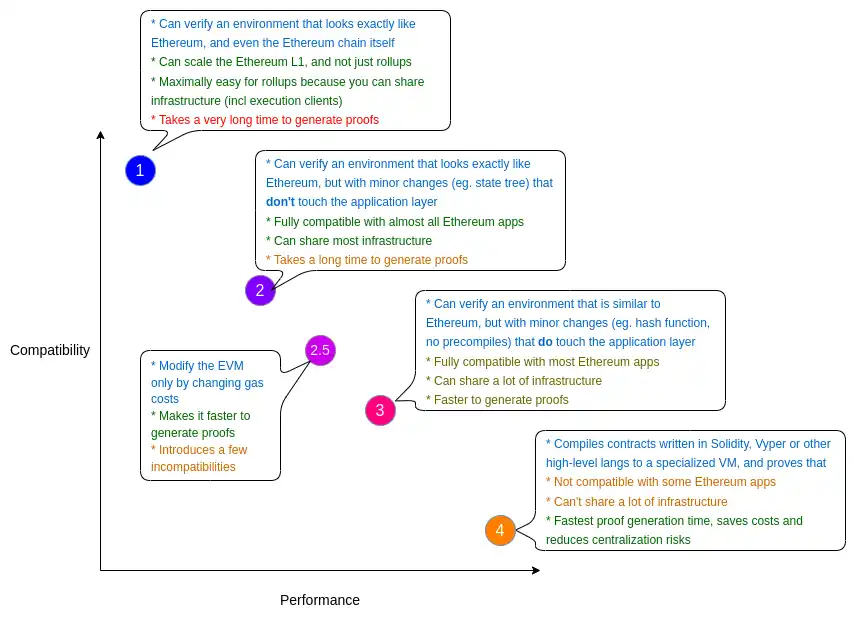
Source: Vitalik
LumiBit's Type2 ZK-EVM is based on a universal circuit design, and the EVM layer ensures full compatibility with the Ethereum ecosystem. In addition, considering the differences between Bitcoin and Ethereum states, a state tree update plan more in line with Bitcoin's UTXO has been adopted. At the same time, Bitcoin will act as a DA, and user transactions, LumiBit's historical transaction status, and global account status will be generated by the zero-knowledge proof generator to produce corresponding root proofs, which will then be packaged and transmitted back to the Bitcoin mainnet. Bitcoin's massive computing power structure will ensure the security of LumiBit's L2.
Compared with ZK-Rollup and similar solutions, LumiBit differs in that its zero-knowledge proofs for transactions will be generated based on Halo2 + FRI, and will use polynomial commitments to reduce verification costs. Halo2 is a zero-knowledge proof system that belongs to zk-SNARK and can be used to generate concise non-interactive proofs to verify the validity of transactions. FRI belongs to the STARK proof system and is used to construct and verify proofs related to complex polynomial data. This means that LumiBit integrates the advantages of both STARK and SNARK.
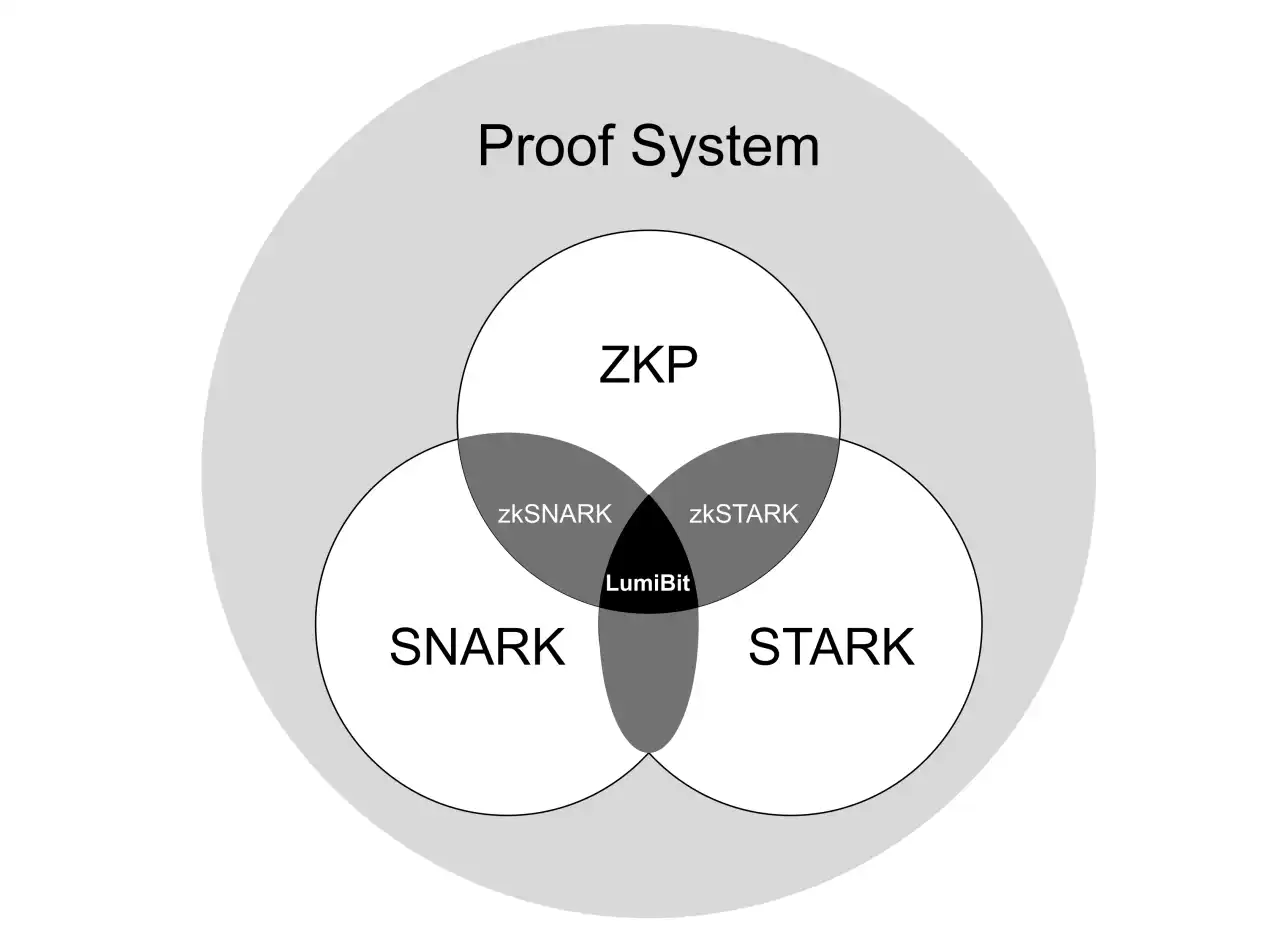
Source: LumiBit
Currently, Type2 ZK-EVM is considered a leading solution in the market, but there is still some gap from the native Ethereum environment. To ensure 100% migration of all Ethereum ecosystems, it is necessary to implement Type1 ZK-EVM, which is completely equivalent to Ethereum. LumiBit has also proposed the concept of Type1 ZK-EVM based on Type2 ZK-EVM, which abstracts another layer of Type1 ZK-EVM on L2. The execution results of transactions are returned to Type2 ZK-EVM, and then LumiBit updates the state to the Bitcoin network, indirectly achieving Type1 ZK-EVM through a three-layer structure.
Bitcoin Ecological Explosion Eve
LumiBit is not only bringing scaling solutions to Bitcoin, but also attempting to disrupt the current market for encrypted transactions.
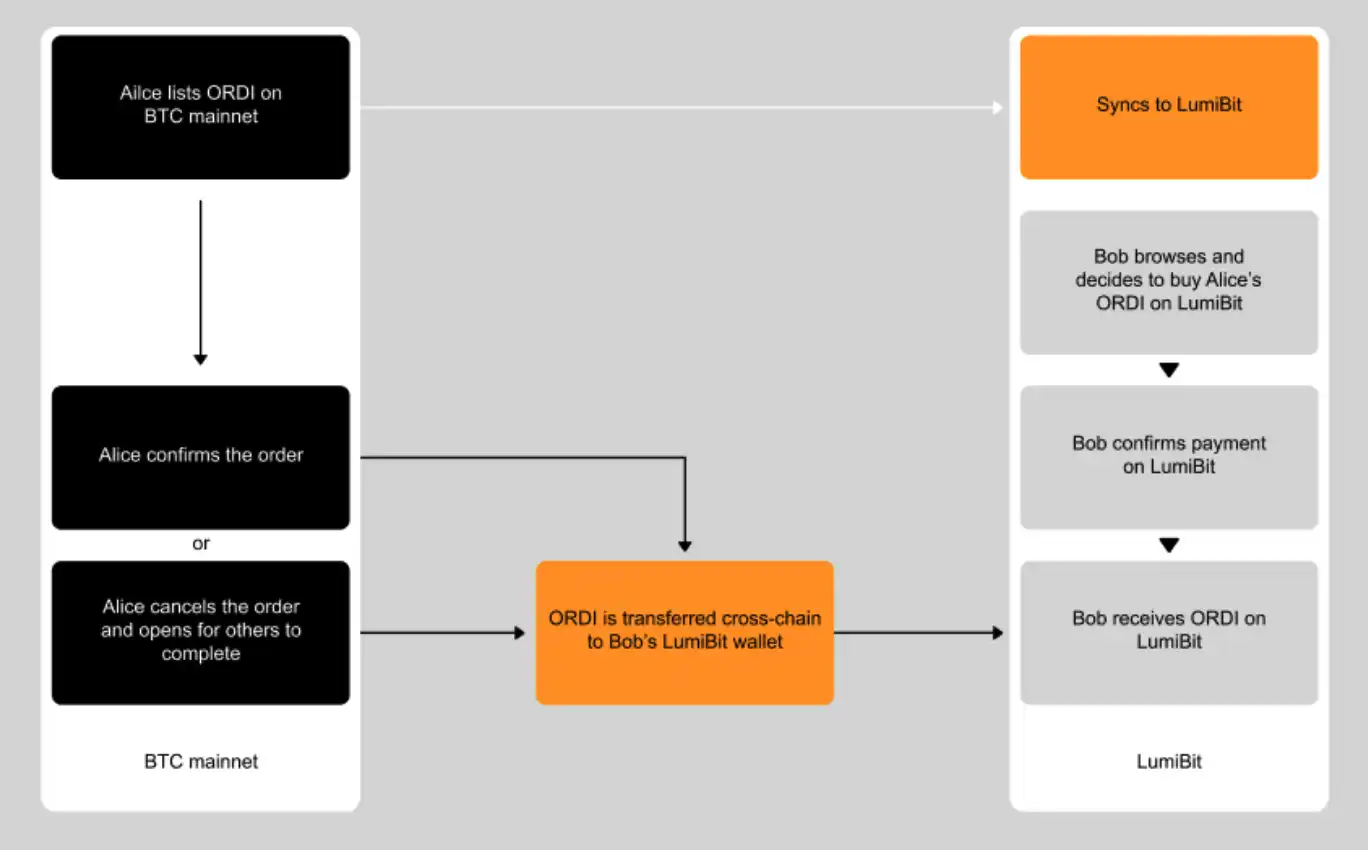
Welcome to join the official BlockBeats community:
Telegram Subscription Group: https://t.me/theblockbeats
Telegram Discussion Group: https://t.me/BlockBeats_App
Official Twitter Account: https://twitter.com/BlockBeatsAsia