The Ten Principles of Economics: Understanding the Basic Laws of Economic Behavior and Decision-Making.
Original author: Cryptocurrency Master
Editor's note: Cryptocurrency blogger Crypto Master introduced the ten principles of economics on X. Understanding basic principles and laws is essential for better understanding the market. BlockBeats has compiled the full text as follows:
This article will introduce the ten principles of economics, explore their historical background and related examples, and explain their importance in economic operation.
One, Historical Origin
The formation of the ten principles of economics can be traced back to economists such as Adam Smith in the 18th century.
During this period, the Industrial Revolution brought about significant economic changes, and people began to think about how to better understand and manage economic activities.
Adam Smith's "The Wealth of Nations" is a milestone in economics, which includes some basic principles of economics, such as division of labor and trade. Over time, economists have gradually developed more principles based on these foundations, forming the framework of the ten principles of economics.
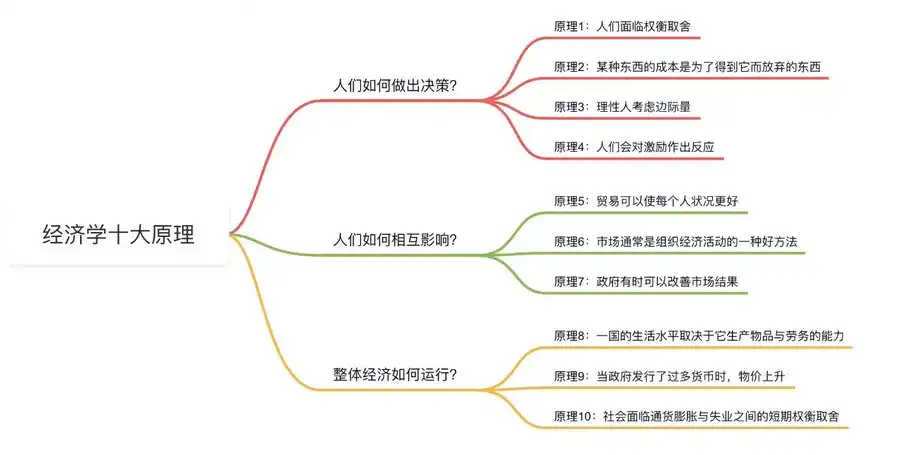
二、十大原理概述
translates to
2. Overview of the Ten Principles
in English.
1. People face trade-offs
When people form a society, they face various trade-offs.
Typically, it is a choice between "guns and butter", where when a society spends more on defending its coastline from foreign invasion (guns), there is less spending on consumer goods that improve domestic living standards (butter).
In modern society, it is equally important to balance the trade-off between a clean environment and a high income level.
Realizing that people face trade-offs does not tell us what decisions people will or should make.
However, it is important to recognize the trade-offs in life, because people can only make good decisions when they understand the choices they face.
2、某种东西的成本是为了得到它而放弃的东西(The cost of something is what you give up to get it)
2. The cost of something is what you give up to get it.
The opportunity cost of something is the thing that is given up in order to obtain that thing.
When making any decision, such as whether to go to college, the decision maker should recognize the opportunity cost that comes with each possible choice.
Actually, decision makers are usually aware of this.
Athletes who reach college age and choose to drop out to pursue professional sports can earn millions of dollars. They realize that the opportunity cost of attending college is extremely high. They often decide that it is not worth the cost to obtain the benefits of attending college, and this is not surprising.
3、Rational people think at margin
Marginal quantity" refers to the amount of change in an economic variable under certain influencing factors.
Economists use the term "marginal change" to describe small incremental adjustments to existing action plans. Marginal change is the adjustment around the edge of what you are doing.
Individuals and businesses will make better decisions by considering marginal quantities. Moreover, only when the marginal benefit of an action exceeds the marginal cost, a rational decision maker will take that action.
4、People respond to incentives
Due to people making decisions based on comparing costs and benefits, when the costs or benefits change, people's behavior will also change. This means that people will respond to incentives.
However, policies sometimes have subtle effects that are not immediately apparent. When analyzing any policy, we should not only consider its direct impact, but also its indirect impact through incentives. If a policy changes incentives, it will cause people to change their behavior.
5、贸易可以使每个人状况更好(Trade can make everyone better off)
5, Trade can make everyone better off
Perhaps you have heard in the news that Japanese people are competitors of Americans in the world economy.
Actually, trade between the two countries can make the situation better for both countries.
In a sense, every household in the economy competes with all other households. Despite this competition, isolating your household from all others will not make everyone better off. By trading with others, people can obtain a variety of goods and services at lower costs.
By improving productivity, technological innovation, and optimizing resource allocation, a country can achieve economic growth and improve social welfare.
Four, Summary
By understanding these principles, we can better explain and predict economic phenomena, and provide guidance for the formulation of economic policies.
By introducing some historical background and specific examples, we can better understand these principles and apply them to practical situations.
Original Link
Welcome to join the official BlockBeats community:
Telegram Subscription Group: https://t.me/theblockbeats
Telegram Discussion Group: https://t.me/BlockBeats_App
Official Twitter Account: https://twitter.com/BlockBeatsAsia
 Related Articles