Innovation beyond Ordinals: The Rise of Stamps and SRC-20 Tokens.

Original Title: "Bitcoin Stamps Explained"
Original Author: WILLIAM M. PEASTER
Original Source: banklesshq
Translated by: Deep Tide TechFlow
Recently, Ordinals has triggered an explosive growth in the tokenization of "Inscription" on Bitcoin (and other chains).
However, there is another relatively new Bitcoin tokenization protocol - Stamps, which has recently been gaining attention.
Have you not heard of Stamps or SRC-20? Don't worry. In today's article, let's learn about how Stamps works, how it differs from Ordinals, and how to enter this field!
The Rise of Bitcoin Stamps
The Bitcoin Stamps system was released by Mike In Space in March 2023 and was initially a proof-of-concept project on Counterparty (a Bitcoin L2 that has existed since 2014). Due to updates to its underlying protocol, Stamps has fully transitioned to Bitcoin and is now known as SRC-20, which was renamed last summer.
Founder Mike originally envisioned Stamps as a way to mint permanent Bitcoin NFTs. However, the protocol has since expanded to replicate BRC-20, a batch fungible token. Since Casey Rodarmor introduced Ordinals in January 2023, this token has flourished on Bitcoin due to the rise of the inscription craze.
The main difference between Stamps and Ordinals lies in their architecture. This is because Stamps store their metadata in the Unspent Transaction Outputs (UTXOs) of multi-signature transactions, while Ordinals store their metadata in the "witness" section of Bitcoin transactions.
The design differences between the two are evident in the choices made by the developers. Stamps' UTXO method makes them unprunable, making them appear permanent despite their higher manufacturing costs compared to Ordinals' casting. Conversely, Ordinals use witness data to eventually make them prunable, resulting in lower manufacturing costs compared to Stamps.
Therefore, although Ordinals may offer the best persistence cost ratio for NFTs in the current encryption field (chain-based NFTs can also be obtained on Ethereum, but their construction cost is relatively higher than that of Ordinals), Stamps currently seem to provide the best direct permanent guarantee.
However, not everyone thinks that these Stamps and Ordinals are completely harmless!
For example, old-school and hardcore Bitcoin supporters like Luke Dashjr have recently launched attacks on Ordinals and Stamps, calling them spam attacks against Bitcoin. As for Dashjr himself, his newly established Ocean mining pool has been set up to filter out inscription and Stamps transactions, and he has also proposed the idea of changing Bitcoin to another Proof of Work (PoW) algorithm to resist Bitcoin miners who support NFTs.
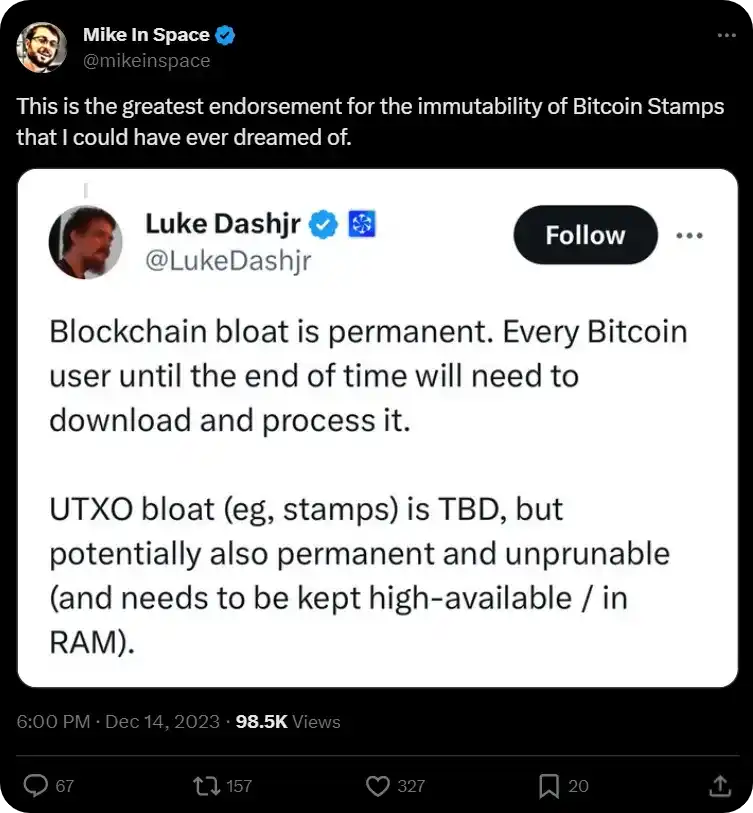
Perhaps the Bitcoin community will split again due to these differences. Another war over block size may be coming, with one side being the technology innovation faction that supports Ordinals and Stamps, and the other being the conservative faction that believes "Bitcoin is just a currency".
However, at present, Dashjr's recent comments are just adding fuel to the fire, as the attention and activity surrounding Stamps seems to have reached a new historical high in recent days. In fact, the first and second Stamps ever sold were bundled together for 1.7 bitcoins (approximately $150,000), indicating a surge in interest.
Of course, the Stamps market may go through cycles of prosperity and decline like any other asset, but regardless, this technology is legitimate and noteworthy. What makes Stamps interesting is not only their permanence, but also because they provide a new token standard like Ordinals, opening up new possibilities for Bitcoin that did not exist before.
Smart contract platforms like Ethereum and Solana have enjoyed native token standards for years and have little need for such technologies. Instead, as advanced technologies such as Ordinals and Stamps begin to emerge and unleash unprecedented demand, the Bitcoin ecosystem will explode in 2023.
In other words, it is currently the revival period of Bitcoin. So, assuming you have already tried Ordinals, how do you explore Stamps?
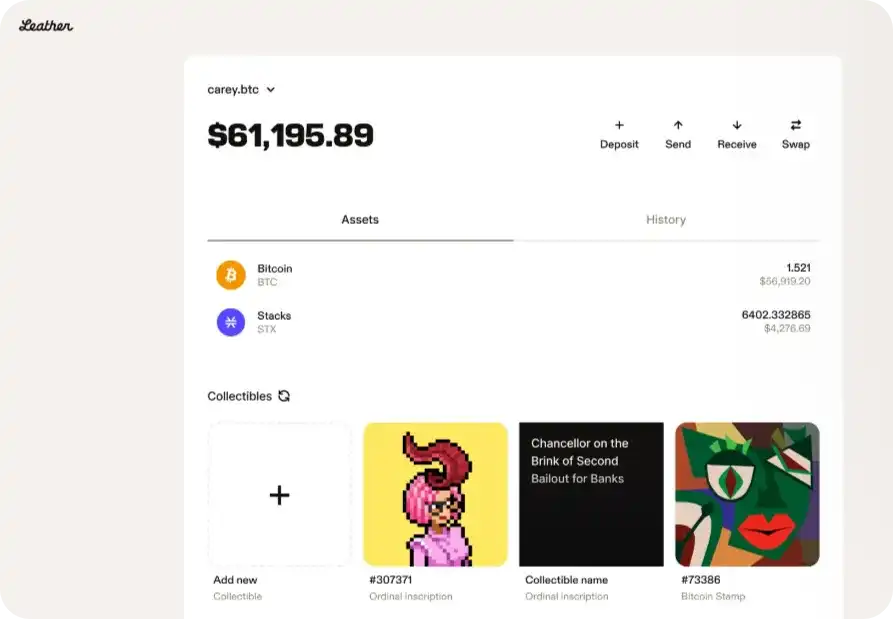
In terms of wallets, I suggest starting with a Bitcoin wallet like Leather (formerly known as Hiro), which supports Ordinals and Stamps as well as BRC-20 and SRC-20. If you have experience using browser wallets like Coinbase Wallet, MetaMask, or Rainbow, you will find using Leather very convenient. Although it is Bitcoin-centric, it provides a user experience similar to these mainstream products.
In other words, no matter what you do, it is recommended that you do not use an old Bitcoin wallet to research Stamps. If you try to use incompatible wallets to access assets, you may lose them!
Once you have prepared the corresponding Bitcoin wallet, you can start looking for Stamp NFT minting or SRC-20 tokens. OpenStamp is a platform where you can currently perform both operations simultaneously, but you can also consider some early markets, including RareStamp, Stampscan, and StampedNinja. If you are interested in minting your own Stamps, you can try the Stampsbot platform.
In the end, whether Stamps will become a permanent part of the encrypted ecosystem is still an undecided question. However, the current popularity of Stamps and the new possibilities they introduce for Bitcoin cannot be ignored. Combined with Ordinals, Stamps may lead to a more prosperous innovative scene for Bitcoin in the coming years, which also means more disputes with Bitcoin extremists who hate JPGs.
Original article link
Welcome to join the official BlockBeats community:
Telegram Subscription Group: https://t.me/theblockbeats
Telegram Discussion Group: https://t.me/BlockBeats_App
Official Twitter Account: https://twitter.com/BlockBeatsAsia
 Related Articles