Etherscan’s Istanbul Devconnect Insights
Original Title: "Learnings from Devconnect Istanbul"
Source: Etherscan Blog
Translated by: 0x26, BlockBeats
The second Devconnect event held in Istanbul took place from November 13th to 19th, with more than 3500 people attending. Istanbul is known for its vibrant and rich cultural history. The Ethereum community organized more than 70 independent events in different locations throughout the city. You can check out the review from the Devconnect team for more details.
In this article, we will share the three key themes of the entire event: "Programmable Cryptography", "Enhancing User Experience", and "Expanding Ethereum" to promote higher transaction throughput while maintaining low transaction fees for real users.
Enhance User Experience
The current main challenge is to simplify the process of user access to the Ethereum ecosystem. The current process involves many tedious steps:
First, users need to have Ether (ETH) in their wallet. For new users, figuring out how to fund their wallet can be tricky. Additionally, they may encounter expensive gas fees for transactions over $10, which causes many people to give up at this step.
Users may want to know if there is a more cost-effective chain available. If so, how can they switch networks? Once users figure out how to switch networks and fill their wallets with enough ETH, they will encounter another obstacle, which is that the protocol they are interacting with does not use the same network as the current one. Now users need to know how to transfer funds across chains, "this is really fascinating".
All of these complexities must be effectively abstracted to ensure that real users do not spend too much time dealing with them.
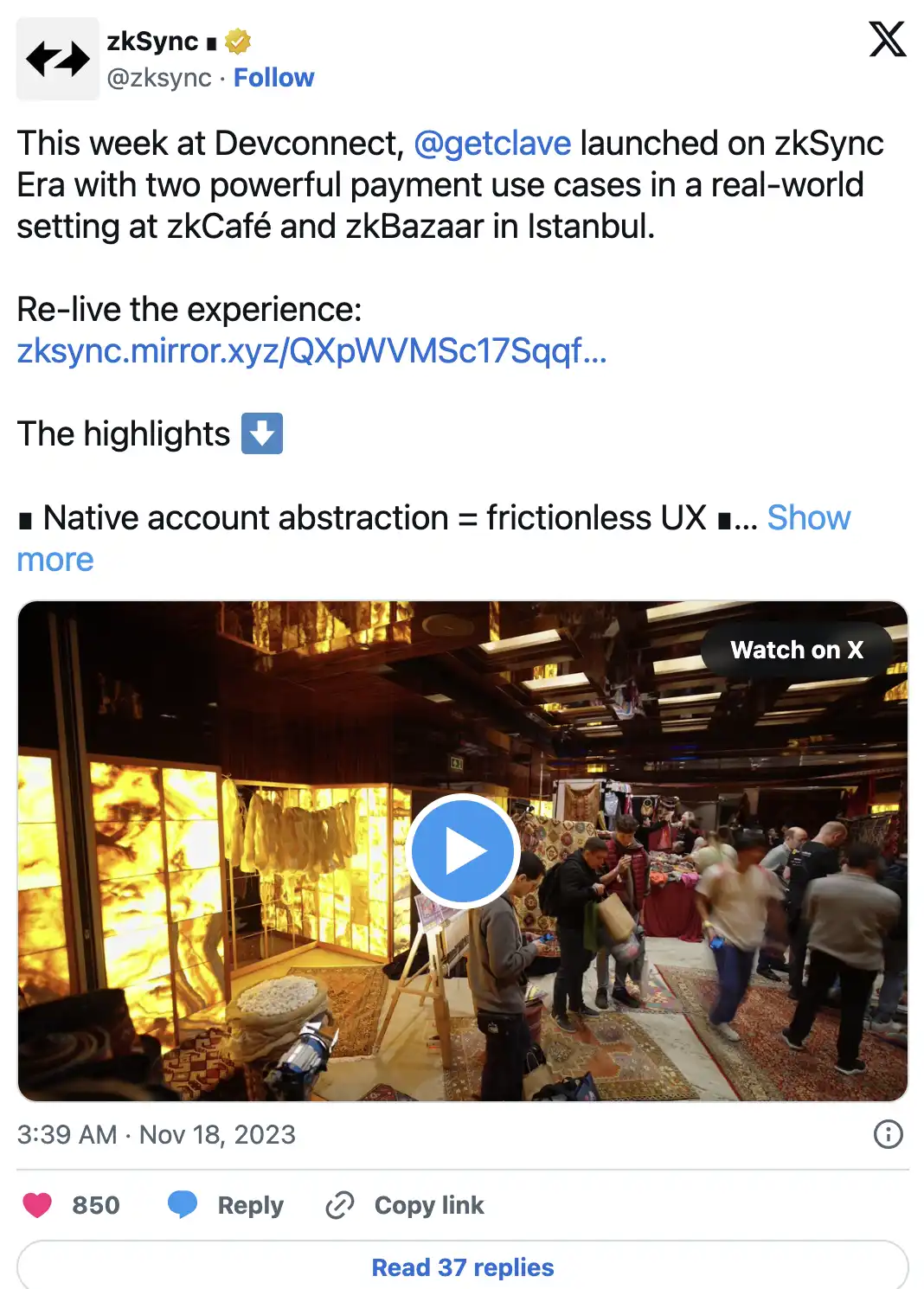
During the event at zkBazaar, I had a refreshing experience where I received a wallet with test network ETH and was able to purchase Turkish souvenirs with it. The atmosphere at zkBazaar was lively, and people happily picked out their favorite scarves, ceramic bowls, blue evil eye talismans, soap, spices, and baklava - all of which could be conveniently paid for using a cryptocurrency wallet.
I was surprised to find that no Gas fees were deducted from my wallet for each transaction. This means that I don't have to worry about leaving a balance or dealing with decimals, and can purchase exactly what I want, especially since most items are priced in whole numbers.
The payment process was fast and I didn't encounter too many difficulties. Overall, it was a pleasant experience. You can revisit this experience here:
The finalist of ETHGlobal Istanbul, BridgeBuddy, developed a chain-agnostic wallet that automatically performs cross-chain asset transfers as needed. The project improves user experience by simplifying the complexity associated with various EVM-compatible chains.
Unlike managing and executing cross-chain processes where users need to be aware of and manage funds on each chain, this wallet simplifies everything by organizing and displaying all assets. When a transaction requires funds on a specific chain, the wallet seamlessly crosses the required amount before executing the transaction, achieving a smooth and effortless process through account abstraction.
Expand Ethereum
In order to improve user experience, it is necessary to expand Ethereum and increase block space supply to support higher transaction throughput and reduce actual user usage costs.
Despite the fact that Devconnect's activities are independently organized, if there is a common vision, it is to strive to expand Ethereum. "Battle of the L2s" brings together top teams developing scaling solutions on top of Ethereum, sharing their insights on the constantly evolving L2 ecosystem.
As a Rollup-as-a-Service (RaaS) provider, they aim to make it easier to launch a new project on a chain, whether it is an application-specific or general-purpose chain. These Rollups can be configured with different base Gas currencies, custom precompiles, and opcodes. In addition, these providers are also experimenting with account abstraction wallets to enable application-specific chains to offer their users gas-free transactions.
Against the backdrop of expanding Ethereum, data availability remains a crucial topic. With the increase in transaction throughput, the amount of data that needs to be sent back to Ethereum will inevitably surge. Frequent sending of large amounts of data back to Ethereum will become extremely expensive.
There is no one-size-fits-all technology stack for all L2 solutions. Each team has its own unique perspective on building the chain that best suits their chosen use cases. This choice often involves making decisions between optimistic and validity rollups, as well as choosing different data availability layers such as Celestia and Eigen DA.
Due to the large number of L2 running on Ethernet, it is necessary to establish appropriate front-end standards to ensure that users are fully aware of this trade-off when using different L2.
可编程密码学
translates to
Programmable Cryptography
in English.
The Programmable Cryptography Conference (Progcrypto) is a two-day event organized jointly by the Privacy, Scalability, and Exploration (PSE) team of the Ethereum Foundation and 0xPARC. It covers various topics including programmable cryptography, multi-party computation, fully homomorphic encryption, indistinguishable obfuscation, and a focus on decentralized interface technology rather than centralized servers.
However, what exactly is programmable cryptography? It is a new generation of cryptography that allows developers to write any function on top of cryptographic primitives (such as ZK proofs). This enables us to move from verifying specific statements to verifying any statement that can be expressed mathematically. Please listen to gubsheep's introduction to programmable cryptography in this presentation.
可编程密码学以两种方式降低高级别安全性的成本:
1. Cheap in terms of verification cost (using ZK-SNARKs).
2. Save development time (developers only need to write programs for new applications, without creating brand new cryptographic security protocols).
You can listen to Vitalik's speech on cryptography as a defense technology here (d/acc).
Participants of Devconnect can use ZuPass, an open-source tool built by developers from Devconnect and the Zuzalu community, to verify their attendance at shared workspaces and Progcrypto conferences without revealing personal information.
Welcome to join the official BlockBeats community:
Telegram Subscription Group: https://t.me/theblockbeats
Telegram Discussion Group: https://t.me/BlockBeats_App
Official Twitter Account: https://twitter.com/BlockBeatsAsia

 Related Articles