Check out the 7 protocols that are about to be upgraded to gain potential benefits in the bull market

Original title: 《Top 7 Upcoming Protocol Launches & Upgrades》
Original author: Ignas
Original translation: TechFlow
The cryptocurrency market is picking up, and the question is: what should we invest in?
Certain tokens like MUBI have shown high returns, but require keen wisdom and close attention to community trends to invest in time. However, there are other tokens that can provide higher returns over a longer period of time because they involve the development of Web3 technological innovations. These projects allow us to discover it before the price rises and then invest.
The following is a list of 10 protocols that I am following that are about to have a major launch. I will pay attention to what these projects are about to launch and also explain why I am interested.
1.Frax V3 and Fraxchain
Frax is rated D (unsafe) in the ranking of non-profit stablecoin rating agencies.
According to the report, Frax is unsafe because it is collateralized by volatile FXS tokens, over-reliance on centralized assets (USDC), and the core team's significant control over voting rights and monetary policy.
Like DAI, FRAX also lost its dollar peg during the USDC decoupling, but Frax has now made the transition through v3.
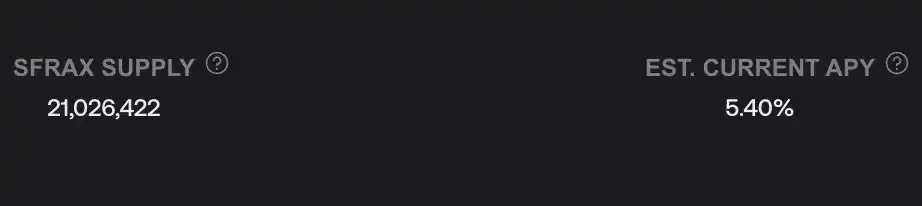
Frax v3 is being rolled out gradually, and sFRAX is already online. The sFRAX annualized yield attempts to track the US Federal Reserve's deposit reserve balance (IORB) interest rate, using the IORB oracle. It can basically be called the "risk-free rate" on the chain.
The current annualized yield is 5.4%, with about 22 million FRAX collateralized.
With the launch of Frax v3, FRAX is moving away from the algorithmic stablecoin system and transitioning to 100% collateralization. FRAX will be pegged to the US dollar through Chainlink oracles and governance approval.
Then there is the launch of BAMM (Lending AMM). Curve founder Michael called Frax's BAMM "the biggest innovation in the DeFi field since crvUSD."
BAMM allows users to leverage any token without an oracle. It operates within its ecosystem, managing asset prices and liquidity internally to prevent bad debts and ensure solvency. BAMM allows for efficient use of capital and increases demand for FRAX. Check out this thread for details.
To be honest, I still don't quite understand how it works, so expect to dig deeper as more details come out.
There are also FXBs, which are debt utility tokens that are convertible to Frax after a certain time. You can buy FXBs at a discount and then convert them to Frax for a low-risk profit.
Interestingly, Frax and Maker are both moving away from USDC to embrace RWAs, starting from different starting points. RWAs allow protocols to move away from leveraged stablecoin recycle requirements, providing more predictable returns.
Another point of similarity between the two protocols (Frax and Maker) is that they are both launching their own native blockchains.
MakerDAO is exploring forking Solana, but Frax is building a hybrid OP and zk Rollup and will use frxETH as a gas token (but potentially all Frax stablecoins will be supported). I applaud Frax for its innovative move towards decentralization, which sets Fraxchain apart from other L2s. Fraxchain is already on testnet, you can try its tutorial here on Frax Telegram.
Why am I bullish on this project?
Frax is building a premium blockchain ecosystem, and with more upgrades and technological innovations, the veFXS token will also have a higher value.
These developments take time, so I believe the current market price (FXS has a market cap of $647 million) has not been affected by the upcoming RWA+L2+BAMM upgrades, and the price may rise later if these events are anticipated.
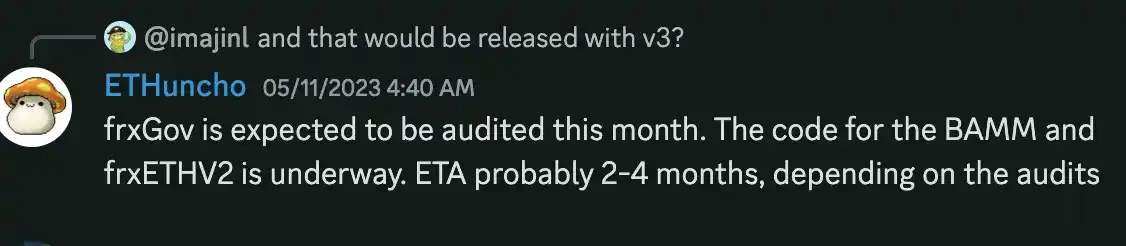
sFRAX is live, Fraxchain is on testnet, BAMM/frxETH v2 code is in progress and expected to be completed in 2-4 months.
2. Synthetix Andromeda version and eliminating inflation of SNX
Synthetix is gradually upgrading to V3 to solve multiple project pain points, but there are two pain points that stand out to me:
· Multi-collateral pricing: V3 is collateral-agnostic and allows any collateral to be supported to support synthetic assets. V2 only allows SNX. This will increase the liquidity of sUSD and the markets supported by Synthetix.
·Synthetix Lending: Users can now provide collateral to the system to generate sUSD without taking on the risk of a debt pool and without paying any interest or issuance fees.
This month’s upcoming Andromeda release includes the launch of Core V3 and Perps V3 Base, using USD as collateral.
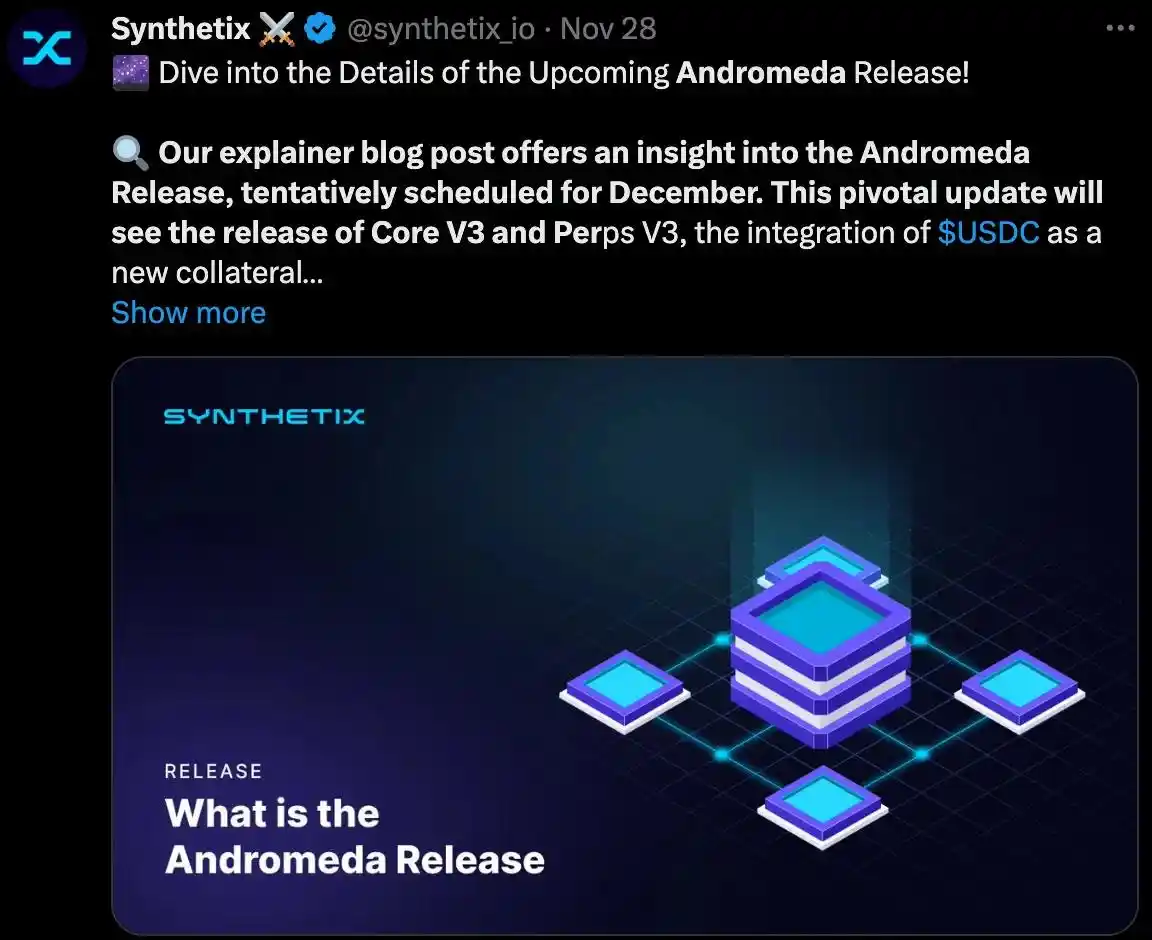
Previously, Synthetix relied on sUSD, but the addition of USDC should attract more users and LPs. However, USDC is used for front-end integration, and Synthetix wraps it into sUSD for use in back-end Synthetix contracts.
Andromeda is exclusive to Base and an important upgrade to follow, as it will test demand for USDC as collateral, LP returns, and fees/volume generated.
Multiple Synthetix ecosystem protocols such as Polynomial, Kwenta, Infinex, and dHEDGE have confirmed deployments on Base, so there will be more action on Coinbase L2.
Why am I bullish on this project?
Synthetix DAO voted to use 50% of the fees earned on Base to buy back and burn SNX, so if the fees are high, it will put upward pressure on SNX.
More importantly, the founders of Synthetix have proposed ending inflation of the SNX token.
Initially, inflation was used to incentivize subscriptions and increase liquidity, but over time, it has become less and less effective. The proposal argues that making SNX deflationary by stopping inflation is more in line with the future development of the network, including potential new developments and a shift in primary collateral.
Base deployment is therefore an important test for SNX, and I will be keeping a close eye on trading volumes and the project's proposals to eliminate inflation.
3. Fluid in Instadapp
I am bullish on the Instadapp ecosystem.
The team has already launched multiple products, such as Instadapp Pro, Lite, and Avocado, but the most important product is coming soon.
Instadapp combines the best of Uniswap, Maker, Compound, Aave, and Curve to change the way Fluid lends and trades.
Below is a quick overview of the main innovations from my twitter thread about Fluid.
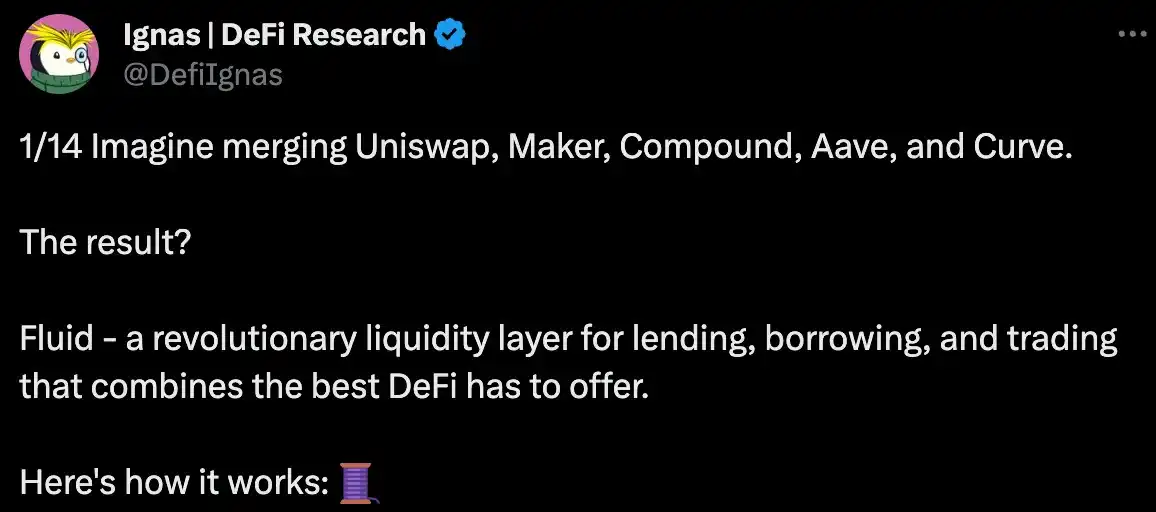
· Lenders can lend up to 95% LTV in ETH and reduce liquidation penalties to 0.1%
· Partial liquidations only liquidate the amount needed to return to a healthy state
· The liquidity layer aggregates liquidity from all protocols so users don’t need to remove liquidity on every upgrade
· Smart Debt and Smart Collateral, earn money on your collateral, or reduce debt from transaction fees generated. So instead of adding to your debt through fees, traders can now trade on top of your debt, and the debt goes down.
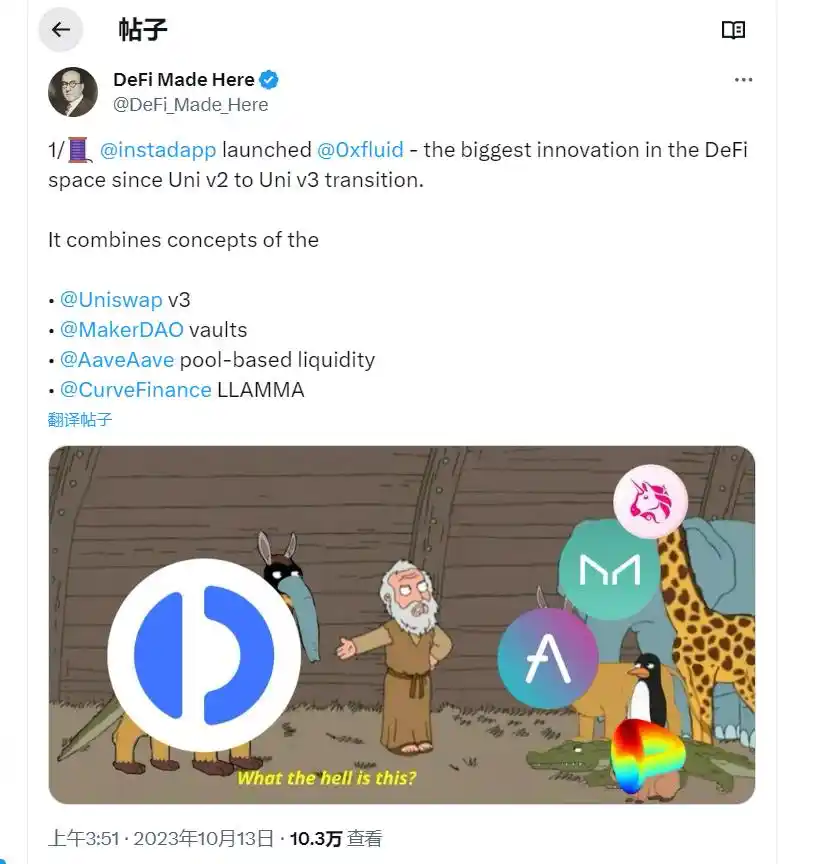
Another post from DeFi Made Here on why he believes "Fluid is the biggest innovation in the DeFi space since the transition from Uni v2 to Uni v3."
Why am I bullish on this project?
Obviously, as an ambassador for Instadapp, I have a personal bias. But we can't ignore the significant innovation of Fluid. With Fluid (and Avocado), Instadapp will transform from a "middleware" protocol (aggregator of other DeFi protocols), and the role of the INST token will be strengthened.
INST will manage Fluid in a similar way to other lending protocols such as Aave.
Fluid is expected to launch in mid-December, with a $500k bounty for hackers, and will be launched to the public in mid-January.
4. Eigenlayer + LRT
If you are a loyal reader of mine, you will know why I am bullish on Eigenlayer, but now we have a more detailed timeline.
Eigenlayer launched the second phase test network, providing Restakers like you with the opportunity to delegate to operators.
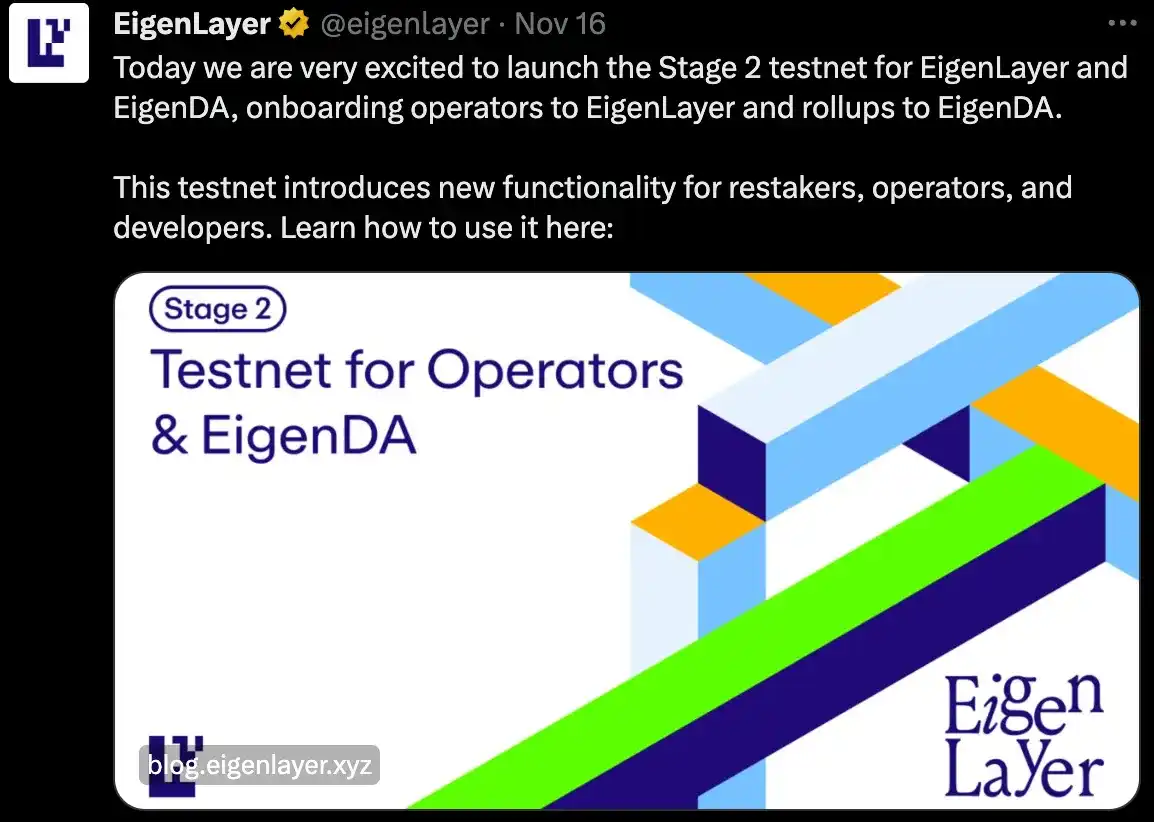
These operators will verify Actively Validated Services (AVS), which is also the basis for my bullish LRT (liquid re-staking) token.
At this stage, EigenDA is the first and only AVS. Rollups can integrate EigenDA to increase throughput.
As new AVS emerge, we will witness the expansion of Ethereum's shared security use cases. Here are a few examples: · Ethos: Ethereum’s hub for rebooting Cosmos
· Witness Chain: Proof-of-Diligence defense and proof-of-location physical decentralization
· Hyperlane: Inter-chain messaging (bridging) for Rollups issuance
· Espresso Systems: Decentralized sorter for Rollups transactions
· Blockless: Infrastructure for network neutral applications (nnApps) that can run in any L1/L2 blockchain network, not restricted to a specific blockchain.
Multiple AVS will launch their own tokens to incentivize operators and restakers to delegate ETH to them.
However, things get complicated when deciding which AVS to support. As a restaker, you need to choose an operator who validates the AVS.
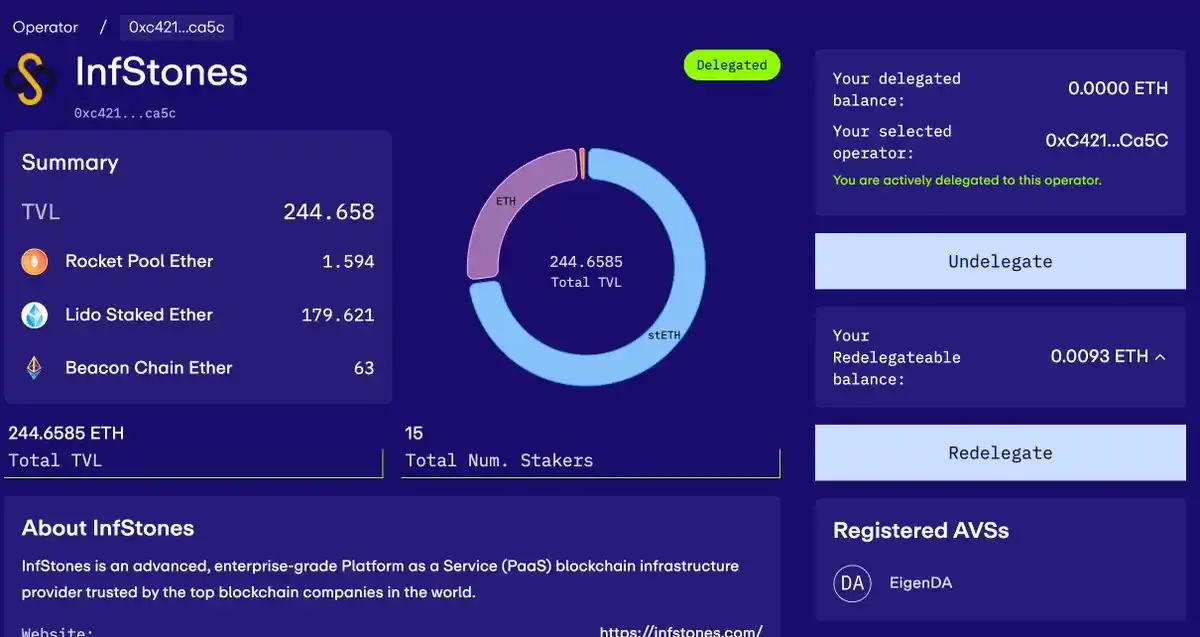
Currently, there are 107 operators on the testnet, and more are expected to join. So how do you choose the operator with the highest risk-reward ratio?
This is where Liquid Restaking Tokens (LRT) come in. Instead of staking directly through Eigenlayer, you can deposit funds into the LRT protocol. However, LRT still needs a governing body to select operators and manage risk. This means new protocol tokens will be airdropped and earn higher yields.
With LRT, we can expect to earn Ethereum deposit yields (yield 5%), Eigenlayer redeposit rewards from AVS (yield 10%), and LRT protocol token emissions (yield 10%+). Without considering the initial airdrop, ETH's annual yield is about 25%.
It's too early to see which LRT protocol will prevail, but it seems that Ether.fi is the leading protocol.
Why am I bullish on this project?
Restaking + LRT narrative, because it has the 3 key elements I look for in a project: 1) Innovative technology 2) Opportunity to mint tokens 3) Compelling narrative.
I believe that re-staking and the implementation of LRT will make ETH an attractive asset to buy and hold. This in turn will allow ETH to catch up to BTC and alternative coins. However, this is not a risk-free return!
Unfortunately, we still need to wait. The Phase 2 mainnet will be launched in the first half of 2024, and Phase 3 will be launched later in 2024, when there will be more AVS (the real fun begins).
5. Uniswap V4
Uniswap V4 introduces a "singleton" contract that merges all pools into a single framework, thereby reducing the gas cost of creating a pool by 99% and making multi-pool swaps cheaper.
In fact, you can already try out the benefits of "singleton" contracts through Ambient Finance. I am always amazed at how low the gas fees are.
The reason why Uniswap v4 makes the list is "Hooks", which makes Uniswap v4 more like a platform.
Hooks in Uniswap V4 are essentially programmable contracts that can play a role at different stages of the liquidity pool lifecycle. These Hooks can be thought of as "plugins" that allow custom code to be executed when key events occur in the funding pool. This may include events such as on-chain limit orders, time-weighted average market making, depositing out-of-range liquidity into the lending protocol, and automatically compounding LP fees to LP positions.
In fact, Instadapp has already previewed a no-liquidation lending protocol using v4 Hooks with a 0% liquidation penalty.
Why am I bullish on this project?
Uniswap with V4 hooks will become the liquidity center of DeFi, even stronger than it is now. You know, protocols face liquidity issues when they launch, but with Hooks, developers can use Uniswap as liquidity to try and launch their own protocols + new tokens.
This in turn will bring more liquidity to Uniswap, which may attract liquidity from other DEXs.
Since V4 will be launched under a commercial license, forks will not be allowed until 2027. As multiple dApps are launched on Uniswap, Uniswap may gain more market share. Hopefully, the Uniswap DAO and the community of builders can find ways to distribute value to UNI token holders.
But we have to wait until the Cancun Ethereum upgrade goes live in Q1 2025 (which includes EIP-1153): transient storage, which is critical for Uniswap v4 to reduce network costs.
Maybe betting on UNI during the Cancun upgrade is a good short-term strategy.
6. Stacks Nakamoto Upgrade
My view on Stacks is simple and I recently shared it on X.
The Stacks ecosystem token has performed well with three major innovations:
· Stacks Nakamoto Release: Will reduce txs speeds from current 10m-30m to ~5s
· sBTC: Non-custodial, trust-minimized BTC USD peg that allows smart contracts to write back to Bitcoin
· BTCfi’s growth: Ordinals, BRC20, etc.
Stacks expects to launch the upgrade in Q1 2024.
The biggest beneficiary may be Alex Lab, the liquidity center of Stacks DeFi, providing BRC20 order book trading, BTC and bridges between BRC20 and Bitcoin, and EVM chain.
Why am I bullish on this project?
If you read my previous article about the three major factors for a thriving ecosystem in cryptocurrencies, you will find that Stacks meets all three conditions, as user attention and funds are concentrated on a small number of assets, and more tokens are coming soon.
The three major factors for a thriving ecosystem in cryptocurrencies:
·Technological innovation
·Token minting opportunities
·Compelling narrative
Reducing transaction speeds to 5s and bringing BTC liquidity, coupled with the narrative of BTCfi, makes me quite excited about the future of Stacks.
Also, Stacks MC is relatively cheap compared to the unique value proposition, but Alex Lab is like a leveraged bet on STX. The Q1 2025 upgrade is also on the way.
7. Growth of Monolithic L1: Fantom 2.0 Upgrade and SEI V2
Let me explain why FTM and SEI are put together. There are two reasons:
First, modular vs monolithic scaling approaches is one of the most interesting narratives of this bull run. There is a growing frustration with scaling Ethereum via L2 solutions.
Issues include compromises to decentralization, security, and worse user experience, as well as the methods used by L2 (Blast) to distribute airdrops.
Also, L2 tokens lack a value proposition for investors. The recent ARB "staking" from the Treasury Fund shows the limits of L2 DAOs' creativity in token economics.
Perhaps things will improve in the future as security and network obfuscation improve, and token economics will improve with a truly natively decentralized L2 and hopefully revenue sharing.
But at this stage, even with L2, transaction fees are too expensive for lower transaction amounts. We need L3 or L4.
But these technological changes may not come in this bull run. If we want maximum security, we will end up paying high gas fees on Ethereum, or we will rotate funds from one L2 to another through third-party bridges to get airdrops because no one wants to wait for 7 days for withdrawals on Optimistic rollup.
Now, monolithic blockchains have their own problems. Compromises on decentralization through limited number of nodes or high hardware costs are the most important.
But since Ethereum stopped focusing on or slowed down the expansion of L1, can Ethereum's modular design solve these problems before the current monolithic blockchain improves decentralization?
This is where Fantom comes in with the Fantom Sonic upgrade. It brings 2k+ txs per second and 1.1s finality time without sharding or L2. The team is targeting a new generation of dApps, such as GameFi.
Why am I bullish on this project?
I am bullish on Ethereum and Solana as it is a major competitor to Ethereum. However, Fantom is innovating new things to benefit from the MCU scaling narrative.
Next spring, I hope to see dApps actually built on Fantom, which will be the most important follow-up factor.
Then there is SEI V2
I know a lot of people hate it. Or some can't even tell SEI apart from SUI or Aptos. But I'm open to SEI (as with FTM) because it fits perfectly with my views on modular vs. monolithic development.
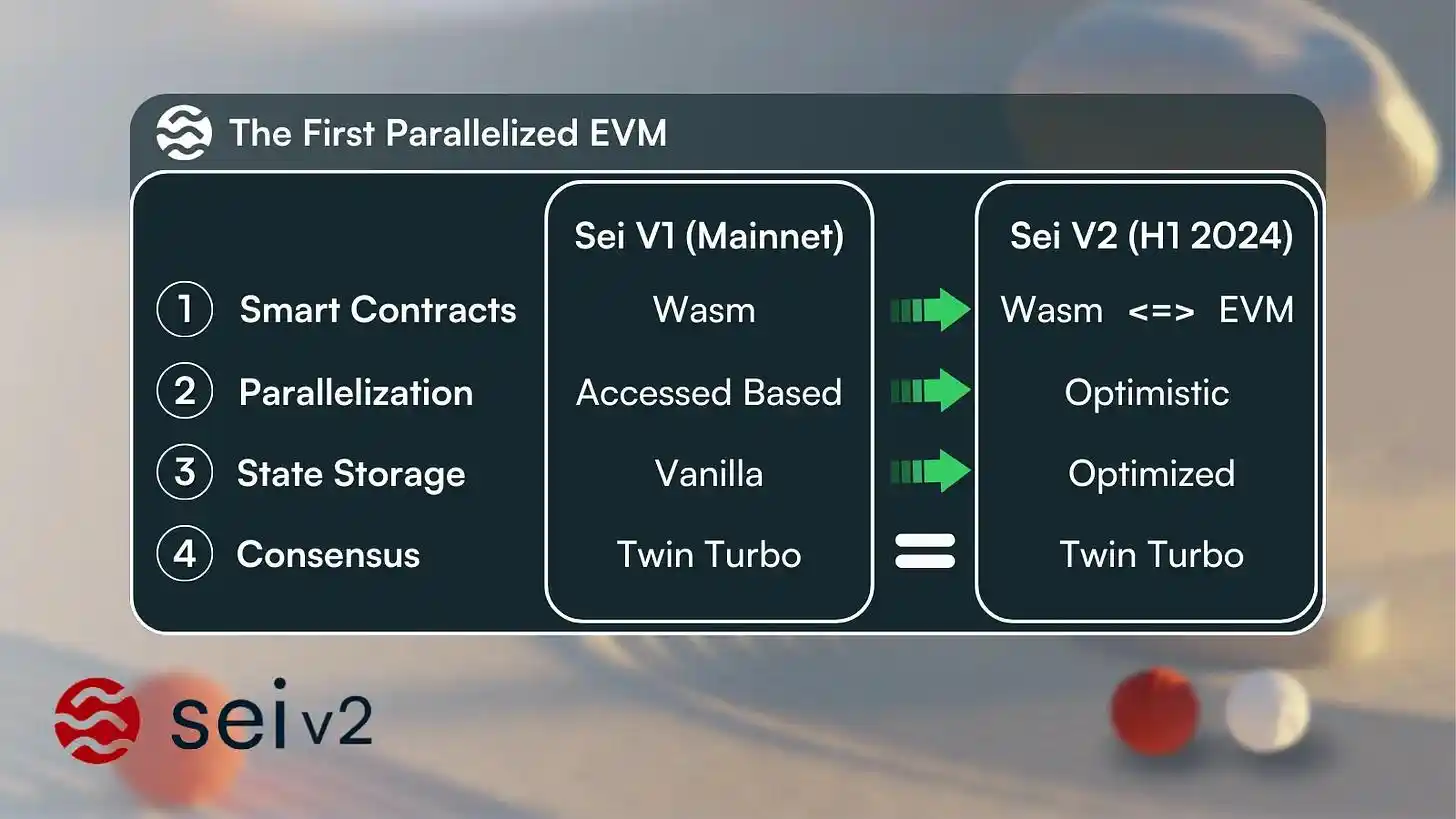
You can read all about the SEI v2 upgrades, but the most important of these are
· Support for parallelized EVM, which will benefit the development of the dApp ecosystem as developers can redeploy smart contracts on the EVM blockchain to the SEI.
· 390 milliseconds finality time (already launched on the mainnet)
· 12.5k theoretical TPS
Why am I optimistic about this project?
In the last bull market cycle, L1 speed was the most important, but I think this bull market will also have an L1 war like the last one.
Like Fantom, Sei is also built for the vision of expanding the technology ecosystem, but its current market value is the lowest among the three, and it will not start unlocking tokens in large quantities until the third quarter of 2025.
Original link
Welcome to join the official BlockBeats community:
Telegram Subscription Group: https://t.me/theblockbeats
Telegram Discussion Group: https://t.me/BlockBeats_App
Official Twitter Account: https://twitter.com/BlockBeatsAsia

 Related Articles