Intent-driven interoperability with Orby and Orb Stack
Original Title: "Introducing Intent-Driven Interoperability via Orby and the Orb Stack"
Original Source: Shima Capital
TLDR: Introducing Orby, an intent engine, and Orb Stack, an intent-driven interoperability stack, to enable better interaction between applications and users in a multi-chain world and solve the problem of account fragmentation.
In the cryptocurrency industry, it is difficult to find people who enjoy multi-chain experiences. Most people have to admit that the current multi-chain user experience is very poor. The reason is that existing interoperability solutions are built for cross-chain applications, and the largest part of applications are what we call single-chain applications.
Single Chain Applications and Unresolved Interoperability Issues
Single-chain applications limit all their logic and processes to one chain and do not communicate with other chains. They only interact with users, assets, and data on that chain. On the other hand, cross-chain applications have multiple components on different chains that communicate through message passing protocols. This subtle architectural difference makes their interoperability requirements very different. Cross-chain applications mainly need interoperability solutions for data and liquidity fragmentation, so the existing dozens of message passing protocols and liquidity networks are useful for them. However, single-chain applications mainly need interoperability solutions for account fragmentation. Currently, there is no interoperability solution that can effectively solve this problem.
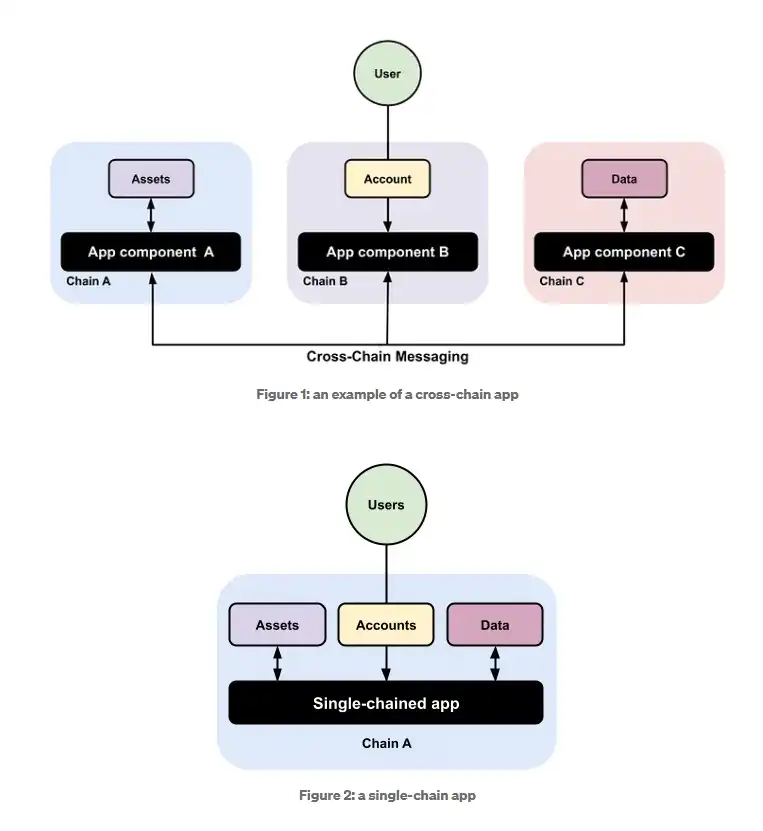
Account fragmentation refers to the inability of users to seamlessly access collective assets across all individual accounts on a single chain. This is why users must actively manage and maintain tokens on accounts/wallets across different chains in order to use applications on those chains. It is also one of the three problems in the broader interoperability issue, with the other two being data and liquidity fragmentation. Although account fragmentation is the most painful for users, it is the least solved problem in the interoperability issue for two reasons. First, it may be the most challenging interoperability problem as it requires the development of an intermediate layer between users and chains. This intermediate layer must unify all user accounts while enabling these accounts and their corresponding assets to interact with any application on any chain. When building this intermediate layer, you may encounter all three interoperability problems. Second, because it involves accounts, it is mistakenly considered a wallet problem.
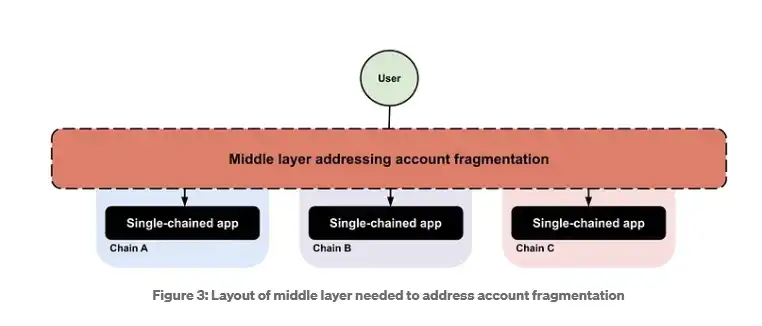
World without Interoperability for Single-Chain Applications
Without a fully resolved interoperability solution for fragmented accounts, single-chain applications are forced to adopt stopgap measures. Currently, there are three options:
1. Deploying copies of applications on different chains so that users on different chains can use some version of the application. This approach has been adopted by Aave and Uniswap, among others. However, it also has some issues: (1) it increases the management burden for developers, as they must manage and maintain multiple instances of their applications; (2) developers need to rebuild their applications from scratch to access different execution environments; (3) many encrypted applications are networks, and by deploying multiple instances of their applications on different chains, they split the network, which means that the effectiveness or efficiency of the application may not be optimal.
2. Become a cross-chain application. Deploy interconnected components on different chains. Let users on these chains use these components as entry points to the application. The adoption of this approach is very limited. Conversations with developers reveal a long list of reasons, including: (1) unwillingness to bear the additional security burden of becoming cross-chain, (2) unwillingness to drag down the user interface of core applications due to the delay caused by the introduction of cross-chain elements, (3) counterproductive when building custom stacks (i.e. application chains or application blockchains), (4) futile for cross-chain applications. Yes, you can deploy your application on a few chains, but what happens when the number of chains reaches hundreds, thousands, or tens of thousands? (5) The effort required to build cross-chain applications makes it only feasible when the application has product-market fit.
3. Do nothing. Deploy their application on the chain where they expect to bring in the most users, and let users on other chains access the application through makeshift measures.
Most developers choose the third option partially because it has the best cost-effectiveness ratio. Spending time, money, and effort on integrating chains that do not significantly increase application usage is not reasonable. The result is the nightmare of multi-chain that we are familiar with. A simple multi-chain interaction involving two accounts on different chains may look like the following:
1. Go to the application deployed on Chain A that you want to use.
2. Connect your wallet on Chain A.
3. Realize that your wallet needs more funds to use the application on Chain A.
4. Switch your wallet to Chain B, where you have some funds.
5. Go to a trading platform.
6. Exchange/bridge your assets on Chain B to the assets required on Chain A (multi-step process).
7. Wait for the exchange to complete (minimum 3-5 minutes).
8. Switch the wallet back to Chain A.
9. Return the application deployed on Chain A.
10. Finally, execute your transaction.
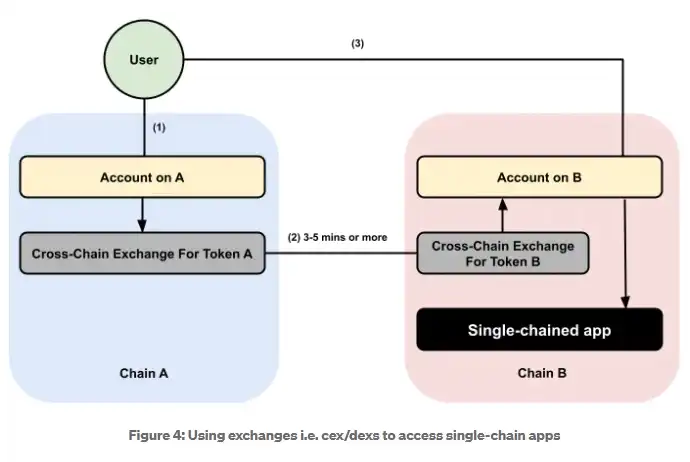
For each additional chain or account in this process, the number of steps increases by 4-5 and the delay increases by at least 3-5 minutes. For more aggressive account fragmentation forms, users must gather funds from 3 or 4 different chains, requiring us to perform about 20 steps and a delay of 10-20 minutes. Even if we build a system that can abstract the number of clicks/steps like some liquidity networks and parallelize exchanges, we still need a delay of 3-5 minutes. For native crypto users, this is already far from an ideal user experience, let alone new users who expect a web2-like user experience.
Single-chain applications need a new interoperable system that allows them to provide a user experience comparable to web2 applications for multi-chain users, while solving the problem of account fragmentation. Additionally, this system should not impose significant burdens on users, application developers, or wallet providers. Building such a system is crucial for the development of web3, from Ethereum's scalable and modular chains to application chains. All of these developments will increase the number of chains, and new chains mean users need to manage more accounts. In a world without a better interoperable system to solve the account fragmentation problem of single-chain applications, users may continue to cluster on a few chains. In turn, developers will be forced to build on these chains rather than the ones that are best suited for their applications, resulting in many poorly performing applications. Ultimately, this poor user experience will hinder the adoption of web3.
通过 Orby 和 Orb Stack 实现意图驱动的互操作性
Through Orby and Orb Stack, achieve intent-driven interoperability
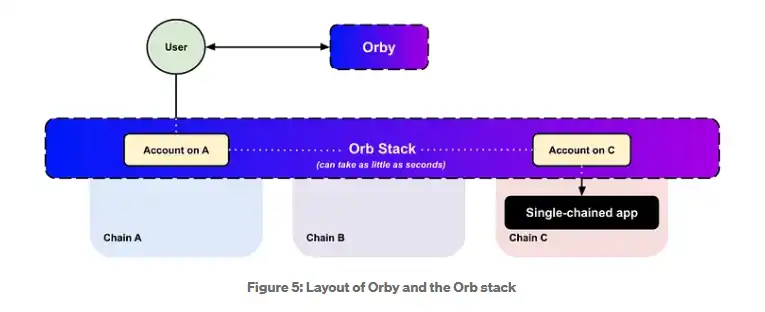
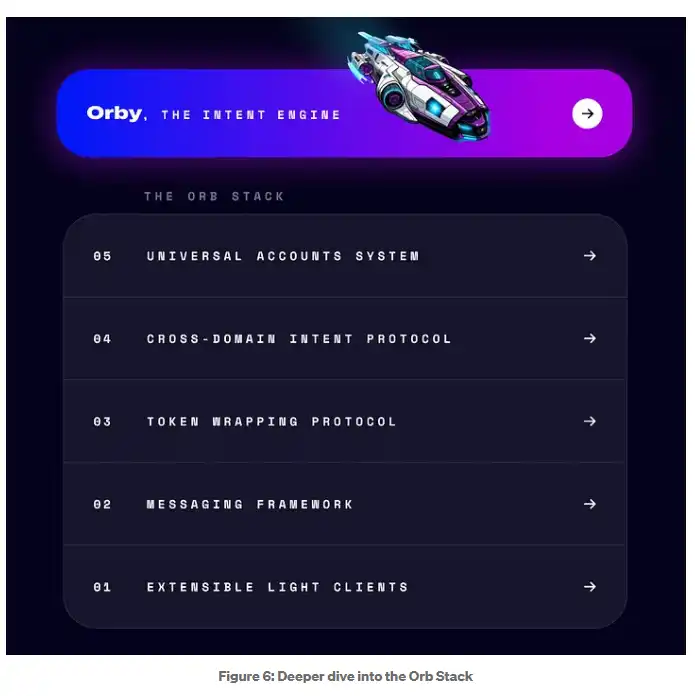
At Orb Labs, we believe that the key to improving multi-chain UX is to build an interoperability solution specifically tailored to the needs of single-chain applications. Our vision is to empower developers to build on any chain that best suits their application while allowing them to access any user on any chain. This means building an interoperability solution that solves the problem of account fragmentation. This is easier said than done. A lot of work needs to be done to ensure that this solution maintains the highest standards in security, cost, and speed to prevent users from using applications on other chains. After months of addressing this issue, we are pleased to announce the implementation of intent-driven interoperability through Orby and Orb Stack.
Welcome to join the official BlockBeats community:
Telegram Subscription Group: https://t.me/theblockbeats
Telegram Discussion Group: https://t.me/BlockBeats_App
Official Twitter Account: https://twitter.com/BlockBeatsAsia

 Related Articles