Where do THORChain and Maya Protocol's high yields come from?
Original Title: "What is the High Income Source Behind the Popularity of RUNE and CACAO Protocols?"
Original Author: Joel Valenzuela
Translated by: Deep Tide TechFlow
Where do profits come from?
Bitcoin maximalists often ask this question about DeFi, especially when faced with the crazy high yields on THORChain and Maya Protocol. There is indeed an answer to this question, let's take a look at where the profits come from.

Generally speaking, profits come from organic sources. Otherwise, you are the profit.
I extensively discussed the potential source of this profit in my previous article, but in this article, I focus on THORChain and Maya as they are currently gaining popularity.
Let's start with Maya, because it's actually simpler.
Maya's 100% revenue comes from transaction fees. People spend money to exchange assets, and those who provide liquidity can get 80% of it. $MAYA holders can get 10%, and the impermanent loss fund (to prevent negative fluctuations from LPer) can get 10%.
THORChain has token issuance (inflation issue), just like most cryptocurrency projects.
From last week's statistics, it can be seen that slightly over 40% of the revenue comes from transaction fees. The remaining portion is block rewards for issuing new coins, at present. Nodes and LPs receive transaction fees and newly issued coins.
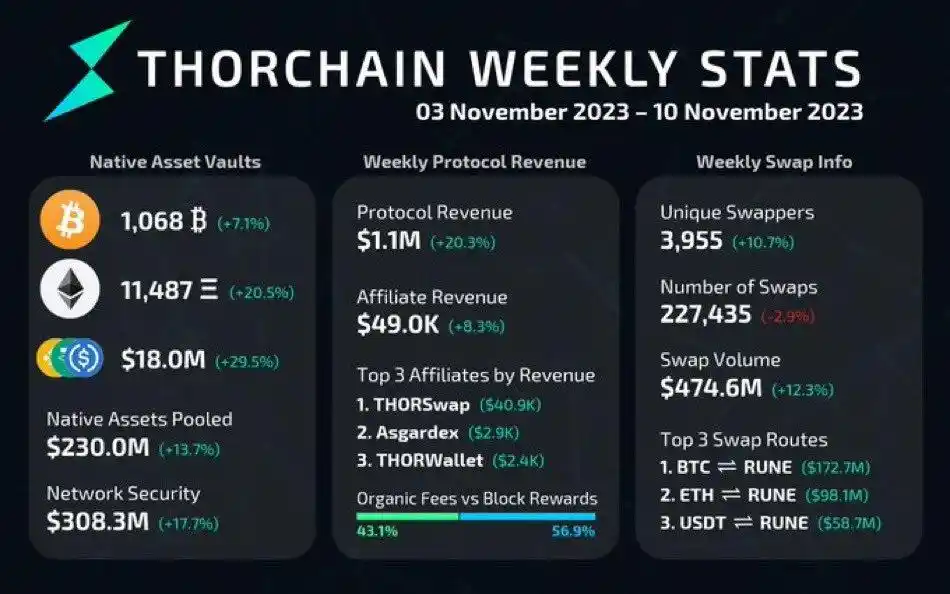
More specifically, in these two networks, when a transaction occurs, the transaction fee (or THORChain's transaction fee + issuance fee) will enter the liquidity pool. The value in the pool will increase. The assets are kept in a 50/50 balance between tokens (such as BTC) and native tokens (RUNE/CACAO).
But why is the yield so high?
There are two reasons: revenue from fees and appreciation of tokens.
Most of it comes from fees paid by paying customers. Some of it comes from the appreciation of RUNE and CACAO.
If you have 50% BTC and 50% RUNE, and RUNE skyrockets, your liquidity position will earn a generous annual interest rate.
Currently, the high yield still comes from Savers, which allows you to earn asset returns without touching RUNE.
This means that you can only obtain positive returns, while liquidity providers bear the risk of volatility and additional returns.
Reiterate again: revenue comes from fees paid by satisfied customers. If you provide liquidity, you can earn revenue, but if the RUNE price drops sharply, you may lose some money. However, if you choose Savers, you will not lose money. Only gain, no loss.
Before Bitcoin maximalists try to find fault, please remember that the question of "where does the profit come from" has also been raised for Bitcoin.
Only when other people buy Bitcoin and raise the price can Bitcoin holders make money. It's like the appreciation of RUNE, except that RUNE is more practical. Alternatively, you can earn income by running a Lightning Network routing node, but the returns there are low.
"But hasn't THORChain been hacked before?!"
Yes. But that was before the mainnet went live. It was indeed very stable and secure, but anything is possible.
Bitcoin also has fatal vulnerabilities and inflation vulnerabilities, and it has experienced everything you can think of. A long enough survival time has made Bitcoin very strong. THORChain will also be like this. It is still young and currently performing very well.
Original Link
Welcome to join the official BlockBeats community:
Telegram Subscription Group: https://t.me/theblockbeats
Telegram Discussion Group: https://t.me/BlockBeats_App
Official Twitter Account: https://twitter.com/BlockBeatsAsia

 Related Articles