The market value exceeded 1.7 billion US dollars. THORChain, which disappeared for a year and a half, is back.

Author: Lucy, BlockBeats
Editor: Jack, BlockBeats
In the past two months, THORChain's native token RUNE has risen from $1.8 on October 23 to $7.3 on December 3, setting a new high since April 2022, and the token's market value has also jumped from outside the top 100 to the top 40.
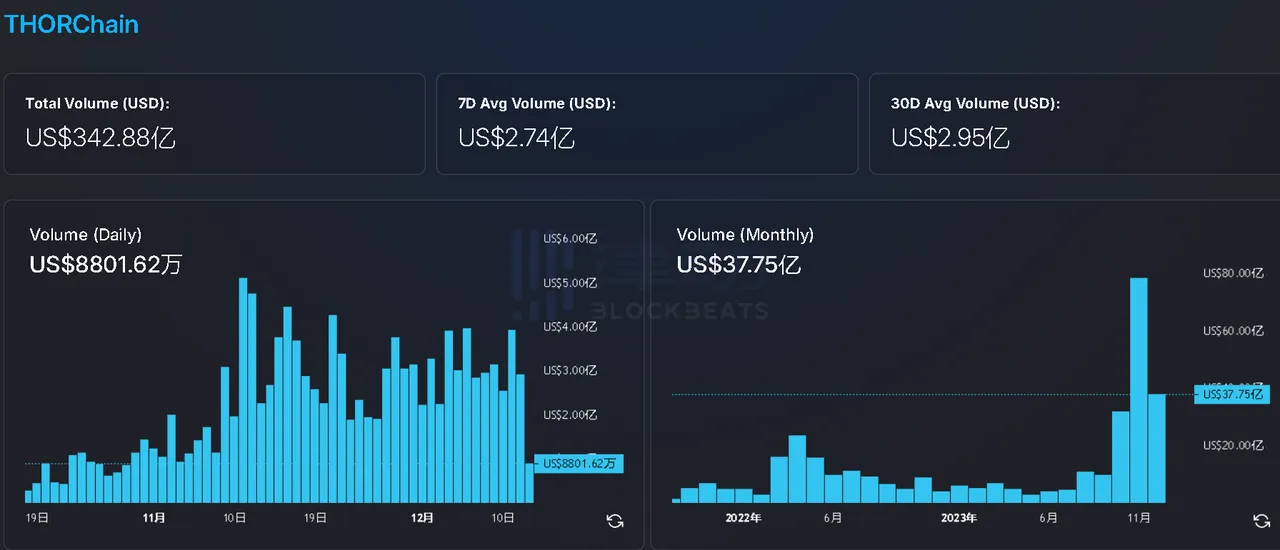
According to thoryield data, RUNE's trading volume has also soared since October, and the trading volume in just two months accounts for about 1/3 of the total trading volume since its issuance, and this momentum continues in December.
Interestingly, THORChain has been around for 5 years, earlier than many popular decentralized exchanges, but it seems to have been in a state of "no one cares" for a long time. Perhaps when you mention THORChain, you will only think of "Oh, the project that is always stolen?"
However, this year, we have seen THORChain complete the trio of swap, storage and lending, and make a name for itself in the DeFi field with Streaming Swap.
Dual Beta of Bitcoin and Cosmos Ecosystem
THORChain's outstanding performance since October can be said to have eaten the dual beta of Bitcoin and Cosmos Ecosystem.
On the one hand, THORChain is a decentralized exchange (DEX) platform based on the Cosmos blockchain, similar to Uniswap, except that it supports multi-chain swaps and provides cross-chain exchange functions with first-layer assets. In the past month, the Cosmos-based Layer 1 blockchain Injective and the modular blockchain Celestia have led the rise and even have a special name "InCel". The explosion of the Cosmos ecosystem has also attracted funds to the hype of its ecosystem.
On the other hand, with the explosion of the Bitcoin ecosystem, the demand for BTC on-chain transactions has also increased.
However, currently, if users want to obtain BTC on the chain or exchange BTC on the chain for other assets, the usual way is to use the CEX platform as a transit station, extract BTC from the CEX platform to the chain or extract BTC from the chain to CEX and then exchange it for other assets. This process is too complicated for users who are accustomed to on-chain transactions. At present, many users' encrypted assets are stored in different on-chain ecological applications. BTC cross-chain or the ability to directly exchange other assets for BTC has become a rigid demand.
THORChain's cross-chain Swap is almost the only way to conduct native BTC transactions in a decentralized manner on the chain, except for CEX.
Related reading: "An Introduction to THORChain for Bitcoin Enthusiasts"
According to the official THORChain platform data, the value of BTC locked on THORChain has increased from tens of millions of US dollars to 130 million US dollars. The increase in BTC trading volume has prompted the platform's trading volume to rise steadily.
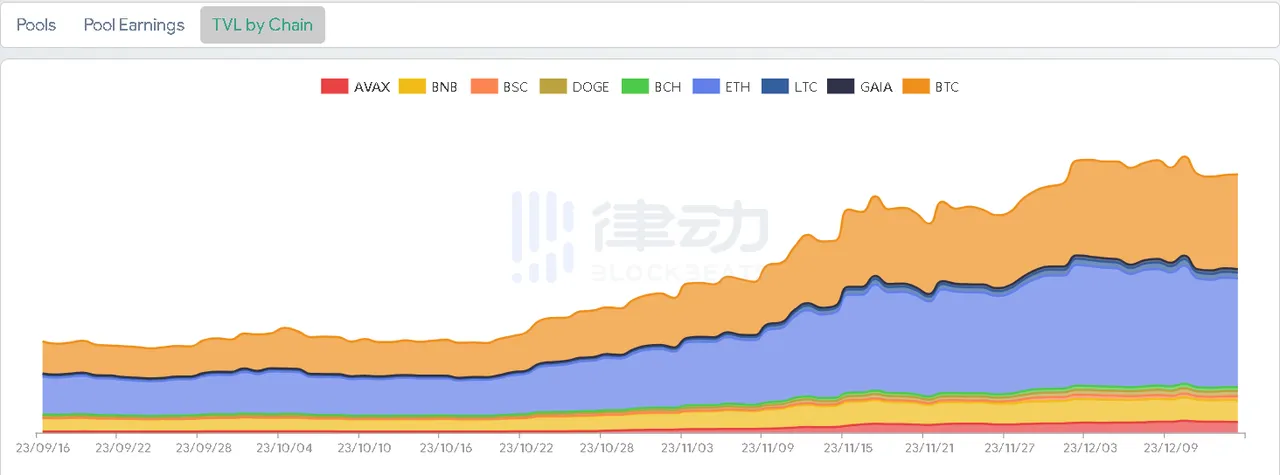
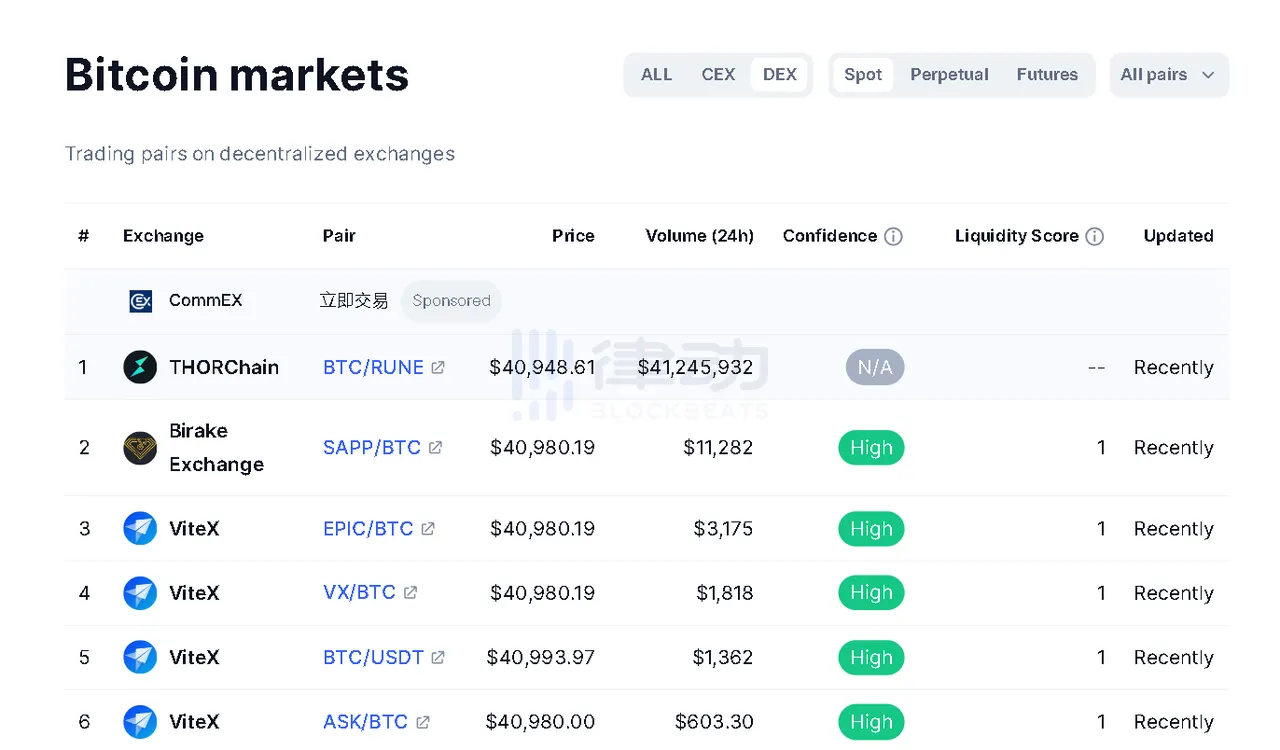
According to bitcoin market data, THORChain has become the largest BTC trading platform on the chain, with a 24-hour transaction volume of over 40 million US dollars, 4,000 times higher than the second-ranked Birake Exchange.
In addition, THORChain announced on October 18 that its token RUNE has been fully allocated to protocols and reserves. The Treasury holds only 7 million (2% of circulation) to fund the ecosystem. All OG seed/team/investor tokens were unlocked several months ago, and all participating venture investors have exited.
With the full unlocking of RUNE, a large amount of RUNE continues to boost the operation of the flywheel, bringing huge benefits to the entire ecosystem.
5 years of cross-chain transaction exploration
As early as five years ago, before Cosmos was born, THORChain aimed at the field of cross-chain exchange.
"As an entrepreneur who has been building things for a long time and thinking about ideas, making things and having fun with them, I just felt that my skills might be useful here, and maybe I could build something that is really valuable, really important, or really contributes to the industry, and THORChain ended up being that thing."
——Chad Barraford, CTO
The THORChain ecosystem was once in a "pre-breakout" state that could take off at any time, but with the collapse of LUNA, 3AC, and FTX, the pace of development slowed down, and THORChain gradually disappeared from the market's vision. However, THORChain did not give up its promise and has been quietly laying out for the past year and a half.
A project born from a hackathon, the spiritual protocolized offspring of ShapeShift
In 2017, Chad Barraford ended his 7-year Web2 entrepreneurial journey as a software engineer and packed his bags to travel the world. He met two backpackers in Croatia, and that was the first time he heard about Ethereum and Bitcoin, and he was hooked. To this day, Chad Barraford is still committed to the core development of THORChain and is the largest code contributor to THORChain since Chad.
Initially, Chad went to Lisbon, where he barely left his apartment during that time, only eating and sleeping in his free time, and he began to learn to build a blockchain from scratch. At the 2018 German hackathon, several participants wrote THORChain together, and it was just a string of code without a name at the time. After the game, THORChain's early co-founders hired an anonymous team dedicated to developing decentralized transactions to take over the project and continued to deliver tokens for several months.
However, in 2018, there was a lack of infrastructure and developer tools, and even Cosmos did not really exist. The maturity of technology and cryptography was not enough to build today's cross-chain exchange mechanism, so the project development stagnated.
It wasn’t until 2019 that one of the early co-founders invited Chad to join the team as CTO, trying to continue the idea of cross-chain swaps that year. At the Cosmos hackathon that year, Chris wrote the first line of code dedicated to the THORChain project.
Chad and the team created a very early, not yet fully functional code “nstaswap” in two days, which was launched as BEPSwap (DEX on Binance Chain) for trading Binance Chain assets. Due to the love of Norse mythology by some early team members, the team eventually adopted the name THORChain and issued it through Binance Chain.
With the release of the GG18 threshold signature scheme (TSS), THORChain applied TSS to its trustless cross-chain bridging mechanism, and then the emergence of the Cosmos SDK, the basic logic began to work, so THORChain began to work, and thus attracted the attention of Shapeshift founder Erik Voorhees.
In 2014, Erik Voorhees founded Shapeshift, an exchange focused on cross-chain exchanges. Since Shapeshift is essentially designed as an intermediary, after experiencing the big bubble in 2017 and regulatory pressure in 2018, it had to implement KYC and struggled in this mode for several years. At this time, Erik noticed Uniswap, which, as a smart contract, can effectively avoid regulatory issues and realize cross-chain assets without KYC.
The design mechanism of Uniswap gave Erik an idea, and he realized that he could actually replace the entire backend of Shapeshift with infrastructure, so that Shapeshift would be free from intermediary status and become its own exchanger. But Uniswap cannot run on chains other than eth, so he turned his attention to THORChain, and resonated deeply with THORChain's mission. In 2021, he wrote a research report titled "An Introduction to THORChain for Bitcoiners."
The report points out that the THORswap process involves two swaps, which require the help of an intermediary, namely the THORChain governance token RUNE. The characteristic is that all assets are settled using RUNE. If you want to exchange BTC for ETH, you will actually go through BTC-RUNE and RUNE-ETH, which significantly increases the opportunity for RUNE to obtain value. In addition, RUNE tokens can serve as both gas for transactions and node fees for maintaining network security. THORChain requires that the total value of RUNE staked by nodes must be equal to the total value of the liquidity pool, maintaining a 3:1 ratio of RUNE to non-RUNE assets to ensure that financial risk is always proportional to network security.
With these two features, THORChain spins its basic flywheel: the more cross-chain transactions, the deeper the liquidity required, and therefore the more RUNE must be staked.

So what is the cross-chain swap that THORChain has been focusing on? Compared with other cross-chain "bridges", what is special about the native asset cross-chain done by THORChain?
First, it is asset cross-chain. As an independent accounting book that can define its own native assets, each blockchain hopes that the assets can be separated from the original books that define them, and then flow freely in different accounting systems. However, just as physical gold cannot be put into a bank account, Bitcoin cannot be separated from the blockchain that defines Bitcoin, and the real asset cross-chain is theoretically impossible.
Therefore, asset cross-chain is essentially a value transfer process across different accounting systems, and this process needs to be completed with the help of a cross-chain bridge. The official bridge can issue "redeemable certificates" of the original chain assets on the transfer-in chain, that is, cross-chain assets, and then complete the cross-chain transfer of asset value. After waiting for the official bridge to be established, a third-party bridge can be deployed again. It can directly take out the cross-chain assets that have been minted by the official bridge in advance, and the cross-chain work can be completed immediately.
Related reading: "When you are cross-chain, are the assets really transferred? "
Simply put, in the general cross-chain transaction model, the asset being traded is not the token itself, but a "redeemable certificate" equivalent to the value of the token, and the protocol itself serves as a bridge to transfer this certificate. Therefore, from this essential point of view, THORChain is not a cross-chain bridge, but should be regarded as an exchanger, which can directly exchange tokens between different chains.
Two rounds of bull and bear
At the beginning of 21, after the initial cross-chain mechanism was built, the cross-chain exchange market ushered in spring with the rise of new public chains. THORChain TVL doubled, and the token price soared to a high of $20 in March.
However, a "cross-chain disaster" from June to July interrupted THORChain's upward momentum.
According to the SlowMist Zone, on June 29, 2021, THORChain tweeted that a malicious attack against THORChain was discovered. The SlowMist security team intervened and analyzed at the first time and found that this was a "fake recharge" attack on the cross-chain system, with a loss of nearly $350,000.
THORChain is essentially a cross-chain of information. Users send assets to THORChain nodes on the BTC network. After the node confirms receipt of the information, it sends the same amount of assets to the user on the ETH mainnet. As a result, the hacker tricked the node into thinking that he had deposited a large amount of ETH, resulting in an erroneous outflow of $140,000.
On July 16, THORChain was attacked again by a "fake recharge" attack, losing nearly $8 million. In the third attack on the 23rd, nearly $8 million was lost. There were three hacker attacks in one month. Although the THORChain network responded quickly and the core developers immediately made repairs and compensation measures, people were concerned about the quality of THORChain's code, and the price of RUNE also fell sharply.
In addition, the Cosmos team announced that it would no longer maintain the 0.42.x version of the SDK, so THORChain was forced to hard fork to upgrade to the latest version 0.45.1. In the first round of bull and bear, we witnessed THORChain's TVL doubled in its heyday, and also witnessed its token price fall from a high of $20 to a low of $3.
But in April 2022, THORChain was lucky enough to get on the terra train.
At that time, THORChain had been integrated with some of the industry's largest blockchains, including Bitcoin, Bitcoin Cash, BNB Chain, Ethereum, and Dogecoin. At that time, Terra's TVL ranked second, second only to Ethereum. As a new member, Terra brought huge liquidity advantages to THORChain. Overnight, RUNE’s value surged by more than 70%, trading volume tripled, and TVL reached an unprecedented nearly $600 million.
In addition, THORChain announced the launch of DeFiSpot, a decentralized multi-chain exchange created on its network. DeFiSpot offers "enhanced APY", promising to pay investors an annualized rate of return (APY) that will be higher than the rate currently offered by projects that provide liquidity to chains integrated with THORChain. RUNE continued to rise after the launch of DeFiSpot.
With this momentum, THORChain proposed the idea of a liquidation-free lending agreement, aiming to further demonstrate THORChain's application scenarios.
However, on May 10, LUNA suffered a catastrophic collapse, and the native algorithmic stablecoin UST of the Terra ecosystem suffered a serious de-anchoring incident due to capital hunting and debt crisis, falling to as low as $0.6. This second-largest public chain ecosystem with a TVL of nearly $20 billion simultaneously repeated the horror disasters of the Thai baht and Lehman in just 2 days.
Related reading: "84 million US dollars leveraged the 40 billion financial empire, the whole story of UST collapse"
THORChain, which had just tasted the sweetness of the increase, was implicated, and the price of the currency fell back to around 2 US dollars. The development of the previously proposed no-liquidation lending protocol stagnated, and THORChain gradually disappeared from the market's view.
The belated no-liquidation lending, and the new favorite Streaming Swap
Many people may have forgotten the promises made by THORChain in its heyday, or its ambition to establish a no-liquidation lending protocol. But in the year and a half after the collapse of luna, THORChain did not give up building. While continuing to develop the liquidation-free lending protocol, it also developed Streaming Swap based on THORswap.
At the end of 22, THORChain first announced the launch of Savers Vaults. On July 27 this year, the official announced the launch of Streaming Swaps, allowing users to split large transactions into sub-transactions to obtain better execution prices. Users can choose between time optimization or price optimization. On August 21, the forum discussed the launch of the lending protocol that has been online for nearly two years.
A year and a half late, liquidation-free lending is quietly launched
THORChain's liquidation-free lending tool, in simple terms, means that even if your collateral becomes worthless in the end, there will be no liquidation, and there is even no expiration date for the loan. You can repay it if you want, or not. On the contrary, THORChain stipulates that the repayment date cannot be less than 30 days, and if you choose to repay in advance, you may even face penalties.
The entire lending process is similar to a swap, involving the conversion of native tokens and RUNE. RUNE controls the deflation of token prices through a destruction and recasting mechanism.
Take BTC to borrow USDT as an example. Due to the 1:1 swap ratio, the pledge rate is about 200%. That is, if you pledge $10,000 of BTC, BTC will be converted into RUNE first, half of which will be converted into USDT (5,000 USD) and returned to the user, while the other half of RUNE will be directly destroyed, and RUNE will be deflated. For this reason, after the loan is completed, the agreement has been cancelled, so there is no interest and no liquidation. In this process, you actually provided $10,000 to the platform and only borrowed $5,000, so even if you don’t repay, the platform will not be held responsible, and there is no due date.
Since each loan agreement is automatically cancelled, the entire agreement will be deflated. When the user repays the money, the agreement needs to issue the remaining RUNE to exchange enough BTC to return to the user, and RUNE will be inflated again. Whether the user repays the money depends on the relative price of RUNE and BTC. We divide it into four situations. If the user is willing to repay, when the price of BTC and RUNE remains relatively unchanged, the protocol issues RUNE equal to the number of RUNE destroyed, and the system inflation and deflation offset each other; when BTC rises relative to RUNE, more RUNE needs to be minted to buy BTC, and the newly issued RUNE is greater than the destroyed RUNE, the whole system is inflated, and the user makes money; when BTC falls relative to RUNE, the newly issued RUNE is less than the destroyed RUNE, the whole system is deflated, and the protocol makes money.
If the user is unwilling to repay, the BTC decline exceeds the suppression rate, and the repaying user will suffer a loss, so he chooses not to repay. Interestingly, since the user chooses not to repay, the protocol does not need to mint extra RUNE, and the system generally only experiences deflation. So to some extent, not repaying is a good thing for the entire protocol. Simply put, as long as you borrow and lend on THORChain, you will increase the buying of RUNE. Whether there will be inflation or deflation when repaying depends on the relative price of RUNE.
This design mechanism is similar to luna, and the coin price plays a decisive role in deflation and inflation. We know that UST minted by staking LUNA is pegged to $1, and the inflation redemption mechanism causes Luna to trigger a death spiral once UST is significantly decoupled.
However, the RUNE protocol has taken strict risk control and risk isolation measures. However, under the THORChain lending mechanism, only 50% of RUNE is returned, and the product capacity is also small, so the overall risk is relatively small, and there will be no systemic risk similar to Terra LUNA. Even if a negative spiral occurs, it will not affect other functions of THORChain.
For those who want to join THORChain to earn physical income, but are unwilling to use RUNE as an exposure user, Savers Vaults is a good choice. Savers Vaults supports users to deposit single currencies (such as BTC, ETH, BNB and other assets) and earn income from each cross-chain exchange.
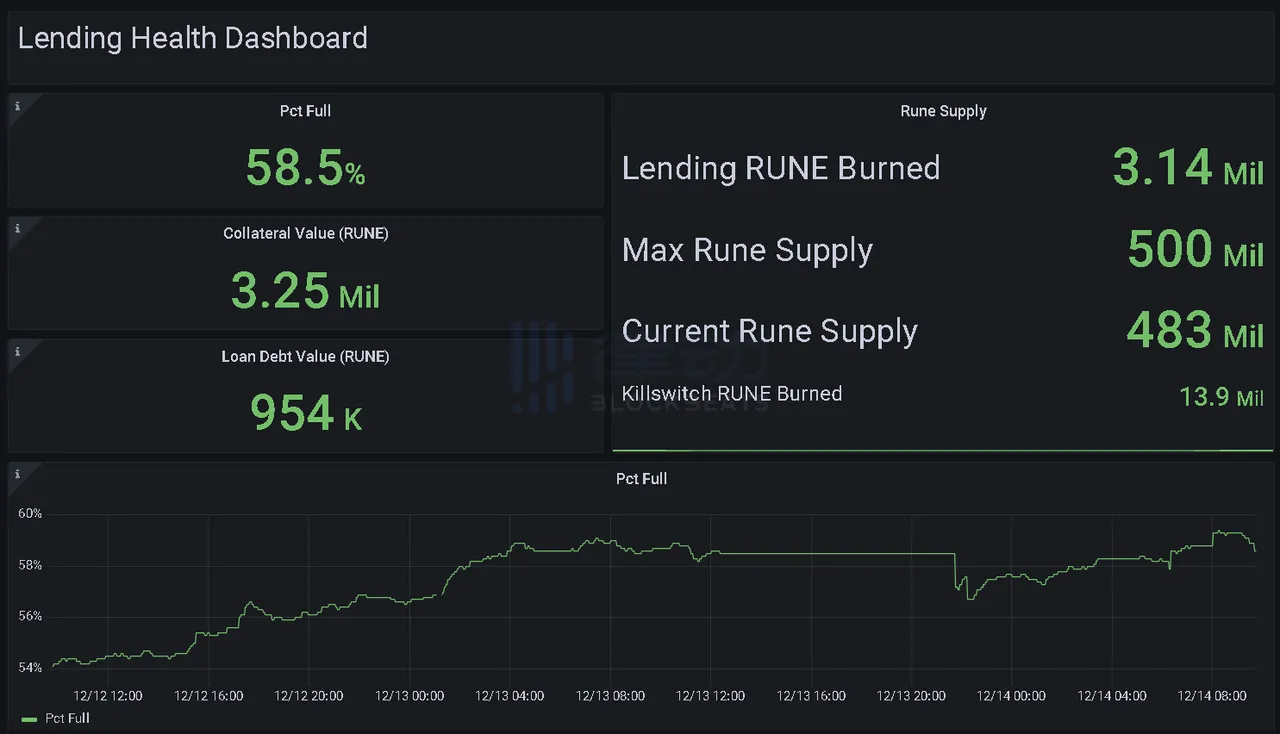
From the operating data performance of these two products, THORChain's lending rate is close to 60%, and more than 3 million US dollars of RUNE have been destroyed. But this data is not ideal compared with the storage income product Savers Vaults. The still high yield now comes from Savers. As of December 13, the value of BTC pledged on THORChain's lending products is $4.28 million, ETH is worth $1.13 million, and the total locked value is $974 million.
But why is the return so high? There are two reasons: fee income and token appreciation.
For miners, there are three ways to earn coins, namely LP, node and deposit. LP who provides liquidity to the protocol will receive two rewards, one is the fee income, and the other is the block reward. Currently, a single block can release 4.28 RUNE, half of which goes to the node and half to the LP. In order to ensure the balance of node and LP rewards, the block reward will have a mid-swing mechanism. When the LP's funds become more, the protocol will reward the node more. When the node's funds are too large, the protocol will reward the LP more.
It should be noted that the official subsidy for impermanent loss of LP assets on THORChain has been cancelled. On December 8, THORChain posted a message on social media to remind users that impermanent loss of LP positions has been disabled and users need to reassess their risks.
This means that choosing Savers can only get positive returns, while LPs bear volatility risks and additional returns. If you provide liquidity, you can get returns, but if the price of RUNE plummets, you may lose some money. But if you choose Savers, you will not lose money, and you will only make money.
Streaming Swap, changing the rules of the game for THORChain
Based on THORswap, THORChain launched Streaming Swap at the end of July, which breaks down a swap into multiple sub-swaps executed over a period of time. It is similar to a time-weighted average price (TWAP) transaction, limited to 24 hours.
Streaming Swap can specify two additional parameters to adjust the sub-swaps. The first is the swap interval, which is the waiting time between sub-swaps. The waiting time specified in the THORChain block is about 6 seconds, which leaves enough arbitrage time for sub-swaps and the capital pool can be constantly rebalanced. This allows capital needs to be met throughout the process, rather than after the swap.
The second is the swap count, which is the number of sub-swaps performed during the entire swap process. The more sub-swaps that are performed, the smaller the swap size for each side, minimizing slippage for each sub-swap. If the swap count is set to "0", THORChain will automatically maximize the swap size to achieve the lowest allowed liquidity fee (5bps).
Previously, swappers could only perform one swap at a time, and all liquidity requirements for that swap had to be met at that moment. Arbitrage will restore liquidity after the swap. Streaming Swap allows swappers to access the time domain at the time of the swap, and the liquidity requirements of the swap can be spread across multiple moments, allowing arbitrage to "correct" the price during the swap process, resulting in better price execution.
This advantage makes THORChain similar to a real-time state machine that can save state across time and act on it, which is in stark contrast to the EVM ledger. In the EVM ledger, the entire state change must be completed in a single block, and attempts to save state and act on it in multiple blocks require external input.
Simply put, Streaming Swaps amplify THORChain’s capital efficiency without changing TVL. A Streaming Swap count of 10 makes the sub-swap/pool ratio look 10x larger than a single large swap pool. A Streaming Swap count of 100 makes the pool look 100x larger.
Assuming a healthy arbitrage market, a BTC pool depth of $20m, and an ETH pool depth of $10m, a single BTC<>ETH stream could be as large as $42m and still theoretically achieve a total of 5bps of 24h volatility with price execution matching. (This swap would be performed 14,400 times in 24h as a $3,000 sub-swap).
Streaming Swap should make it more feasible to execute larger trades on THORChain. Slippage-based fees are an innovation that allows THORChain to protect itself from asset price manipulation, but are a point of friction for exchangers who want to trade in large volumes. As a result, the largest trades are being moved off THORChain to centralized exchanges, where they can pay the lowest fees.
With the move to Streaming Swap, the largest exchangers can pay liquidity fees as low as 5 basis points to the protocol, making THORChain a more attractive venue for the largest on-chain traders. For example, in a large Streaming Swap on August 9, 329.7 Ethereum was successfully exchanged for 19.6843 Bitcoin after 3 and a half hours.
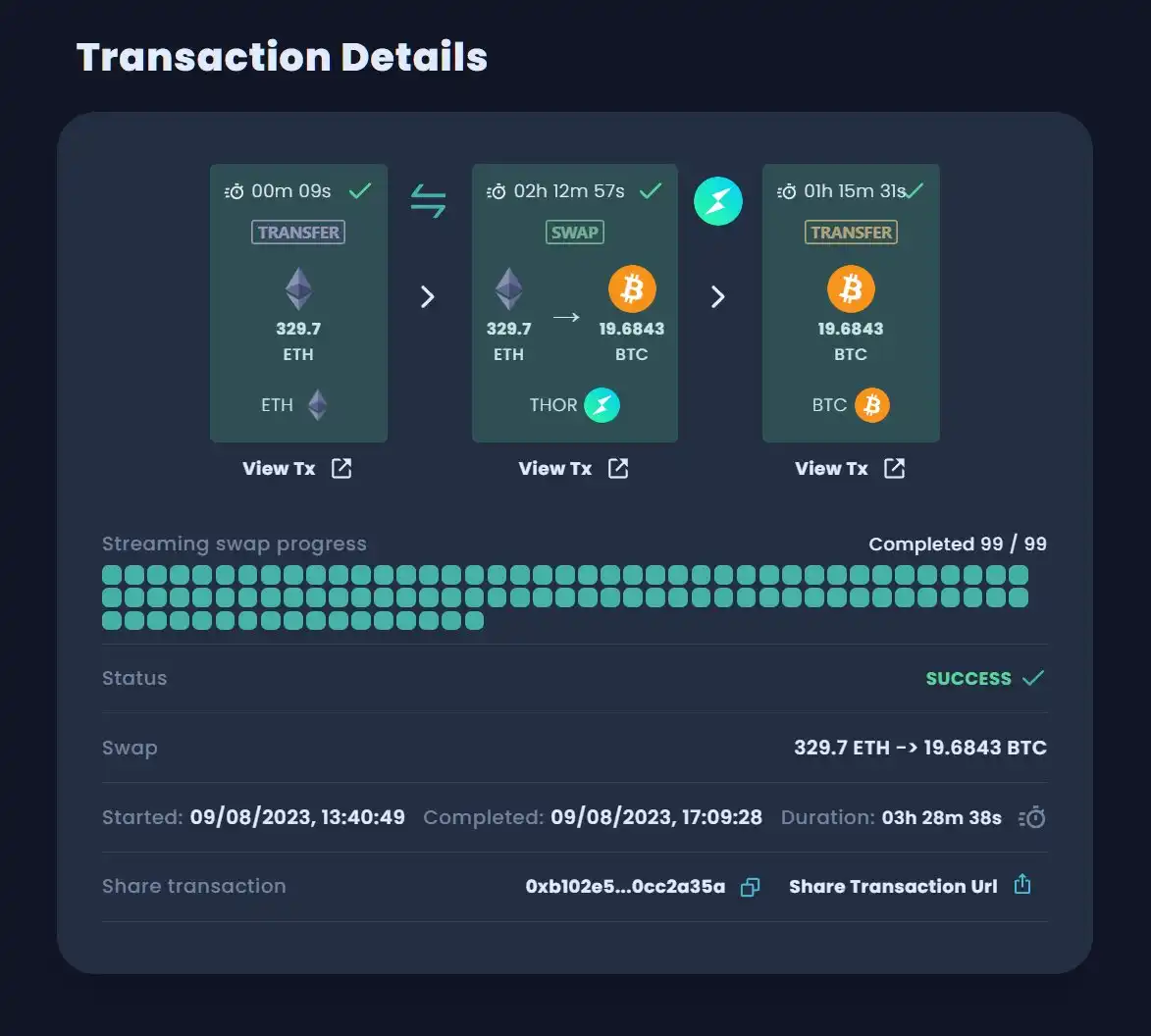
The swap was divided into 99 sub-swaps, each executed in 9 blocks. The final result was $10,000 higher than the quoted price, and due to the extremely high capital efficiency of Streaming Swap, it brought users more than $100,000 in additional BTC benefits.
The swap brought 1,806 RUNE ancillary fees to THORSwap, of which 75% was shared with $THOR holders and $vTHOR. This is another victory for DeFi.The 1,806 RUNE ancillary fees used in the swap are the price limit function set by THORChain in Streaming Swap for security reasons.
According to official information, the price limit function means that if any sub-exchange is below the specified price limit, the sub-exchange will not proceed, but the Streaming Swap will continue. In the event of a failure, two outbound transactions will be sent to the user at the end of the Streaming Swap: one is the refunded assets of the failed sub-exchange, and the other is the successfully completed sub-exchange. Price limits are completely optional, and users can choose to trade without price limits to curb the risk of sub-exchange failures.
Crypto researcher @TheDesertLynx believes that this design provides a new idea for blockchain expansion. Due to the flaws in the economics of the system, only miners or nodes can directly profit from the network they use. "THORChain allows affiliate fees to be added through the interface, which can not only pay the network but also pay application developers, which undermines the motivation of companies to occupy the network."
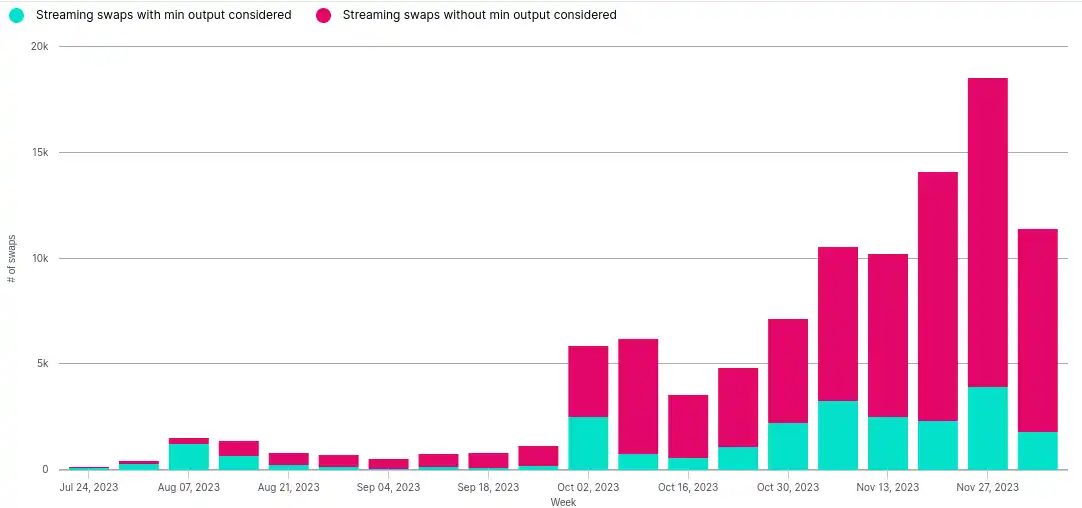
Although more than 80% of swaps since the launch of Streaming Swap do not consider swapping minimum outputs, there have been no reports of MEV or sandwich attacks on THORChain's nodes and validators. This is undoubtedly good news for the stereotype that THORChain is "always stolen."
This time, we are ready
Since December, in just 13 days, THORChain has sold more than $3.7 billion. But THORChain has not stopped its pace and continues to innovate.
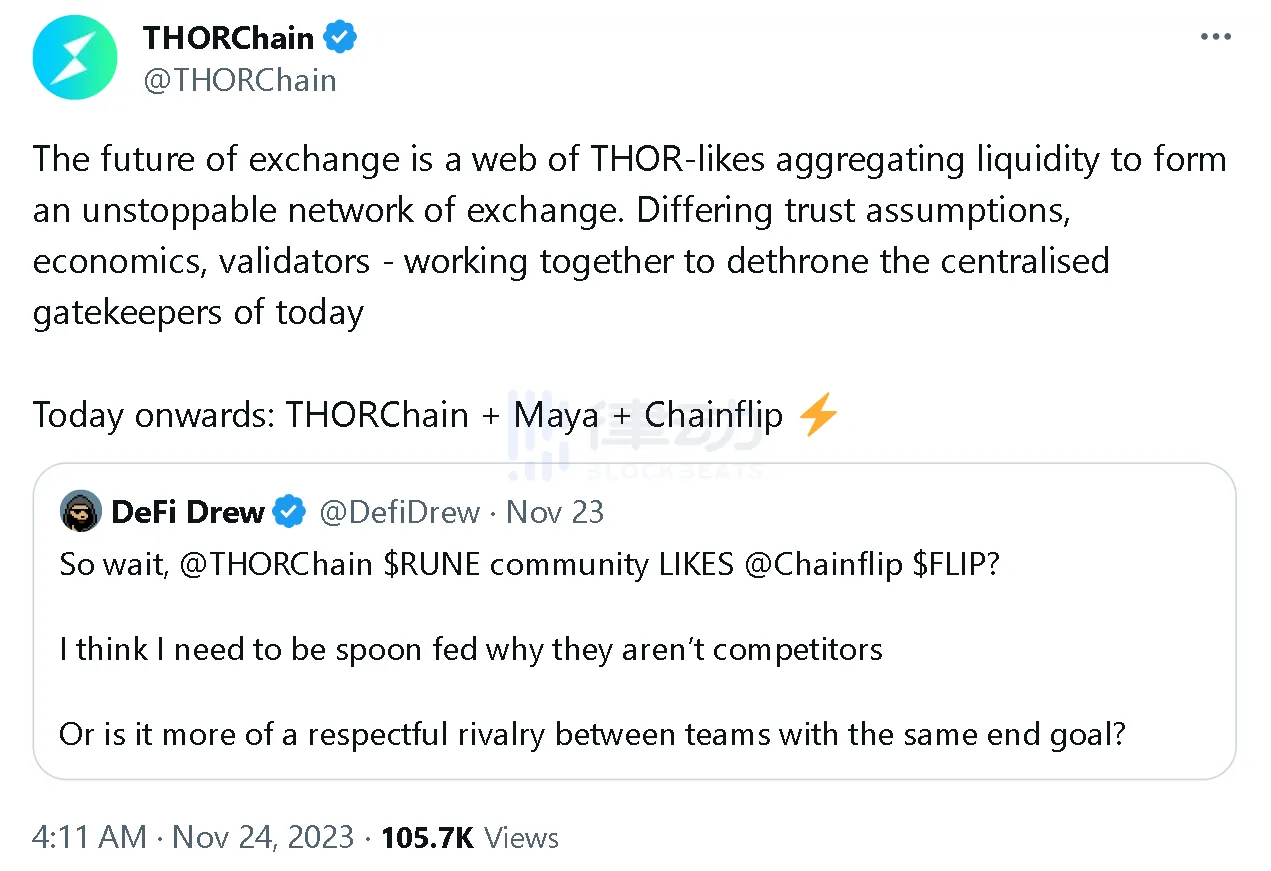
In the next few weeks, THORChain hopes to achieve the goal of trading with any wallet in the world, and even competing projects are regarded as friendly partners by THORChain. A tweet released by THORChain on November 24 stated: THORChain + Maya + Chainflip will jointly challenge today's centralized portals, and THORChain's desktop wallet ASGARDEX also released the 1.20.8 update on December 8, and announced the launch of the MayaChainWallet function.
In addition, THORChain also plans to aggregate all CEX order books. Chad Barraford said, "What's really fascinating about limit orders on THORChain is that you can actively arbitrage. And when arbitrage robots arbitrage within blocks, they can execute exchanges back and forth between each other at the exchange speed of Uniswap and the price of Streaming Swap."
As THORChain continues to launch new features and attract more users, it is expected to play an increasingly important role in the field of decentralized finance. Behind the success of THORChain is the team's continuous exploration and innovation of blockchain technology and its keen insight into user needs.
There is a saying in the currency circle that "you can be free after two rounds of bull and bear." From 2018 to 2023, in just five years, countless crypto industries have experienced their peak and were quickly eliminated. Terra and FTX, which were once regarded as "jewels in the palm", have also suffered the consequences and have been spurned by the market. But THORChain is still there, and the ups and downs of two rounds of bull and bear markets have made it more mature. I think they are ready this time.
References:
1. Terra: THORChain, my valiant successor, behold the last of my Hamon, LBank Labs
2. An Introduction to THORChain for Bitcoiners, Erik Voorhees
3.《THORChain's liquidation-free lending may be the trump card to change DeFi, BlockBeats
4.《Savers Vaults Live on THORChain, Nine Realms
5.《
Welcome to join the official BlockBeats community:
Telegram Subscription Group: https://t.me/theblockbeats
Telegram Discussion Group: https://t.me/BlockBeats_App
Official Twitter Account: https://twitter.com/BlockBeatsAsia

 Related Articles